
- Best for
- SMB to mid-market stores wanting email, SMS and push
- Starting price
- Standard from $16/mo (500 contacts)
- Free plan
- Yes (250 contacts, 500 emails/mo)
- Features listed
- 5 highlighted
Prices checked November 25, 2026
Ecommerce desk · 9 tools compared
Best Email Marketing Platforms for Ecommerce: 9 Tools for 2026
Nine ecommerce email platforms scored on automation depth, pricing predictability, channel coverage, integrations and setup effort, with prices checked on November 25, 2026.
Omnisend is a strong fit for small and mid-market ecommerce stores as of November 2026, because email, SMS and web push run in one set of flows and the listed features are available across plans, with SMS on the Pro plan. Klaviyo suits growth-stage and large DTC brands that will pay for predictive analytics and revenue attribution. Drip fits established stores that want deep behavioral segmentation with unlimited sends. Prices below come from vendor pricing pages checked on November 25, 2026.
Top 3 picks
- Best for
- Growth-stage and large DTC brands focused on revenue
- Starting price
- Email $20/mo (500 active profiles)
- Free plan
- Yes (250 active profiles, 500 emails/mo)
- Features listed
- 4 highlighted
- Best for
- Established DTC brands investing in behavioral automation and retention
- Starting price
- From $39/mo (up to 2,500 contacts)
- Free plan
- No
- Features listed
- 4 highlighted
Disclosure for this page: Omnisend is a paid Featured listing on this page and is labelled wherever it appears. The other 8 tools are unpaid editorial picks, and no vendor reviewed this page before publication. The position of a paid listing can be part of what the vendor pays for. The same rubric and the same honest cons apply to paid and unpaid rows. How we handle paid listings.
Compare all 9 at a glance
| Tool | Best for | Free plan | Actions | |||
|---|---|---|---|---|---|---|
| 1 |  OmnisendFeatured | SMB to mid-market stores wanting email, SMS and push | Standard from $16/mo (500 contacts) | Yes | ||
| 2 |  Klaviyo | Growth-stage and large DTC brands focused on revenue | Email $20/mo (500 active profiles) | Yes | ||
| 3 | Drip | Established DTC brands investing in behavioral automation and retention | From $39/mo (up to 2,500 contacts) | No | ||
| 4 |  Mailchimp | Small businesses and general marketers wanting an all-in-one suite | Essentials from $13/mo (500 contacts) | Yes | ||
| 5 |  Brevo | Stores with large contact lists and modest send volumes | Starter from $17/mo (monthly billing) | Yes | ||
| 6 |  ActiveCampaign | Teams needing sophisticated automation and a light CRM | Starter $15/mo (1,000 contacts, billed yearly) | No | ||
| 7 |  GetResponse | Small marketers wanting funnels, webinars and email together | Starter $19/mo (1,000 contacts, monthly billing) | Yes | ||
| 8 |  MailerLite | Small stores and content-led businesses needing simple, cheap email | Comfort $10.80/mo (500 subscribers, billed yearly) | Yes | ||
| 9 |  Privy | Shopify stores prioritizing list growth plus email and SMS | Email $30/mo (up to 1,500 mailable contacts) | Yes |
On this page
- Key takeaways
- Top 3 picks
- Comparison table
- How we chose and scored these tools
- Scoring rubric
- 1. Omnisend
- 2. Klaviyo
- 3. Drip
- 4. Mailchimp
- 5. Brevo
- 6. ActiveCampaign
- 7. GetResponse
- 8. MailerLite
- 9. Privy
- What does ecommerce email marketing software actually do?
- How ecommerce email pricing works: contacts, sends and add-ons
- How to choose an ecommerce email platform in six steps
- Mistakes that cost ecommerce teams money on email software
- FAQ
- Related pages
How we chose and scored these tools
We scored nine platforms on five criteria and weighted them for ecommerce work. Ecommerce automation carries 25 percent because prebuilt flows, product recommendations and behavioral triggers decide whether the tool earns its keep. Pricing fit, channel coverage, and integrations with setup each carry 20 percent. Pricing fit asks whether the billing model rewards the way you actually mail, not whether the sticker is lowest. Channel coverage counts native email, SMS and web push rather than add-ons bolted on later. Integrations and setup measures how quickly a store platform connects and how much mapping the sync requires. Usability and support carries 15 percent and covers the editor, the flow builder and whether help arrives when a send breaks.
Every price, plan name and free-tier limit here was read from the vendor's own pricing page on 25 November 2026. Where a promotion was running, we noted it in the listing and used the standing price for comparisons. Where a vendor page showed a range, we used the entry tier that a small store would actually buy. Prices change, so confirm on the vendor site before you sign.
The Featured listing is a paid placement. It sits at the top of the page by commercial arrangement, and it was scored with the same rubric as every other tool, with the same honest cons listed. Placement did not change its score or remove its weaknesses.
We did not run live sending tests for this round. The assessment comes from published plan details, feature documentation and the billing rules each vendor states on its own site.
The full process, including how we handle corrections, is on the methodology page. Paid listings follow our advertising disclosure.
The scoring rubric
| Criterion | Weight | What we check |
|---|---|---|
| Ecommerce automation | 25% | Prebuilt flows, product recommendations and behavioral triggers decide whether the tool earns its keep on a store. |
| Pricing fit | 20% | Whether the billing model rewards the way you actually mail, not whether the sticker price is lowest. |
| Channel coverage | 20% | Native email, SMS and web push in one account rather than add-ons bolted onto an email tool. |
| Integrations and setup | 20% | How fast a Shopify or other store platform connects and how much data mapping the sync needs. |
| Usability and support | 15% | The editor and flow builder, plus whether help arrives when a send breaks. |
Omnisend
FeaturedUnified channel flowsStandard from $16/mo (500 contacts)Free planRubric 8.4
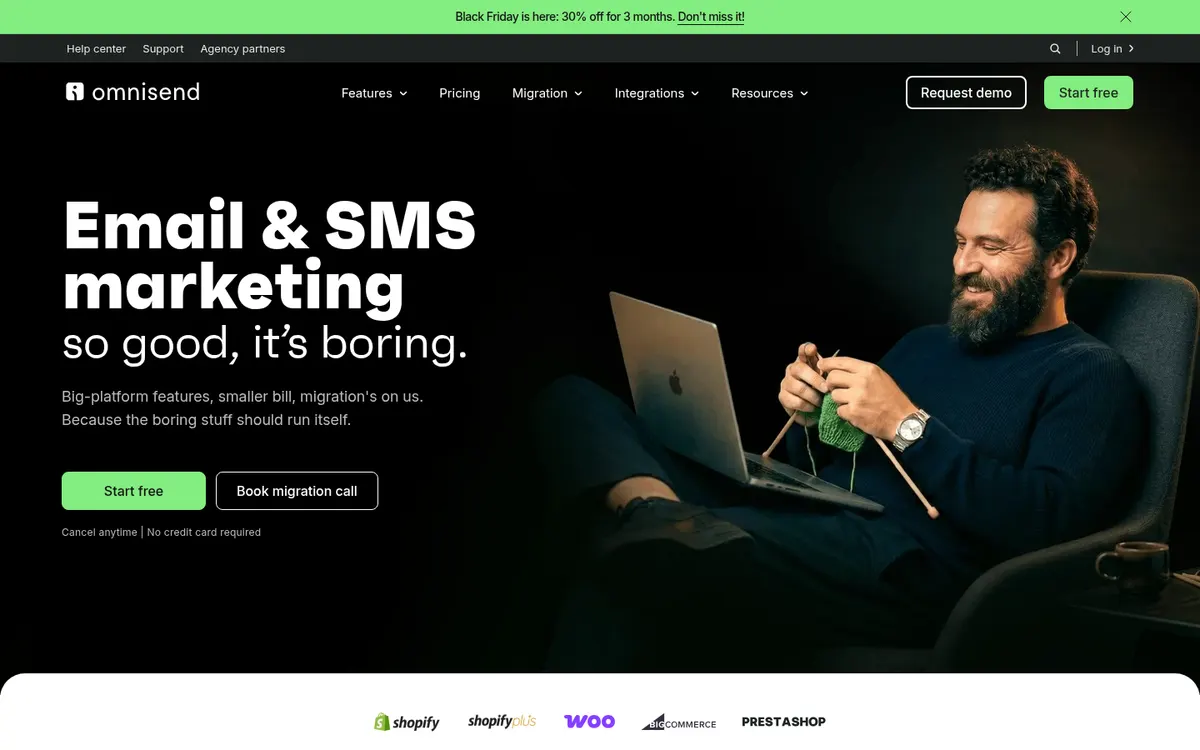
Omnisend packs email, SMS and web push into one flow builder and puts the listed features on every plan, though SMS requires the Pro plan.
Omnisend is built for stores that want email, SMS and web push. Prebuilt ecommerce automations, product recommendations and AI tools are available across plans, though SMS requires Pro. The free plan covers 250 contacts and 500 emails per month. Standard starts at $16 per month for 500 contacts and Pro starts at $59. On 25 November 2026 the pricing page showed 30 percent off the first three months, though regular Standard is $16.
The flow builder treats channels as steps. A cart abandonment sequence can send an email, wait a day, send an SMS and finish with a web push in one automation, so you build and measure it once. SMS needs Pro plus separate credit packs, so add that cost.
Contact-based billing is the main risk: non-subscribed checkout contacts count, so guest emails can mean paying for people who never opted in. Pruning and archiving keeps the bill predictable. Live chat and email support run around the clock. Product recommendations and prebuilt flows are solid rather than deep, so a brand with many intricate behavioral branches will want more control.
Pros
- Core automations and product recommendations on every plan, including the free tier
- Email, SMS and web push share one flow builder
- Quick Shopify setup with automatic tier upgrades
Cons
- Contact-based pricing climbs sharply as the list grows
- Non-subscribed checkout contacts count toward billing
- SMS needs the Pro plan plus separate credit packs
Pick it if
You run a small or mid-market store and want email, SMS and web push built and measured in one flow builder.
Skip it if
You hold a very large list, plan heavy SMS volume, or need branching logic deeper than the prebuilt flows allow.
Klaviyo
Revenue attributionEmail $20/mo (500 active profiles)Free planRubric 8.2
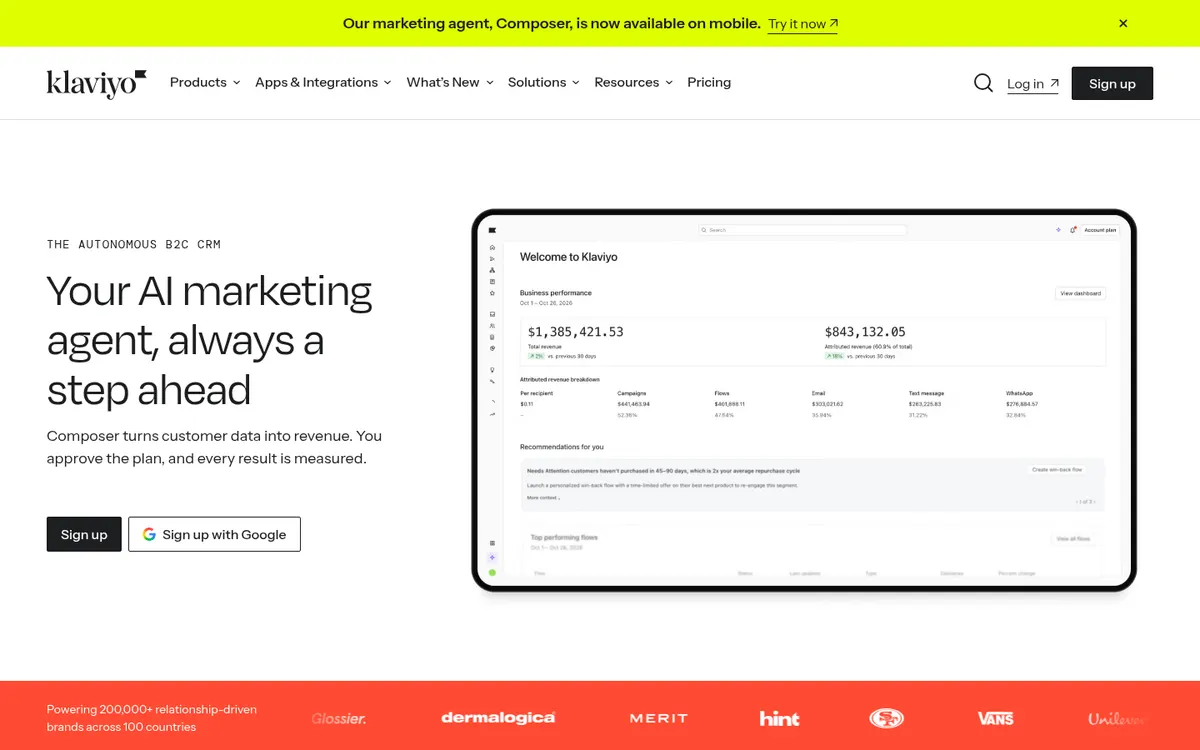
Klaviyo gives large DTC brands a deep ecommerce data model, with predictive scoring and revenue attribution.
Klaviyo is the pick when revenue reporting matters more than the monthly bill. Its data model is built around ecommerce events, so predictive analytics, customer lifetime value and churn scoring run on purchase history rather than opens and clicks. Segmentation is a strength, and per-flow revenue attribution shows what each automation earns.
The free plan covers 250 active profiles and 500 emails per month. Email starts at $20 per month for 251 to 500 active profiles, and Email plus SMS starts at $35. Billing runs on active profiles, so anyone who can receive mail counts. Suppressing unengaged contacts is direct cost control because the tier drops. SMS, WhatsApp and analytics are billed separately, so multi-channel costs more than the headline. Enterprise adds a mandatory surcharge above $10K.
Setup is heavier. With 350-plus integrations and a detailed event model, a full migration can take days rather than hours, and the Shopify sync needs mapping decisions before the first flow. Smaller stores sending one campaign a week will pay for capability they never touch. Budget someone to maintain segments and review flow revenue monthly.
Pros
- Predictive analytics and customer scoring on real purchase data
- Per-flow revenue attribution shows what each automation earns
- Large integration ecosystem with strong Shopify sync
Cons
- Active-profile billing makes list hygiene a direct cost control
- SMS, WhatsApp and analytics are billed separately
- Enterprise plans add a surcharge above $10K monthly spend
Pick it if
You are a growth-stage or large DTC brand that will use predictive analytics, deep segmentation and per-flow revenue reporting.
Skip it if
Your list is small, your sends are simple, or you want SMS and analytics inside one flat price.
Drip
Behavioral segmentationFrom $39/mo (up to 2,500 contacts)No free planRubric 6.7
Drip sells behavioral depth and unlimited sends on every plan, at a price that only makes sense once your list is established.
Drip targets established direct-to-consumer brands that treat email as a retention channel. Segmentation captures micro-interactions such as product views and near-purchases, so a shopper who views one item three times can receive a different message. Revenue attribution links campaigns and flows to orders. Unlimited email sends apply on every plan, and every feature is included at every level.
The lowest paid tier starts at $39 per month for up to 2,500 contacts. There is no free plan. A 14-day trial is the only way to evaluate it, and pricing is premium from the first paid tier. Cost rises steeply past 2,500 contacts. Stores mailing several times a week to a tight, engaged list get more from unlimited sends than stores mailing once a month.
Drip's listed features do not include predictive scoring, SMS or web push, so a multi-channel program needs a second vendor and a second bill. The behavioral segmentation is the reason to choose it, and ecommerce automation and purchase tracking are native. Teams that want one vendor for email, SMS and push, or a free tier to test, should look elsewhere.
Pros
- Segmentation captures micro-interactions such as views and near-purchases
- Unlimited email sends and all features on every plan
- Revenue attribution links campaigns to purchases
Cons
- No free plan; the 14-day trial is the only free evaluation
- Premium pricing from the first paid tier
- Costs rise steeply past 2,500 contacts
Pick it if
You run an established DTC brand with a tight list and want granular behavioral segmentation with unlimited sends.
Skip it if
You need a free plan, mail infrequently, or want SMS and web push from the same vendor.
Mailchimp
All-in-one suiteEssentials from $13/mo (500 contacts)Free planRubric 7.1
Mailchimp offers a broad all-in-one suite, but ecommerce depth only arrives on Standard and above, and billing counts every contact.
Mailchimp works best for small businesses that want email plus landing pages, social posting and surveys in one login. Product recommendations appear on paid plans. Essentials starts at $13 per month for 500 contacts and Standard at $20. The free plan allows 250 contacts and 500 sends per month. A 50 percent promotion for 12 months, listed at $6.50 per month, was running on 25 November 2026, a discount.
The billing rule is the trap. Unsubscribed and non-subscribed contacts count toward the tier unless you archive them, so a list can push you into a higher band than the number of people you mail. Ecommerce automation sits on Standard or higher. SMS and transactional email are paid add-ons, so multi-channel costs more than the headline.
Campaigns and reporting are straightforward. The trade-off is depth. Flows are simpler than Klaviyo or Drip, and segmentation does not reach purchase-behavior granularity without workarounds. A store that wants browse abandonment triggers and per-flow revenue wants a specialist tool. A store that wants one login for email, a landing page and a survey will be satisfied.
Pros
- Broad all-in-one suite for basic marketing
- Large template and integration ecosystem
- Quick setup with a friendly editor
Cons
- Bills on all contacts, including unsubscribed contacts unless archived
- Ecommerce depth requires Standard or higher
- SMS and transactional email are paid add-ons
Pick it if
You are a small business that wants email, landing pages and social posting managed from one account.
Skip it if
You need purchase-level segmentation, per-flow revenue, or billing that ignores unsubscribed contacts.
Brevo
Send-volume billingStarter from $17/mo (monthly billing)Free planRubric 7.4
Brevo charges for send volume rather than list size, which suits large lists that mail lightly.
Brevo flips the usual model: contacts are unlimited and you pay for email volume. A store holding a large address list but mailing a modest volume pays for sends, not storage. Starter starts at $17 per month on monthly billing, and the free plan is free forever with no credit card, though it caps daily sends. Multiple channels sit in one account, including email, SMS, WhatsApp and chat, alongside a built-in CRM and transactional email.
The transactional side is genuinely strong, which matters for order confirmations, shipping updates and password resets. The CRM is included for a small sales team working the same contact records as marketing. Ecommerce automation is where it trails. Ecommerce automation and product recommendations are not as deep as on specialist platforms, and automation on the cheapest tiers is limited. Stores that need a sophisticated post-purchase journey will find the edges quickly.
The unlimited-contact model rewards list size and penalizes frequency. Mailing the full list three times a week pushes send-based billing up fast, and the savings evaporate. Check the vendor site for current plan limits before budgeting.
Pros
- Unlimited contacts with send-volume billing
- Email, SMS, WhatsApp and chat in one account
- Strong transactional email deliverability
Cons
- Ecommerce automation and recommendations trail specialist platforms
- Automation on the cheapest tiers is limited
- The free plan caps daily sends
Pick it if
You hold a large contact list and mail at a moderate volume, especially if transactional email matters.
Skip it if
You need deep purchase-based automation, product recommendations, or frequent high-volume sends.
ActiveCampaign
Visual automation builderStarter $15/mo (1,000 contacts, billed yearly)No free planRubric 7.4
ActiveCampaign has a powerful automation builder, though ecommerce features arrive through integrations rather than a native data model.
ActiveCampaign is an automation and CRM tool that also sends ecommerce email. The visual builder handles multi-branch journeys with conditional logic, and the built-in CRM shares sales and marketing data in one record, which suits stores with a wholesale arm or a high-touch segment.
Starter is $15 per month for 1,000 contacts billed yearly, and a 14-day free trial is the only evaluation. There is no free plan. Ecommerce capability comes through integrations rather than a native event model, so setup and data mapping matter. Teams with a developer or experienced operations person manage it; lean teams often end up using a fraction of what they pay for. SMS is a separate add-on.
The automation depth has a learning curve. Conditional logic is powerful, and poorly planned flows become hard to audit after a few months. For a store whose main need is retention journeys tied to a sales pipeline, the combination of automation and CRM is a strong fit. For native ecommerce features out of the box, a specialist platform means less configuration. The 14-day trial is enough to build one journey.
Pros
- Deep visual automation with multi-branch journeys
- Built-in CRM unifies sales and marketing data
- Predictive sending and split testing on higher tiers
Cons
- No free plan; evaluation is through a 14-day trial
- Ecommerce features depend on integrations rather than a native model
- Advanced automation has a steep learning curve
Pick it if
You need branching automation and a light CRM in one account and have someone to run the configuration.
Skip it if
You want product recommendations and revenue attribution working within a day of signing up.
GetResponse
Funnels and webinarsStarter $19/mo (1,000 contacts, monthly billing)Free planRubric 6.8
GetResponse bundles email, funnels, landing pages and webinar hosting, a good fit for small marketers who sell through events and content.
GetResponse puts email, landing pages, signup funnels and webinar hosting in one account. For a small brand that runs live product launches or teaches a skill before selling, the webinar tool removes a separate subscription. Ecommerce tracking and abandoned-cart automation are included, and list-building tools cover the basics.
Starter is $19 per month on monthly billing or $15.58 per month billed annually, and there is a free account plus a 14-day trial. The free plan supports up to 500 contacts with restrictions, and automation is withdrawn after an initial period, so real flows need a paid plan. The 14-day trial is the better test.
Ecommerce segmentation is less deep than specialist tools, and product recommendations are not listed. A store with a large catalog and complex browse behavior will run out of room. A store selling a handful of products through launches, workshops or seasonal campaigns will find the fit easier, because funnels and webinars do work a pure email tool cannot. Setup takes hours rather than minutes. Stores that only want email and SMS will pay for funnel and webinar tooling they never open.
Pros
- Email, funnels, webinars and landing pages in one account
- Ecommerce tracking with abandoned-cart automation
- Free tier for testing
Cons
- The free plan is limited and removes automations after an initial period
- Ecommerce segmentation is less deep than specialist tools
- Real automation requires a paid plan
Pick it if
You sell through launches, webinars or content and want funnels and email in the same account.
Skip it if
You need granular purchase segmentation or only want an email sender at the lowest price.
MailerLite
Low entry priceComfort $10.80/mo (500 subscribers, billed yearly)Free planRubric 6.4
MailerLite is a low-cost credible option for small stores, with a clean editor and a free tier that actually sends.
MailerLite suits small stores and content-led businesses that need straightforward email at a low price. The drag-and-drop editor is quick to learn, the free tier has a subscriber allowance and a monthly email allowance, and a 14-day trial is available. Comfort is $10.80 per month for 500 subscribers billed yearly, or $12 on monthly billing. Automation covers the basics, and subscriber management is clear enough to run without training.
Ecommerce features are basic. Product recommendations, browse abandonment and revenue attribution are not the reason to buy, and a store that needs purchase-level segmentation will outgrow it. Template and integration options are narrower than Mailchimp's, and SMS is an add-on rather than a native strength. For a store sending a weekly campaign and a welcome sequence, none of that matters. Campaign setup takes minutes.
The limit shows up as the store grows. Once you need behavioral triggers, multi-channel flows or per-flow revenue, migration is the cheaper path, and moving a list is easier before it gets large. Starting here and planning an exit is sensible for a new store. Expecting it to carry a scaling catalog is not.
Pros
- Simple editor that beginners can use quickly
- Low prices and a useful free tier
- Clean deliverability and straightforward automation
Cons
- Ecommerce features are basic compared with specialized platforms
- Template and integration options are narrower
- SMS is an add-on rather than a native strength
Pick it if
You run a small store or content business and want reliable email at the lowest credible price.
Skip it if
You need product recommendations, browse abandonment triggers or per-flow revenue reporting.
Privy
List growth popupsEmail $30/mo (up to 1,500 mailable contacts)Free planRubric 6.5
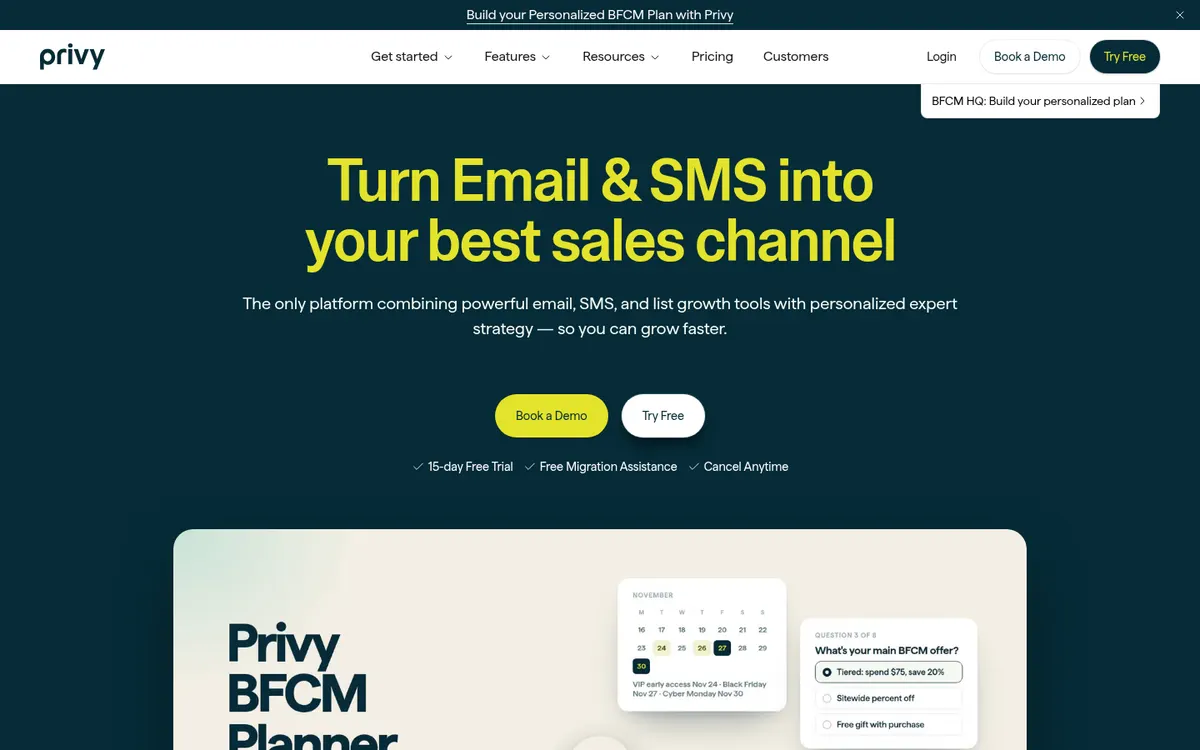
Privy is a Shopify list-growth tool first and an email platform second, best when popups and cart savers drive the plan.
Privy focuses on conversion tools for Shopify and list growth. Popups, spin-to-win campaigns, gamified signup forms and cart savers are the core, and email plus SMS sit alongside them in one account. Email is $30 per month for up to 1,500 mailable contacts, with a free plan and a 15-day trial. Shopify setup is fast, and the ecommerce templates are written for stores.
Email depth trails the email-first platforms. Segmentation, behavioral automation and reporting are adequate rather than advanced, and a store with a complex post-purchase journey will run out of room and look at Omnisend or Klaviyo. The sending side is reliable enough for a modest store.
Privy is now part of Attentive, and plans and packaging have shifted under that ownership. Confirm current pricing and limits before budgeting, because older tutorials and plan names may not match the signup page. The combination works when the growth engine is the point: a store that expects popups and gamified forms to add subscribers gets capture and sending on one bill. A store that has a large list and needs automation should look at email-first options instead.
Pros
- Strong list-growth tools built for Shopify
- Email and SMS in one account
- Fast Shopify setup
Cons
- Email depth trails full email service providers
- Pricing and packaging have changed under Attentive ownership
- Current plans should be confirmed before budgeting
Pick it if
You run a Shopify store and expect popups and gamified forms to be your main subscriber source.
Skip it if
Your list is already large and your priority is behavioral automation and revenue reporting.
What does ecommerce email marketing software actually do?
Ecommerce email marketing software is the system a store uses to send one-off campaigns and automated sequences that react to shopping behavior. It sits between your product catalog and your customer list, pulling order and browse data from the store platform and using it to decide who gets which message and when.
The category does four jobs. It stores contacts with consent status, tags and purchase history. It builds and sends campaigns to segments. It runs automations triggered by events such as a signup, an abandoned cart, a delivered order or a lapse in buying. It reports on revenue per message and per flow.
Most tools here started as general email senders and added ecommerce features later, which is why depth varies so much. Klaviyo and Drip were built around store events, so segmentation and attribution reach purchase behavior. Mailchimp and MailerLite began as broadcast email tools and now cover ecommerce basics. Omnisend and Privy started from the store side, with popups and multi-channel flows.
Three things separate a store tool from a newsletter tool:
- A native product catalog and recommendations that update from the store feed
- Event triggers such as browse abandonment and near-purchase, not just opens and clicks
- Revenue attribution that ties a flow to orders, not to click rates alone
The practical test is whether you can build a cart recovery sequence in under an hour without custom code. If the answer is no, the tool will not keep up with a growing store, and you will end up bolting on a second product for SMS, popups or recommendations, which means two bills and two contact records.
This comparison sits on the Ecommerce desk. Readers comparing neighbouring stacks often check our guides to SEO software and AI video ad creation software next.
How ecommerce email pricing works: contacts, sends and add-ons
Pricing in this category follows a few models, and the model matters more than the headline number. Contact-based billing charges by stored contacts in tiers, so the price rises as the list grows regardless of how often you mail. Active-profile billing is a variant that counts only contacts who can receive mail, which rewards suppression. Send-based billing charges for volume and leaves contacts unlimited. Flat bands bundle a contact range with unlimited sends. Then come the add-ons. SMS sits outside the email subscription on most platforms, either as a credit pack or a separate plan. Mailchimp treats transactional email as an add-on. Klaviyo bills analytics and WhatsApp separately and adds a surcharge above $10K in monthly spend on Enterprise. Brevo's free plan caps daily sends, which is a limit rather than a price. | Model | How it bills | Typical fit | Example from this list | | --- | --- | --- | --- | | Contact tiers | Price rises with stored contacts | Lists that mail often | Omnisend Standard, $16/mo for 500 contacts | | Active profiles | Only mailable contacts count | Brands with mixed engagement | Klaviyo Email, $20/mo for 500 active profiles | | Send volume | Contacts unlimited, pay for sends | Large lists, low frequency | Brevo Starter, $17/mo on monthly billing | | Flat band | One price, unlimited sends | Mid-size stores mailing heavily | Drip, from $39/mo up to 2,500 contacts | | Subscriber tier | Free allowance, then paid tiers | Small stores starting out | MailerLite Comfort, $10.80/mo billed yearly | Read the band above your current list size, not the one you are in today. A store just under a contact-tier boundary can cross into the next band quickly once popups run. Price the band you expect in twelve months and compare that number across vendors before deciding. Also check whether the entry tier includes the automation and segmentation you shortlisted, because several platforms put the useful features one tier up.
Every price above was checked on the vendor's own pricing page on November 25, 2026. Where a vendor does not publish a figure we write "See website" instead of guessing. To compare annual and monthly billing quickly, try the free percentage calculator.
How to choose an ecommerce email platform in six steps
- Set the billing model first. Decide whether your list is large and rarely mailed, small and mailed often, or somewhere in between. That single answer removes half this list before you compare a feature. 2. List the flows you will actually build. Welcome, abandoned cart, browse abandonment, post-purchase and win-back cover most stores. Match them against native automations rather than features you would need a third-party integration to reach. 3. Decide if SMS and push are in scope. If yes, check which vendors include SMS and web push; Omnisend lists both, while Klaviyo, Brevo and Privy list SMS. If no, drop those channels from scoring and price the email tier alone. 4. Price the tier you need in twelve months. Take your current contact count, add expected growth, and price that band on each vendor page. The entry tier is a marketing number, not a budget. 5. Check the trial and free plan before committing. Drip and ActiveCampaign have no free plan, so a 14-day trial is your only evaluation window. Build one real flow inside it rather than clicking through the interface. 6. Test the migration path. Ask how contacts, tags and engagement history export, and whether the new tool accepts them cleanly. A migration that loses engagement history resets your deliverability standing.
Mistakes that cost ecommerce teams money on email software
- Paying for contacts you never mail. Mailchimp counts unsubscribed contacts unless you archive them, and Omnisend counts non-subscribed checkout contacts. Archive and suppress regularly, or the tier you pay for grows faster than the audience you reach. - Choosing on the entry price. The entry tier may lack the automation, segmentation or recommendations you need, so check the feature list for that specific plan. Price the tier that includes what you need, then compare. - Importing a cold list without warming the domain. A large import onto a new sending domain can damage inbox placement for months. Segment by engagement and send to recent openers first. - Adding SMS before email flows work. SMS costs more per message and needs its own consent. Prove the cart recovery flow in email, then duplicate the winner on SMS. - Skipping revenue tracking. Without attribution you cannot tell a flow that earns from one that only sends. Set up conversion tracking before the first campaign goes out, not after.
Frequently asked questions
What does ecommerce email marketing cost in 2026?
Entry tiers in this list run from $10.80 per month for MailerLite Comfort on yearly billing to $39 per month for Drip, with Mailchimp Essentials at $13, Omnisend Standard at $16, Brevo Starter at $17 and Klaviyo at $20. Cost climbs with contacts or sends, and SMS, analytics and transactional email are often extra. Budget for the tier you will need in twelve months, not the one you need today.
Klaviyo or Omnisend for an ecommerce store?
Omnisend costs less and puts email, SMS and web push in one flow builder, so a small or mid-market store gets multi-channel automation without a second vendor. Klaviyo costs more and delivers a deeper data model, predictive scoring and per-flow revenue attribution. Choose Omnisend when simplicity and entry price matter, and Klaviyo when analytics and segmentation drive your decisions.
Should I pay per contact or per send?
Pay per contact when your list is small and you mail often, because send-based billing punishes frequency. Pay per send when your list is large and you mail rarely, since Brevo's model leaves contacts unlimited. Active-profile billing, used by Klaviyo, is a middle path that rewards list hygiene. Model your last three months of sends before you choose.
Do I need SMS marketing as well as email?
Only if your customers buy on a phone and respond to short reminders. SMS earns its cost on cart recovery, delivery updates and time-limited drops, and it needs separate consent. On this list SMS appears natively in Omnisend, Klaviyo, Brevo and Privy, as an add-on in Mailchimp, ActiveCampaign and MailerLite, and is absent from the feature lists for Drip and GetResponse.
How do I migrate email platforms without losing my list?
Export the full list with consent timestamps and engagement history before you cancel anything, then import into the new tool and keep double opt-in for cold segments. Run both platforms in parallel for two to four weeks on your core flows. Authenticate the sending domain with SPF, DKIM and DMARC first, then watch deliverability for the first three campaigns.
Which of these platforms works best with Shopify?
Omnisend and Privy both advertise quick Shopify setup, and Omnisend upgrades its tier automatically as contacts grow. Klaviyo has strong Shopify sync plus 350-plus integrations, which suits stores running several apps. Check each vendor site for Shopify support, because ecommerce depth varies. Confirm the specific data you need, such as browse events and catalog sync, before you choose.
Still choosing a tool?
Browse every comparison on the Ecommerce desk, with the same rubric and dated prices.