
- Best for
- Small and mid-size consumer brands, Shopify merchants and Amazon sellers
- Starting price
- Monthly $199/month
- Free plan
- No
- Features listed
- 5 highlighted
Prices checked November 25, 2026
Security desk · 9 tools compared
Best Brand Protection Software 2026: 9 Tools Ranked and Compared
Nine tools that chase counterfeits, lookalike domains and ad abuse, scored on coverage, evidence quality, cost model and how much work lands on your team.
Brand Protector is the best brand protection software for small and mid-size consumer brands, Shopify merchants and Amazon sellers, because it publishes a $199 per month price and attaches evidence to every finding. Red Points suits brands that need uncapped takedowns handled by a managed team, and BrandShield suits security teams fighting phishing, fake domains and impersonation. Prices were checked on 2026-11-25. The ranking below covers nine tools, from self-serve marketplace enforcement to enterprise trademark and domain programs.
Top 3 picks
- Best for
- Brands fighting counterfeits across marketplaces
- Starting price
- See website
- Free plan
- No
- Features listed
- 5 highlighted
- Best for
- Cybersecurity teams fighting phishing and impersonation
- Starting price
- See website
- Free plan
- No
- Features listed
- 4 highlighted
Disclosure for this page: Brand Protector is a paid Featured listing on this page and is labelled wherever it appears. The other 8 tools are unpaid editorial picks, and no vendor reviewed this page before publication. The position of a paid listing can be part of what the vendor pays for. The same rubric and the same honest cons apply to paid and unpaid rows. How we handle paid listings.
Compare all 9 at a glance
| Tool | Best for | Free plan | Actions | |||
|---|---|---|---|---|---|---|
| 1 |  Brand ProtectorFeatured | Small and mid-size consumer brands, Shopify merchants and Amazon sellers | Monthly $199/month | No | ||
| 2 | Red Points | Brands fighting counterfeits across marketplaces | See website | No | ||
| 3 |  BrandShield | Cybersecurity teams fighting phishing and impersonation | See website | No | ||
| 4 |  Corsearch | IP and legal teams needing trademark plus enforcement | See website | No | ||
| 5 |  ZeroFox | Security teams protecting brands, executives and domains | See website | No | ||
| 6 |  MarkMonitor | Enterprises with large domain portfolios | See website | No | ||
| 7 |  Tracer | Enterprises wanting AI-first detection across channels | See website | No | ||
| 8 |  OpSec Security (Crane Authentication) | Brands needing physical and digital protection together | See website | No | ||
| 9 |  BrandVerity | Paid search and affiliate compliance monitoring | See website | No |
On this page
- Key takeaways
- Top 3 picks
- Comparison table
- How we chose and scored these tools
- Scoring rubric
- 1. Brand Protector
- 2. Red Points
- 3. BrandShield
- 4. Corsearch
- 5. ZeroFox
- 6. MarkMonitor
- 7. Tracer
- 8. OpSec Security (Crane Authentication)
- 9. BrandVerity
- What Does Brand Protection Software Actually Do All Day?
- What Brand Protection Software Costs, and Why the Model Matters More Than the Number
- How to Choose: A Six-Step Decision Path
- Five Mistakes That Waste a Brand Protection Budget
- FAQ
- Related pages
How we chose and scored these tools
We scored nine tools against five criteria, weighted for the way brands actually buy. Channel coverage (25 percent) asks how many of the places your customers shop and search are monitored, including newer marketplaces such as Temu, Shein and TikTok Shop. Takedown execution (25 percent) covers whether the vendor files notices itself, how direct its platform and registrar channels are, and whether volume is metered. Evidence quality (20 percent) is about what arrives with a finding: seller, price, image and reason, or a bare URL. Pricing clarity (15 percent) rewards a published price and a trial you can start without a call. Operational fit (15 percent) asks who does the work each week, your team or the vendor's.
Pricing facts come from vendor pricing pages checked on 2026-11-25. Where a vendor publishes a price, we used it and noted it. Where pricing is quoted per engagement, we say so and do not estimate a number. One price in this list, Brand Protector at $199 per month with a 7-day trial, could be confirmed on the vendor's official page on the check date.
The Brand Protector listing is a paid placement and is marked Featured. It was scored with the same five criteria and the same weights as every other tool, and its weaknesses are listed in full. Placement affects where it appears, not what the rubric says about it. Several tools here score well on capability and poorly on pricing clarity, which is the honest result when a vendor does not publish a number.
The full process, including how we handle corrections, is on the methodology page. Paid listings follow our advertising disclosure.
The scoring rubric
| Criterion | Weight | What we check |
|---|---|---|
| Channel coverage | 25% | How many marketplaces, social platforms, domains and ad channels the tool monitors, including newer marketplaces. |
| Takedown execution | 25% | Whether the vendor files notices directly, how strong its platform and registrar channels are, and whether volume is metered. |
| Evidence quality | 20% | What arrives attached to each finding, from a bare URL to a pack with seller, price, image and flag reason. |
| Pricing clarity | 15% | Whether a list price and a trial are published, so a buyer can decide without a sales cycle. |
| Operational fit | 15% | How much weekly work lands on your team versus the vendor's, and whether the product matches the team that will own it. |
Brand Protector
FeaturedPublished self-serve priceMonthly $199/monthNo free planRubric 8.3
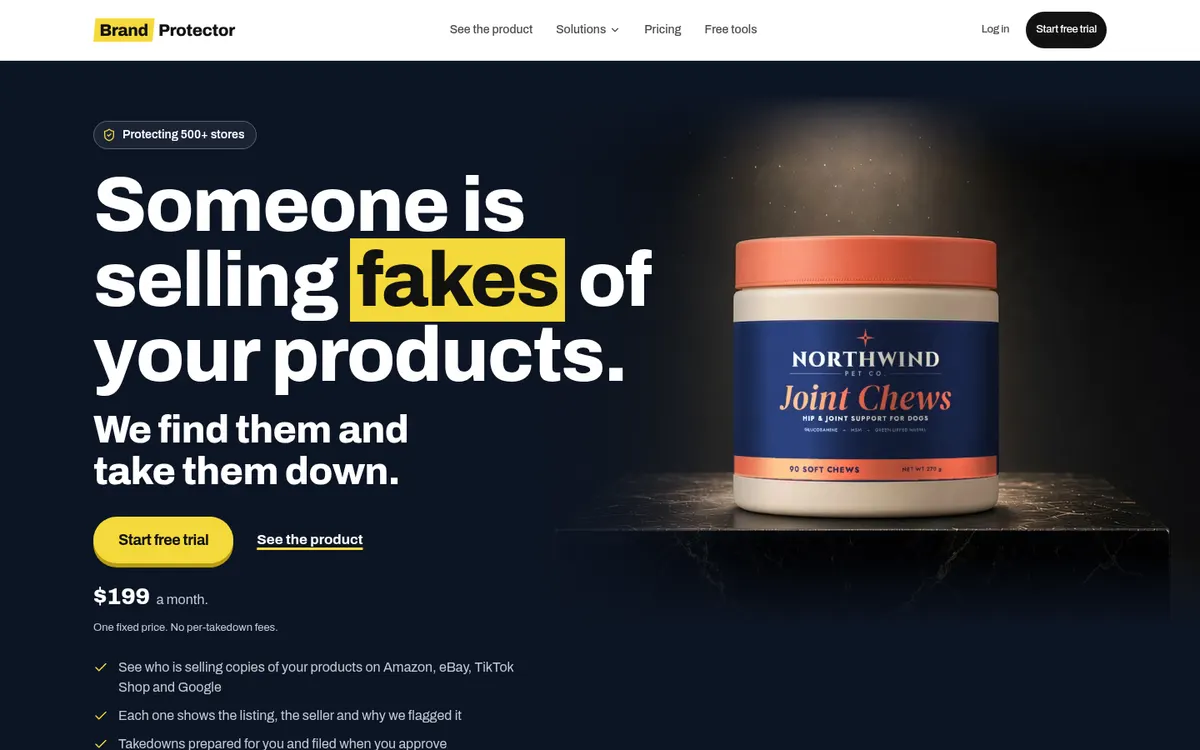
The only tool here with a published price and self-serve setup, best for Shopify and Amazon sellers who will approve their own takedowns.
Brand Protector is aimed at the brand owner who runs enforcement themselves. A Shopify app install imports product images, so the tool knows genuine listings before it scans. Monitoring covers Amazon, eBay, Etsy, Walmart, AliExpress, Temu, Shein, TikTok Shop, Google Shopping and lookalike domains, including newer platforms where small brands lose sales.
Findings arrive in one inbox, each recording seller, price, image and reason flagged. The tool builds a per-platform evidence pack and prepared takedown notice; eBay reports are filed through eBay's API using VeRO. Nothing goes out until a person approves it, which keeps bad notices off the wire and means the product is not hands-off.
Pricing is the differentiator: $199 per month, published, with a 7-day free trial and no sales contact. A marketing manager can decide without procurement. It is the Featured listing, scored on the same rubric. Limits: every removal needs human approval, so someone must own the queue. There is no trademark portfolio management, litigation support or investigator network. It fits small and mid-size brands, not enterprises with outside counsel; through a law firm, treat it as a first-pass detector.
Pros
- Published $199 per month price with no sales call
- Eight marketplaces plus Google Shopping and lookalike domains
- Evidence pack attached to every finding
Cons
- A person must approve each takedown
- No trademark portfolio or litigation support
- Built for small brands, not legal-led enterprises
Pick it if
You are a Shopify or Amazon seller who wants to start enforcement this week at a known monthly cost.
Skip it if
Your program is run by in-house counsel who need portfolio management and litigation backing.
Red Points
Unmetered takedownsSee websiteNo free planRubric 7.8
Uncapped managed enforcement across marketplaces, including China-based platforms, priced per engagement for brands with a real counterfeit problem.
Red Points is for brands whose main problem is counterfeit listings across marketplaces and who do not want to staff enforcement. It scans marketplaces, websites, social media, domains and ads with AI models trained on large infringement datasets, then files takedowns. Fully managed specialists handle enforcement, not your marketing coordinator.
The commercial model matters. Detection and takedown volume are unlimited, not metered, so a surge in fakes does not create a budget spike or force triage. That separates it from tools charging per takedown or analyst hour. Coverage includes China-based platforms, where much counterfeit supply sits. The vendor says it processes tens of millions of digital signals each day. Analytics on infringement activity are included for board or licensee questions.
Pricing is quoted per engagement, with no list price and no free trial. Custom enterprise pricing is out of reach for a brand spending a few hundred dollars a month. Analytics can overwhelm a small team, and the dashboard has a learning curve. It fits a brand with a sustained counterfeit problem and someone to manage the vendor relationship, not a Shopify seller who wants an app this afternoon.
Pros
- Unlimited takedowns with no metering
- Managed specialists handle enforcement
- China-based marketplace coverage
Cons
- Enterprise custom pricing only
- No free plan and no trial
- Analytics and dashboard take time to learn
Pick it if
Counterfeit volume is high and unpredictable and you would rather pay a managed team than hire specialists.
Skip it if
You need a published price and a self-serve start before you can get budget approved.
BrandShield
Threat clusteringSee websiteNo free planRubric 7.2
Fast phishing, domain and impersonation takedowns from a security angle, with thinner marketplace counterfeit tooling than the specialists.
BrandShield approaches brand protection from cybersecurity, and that shapes what it does well. Phishing site detection and takedown, fake and lookalike domain monitoring, social media impersonation and fraudulent ads are the core. If someone runs a fake login page under your name or buys ads against your trademark, this is the kind of tool that finds it.
The separating feature is AI clustering. Related threats get grouped into network-level investigations, so one case can cover a cluster of sites or accounts rather than one site. That cuts analyst time per takedown on large campaigns. Executive impersonation monitoring is included, and takedown workflows run across registrars and platforms. It fits finance, pharma and gaming brands, where phishing and impersonation do the most damage.
Pricing is not published, with no free plan and no trial. Marketplace counterfeit workflows are less developed than specialist tools here. If Amazon sellers undercut you with fakes, other tools are a better shape. The vendor is smaller than large incumbents and ownership has changed as a listed company, so ask about roadmap. Treat it as security-led brand protection, not the reverse.
Pros
- Fast phishing and domain takedowns
- Threat clustering covers whole networks
- Strong fit for finance, pharma and gaming
Cons
- Marketplace counterfeit workflows lag specialists
- Ownership changes make the roadmap worth checking
- No published pricing, free plan or trial
Pick it if
Fake login pages, lookalike domains and social impersonation are the damage you are actually seeing.
Skip it if
Counterfeit product listings on marketplaces are the whole problem you need solved.
Corsearch
Trademark lifecycleSee websiteNo free planRubric 7.2
The full trademark lifecycle in one vendor, from clearance searching to enforcement, better suited to legal teams than to marketers.
Corsearch is the pick when legal owns the program. It covers the full trademark lifecycle: clearance searching through TrademarkNow, trademark watching, online enforcement across marketplaces and the web, and investigations support. The Zeal platform combines the enforcement tooling, and data is shared between legal and enforcement workflows, so a watching alert and an enforcement case can live in the same place.
That matters where one team handles portfolio registration and takedowns. In most organizations those sit in different systems, which is how a mark gets registered in one place and defended in another with no shared record. Corsearch has absorbed Pointer Brand Protection and Yellow Brand Protection, folding their enforcement technology into Zeal, so enforcement is not an afterthought bolted onto a search business.
The trade-off is weight. It is heavier and costlier than pure-play tools, and marketplace-only teams pay for trademark machinery they never touch. Setup takes longer than self-serve. Pricing is not published, with no free plan and no trial. Expect a scoped quote. It fits an enterprise or law firm with an existing portfolio and someone to manage it; a mid-size brand without in-house IP counsel will struggle to justify the complexity.
Pros
- Trademark lifecycle in one vendor
- Deep legal and investigation expertise
- Shared data between legal and enforcement
Cons
- Heavy and costly for takedown-only needs
- Platform feels dated in places
- Longer setup than self-serve tools
Pick it if
In-house IP counsel manages a trademark portfolio and wants enforcement in the same system.
Skip it if
You only need marketplace listings removed and have no portfolio to manage.
ZeroFox
Takedown networkSee websiteNo free planRubric 7.2
Threat intelligence and rapid takedowns for social, domain and executive impersonation, built to be run by a security operations team.
ZeroFox is a security product that does brand protection, not a brand protection product with security features. Social media impersonation detection, phishing and malicious domain detection, executive threat monitoring and dark web monitoring are core. Those are threats a security operations center cares about, and the tool is built to be read by one.
The disruption and takedown network is the operational heart. Long-standing platform and registrar relationships mean takedowns often complete in hours, a deliberate design goal. The HNTR console combines threat intelligence with brand protection, and managed services are included, which matters for teams without staff to work a queue. It fits a security team that owns external threat monitoring and wants brand coverage in the same console.
It does not fit a marketing team wanting a clean list of counterfeit listings. Marketplace counterfeits are less specialised than dedicated enforcement tools, so if fake listings are your main loss, look elsewhere. Pricing is not published, with no free plan and no trial. Expect premium pricing for security budgets. A SOC analyst fits; a brand manager will find the console and vocabulary feel like someone else's job.
Pros
- Takedown network with platform and registrar ties
- Strong social media and dark web coverage
- Managed services included with the platform
Cons
- Less specialised in marketplace counterfeits
- Premium pricing aimed at security budgets
- Assumes a security team owns the console
Pick it if
A security operations team will own brand protection and wants it inside their threat console.
Skip it if
The buyer is a marketing or ecommerce manager chasing counterfeit product listings.
MarkMonitor
Domain recoverySee websiteNo free planRubric 6.8
Corporate domain management and recovery with deep registrar relationships, while marketplace counterfeit enforcement takes second place.
MarkMonitor is the domain management specialist here, and that is the reason to buy it. Corporate domain portfolio management, registry locks, domain monitoring and domain recovery are core, backed by decades of registrar relationships and direct ISP and registrar escalation. If a lookalike domain is harvesting customers, or a lapsed registration handed your brand to a stranger, it has the shortest path to getting it back.
Anti-fraud and phishing response are strong for the same reason: the escalation channels are real and old. There is a broader brand protection module alongside the domain work, but it trails the dedicated vendors here. Marketplace and social enforcement are not the product's centre of gravity.
Ownership has moved. Com Laude acquired MarkMonitor in January 2026, following Clarivate and Newfold Digital. The company has managed corporate domain portfolios since 1999, so operational depth is not in question, but confirm roadmap continuity and named support. Pricing is not published, with no free plan and no trial. It suits a large enterprise with many domains and a legal or security team. It does not suit a marketplace-first brand whose counterfeits sit on Amazon and Temu.
Pros
- Best-in-class corporate domain management
- Strong anti-fraud and phishing response
- Decades of registrar relationships
Cons
- Brand protection module trails specialists
- Domain-led design may not fit marketplace-first programs
- Ownership changed in 2026, roadmap needs checking
Pick it if
You run a large corporate domain portfolio and need recovery and escalation channels you can trust.
Skip it if
Your losses are counterfeit product listings rather than domain and phishing abuse.
Tracer
Network graph mappingSee websiteNo free planRubric 7.4
Graph-based detection that links related infringements into networks, with AI triage and broad channel coverage at enterprise pricing.
Tracer renamed from AppDetex in 2022, and the platform is built around a graph. Tracer Graph maps linked brand abuse, treating infringements as connected networks rather than isolated listings, a more honest model of how counterfeiting works: one operator often runs many storefronts. The company holds patents on the network mapping approach.
Flora, its agentic AI, handles detection triage. The practical effect is that low-value hits get filtered before a human sees them, which shortens response times on the ones that matter. Channels covered include domains, social media, app stores, marketplaces and paid search, so it is broad rather than deep in one place. Human analysts sit alongside the automation rather than the product being fully self-serve.
The rebrand is still a procurement issue. Buyers who shortlist AppDetex then search for it will not find the same site, and stakeholders may not realize they are the same vendor. Flag it early. Pricing is not published, with no free plan and no trial. Advanced tooling may exceed mid-market needs, and graph mapping matters most with hundreds of related infringements. It fits an enterprise with cross-channel abuse and an analyst team.
Pros
- Patented network mapping links related infringements
- Agentic AI triage shortens response times
- Broad coverage across marketplaces and other channels
Cons
- Old AppDetex name still causes procurement confusion
- Enterprise custom pricing only
- More tooling than a mid-market brand may use
Pick it if
You face hundreds of linked infringements across channels and want them handled as networks.
Skip it if
You have a short list of listings and no analyst team to work the platform.
OpSec Security (Crane Authentication)
Physical authenticationSee websiteNo free planRubric 6.0
Physical authentication labels, track and trace and online monitoring in one program, now under the Crane Authentication brand.
OpSec Security is the only vendor here that protects the physical product as well as the listing. Optical authentication labels and holograms, track and trace systems and supply chain security sit alongside online channel monitoring for counterfeits and digital takedown support. If fakes are indistinguishable from the real thing at the point of sale, software alone cannot fix it.
That combination matters in luxury, pharma and sports, where authentication is part of the product and regulators or licensees expect a physical control. Authentication labels and track and trace protect billions of physical products each year alongside online monitoring, so the two halves are not bolted together for marketing. InsightPulse is the current system name.
Corporate identity has changed. The opsecsecurity.com site redirects to Crane Authentication, and the product operates under that brand. Crane NXT acquired the company in 2024. Confirm which entity contracts and supports you before signing. Pricing is not published. Expect an enterprise contract plus a manufacturing and logistics project for the physical side. That is overkill for an online-only problem. It fits a brand whose counterfeits are physical and whose channels include distributors and resellers, not a Shopify seller.
Pros
- Optical authentication labels and holograms
- Supply chain track and trace
- Online monitoring in the same program
Cons
- Overkill and overpriced for online-only needs
- Corporate changes after the 2024 acquisition
- You pay for physical capability you may not use
Pick it if
Counterfeit goods are physical, distributed through resellers, and need authentication at the product level.
Skip it if
All your losses are online listings and you have no physical supply chain to secure.
BrandVerity
Paid search depthSee websiteNo free planRubric 5.5
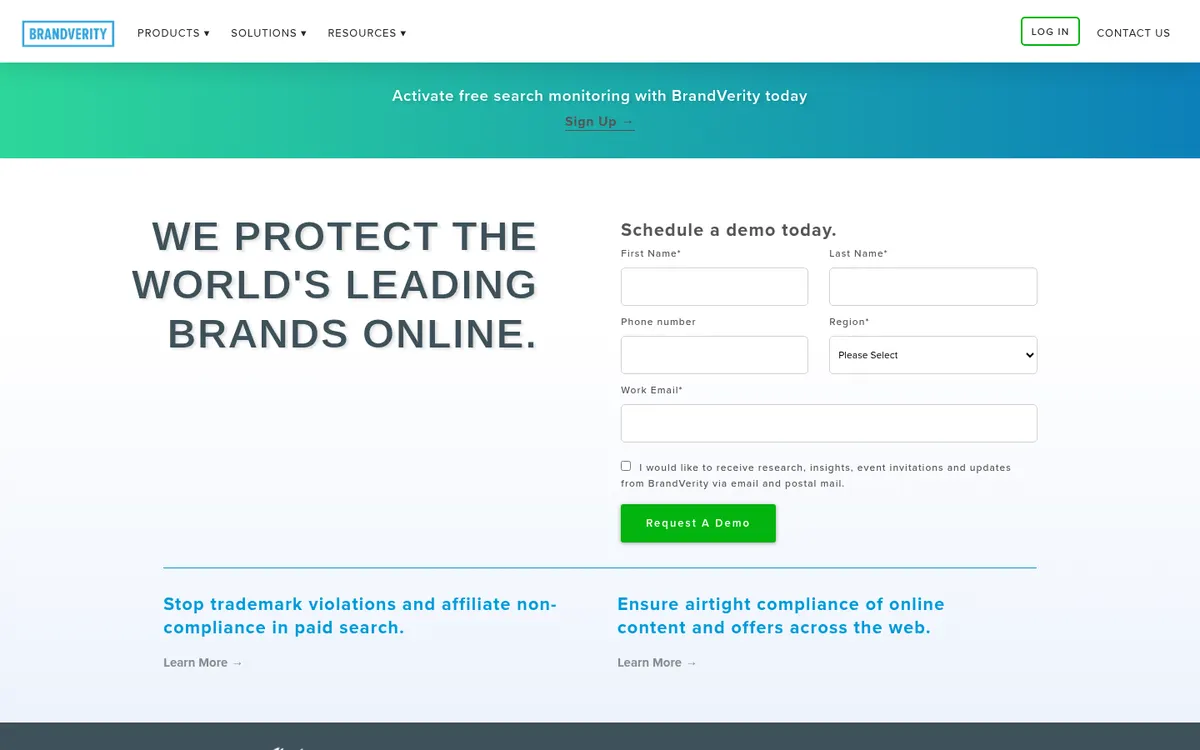
Deep paid search and affiliate compliance monitoring with bulk takedowns, deliberately narrow and not a full enforcement suite.
BrandVerity does one job deeply: paid search and affiliate compliance. It monitors paid search across thousands of daily search results with geo-specific tracking, so you can see who bids on your brand terms in each market rather than one country only. Affiliate branded keyword bidding detection and affiliate terms violation flagging make up the other half.
Bulk takedown workflows and compliance reporting make the output usable by channel marketing. The typical finding is a partner or rogue affiliate buying your trademark, a contract and relationship problem as much as enforcement. The tool gives evidence for that conversation. Scope is deliberately narrow: no marketplace, social or domain monitoring, so it is not a full brand protection suite. The team is small. Partnerize acquired the company in 2020 and it now sits inside a partnership automation ecosystem, a reasonable home for an affiliate compliance tool.
Pricing is not published, with no free plan and no trial. It fits an affiliate or channel marketing program with real spend and partners who bend the rules. It does not fit a brand whose main loss is counterfeit product, where pairing it with a marketplace enforcement tool is the usual answer.
Pros
- Deep paid search coverage across locations
- Bulk takedown workflows
- Focused affiliate compliance capability
Cons
- Narrow scope, not a full protection suite
- No marketplace or social monitoring
- Small team behind the product
Pick it if
Affiliates and paid search competitors are stealing branded traffic and you need geo-level evidence.
Skip it if
Counterfeit listings or impersonation are the problem you are trying to solve.
What Does Brand Protection Software Actually Do All Day?
Brand protection software watches the places your brand appears without permission and gets the abusive ones removed. The daily work is detection: scanning marketplaces, websites, social accounts, app stores, ad auctions and domain registrations for listings, posts, pages or domains that use your name, logo or product images without authorization. The output is a queue of findings, each one ideally carrying the seller, the price, the image and the reason it was flagged.
Enforcement is the second half. Once a finding is confirmed, the tool prepares a notice for that specific platform and files it, either directly through a channel such as eBay's VeRO program or by routing it to a person, a registrar or a platform form. Tools differ enormously here. Some file on your behalf and report back. Others prepare a pack and leave the submission to you.
The categories involved are often confused:
- Counterfeit enforcement: fake product listings on marketplaces and the sites behind them.
- Impersonation and phishing: fake login pages, social accounts and executive profiles.
- Domain abuse: lookalike registrations, typosquatting and lapsed domains.
- Channel abuse: paid search bidding, affiliate terms violations and gray market selling.
Most vendors are strong in one or two of these. A security-led product is usually best at phishing and domains. A marketplace-led product is best at listings.
Software also supports rather than replaces your in-house legal team. A well-run program gives counsel a filtered, evidenced file with a documented notice history, which shortens review and makes repeat infringement easier to argue.
One honest limit: software does not make a counterfeit disappear permanently. Sellers relist, and a takedown is a single action in an ongoing contest. The vendors that work spend less on detection claims and more on the speed and legitimacy of the enforcement path. Ask about that path before you look at dashboards.
This comparison sits on the Security desk. Readers comparing neighbouring stacks often check our guides to PRM software and SEO software next.
What Brand Protection Software Costs, and Why the Model Matters More Than the Number
Published list pricing is rare in this category. One tool on this list publishes a monthly price; the rest quote per engagement, which means the number you see depends on your scope, your volume and your negotiating position. The model matters more than the headline, because it decides what happens when counterfeiting spikes.
| Model | How it bills | Typical fit | Example from this list |
|---|---|---|---|
| Published subscription | Fixed monthly fee, listed publicly | Small and mid-size brands that want to buy without a sales call | Brand Protector, $199 per month |
| Unlimited managed enforcement | Quoted per engagement, takedowns not metered | Brands with sustained and unpredictable counterfeit volume | Red Points |
| Custom enterprise quote | Price on request, scoped to the program | Legal, security or domain-led programs | Corsearch, ZeroFox, MarkMonitor, BrandShield, Tracer |
| Point solution | Price on request, narrow scope | Affiliate and paid search compliance | BrandVerity |
| Physical plus digital | Price on request, plus a physical program | Brands needing authentication labels and track and trace | OpSec Security (Crane Authentication) |
A per-takedown or per-analyst-hour model turns a bad month into a budget problem, which is exactly when you cannot afford to triage. An unmetered managed model costs more predictably but usually carries a higher floor. A published flat subscription is the cheapest way in and the least scalable, because you supply the labor.
Three cost questions separate the quotes:
- Is takedown volume capped, and what happens above the cap?
- Does the fee include filing, or is submission work billed separately?
- What is included in onboarding, such as product imports and keyword setup, and what is a paid professional services phase?
Enterprise quotes in this category also bundle things you may not need. Trademark clearance searching, domain portfolio management and physical authentication labels each carry their own value and their own price. Buying all three because one vendor offers them is how programs get expensive without getting better.
All prices and plan facts in this list were checked on 2026-11-25. Where a vendor does not publish a price, we say pricing is on the vendor site rather than guessing. Budget for setup time even when setup is free, because someone has to load products, define keywords and approve notices before the queue is useful.
Every price above was checked on the vendor's own pricing page on November 25, 2026. Where a vendor does not publish a figure we write "See website" instead of guessing. To compare annual and monthly billing quickly, try the free percentage calculator.
How to Choose: A Six-Step Decision Path
Name the loss. Write down what you are actually losing: counterfeit product sales, paid search clicks, phishing credential theft or a lapsed domain. The answer eliminates half this list before you sit through a demo.
Map the channels. List where the abuse happens. If it is Temu, Shein and TikTok Shop, coverage of newer marketplaces matters more than registry locks. If it is fake login pages, you want the security-led tools.
Decide who does the work. A self-serve tool with a published price requires your team to review and approve every notice. A managed service needs budget and a vendor manager. Be honest about headcount.
Pressure-test the evidence. Ask for a sample finding and read it. If it does not include seller, price, image and the flag reason, your reviewers will open every listing by hand.
Ask for the enforcement path. Ask which channels are direct integrations, such as eBay VeRO filing through the API, and which are forms submitted by a person. Speed lives in that answer.
Get three quotes on the same scope. Use identical volumes and channels so the comparison is real, and ask each vendor what happens above the cap and who technically supports you.
Five Mistakes That Waste a Brand Protection Budget
Buying for the dashboard. Analytics look impressive in a demo and go unread by week three. Weight the evidence pack and the filing path, the two things your team touches every day.
Assuming takedowns are permanent. Sellers relist, and a removal is one action in a long contest. Budget for repeat enforcement rather than treating a removal as a closed case.
Ignoring the approval queue. Every self-serve tool needs a person to approve notices. If nobody owns that queue, findings pile up and the subscription becomes a report nobody reads.
Using enforcement for gray market selling. Resellers who bought real stock and violate your channel terms are a contract problem. Monitoring tools find them; your agreements have to solve them.
Skipping the ownership check. Several vendors here changed owners in 2024 and 2026. Ask who contracts, who supports and where the roadmap sits before you sign a multi-year term.
Frequently asked questions
What does brand protection software actually do?
It finds unauthorized use of your brand and helps remove it. Detection scans marketplaces, websites, social media, app stores, ad auctions and domain registrations for counterfeit listings, fake accounts and lookalike domains. Enforcement prepares a notice for each platform and files it, or hands it to your team to approve. The useful output is a short queue of evidenced findings, not a raw list of every match.
What does brand protection software cost, and how do takedown models change the real price?
Published pricing is rare. Brand Protector lists $199 per month; most others quote per engagement, so cost depends on scope. The billing model changes the real number more than the headline. Per-takedown and per-hour models spike when counterfeiting spikes. Unmetered managed enforcement costs more predictably but with a higher floor. Ask what happens above the cap before comparing quotes.
How does the software work alongside an in-house legal team?
It feeds them. Detection and evidence collection are repetitive, and software does that part continuously. Counsel then gets a filtered file with seller, price, image, flag reason and notice history, which shortens review and makes repeat infringement easier to argue. Legal keeps judgment, escalation and litigation, while the tool handles volume. Tools with trademark portfolio management go further and overlap directly with legal work.
How long does it take to get a counterfeit listing removed?
It varies by platform and by the strength of your evidence. A direct channel such as eBay VeRO filing through the API is typically faster than a form submitted by a person. Some vendors describe takedowns completed in hours because of long-standing platform and registrar relationships; others hand you a prepared pack to submit yourself. Ask each vendor for the specific path per platform rather than a single average.
Can brand protection software stop gray market selling?
Not on its own. Gray market sellers move genuine stock in breach of your channel terms, which is a contract and distribution problem rather than a counterfeiting one. Monitoring tools do find them, and BrandVerity covers affiliate branded keyword bidding and terms violations specifically. Enforcement then runs through your agreements, your distributors and platform policy, so pair detection with channel contracts that give you remedies.
How is brand protection different from digital risk protection?
Digital risk protection is broader and security-led, covering phishing, credential theft, dark web chatter and executive threats. Brand protection focuses on unauthorized use of your brand: counterfeits, impersonation and domain abuse. They overlap on phishing and fake domains, which is why ZeroFox, BrandShield and MarkMonitor sit in both conversations. If your losses are counterfeit listings, buy a marketplace-led tool; if they are account takeover, buy security-led.
Still choosing a tool?
Browse every comparison on the Security desk, with the same rubric and dated prices.