Ranked #1

LeewayHertz
Own generative AI platform
See websiteHourly rate, quoted range $50 to $99 per hour
- Best for
- Enterprise AI programs with agentic AI and copilots
- Free plan
- No
- Rubric
- 8.2 / 10
Eight firms ranked by fit for the work you are buying, from managed enterprise AI programs to per engineer talent marketplaces, with rates checked in November 2026.
 Prices checked November 25, 2026
As of November 2026, the top AI software development companies split into three buying models. LeewayHertz fits enterprise AI programs, with agentic workflows, copilots and its own ZBrain platform behind custom LLM builds. Turing fits per engineer hiring, placing vetted AI and machine learning engineers from a global marketplace. Toptal fits fast senior freelance hires, with screened talent for niche stacks. None of the eight publishes a live rate; all quote by hourly band or project, and every one is priced on request.
Own generative AI platform
See websiteHourly rate, quoted range $50 to $99 per hour
AI specific vetting
See websiteHourly rate per engineer, quoted range $45 to $110

Selective senior screening
See websiteHourly rate for senior freelance developers, quoted range $60 to $150
Disclosure for this page: All 8 tools here are unpaid editorial picks. The position of a paid listing can be part of what the vendor pays for. How we handle paid listings.
| Tool | Best for | Free plan | Actions | |||
|---|---|---|---|---|---|---|
| 1 | LeewayHertz | Enterprise AI programs with agentic AI and copilots | See websiteHourly rate, quoted range $50 to $99 per hour | No | ||
| 2 | Turing | Per engineer AI hiring through a vetted talent marketplace | See websiteHourly rate per engineer, quoted range $45 to $110 | No | ||
| 3 | Toptal | Vetted freelance AI talent for fast senior hires | See websiteHourly rate for senior freelance developers, quoted range $60 to $150 | No | ||
| 4 |  Simform | Mid market AI product builds at lower rates | See websiteHourly rate, quoted range $25 to $49 | No | ||
| 5 |  Innowise | EU data residency and GDPR sensitive AI work | See websiteHourly rate, quoted range $30 to $60 | No | ||
| 6 | N-iX | Large nearshore engineering teams with AI capability | See websiteHourly rate, quoted range $35 to $65 | No | ||
| 7 |  Master of Code | Customer facing voice and chat agents | See websiteHourly rate, quoted range $45 to $110 | No | ||
| 8 |  RTS Labs | High end generative AI programs with IP ownership | See websiteProject based engagements, typical range $150,000 to $500,000 | No |
No single ranking fits every buyer, so this list orders firms by how well they match the buying situation each entry describes, not by one aggregate number. Each vendor was scored on five criteria: AI depth, price clarity, delivery model, team scale, and IP and terms.
AI depth looks at whether AI is the core business or a service line bolted onto general engineering, and whether the firm owns models, platforms or evaluation methods. Price clarity looks at how much a buyer can learn before a sales call. Delivery model asks whether you get people, a managed team or a fixed project, and who carries the management burden. Team scale covers headcount and multi team capacity. IP and terms covers ownership, compliance posture and what the contract hands over.
Pricing facts come from vendor pricing pages checked on 2026-11-25. Where a page returned no usable content, we kept the rate as recorded and flagged it as unconfirmed rather than guessing. Every firm in this list prices on request, so the bands here are planning inputs, not quotes.
The Featured listing is a paid placement. It is scored with the same rubric and carries the same kind of cons as every other entry, and placement does not change a score.
We did not run builds with any firm. The comparison rests on published service lists, delivery locations, pricing structure and stated engagement models. Confirm scope, rate and IP terms in writing before you sign.
The full process, including how we handle corrections, is on the methodology page. Paid listings follow our advertising disclosure.
| Criterion | Weight | What we check |
|---|---|---|
| AI depth | 28% | How much of the firm's actual business is AI, including model work, platform ownership and evaluation practice. |
| Price clarity | 18% | How much a buyer can learn about cost before a sales call, and whether the firm publishes or only quotes. |
| Delivery model | 20% | Whether you get people, a managed team or a fixed project, and how much management burden stays with you. |
| Team scale | 16% | Headcount, specialization mix and capacity for multi team programs that run for months. |
| IP and terms | 18% | Ownership of delivered work, data residency posture and what the contract actually transfers. |
The strongest enterprise AI partner here, with an owned generative AI platform, though premium rates and long procurement cycles exclude small teams.
LeewayHertz runs a dedicated enterprise AI practice rather than treating AI as an add on to general software work. The build list covers agentic AI and autonomous workflow development, AI copilots for enterprise users, LLM applications trained on enterprise data, computer vision, natural language processing, and deep learning and machine learning engineering. Custom model work spans GPT-4, BERT, LLaMA and PaLM 2. Behind those builds sits ZBrain, the firm's own full stack generative AI platform, which is what makes the practice more than a staffing bench. The company brings over 15 years of development history and more than 160 shipped products, and it now sits inside The Hackett Group. That ownership matters for buyers who need enterprise procurement, security review and regulated industry references rather than a small studio. Teams are staffed from a large in house full stack developer bench, so a program can cover model work, the application layer and integration. Pricing is on the vendor site. The recorded structure is an hourly rate quoted in the range of $50 to $99 per hour, so treat any number as a starting band and confirm it in writing. Budget for a premium engagement: this is not the low cost option in the list. Enterprise orientation leaves little room for startups, and sales and procurement cycles run longer than with smaller shops. It fits a company that already knows the AI use case and needs an accountable partner to ship it into production, especially where compliance, data handling and integration matter. A seed stage team with a narrow prototype and a fixed budget will spend more time in contracting than building.
You are running a funded enterprise AI program and need one accountable partner for agentic workflows, copilots and custom LLM builds.
You are a small team with a narrow prototype and a fixed budget.
Best fit when you need vetted AI engineers by the individual and already have the management layer to run them.
Turing is a talent marketplace, not an agency. You hire pre vetted AI and machine learning engineers by the individual, at an hourly rate, and your own team manages the work. The marketplace covers role based matching for AI and ML projects, a global remote talent pool, and adjacent services for training data creation and annotation plus model evaluation. That combination adds data and evaluation services beyond placing people. The screening is AI and ML specific, which shortens the search for AI and machine learning roles. Because hiring is per engineer, you can start with one specialist instead of committing to a full team, then add capacity as the roadmap grows. Geographic coverage is wide, so time zone overlap becomes a filter rather than a blocker. Pricing is on the vendor site. The recorded model is an hourly rate per engineer, quoted in the range of $45 to $110 per hour. Confirm the number directly with the vendor before you build a budget, because the recorded rate has not been verified against a live page. The tradeoff is structural. A marketplace hands you people, not a delivered product, so onboarding, code review, delivery management and team continuity all sit with you. Some engagements also report large total spend once hours accumulate across several engineers. It fits a company with engineering management already in place that needs to add AI capacity quickly without a six month agency contract. It does not fit a buyer who wants one accountable party for a finished system with a warranty attached.
You need one or two vetted AI engineers on a short horizon and have someone who can manage them day to day.
You want a delivered product with a single accountable owner.
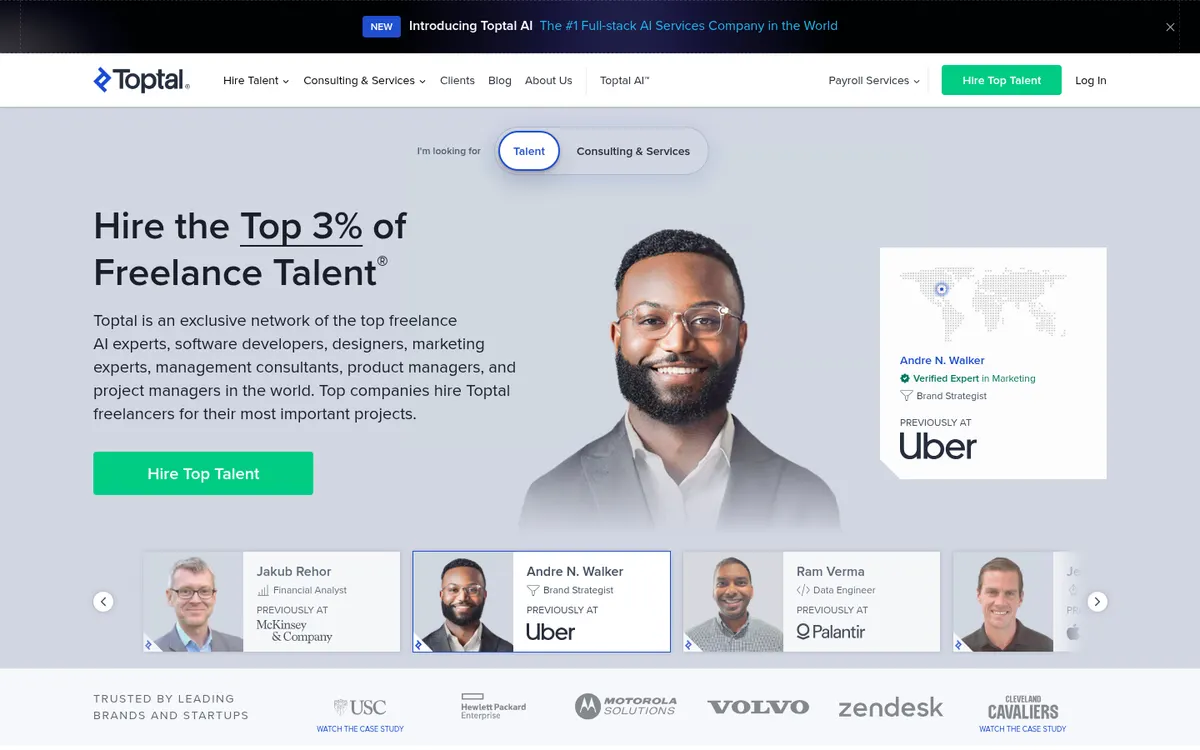
Fast access to screened senior freelancers and niche stacks, at the highest hourly band and with no delivery management included.
Toptal is the fastest route in this list to one or two senior AI engineers, provided you accept freelance terms. The network screens applicants down to roughly the top 3 percent globally, and that filter is the product. Coverage extends to niche and uncommon technology stacks that a general agency may not staff, so specialist work in those stacks can be matched quickly. Engagements are per engineer, freelance, and can run short term or project based. That suits a defined gap: a senior pair to unblock a stalled build, a short sprint before a launch, or a stack nobody on staff knows. The international talent base is broad, so overlapping hours are usually a filter rather than a barrier when you need coverage across time zones. Pricing sits at the top of this comparison. The recorded structure is an hourly rate for senior freelance developers quoted in the range of $60 to $150 per hour, and pricing is on the vendor site. The premium reflects the screening process, not managed delivery, so do not read it as an all in project cost. The limits follow from the model. There is no built in project management, so the client keeps the team together and owns delivery. If a freelancer leaves mid build, replacement is your problem to solve, and knowledge transfer is whatever you organize. It fits a product team that already ships and needs senior reinforcement on a schedule, or a company that needs an uncommon stack for a few weeks. It does not fit a company buying an outcome, a fixed scope or a warranty on delivered work.
You need one or two senior AI freelancers quickly for a defined gap or an uncommon stack.
Your budget is tight or you need a managed team that owns delivery.

Solid mid market product engineering at the lowest hourly band, best when AI features ship inside an existing application.
Simform is the value option in this list. The firm combines product engineering with AI and machine learning implementation, including generative AI integration and cloud native application development, delivered from teams in the US and India. Prototyping is listed at roughly 5 to 10 weeks, quick enough for a mid market buyer to test a use case before committing to a full build. Rates sit at the bottom of the range. The recorded structure is an hourly rate quoted between $25 and $49 per hour, and pricing is on the vendor site. Project scope and total cost should be confirmed with the vendor, so treat the hourly band as a planning input rather than a fixed pilot price. Reconfirm every number before budgeting, because the recorded rate has not been verified against a live page. The strengths are straightforward. A product engineering background means the team builds features, not just models, and cloud native application development is part of the offering. Dual shore delivery lets a US client keep calls in working hours while the build continues offshore overnight, which compresses calendar time on longer engagements. The tradeoff is depth. Generative AI work sits below the enterprise specialists here, and the AI specific bench is smaller than at firms whose entire business is AI. Some reported project floors may exclude very small engagements, so a two week proof of concept may not be an option. It fits a mid market company that wants AI features inside an existing product at a predictable hourly cost. It does not fit a program where model research, evaluation science or regulated deployment is the hard part.
You need AI features inside an existing application and want a predictable hourly rate with dual shore delivery.
The model itself is the product and you need frontier generative AI research depth.
The practical choice for European data residency, with EU delivery centers, though AI is a growing side practice rather than the core.
Innowise is the pick for teams with European data residency constraints. Delivery centers sit in Estonia and Poland, so teams are EU based and can handle GDPR sensitive workloads without routing personal data outside the bloc. For a buyer whose legal team has already ruled out offshore processing, that single fact can decide the shortlist before rates are discussed. The company is a broad software engineering firm with a growing AI and machine learning practice rather than an AI specialist. That shape has advantages: other engineering work can sit in the same engagement as the AI feature, and nearshore time zone alignment keeps European clients in the same working day. Engagement models are built around nearshore teams rather than pure staff augmentation. Pricing is on the vendor site. The recorded structure is an hourly rate quoted between $30 and $60 per hour, which places it in the lower middle of this list. The recorded figure has not been confirmed against a live page, so verify it before you commit a budget line. The limits are honest. AI is an emerging line rather than the core business, the AI case portfolio is smaller than at specialists, and enterprise depth sits below the larger nearshore providers. Expect to do more of the architecture definition yourself. It fits a European company that needs a compliant delivery partner for an AI feature inside a broader application build. It does not fit a research heavy program where the model itself is the product and evaluation science is the main risk.
European data residency is a hard requirement and the AI work sits inside a wider application build.
Your program is model research first and needs a deep AI specialist bench.
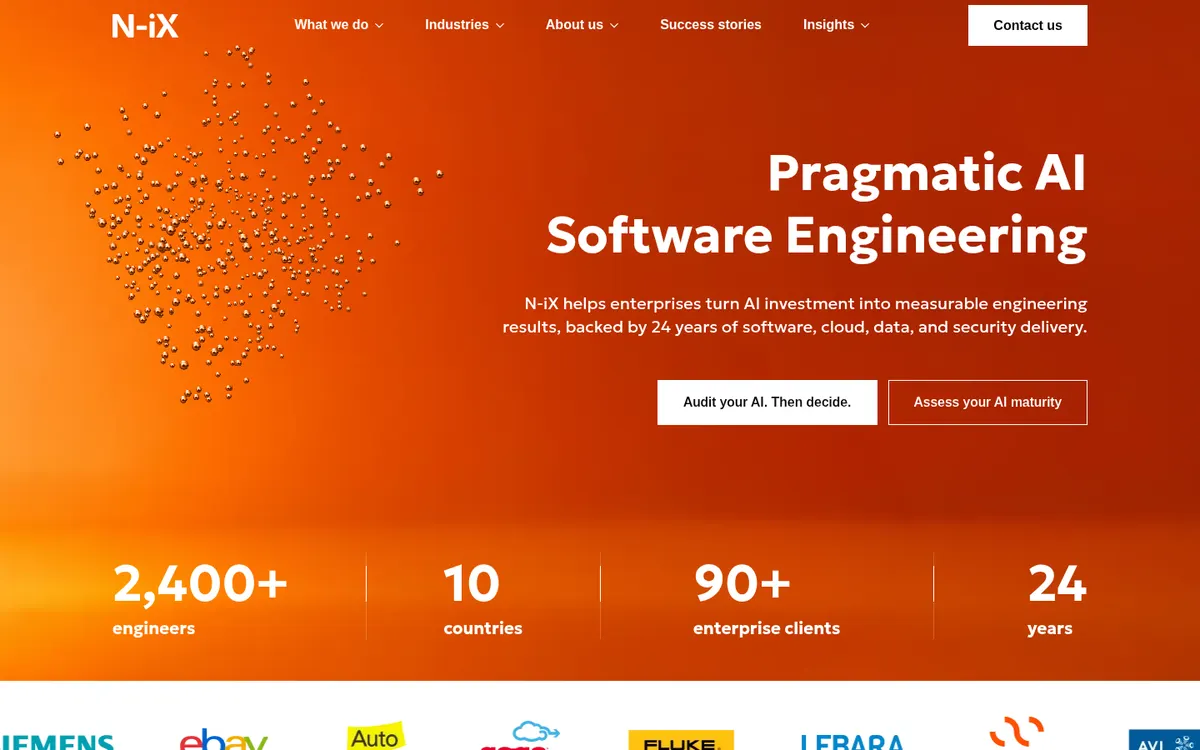
A large nearshore engineering partner that can absorb an AI workstream, as long as you do not need an AI only specialist.
N-iX is a scale play. The firm fields teams of over 2,000 engineers with delivery from Ukraine and Poland, and it runs formal enterprise delivery processes built for multi team programs. If the requirement is forty engineers across three workstreams with a program manager and a reporting cadence, this is the profile that can staff it without stretching. AI and machine learning sit inside a broader engineering offering rather than as a standalone practice. That means an AI workstream can share a delivery organization with other engineering work, which reduces vendor sprawl on large transformations. Nearshore European delivery keeps time zones workable for UK and EU clients, and staffing models are built around committed teams rather than short placements. Pricing is not published. The recorded structure is an hourly rate quoted between $35 and $65 per hour, and pricing is on the vendor site, so treat the band as a planning input and confirm it directly. Nothing captured from the site verifies the recorded figure. The tradeoffs are real. AI is one service line among many, so a buyer needing frontier model work and evaluation science should interrogate the specific bench rather than the headline headcount. Ramp up is slower than with smaller firms, and procurement reflects the size of the provider. It fits a large enterprise or funded scale up that needs a nearshore engineering partner with AI capability attached to a wider program. It does not fit a small team that needs three specialists next month.
You are staffing a large multi team program and the AI workstream can share a delivery organization with other engineering.
AI specialist depth is the deciding factor or you need people in weeks.
Focused, experienced voice and chat agent builders for customer channels, with scope too narrow for broad AI product programs.
Master of Code does one thing: customer facing conversational agents. Voice agent builds, chat agents and chatbots, contact center automation, and the integrations that connect an agent to the systems customers actually use. Management sits in Toronto, and the delivery focus is agent design plus deployment rather than general AI research.
That concentration is the selling point. Teams that build voice and chat agents repeatedly learn where containment breaks, how escalation paths should be designed, and which integrations cause trouble after launch. A generalist agency learning that on your budget is a risk you carry. If your support or sales channel is the target, the specialization is worth more than a broader service list.
Pricing is on the vendor site. The recorded structure is an hourly rate quoted between $45 and $110 per hour, and the figure has not been confirmed against a live page. For a narrow agent build, scope discipline matters more than the rate, because contact center integrations are where hours disappear after the demo works.
The limits come from the focus. Scope is narrower than full service firms, headcount is smaller than at the large nearshore providers, and a program spanning model work, data platform and a new product surface will likely need a second vendor. It fits a support or sales organization that wants an agent handling real customer conversations and nothing beyond that. It does not fit a company building a broad AI platform where the agent is one component among several.
Your goal is a voice or chat agent handling live customer conversations end to end.
The work spans model research, data platform and a new product surface.
Deep generative AI engineering with client owned IP and fast prototypes, priced as premium project work rather than hourly staffing.
RTS Labs sells generative AI programs, not hours. The work covers model selection for a use case, evaluation frameworks and quality testing, cost engineering for inference and usage, and integration with existing systems. The firm also hands full IP ownership of project work to the client, which matters for buyers who need to own the result, and vesting terms should be confirmed in writing rather than assumed from a sales call. Prototyping is reported at 3 to 6 weeks, the fastest window in this list, depending on scope and data readiness. That speed comes from a defined method: pick the model, build the evaluation harness, measure quality and cost per request, then integrate into the product with numbers behind every choice. Pricing is on the vendor site, and the model is project based. The recorded range is $150,000 to $500,000 per engagement, the highest project band here. That figure has not been verified against a live page, so request a written statement of work with a clear scope boundary. Because pricing is by program, comparing it to hourly bands from staffing firms will mislead you. The tradeoffs are cost and size. Premium positioning limits fit for small teams, and headcount is smaller than at large enterprise agencies, so very large multi team programs may stretch capacity. It fits a company with a funded generative AI initiative that wants measurable quality and inference cost, and insists on owning the resulting IP rather than licensing it back. It does not fit a buyer who wants two engineers next week at an hourly rate.
You have a funded generative AI initiative, need measurable quality and inference cost, and want to own the IP.
You need hourly staffing or your total budget sits below six figures.
It is a firm that builds AI systems for clients, and the label covers three quite different businesses. Some are managed agencies that own a delivery team and hand over a working system. Some are talent marketplaces that place individual engineers into your team. Some are nearshore engineering firms where AI is one service line inside a broader build. The buying experience differs more between those models than between two agencies selling the same service.
What separates an AI developer from a general software shop is where the risk sits. In a normal application build the hard part is requirements and integration. In an AI build the hard part is usually behavior: whether the model is accurate enough, whether it fails safely, what each request costs, and whether you can prove any of that before launch. Firms that do this well bring evaluation frameworks, test sets and cost modeling to the first sprint, not the last.
Most engagements fall into a few shapes:
Buyers often assume these are interchangeable. They are not. A fixed project fee buys a defined outcome and less flexibility. Hourly staffing buys flexibility and leaves you with the management work. Nearshore teams buy time zone overlap and compliance posture. Pick the shape before you pick the vendor, because the same firm can be a good or bad fit depending on which one you need.
This comparison sits on the AI desk. Readers comparing neighbouring stacks often check our guides to ChatGPT alternatives and AI clipping software next.
Almost nobody publishes a price. All eight firms in this list list pricing as on request, so the figures below are the quoted ranges recorded for each and checked on 2026-11-25, not published list prices. Treat them as planning bands.
| Model | How it bills | Typical fit | Example from this list |
|---|---|---|---|
| Hourly band | Per hour, quoted as a range | Scoped feature work or staff augmentation | Simform, $25 to $49 per hour |
| Per engineer marketplace | Hourly rate per placed engineer | Adding individual AI specialists | Turing, $45 to $110 per hour |
| Freelance placement | Hourly rate per senior freelancer | Short term senior gaps | Toptal, $60 to $150 per hour |
| Project or program fee | Fixed scope engagement | Defined AI initiative with deliverables | RTS Labs, $150,000 to $500,000 |
| Dedicated nearshore team | Hourly rate on a committed team | Long programs with EU delivery needs | N-iX, $35 to $65 per hour |
Every price above was checked on the vendor's own pricing page on November 25, 2026. Where a vendor does not publish a figure we write "See website" instead of guessing. To compare annual and monthly billing quickly, try the free percentage calculator.
Define the deliverable before the vendor. Write down whether you are buying a working system, a prototype, or extra engineers. That single answer removes half this list and stops you comparing an agency fee against an hourly rate.
Decide who carries management. A marketplace like Turing or Toptal gives you people and leaves onboarding, code review and continuity with you. If you do not have an engineering manager with spare capacity, buy managed delivery instead.
Check the AI bench, not the headline headcount. Ask for the named engineers, the evaluation approach and two case studies in your domain. A 2,000 person firm can still have a thin generative AI team.
Set the data and compliance line early. If European residency or GDPR scope applies, Innowise and N-iX deserve a call before the US based options, because legal review can remove a vendor after weeks of selling.
Settle IP and vesting in writing. RTS Labs hands over full IP ownership, and other firms may not. Confirm assignment, vesting triggers, third party model terms and what happens to fine tuned weights on termination.
Agree a prototype gate with dates. RTS Labs reports 3 to 6 week prototypes and Simform 5 to 10 weeks. Use the first gate to test quality and inference cost, then decide whether the full program proceeds.
Buying hours when you need an outcome. Hourly staffing plus no internal manager is the most common failure. The meter runs while you decide architecture, and nobody owns delivery when the sprint slips.
Skipping the evaluation plan. A demo that impresses in a meeting proves nothing about accuracy at scale. Insist on a test set and a pass threshold before the build starts, not after launch.
Ignoring inference cost. Quality and latency get all the attention, then the first invoice for model usage arrives. Ask for projected cost per request at expected volume and put it in the contract.
Assuming IP transfers by default. Ownership of delivered work, fine tuned weights and prompt libraries is a contract term, not a default. Get assignment and vesting in writing, including what happens if the engagement ends early.
Comparing rates across different models. A $45 per hour marketplace placement and a $45 per hour agency rate are not the same product. One includes delivery management and one does not, so normalize the comparison before you negotiate.
LeewayHertz fits an enterprise AI program, with agentic workflows, copilots and its own ZBrain platform behind custom LLM builds. Turing and Toptal fit per engineer hiring, placing individuals into your team rather than owning delivery. Choose managed delivery when you lack internal engineering management; choose per engineer hiring when you have it and just need capacity.
Hourly bands run from $25 to $49 per hour at Simform up to $60 to $150 at Toptal, with Turing at $45 to $110, Master of Code at $45 to $110, Innowise at $30 to $60, N-iX at $35 to $65 and LeewayHertz at $50 to $99. RTS Labs prices by project instead, at $150,000 to $500,000 per engagement. Every figure is quoted on request, so confirm before budgeting.
Choose an agency when you need a working system and someone accountable for delivery. Marketplaces hand you a person and leave onboarding, code review and continuity with you. If your team has no spare engineering manager, the apparent hourly saving disappears in coordination time. If you have management in place and need one specialist quickly, a marketplace is faster.
It depends on the contract, and it is not automatic. RTS Labs hands full client ownership of project IP, and other firms may retain rights to frameworks and platform components. Third party model providers add their own terms. Confirm assignment of code and fine tuned weights, vesting triggers, and what happens to the work if the engagement ends early.
Prototype windows are 3 to 6 weeks at RTS Labs and 5 to 10 weeks at Simform. The real variable is data readiness, not engineering speed. A vendor waiting on clean data will miss any timeline, so agree a data handover date alongside the prototype date.
Confirm the rate or project fee in writing, the scope boundary, the evaluation method and pass thresholds, the projected inference cost at expected volume, data residency and processing terms, and IP ownership with vesting. Also ask who the named engineers are and what happens if they leave. Every firm here prices on request, so a verbal range is not a budget.
Browse every comparison on the AI desk, with the same rubric and dated prices.