Ranked #1

Netstock
ERP-native planning depth
$900Entry point, billed on an annual contract
- Best for
- ERP-based mid-market distributors and manufacturers
- Free plan
- No
- Rubric
- 7.9 / 10
Forecasting tools run from $49 a month for small Shopify brands to enterprise platforms sold by quote, so the right pick turns on your ERP, channel mix and planner headcount.
 Prices checked November 25, 2026

Netstock is the best fit for mid-market distributors and manufacturers already running NetSuite, Sage or Acumatica, and it starts at $900 a month on an annual contract. StockTrim suits small and mid-sized businesses that want machine learning forecasts without enterprise overhead, from $49 a month billed annually. Inventory Planner by Sage fits multi-channel sellers who need purchasing workflow across Shopify, Amazon and accounting systems, though you have to request pricing. Prices were checked on 2026-11-25 for this November 2026 comparison.
ERP-native planning depth
$900Entry point, billed on an annual contract

Broad SMB integrations
$49Starter plan, per month, billed annually, price scales with annual revenue band

Multi-channel purchasing workflow
See website
Disclosure for this page: All 9 tools here are unpaid editorial picks. The position of a paid listing can be part of what the vendor pays for. How we handle paid listings.
| Tool | Best for | Free plan | Actions | |||
|---|---|---|---|---|---|---|
| 1 | Netstock | ERP-based mid-market distributors and manufacturers | $900Entry point, billed on an annual contract | No | ||
| 2 | StockTrim | SMBs wanting AI forecasting without enterprise overhead | $49Starter plan, per month, billed annually, price scales with annual revenue band | No | ||
| 3 | Inventory Planner by Sage | Multi-channel sellers on major marketplaces | See website | No | ||
| 4 |  Prediko | Shopify brands starting formal demand forecasting | $49Core plan, per month, for under $100K annual GMV | No | ||
| 5 |  EazyStock | Cloud replenishment for distributors and wholesalers | See website | No | ||
| 6 | Lokad | Data teams needing programmable forecasting logic | See website | No | ||
| 7 |  RELEX Solutions | Enterprise retail network optimisation | See website | No | ||
| 8 |  Slimstock (Slim4) | Demand sensing and scenario planning for mid-market | See website | No | ||
| 9 |  Forecast Pro | Statistical forecasting for desktop demand planners | See website | No |
We scored each tool against five criteria: forecast depth (30%), integration fit (25%), planning workflow (20%), pricing clarity (15%) and time to value (10%). Forecast depth asks how the engine copes with seasonality, promotions, new products and slow movers instead of applying one statistical method to every SKU. Integration fit asks whether native connectors reach your ERP, marketplace or storefront. Planning workflow asks whether a forecast becomes a purchase order, a transfer or a safety stock number without a spreadsheet in between. Pricing clarity rewards vendors that publish numbers and bill in a predictable way. Time to value asks how fast you can test the tool on your own sales history.
The weights reflect what usually decides a purchase: a forecast nobody trusts is worthless, and a forecast that cannot reach your purchase orders is a report.
Prices and plan details come from vendor pricing pages checked on 2026-11-25. Where a vendor publishes nothing, we say so and do not estimate a number. Where a FAQ or plan page gave a figure, we used that figure exactly as published, without converting currencies or inferring annual discounts.
Any entry marked Featured is a paid placement. It is scored with the same rubric as every other entry, and its weaknesses appear next to the others.
The order is editorial: each position reflects the buyer described in that entry, together with any Featured placement disclosed at the top of the page. Use the scores to see where a tool is strong, and the pick and skip lines to decide whether it matches your operation.
The full process, including how we handle corrections, is on the methodology page. Paid listings follow our advertising disclosure.
| Criterion | Weight | What we check |
|---|---|---|
| Forecast depth | 30% | How well the engine handles seasonality, promotions, new products and slow movers rather than one method applied to every SKU. |
| Integration fit | 25% | Whether native connectors reach your ERP, marketplace or storefront, and how much setup work the connection needs. |
| Planning workflow | 20% | How forecasts turn into purchase orders, transfer orders, safety stock and supplier follow-up without spreadsheets. |
| Pricing clarity | 15% | Whether the vendor publishes prices, how it bills (seats, revenue bands, usage) and how predictable the cost is as volume grows. |
| Time to value | 10% | How quickly a team can run its own sales history through the tool, from self-serve trial to multi-month implementation. |
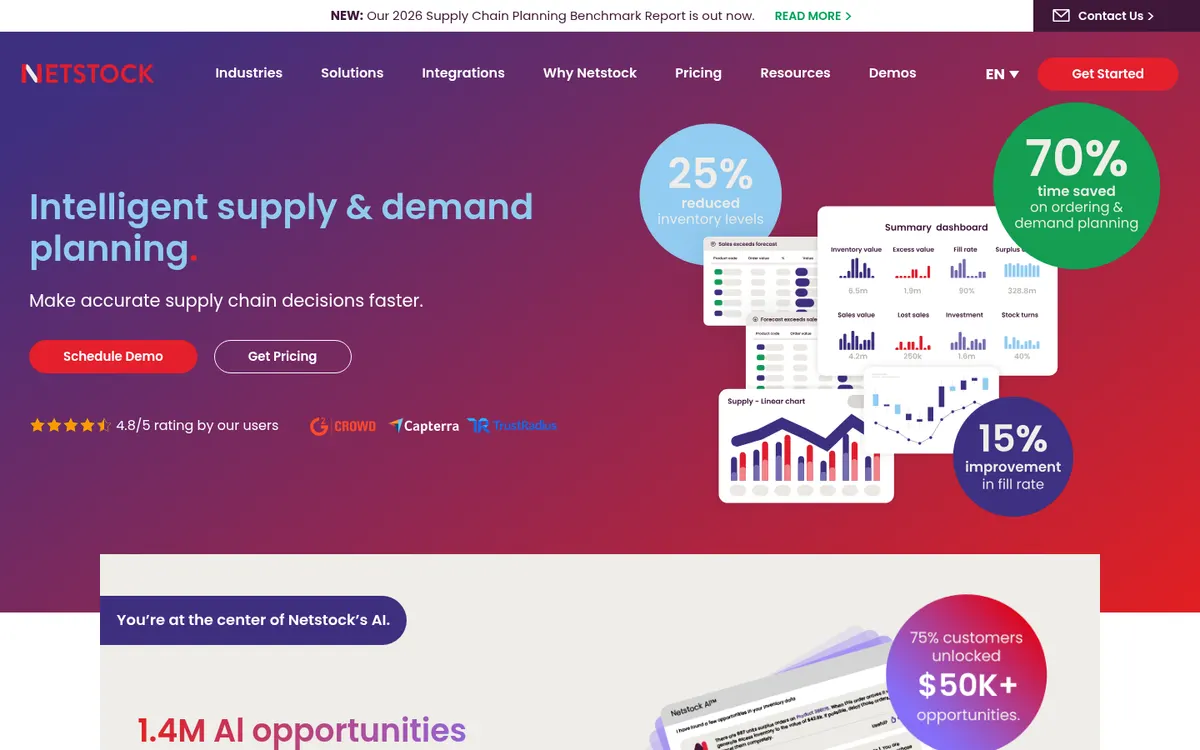
The strongest ERP-connected planning engine on this list, priced and scoped for mid-market distributors that already run NetSuite, Sage or Acumatica.
Netstock sits on top of an ERP rather than replacing it. The connectors cover NetSuite, Sage and Acumatica, so forecasts are built from the same item, sales and stock data your finance team already trusts. Demand planning, replenishment and supplier performance sit in one place, and multi-location transfers are handled natively rather than bolted on.
The engine is built for volume. Distributors running thousands of SKUs across several warehouses use the constrained supply planning scenarios to test what happens when a supplier slips or a promotion pulls demand forward. AI-assisted analytics sit alongside the classic statistical forecasts, which helps planners spot items where the model and the buyer disagree.
Pricing is published only as a headline. The vendor's own FAQ quotes $900 a month as an entry point on an annual contract, which is a serious commitment for a small distributor and a modest one for a mid-market operation with a planning team. There is no free trial, so the model cannot be tested on your own sales history before the annual commitment. Budget time for rollout: mapping item masters, cleaning lead times and agreeing service levels is real work before the first forecast is useful.
The gap is the low end of the market. Companies that run on Shopify, QuickBooks Commerce or a standalone inventory app are outside the integration story, and the annual commitment means a buyer who wants to test the water should look at a trial-friendly tool first. For an ERP-based distributor with a planner on staff, the depth is worth the cost. Ask for a reference in your ERP and a fixed-scope implementation quote before signing.
Your ERP is already the system of record and you have a planner who needs forecasting, replenishment and supplier tracking in one place.
You sell mainly through Shopify or run on a standalone inventory app, because the connector set will not reach you.
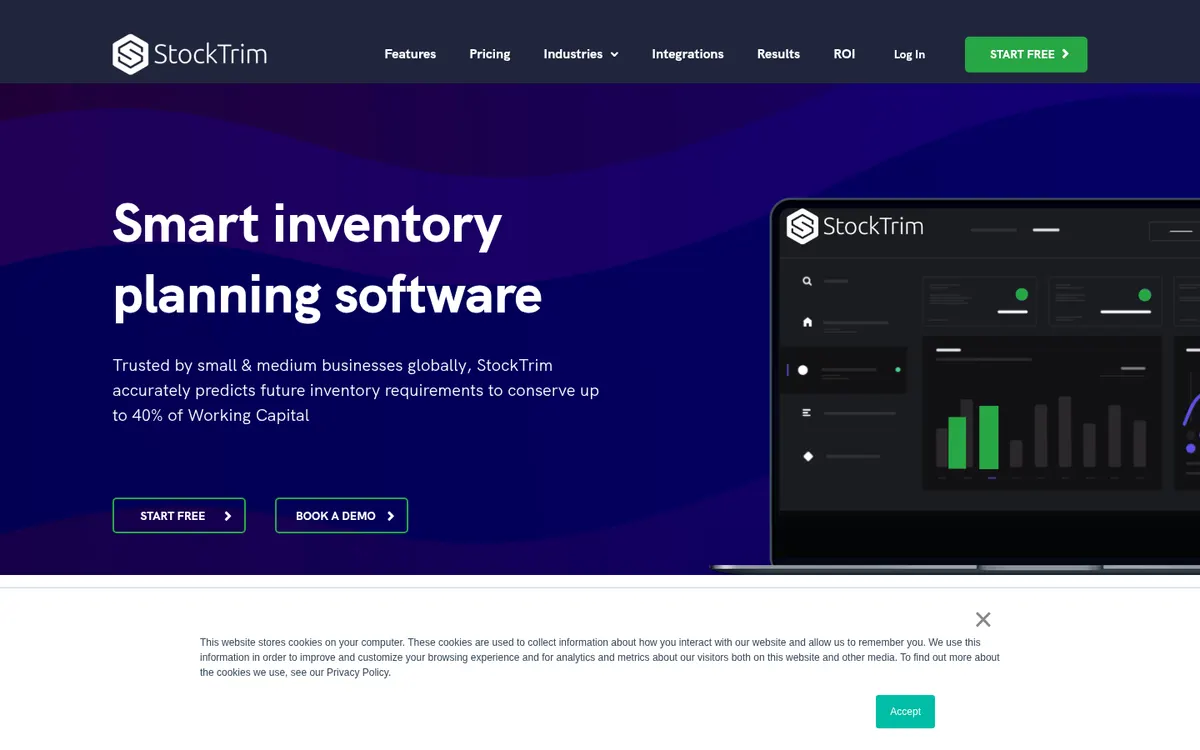
The best balance of price, integration breadth and setup speed for small and mid-sized businesses moving off spreadsheet reordering.
StockTrim targets the company that has outgrown a spreadsheet but cannot justify an enterprise planning suite. Machine learning forecasts, recommended order quantities and safety stock suggestions come out of the same screen, and the system handles assembly and manufacturing as well as straight buy-and-resell. New product forecasting matters here, because an item with no history is where most simple tools give up. Integration coverage is the selling point. Native connections reach Shopify, Cin7, NetSuite, Fishbowl and QuickBooks Commerce, which covers most of the small and mid-market stack. Setup is quick enough that a 14 day free trial with no credit card runs on your own sales history rather than a demo dataset, and that is the right way to judge whether the forecast is believable. Pricing has moved. The vendor now publishes revenue-banded tiers starting at $49 a month for the Starter plan, billed annually, with the price rising as your revenue band and SKU footprint grow. Higher revenue bands carry higher monthly prices, with custom enterprise pricing above the published tiers. Monthly cost therefore scales with success, which is reasonable but should be modelled before a three year projection. Limits are worth stating plainly. No forecast accuracy benchmarks are published, so the trial backtest is your only evidence. Support is email-based on the lower tiers, which matters during a peak season. And a company with a single warehouse and a few hundred SKUs is paying for multi-location machinery it may never use. Ask which tier your SKU count and location count land in before you start the trial.
You run Shopify, Cin7, Fishbowl or NetSuite and want to test forecasts on your own history before committing.
You need published accuracy benchmarks or hands-on support during peak season on a starter tier.
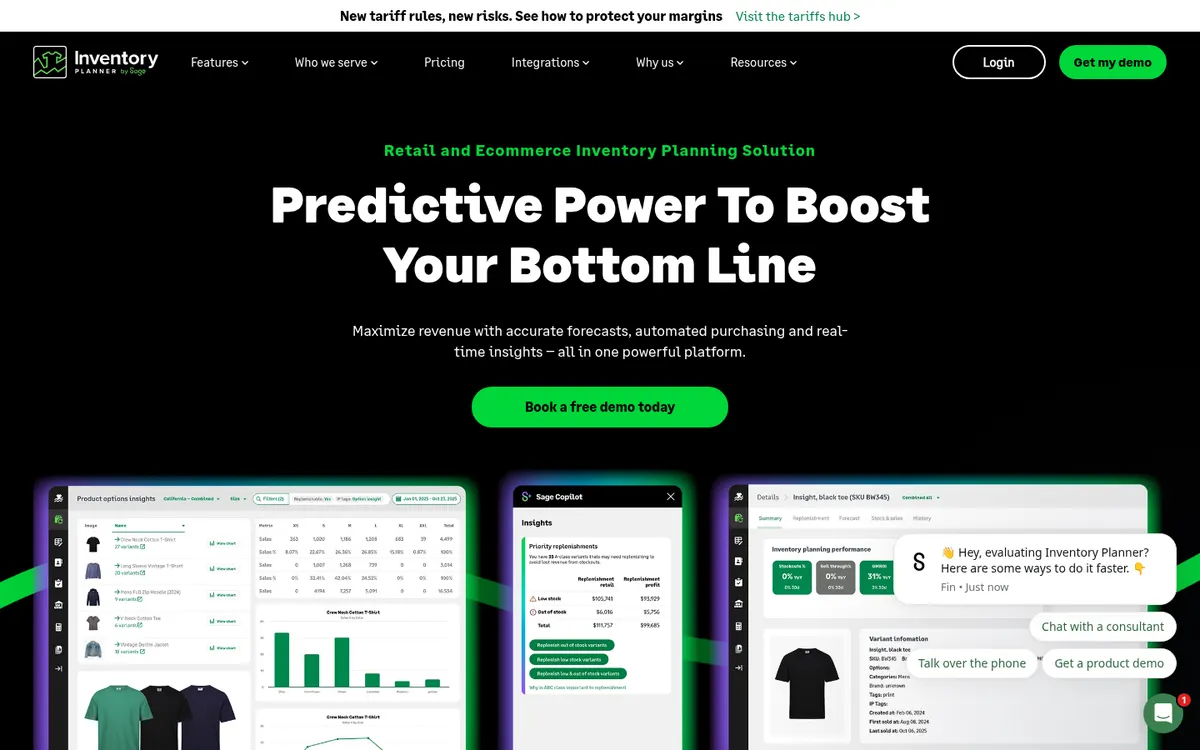
A well-built multi-channel purchasing workflow held back by unpublished pricing, best for sellers with real channel complexity and patience for a sales cycle.
Multi-channel is the whole point. Inventory Planner by Sage connects to Shopify, Amazon, inventory systems and accounting tools, then builds per-SKU, per-location forecasts that feed a centralised replenishment plan. Sellers moving stock across a storefront, a marketplace and wholesale need one place where purchase orders are generated, or they end up reconciling spreadsheets at month end. The purchasing workflow is more developed than most. Forecasts respect seasonality and trend, supplier performance is tracked against actual lead times, and purchase orders can be generated from the plan rather than typed out by hand. That combination is why it fits a seller with hundreds or low thousands of SKUs and a genuine buying process. Pricing is the weak spot. Nothing is published, so every evaluation becomes a sales conversation and the number depends on channel count and SKU volume. Pricing depends on channel count and SKU volume, so ask for a written quote against your own catalogue. The 14 day trial needs no payment details, which is a fair way to see whether the forecasting beats your current reorder rules before pricing enters the conversation. It is also more product than a single-channel seller needs. A Shopify-only brand pays for marketplace and accounting connections it will never switch on, and can get forecasting plus reorder suggestions for a published $49 a month elsewhere. Ownership by Sage adds vendor stability, but roadmap questions follow any acquisition, so ask directly which connectors are being invested in. Set a decision date before the trial ends, because the sales cycle is the slowest part of this purchase.
You sell across a storefront, a marketplace and wholesale, and want purchase orders generated from one replenishment plan.
You sell on Shopify alone or cannot start a negotiated sales cycle this quarter.
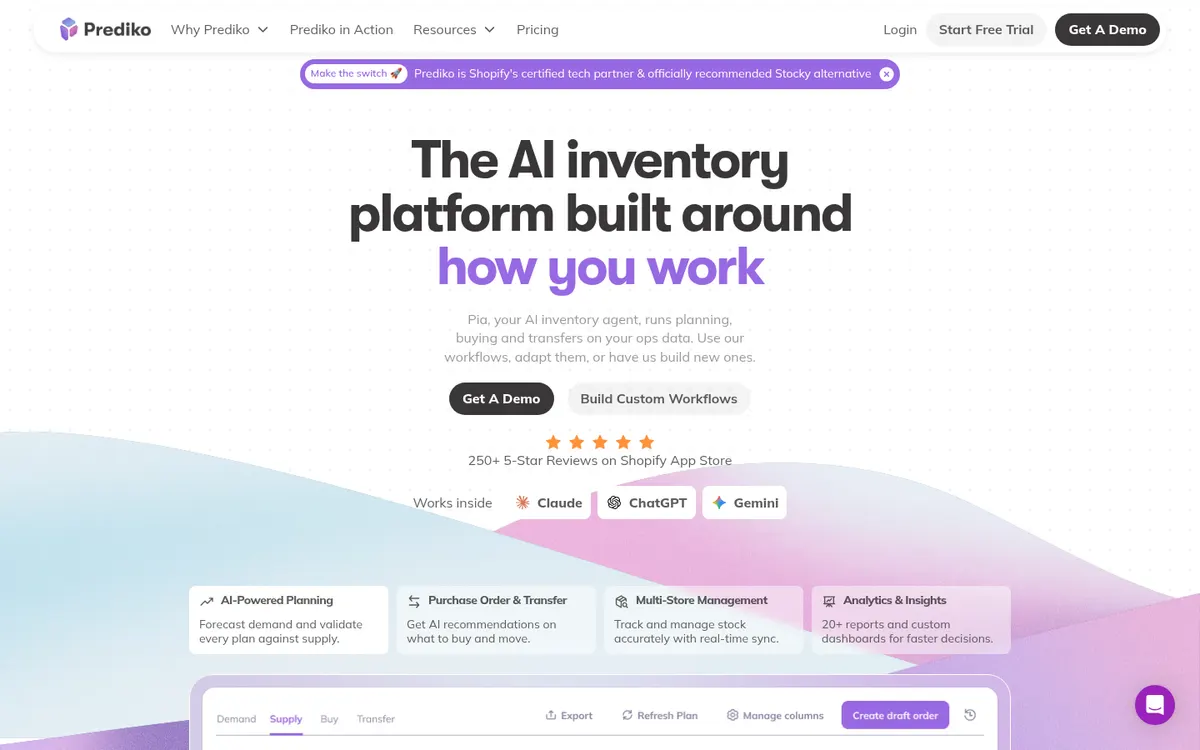
The cheapest credible entry into Shopify forecasting, ideal for direct-to-consumer brands that need reorder suggestions more than planning depth.
Prediko is the smallest credible step into forecasting. It reads Shopify order history, produces demand forecasts, then turns them into reorder suggestions and stockout alerts on a dashboard built for an operator rather than a demand planner. Setup is a direct Shopify connection, so a store can be running forecasts the same afternoon.
The price is the headline. The Core plan is $49 a month for stores under $100K annual GMV, which is a rounding error against the cost of a stockout in a peak season, and there is a 14 day free trial to test the numbers first. For a direct-to-consumer brand doing its first proper buying plan, that is a low risk way to stop reordering on gut feel.
The ceiling is low and honest. Everything runs off Shopify, so a seller also trading on Amazon, in wholesale or through a retail store needs a second tool or a different platform. Planning depth is thinner than the mid-market products: there is no supplier performance module, no constrained supply planning and no multi-warehouse transfer logic. The vendor is also newer, with a shorter track record than the ERP-connected names on this list.
That makes it a first tool, not a final one. A brand that grows past a few million in revenue, or adds a marketplace channel, will likely migrate to something with broader connectors and deeper purchasing workflow. Buy it for the setup speed and the price, and plan to revisit the decision when channels multiply. Check that your Shopify plan exposes the order history the connection needs before you start.
You are a direct-to-consumer Shopify brand that wants reorder suggestions and stockout alerts without a sales process.
You also sell on Amazon, through wholesale or from a retail store, because the Shopify link is the only channel covered.
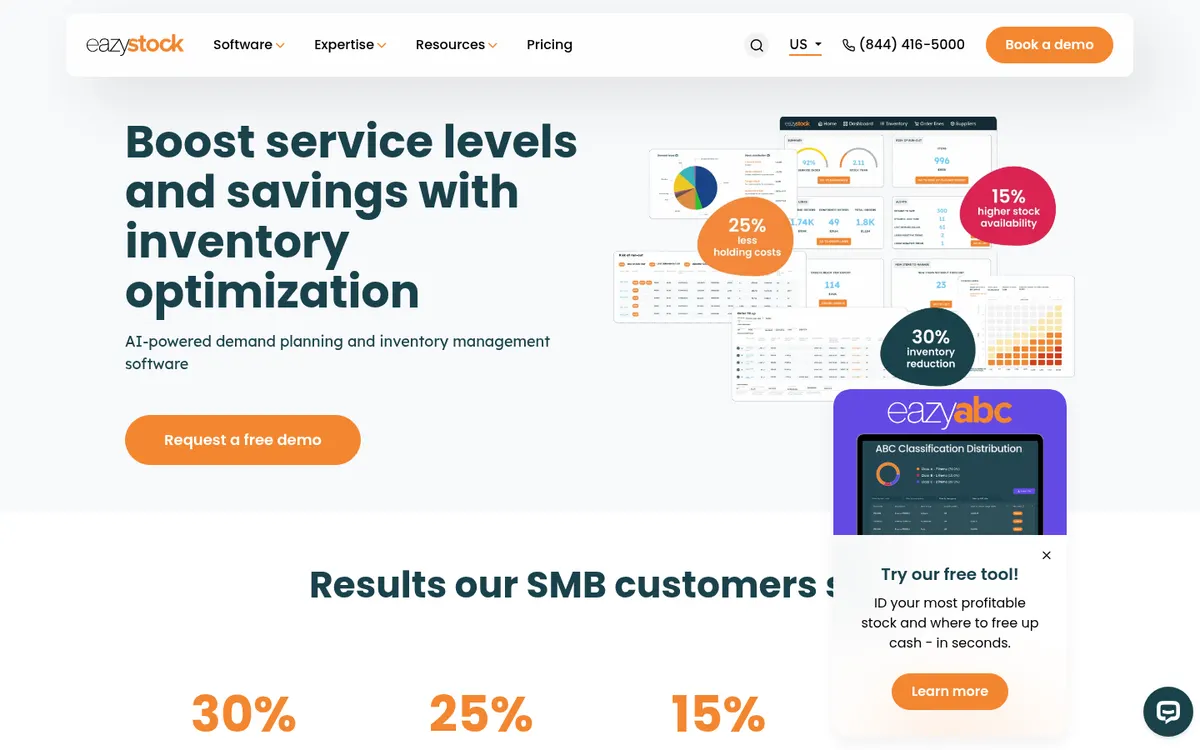
Demand segmentation and MOQ-aware replenishment for wholesale distributors, sold through a proof of concept rather than a trial.
EazyStock is built for the distributor that carries a long tail. Items are classified by demand pattern before any forecast is generated, so fast movers, intermittent items and dead stock each get a method that suits them rather than one algorithm applied across the catalogue. That segmentation is the part most spreadsheet based planning misses.
Replenishment proposals respect minimum order quantities, lead times and service levels set per demand segment, which is what makes the output usable by a buyer. Promotions can be layered in so the forecast does not read a campaign spike as permanent demand growth. Because it runs in the cloud and connects to an ERP, deployment is quicker than an on-premise planning suite, though the quality of the connection depends heavily on the source system's data.
There is no self-serve trial. Evaluation is a demo followed by a proof of concept, and pricing is quote-based in the mid-market enterprise band. That combination means the buying cycle runs for weeks and the real cost only appears after scoping. EazyStock is part of the Syncron group and the vendor targets distributors with revenue in the tens of millions, not small wholesalers.
For a wholesaler with mixed fast and slow movers and a buyer who wants proposals rather than raw forecasts, the segmentation and MOQ logic justify the process. A smaller distributor should compare the total cost against a tool with a published entry price and a free trial before committing to a proof of concept. Ask for the proof of concept scope and price in writing, including any integration work.
You are a wholesale distributor with a long tail of intermittent items and a buyer who wants order proposals, not raw forecasts.
You are a small wholesaler who needs a published price and a trial before starting a proof of concept.
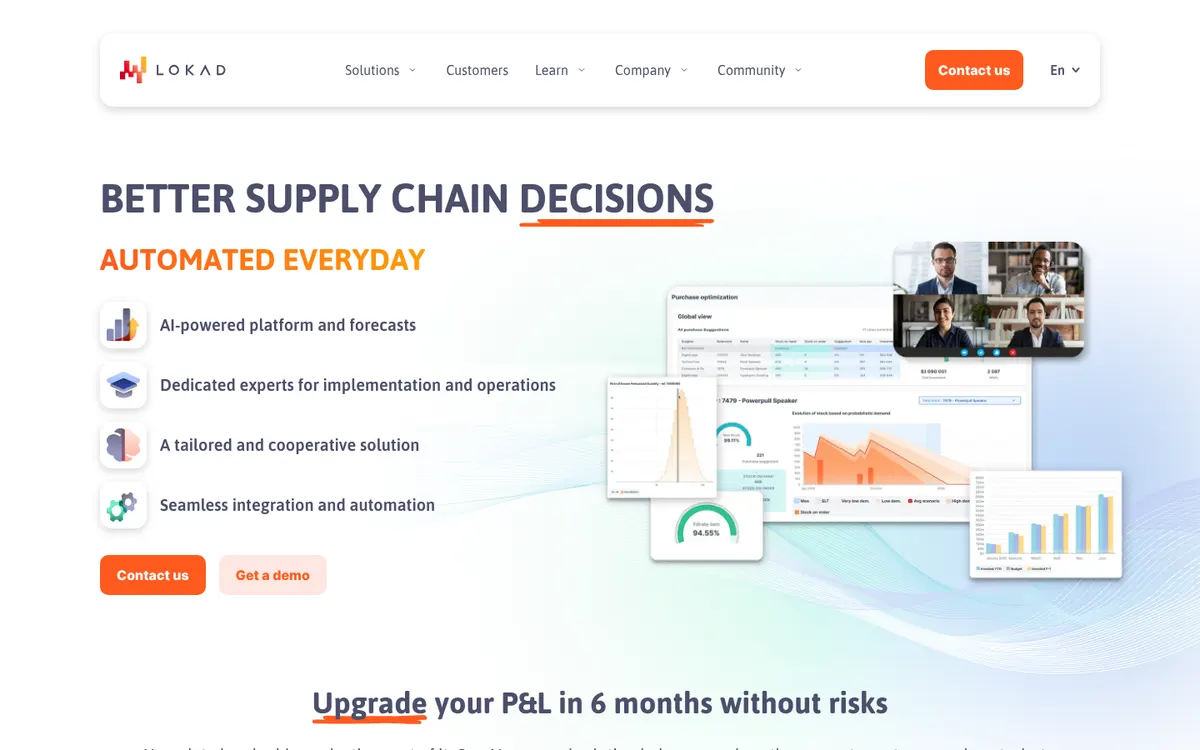
Programmable forecasting for teams with data engineers, powerful at scale but unusable without someone to write and maintain the logic.
Lokad is not a packaged application. Forecasts are written in a proprietary scripting language, which means the logic can be shaped around a specific business: how returns are treated, how a promotion cannibalises a neighbouring SKU, how price changes move volume. Teams that have hit the ceiling of click-to-configure tools come here for that control.
Scale is the second argument. The platform is built for very large SKU counts, and licensing is usage-based rather than per seat, so a small team of analysts can operate a catalogue that would need a much larger per-seat deployment elsewhere. Cannibalisation and promotion modelling plus pricing and margin scenarios extend the output past a replenishment list into commercial decisions.
The cost of that flexibility is people. Someone has to write and maintain the scripts, either in-house technical staff or vendor consultants, and onboarding is consultative rather than a guided setup. There is no self-serve trial and no public price, so evaluation is a conversation about your data and your use case before any number appears.
It is the right answer for a company with an analytics or data engineering function and a forecasting problem that off-the-shelf tools cannot express. It is the wrong answer for an operator who wants a dashboard and reorder suggestions by Friday. Budget for services and technical time, not just licence fees, and expect the first model to take longer than a trial would. Ask the vendor to scope a single category as a pilot before committing to the full catalogue, and ask how the scripts are handed over if your analyst leaves.
You have data engineers or a services budget and your forecasting problem cannot be expressed in a click-to-configure tool.
You want a guided setup, a dashboard and reorder suggestions without writing or maintaining any logic.
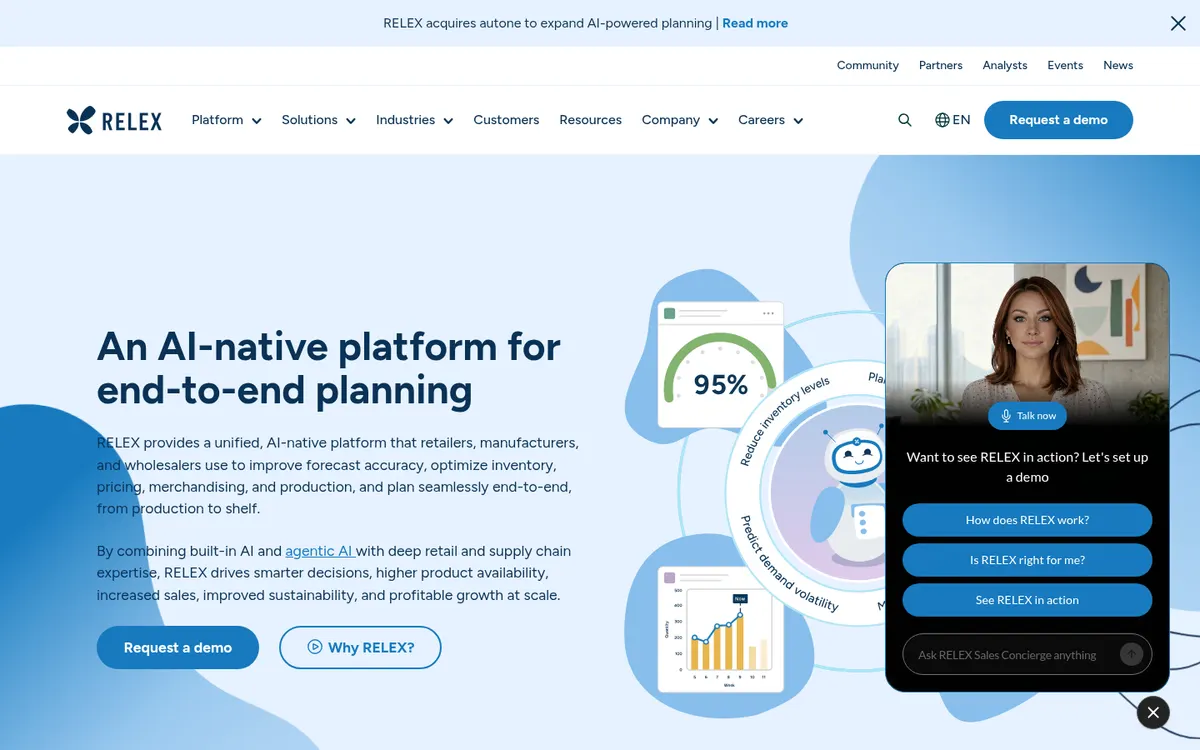
The deepest network forecasting platform here, built for retail chains running thousands of stores and priced accordingly.
RELEX is an enterprise retail platform, and it behaves like one. Demand forecasts, replenishment and allocation, promotion planning and assortment decisions run on a single network model, so a distribution centre problem propagates through to store-level shelf gaps in the same calculation. That network view is the difference between optimising a warehouse and optimising a supply chain. The modelling covers events that break a statistical forecast: supplier disruptions, regional demand shifts, promotions that pull demand forward and then hollow out the following weeks. Assortment planning across a large store estate is included rather than sold as a separate module. Grocery and retail chains with thousands of stores are the reference profile, and the platform is sized for that. Everything about buying it is consultative. There is no public price, no self-serve trial and no fixed package: evaluation runs through demos and a scoping exercise, and implementation is a multi-month project involving the vendor's team and your own data people. For a single-warehouse distributor, that overhead is entirely disproportionate to the problem. The honest verdict is that this is the strongest network forecasting platform on the list and irrelevant to most of the people reading it. If you operate hundreds or thousands of stores and need one model across forecasting, replenishment, promotions and assortment, the depth is the reason to accept the implementation burden. If you need to reorder a few thousand SKUs from one warehouse, buy something else and revisit RELEX when the network gets complicated. Ask for the implementation timeline in writing, including data migration and store-by-store onboarding, before you sign.
You run hundreds or thousands of stores and need forecasting, replenishment, promotions and assortment on one network model.
You are reordering from a single warehouse, because the implementation burden far outweighs the problem it solves.
Demand sensing and scenario planning for European wholesalers, strong on disruption modelling but quiet on price and light on US support.
Slimstock's Slim4 adds demand sensing to statistical forecasting. Instead of planning purely from history, it reacts to real-time demand signals, which matters when a promotion, a competitor move or a supply shock changes the pattern mid-quarter. Scenario planning then lets a planner model a promotion or an assortment change before the orders go out.
The planning cycle is covered end to end: forecast, replenishment and S&OP alignment between commercial and operations teams. That last part is where it differs from a pure reorder tool, because the commercial side can see what a demand plan means for stock and service before committing to a campaign. Scenario modelling addresses disruptions before they turn into expedited freight.
Pricing is quote-only and sits in the mid-market enterprise range, shared through sales rather than published. There is no self-serve trial, so evaluation is a demo and a scoping exercise. Implementation assumes planning expertise in-house: someone has to own demand segmentation, service levels and the scenario calendar, or the tool quietly becomes an expensive report generator.
The geographic caveat is real. Reference customers and partner coverage are concentrated in Europe, so a US distributor should check local support before shortlisting. For a European wholesaler or retailer that wants demand sensing and scenario work without an enterprise programme, it is a credible middle option. For a US buyer or a company without a planner, the support question and the missing trial make it a harder purchase to justify. Ask for named references in your country and sector, plus a written scope for the implementation project, before you commit.
You are a European wholesaler or retailer that needs demand sensing and scenario planning with a planner on staff.
You are based in the US or have no in-house planning expertise to own the model.
A serious statistical engine for a skilled desktop planner, with no cloud connectors, no collaboration and no order generation.
Forecast Pro is a statistics product, not a planning suite. It carries a large library of forecasting models and picks the best one per SKU automatically, which avoids the common failure of forcing every item through the same exponential smoothing. Seasonality and trend modelling are handled properly, and a planner can test candidate models against their own history inside the tool.
That makes it valuable in a specific situation: a demand planning analyst who wants defensible numbers and does not trust a black box. Automatic expert selection gives a documented reason for each forecast, which is useful when someone in sales disputes a plan. Historically the vendor offered perpetual licensing, which appeals to companies that dislike subscriptions, though current pricing now requires contacting the vendor.
The limits are structural. It is desktop software, so there is no real-time collaboration between planners and no live connection to a modern cloud platform; data arrives by import. There are no automatic connectors to the ERP and marketplace stack described elsewhere in this list. The interface is dated, and the product is built around a single expert planner rather than a team with roles and approvals.
For a small planning function with a skilled analyst, a periodic desktop forecast can still be the cheapest credible option, especially with perpetual licensing. For everyone else, the tool stops at the forecast: it does not generate purchase orders, track suppliers or plan transfers. Treat it as a forecasting engine that feeds whatever system does the ordering, and check the price with the vendor before assuming it is the budget option. A free trial is offered, so test it against your own data before buying.
You have a skilled demand planner who wants documented statistical forecasts and can import data from your systems.
You need collaboration, live ERP connections or purchase orders generated from the forecast.
Inventory forecasting software reads your sales history, open orders and stock positions, then predicts demand per item and per location for a coming period. The prediction is only half the job. The other half is translation: turning a forecast into a safety stock number, a reorder point or a purchase order sized and timed against supplier lead times and minimum order quantities. That translation is what separates it from inventory management software. An inventory management system records what you have, what it cost and where it sits. A forecasting tool asks what you will need, and by when, so the buying decision stops depending on a planner's memory. It is common to run both, with the forecast feeding the system of record. Three mechanics matter when you compare tools: - Demand segmentation, which splits fast movers, intermittent items and new products so each gets an appropriate method.
This comparison sits on the Software desk. Readers comparing neighbouring stacks often check our guides to demand forecasting software and glp 1 companies next.
Forecasting software is priced in several different ways, and the billing model tells you more about total cost than the headline number does. Published entry prices in this list run from $49 a month for small sellers to $900 a month for ERP-connected mid-market platforms, while the enterprise retail and data-science end of the market is quoted per deal.
| Model | How it bills | Typical fit | Example from this list |
|---|---|---|---|
| Revenue band | Monthly fee set by revenue tier, billed annually | Small and mid-market sellers | StockTrim Starter from $49 a month; Prediko Core at $49 |
| Annual contract | Fixed monthly fee on an annual commitment | ERP-based mid-market | Netstock at $900 a month |
| Negotiated quote | Per-deal pricing after scoping | Enterprise and multi-channel | Inventory Planner by Sage, EazyStock, Slimstock, RELEX |
| Usage-based | Billed on planning volume | Large data teams | Lokad |
| Perpetual licence | One-time fee, historically | Desktop planners | Forecast Pro |
Every price above was checked on the vendor's own pricing page on November 25, 2026. Where a vendor does not publish a figure we write "See website" instead of guessing. To compare annual and monthly billing quickly, try the free percentage calculator.
Buying the forecast, not the order. A model that predicts demand but leaves purchase orders in a spreadsheet has solved the easy half. Check that suggestions respect lead times, MOQs and order cycles before you compare accuracy claims.
Skipping the backtest. Demos use clean sample data. Hold back several months of your own sales, forecast it, and measure error by SKU and by value, including the slow movers and the launch items that break most models.
Ignoring how the price scales. Revenue-banded and per-SKU pricing rise as you grow. Model the cost at double your current volume before signing a multi-year term, because that is the number your finance team will ask about.
Underestimating the data work. Item masters, lead times, MOQs and service levels all have to be right before a forecast is useful. Projects stall when nobody owns that cleanup, so assign an owner before the kickoff call.
Choosing a tool your team cannot run. A scripting platform needs a technical owner, a demand sensing suite needs a planner, and a Shopify tool needs a channel strategy. Match the operating model to the people you actually have.
It predicts demand per item and location, then converts that prediction into stock decisions. Most tools combine a forecasting engine with replenishment logic, so a forecast becomes a safety stock level, a reorder point or a purchase order sized against lead times and minimum order quantities. Without that second step you have a report, not a planning system.
Published entry prices in this list run from $49 a month for small Shopify sellers to $900 a month for ERP-connected mid-market platforms, with quote-only enterprise pricing above that. Several vendors publish nothing, so you need a sales conversation before you see a number. Model the cost at double your current volume as well as today's price.
Start with your system of record, then your biggest sales channel. If your ERP holds items, stock and purchase orders, you need a native connector that writes orders back, not just an export. If you sell on Shopify or Amazon, check the marketplace link. Tools here range from native NetSuite, Sage and Acumatica connectors to a Shopify-only connection.
Run a backtest on your own sales history. Hold back several months of real orders, let the tool forecast that period, then measure the error by SKU and by value. Look separately at fast movers, slow movers and recent launches, because a model that looks accurate overall can be badly wrong on the items that matter most.
Inventory management software records what you hold, what it cost and where it sits. Forecasting software asks what you will need and when, then proposes what to order. Most companies keep both: the forecast feeds the system of record, which handles transactions, valuation and accounting. Buying forecasting to fix a record-keeping problem, or the reverse, wastes money.
It wins when demand or supply is unstable. Seasonality, promotions, new product launches and volatile lead times all make a fixed threshold wrong for weeks at a time. If your stockouts cluster around campaigns or launches, or your excess stock sits in items that sold well last year, a forecast with replenishment logic will beat a reorder point.
Browse every comparison on the Software desk, with the same rubric and dated prices.