Ranked #1

Greenhouse
Reusable interview kits
See websiteQuote-only pricing based on company size and hiring volume
- Best for
- Mid-market and enterprise teams with structured hiring processes
- Free plan
- No
- Rubric
- 5.9 / 10
Eight applicant tracking systems that compete with Jobvite, checked on 2026-11-25, with the entry prices, free plans, trial lengths and per-seat rules an operator needs before a demo.
 Prices checked November 25, 2026
Greenhouse is the strongest fit for mid-market and enterprise teams running structured hiring, Workable suits small teams that want published pricing before a demo, and Lever fits recruiting teams that treat sourcing as an ongoing program. That is the short answer as of November 2026. Below, eight jobvite alternatives are scored on the same five criteria, with prices taken from vendor pricing pages on 2026-11-25, plus the free plan limits and trial lengths that decide a lot of these purchases.
Reusable interview kits
See websiteQuote-only pricing based on company size and hiring volume

Published self-serve pricing
$299Standard, per month, billed annually, 1 to 20 employees

Built-in talent CRM
See websiteQuote-only pricing based on team size and hiring needs
Disclosure for this page: All 8 tools here are unpaid editorial picks. The position of a paid listing can be part of what the vendor pays for. How we handle paid listings.
| Tool | Best for | Free plan | Actions | |||
|---|---|---|---|---|---|---|
| 1 | Greenhouse | Mid-market and enterprise teams with structured hiring processes | See websiteQuote-only pricing based on company size and hiring volume | No | ||
| 2 | Workable | Small teams that want published, self-serve pricing | $299Standard, per month, billed annually, 1 to 20 employees | No | ||
| 3 | Lever | Recruiting teams running sourcing and talent nurture campaigns | See websiteQuote-only pricing based on team size and hiring needs | No | ||
| 4 |  Ashby | Tech startups wanting deep recruiting analytics in one tool | $400Foundations, per month, 1 to 10 employees, monthly billing, 10% discount for annual commitments | No | ||
| 5 |  JazzHR | Small companies buying their first applicant tracking system | $1,000Hero, billed annually | No | ||
| 6 |  Breezy HR | Lean teams that need logins for every hiring manager | $157Startup, per month, billed annually, unlimited users and positions | No | ||
| 7 | Zoho Recruit | Budget buyers already working inside the Zoho suite | $25Standard, per recruiter per month, billed annually, 10 active jobs per recruiter license | Yes | ||
| 8 |  iCIMS | Global enterprises with high-volume, compliance-heavy hiring | See websiteQuote-only pricing, third-party guides place entry contracts near $10,000 a year | No |
We scored eight applicant tracking systems against the same five criteria, then placed each one where it fits a specific buyer. Scores appear on every entry so you can see the shape of the trade-off, but they do not set the sequence. The order is editorial: it reflects fit for the buyer each entry describes. The rubric weights five things. Structured hiring (25 percent) covers interview kits, scorecards and comparable feedback. Published pricing (20 percent) asks whether the vendor shows a price before a sales call. Sourcing and CRM (20 percent) measures talent pool work beyond inbound applications. Ease of setup (20 percent) looks at how much administration the tool demands before it runs. Seat economics (15 percent) covers per-seat versus flat billing and how cost behaves as headcount grows. Every price, plan name, trial length and free plan detail here was taken from vendor pricing pages on 2026-11-25. Where a vendor publishes no price, we say so and do not estimate. Where a page disagreed with an earlier recorded figure, we flagged it in that entry's price note rather than smoothing it over. A tool scores well here when an operator can see the cost, understand the workflow, and predict the setup work before signing.
The full process, including how we handle corrections, is on the methodology page. Paid listings follow our advertising disclosure.
| Criterion | Weight | What we check |
|---|---|---|
| Structured hiring | 25% | Interview kits, scorecards, consistent evaluation and an auditable decision trail. |
| Published pricing | 20% | Whether the vendor shows a usable price before a sales call. |
| Sourcing and CRM | 20% | Talent pool search, segmentation and nurture work beyond inbound applicants. |
| Ease of setup | 20% | How much configuration and administrator time the tool demands before it runs. |
| Seat economics | 15% | Per-seat versus flat billing and how total cost behaves as the team grows. |
Best for structured, multi-interviewer hiring at mid-market and enterprise scale, provided you can staff an administrator.
Greenhouse suits mid-market and enterprise employers that run structured hiring with several interviewers per role. The core of the product is the interview kit: reusable plans that attach defined questions and scorecards to each stage, so every candidate for a role is judged against the same evidence. Debriefs are tracked in the tool, and hiring decisions leave an audit trail. Approval steps and workflows are configurable, which matters once headcount sign-off involves more than one person. Integrations are a real strength. Greenhouse connects to HRIS, assessment and sourcing tools, and posts jobs to multiple boards from one place. Pipeline and source reporting shows where candidates come from and where they stall. None of that is unusual for an ATS at this level. The difference is how much of the process Greenhouse enforces by default, so a team with inconsistent interview habits gets structure whether or not it asked for it. Pricing is quote-only. The vendor publishes no pricing sheet, and the quote depends on company size and hiring volume. Because no price is published, the total depends on company size and hiring volume. Ask for a written proposal that states seats, job slots and any implementation fee. The trade-off is configuration effort. Scorecards and workflows need an administrator who owns them; leave them unattended and the structure that justifies the price erodes. Small teams hiring a handful of roles a year will find the depth exceeds their needs, and a lighter tool will reach the same outcome for less. Budget a longer setup than a self-serve ATS.
You hire at volume with multiple interviewers per role and want every candidate judged against the same scorecards.
You are a small team that needs a published price before a demo and will not staff an administrator.
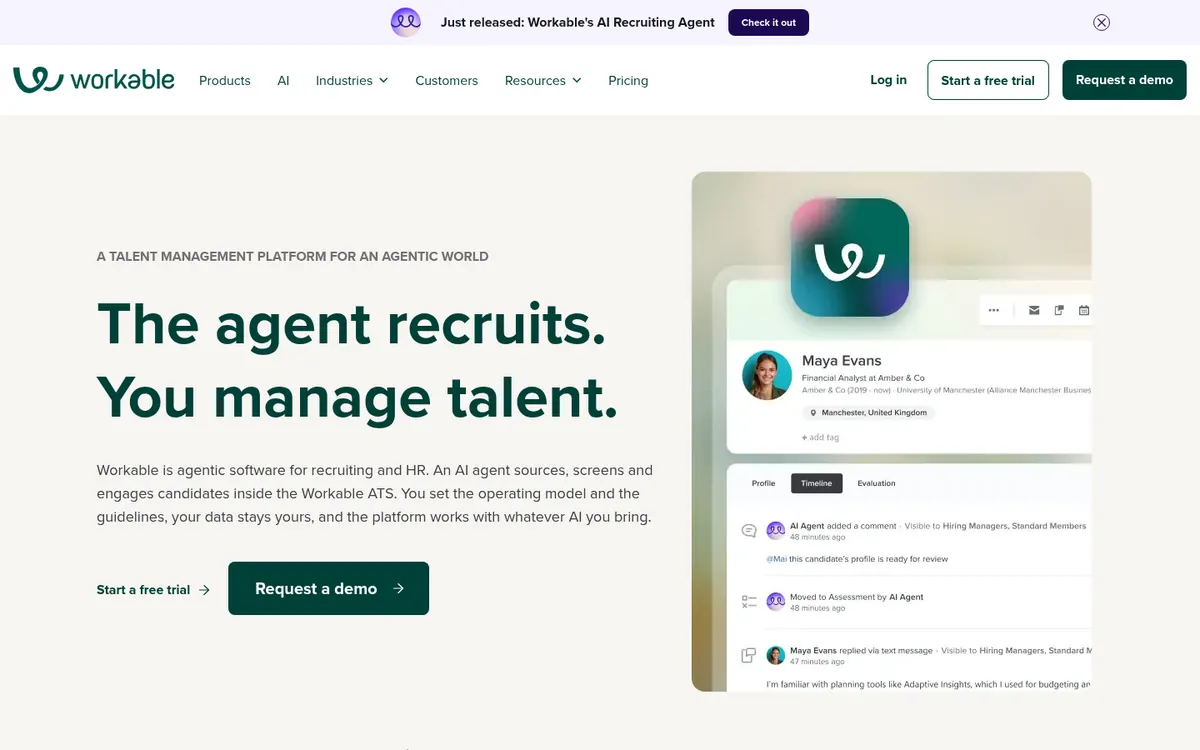
The easiest buy here for a small team: published tiers, a real trial and no sales call needed to see the price.
Workable is the easiest buy in this list because the vendor shows the price. Three recruiting tiers are published at $299, $599 and $719 per month billed annually for 1 to 20 employees, and a 15-day trial covers the full recruiting workflow rather than a cut-down demo. For a team that wants to compare costs before booking a call, that transparency is worth a lot.
The product covers the standard recruiting path: job distribution to more than 200 boards, a collaborative applicant pipeline, automated candidate communication and workflow steps. The AI Recruiter feature searches a large candidate profile database for passive candidates, which is the piece most small teams lack the time to do manually. Add-ons cover texting, video interviewing and assessments. An HR module sits alongside recruiting at $99 per month standalone or $359 bundled.
The limits are in the tiers. AI sourcing and advanced automation sit above the entry plan, and several extras that look included on a feature list carry an additional cost on the cheapest tier. The HR module is a separate purchase, so a company that wants recruiting and core HR in one place should price the bundle rather than the recruiting plan alone.
Workable fits a small company or a single recruiting function that hires steadily but not at enterprise volume. It is a weaker fit for a business that needs deep interview governance, where Greenhouse is stronger, or heavy talent nurture, where Lever and Ashby go further. Confirm current tiers and add-on costs on the vendor pricing page before signing, since published tiers change.
You want published tiers, a working trial and a recruiting workflow you can run without a consultant.
Deep interview governance or long-run talent nurture campaigns are the center of your hiring.
Built for teams that treat sourcing as a program, with a talent CRM that most ATS tools still bolt on separately.
Lever pairs an applicant tracking system with a talent CRM, which is the distinction that matters. Passive candidates who are not ready today go into segmented talent pools, and multi-touch nurture campaigns keep them warm until a role opens. For hard-to-fill or specialist hiring, that changes the job from reactive posting to ongoing relationship work. The tracking side is complete: interview scheduling, interviewer feedback capture, pipeline and source reporting, and integrations with job boards and HR systems. Sourcing and talent pool segmentation sit inside the same interface as the pipeline, so a recruiter does not switch tools to move a candidate from a nurture sequence into an active process. Source effectiveness reporting closes the loop on which channels actually produce hires. Pricing is quote-only, based on team size and hiring needs. Because no price is published, the total depends on team size, hiring volume and any sourcing add-ons. Ask for a written quote that separates the platform fee from implementation and any sourcing add-ons, and confirm the term length before you build a budget around it. One complication is ownership. Lever sits under Employ Inc. together with Jobvite and JazzHR, which has raised fair questions about how the three brands will be positioned and which roadmap gets investment. Ask about product direction and contract terms before a multi-year deal. Lever fits recruiting teams that treat sourcing as a program rather than a task; it is a poor fit for a five-person company hiring two roles a year.
Sourcing and long-term candidate relationships matter as much as tracking active applicants.
You need a published price up front or want a vendor with a settled, single-product roadmap.
The pick for data-minded startups that want custom recruiting reports without buying a separate BI tool.
Ashby puts sourcing, scheduling, offers and analytics in one system, and the analytics are the reason most teams look at it. Custom reports and dashboards are built in at a depth that usually requires a separate BI tool, which means recruiting leads can answer questions about stage conversion, interviewer load and source quality without filing a data request. Scheduling handles panel and multi-interviewer loops, and offer approval workflows are configurable. Pipeline and interview stages are set up in the same place the reporting reads from, so a change to the process shows up in the dashboards rather than breaking them. Keeping sourcing, scheduling and offers in one system cuts the handoff work that usually falls to a recruiter coordinator. Pricing is partly published. The Foundations plan shows $400 per month for 1 to 10 employees on monthly billing, with a 10 percent discount for annual commitments. Published size bands run from roughly $300 to $900 per month for companies of up to 100 employees, so the band you land in is worth confirming during a demo. There is no free tier; access is through a demo and sandbox. The reporting depth has a cost in attention. Someone on the team needs to be comfortable building and reading reports, or the dashboards stay empty and the tool behaves like a plain ATS. Companies below ten employees may also find the price high relative to a single recruiter's needs, and teams that want a free plan should look at Zoho Recruit instead. For a data-minded startup recruiting engineers, the all-in-one coverage removes a lot of tool sprawl.
You want to build your own recruiting analytics and run sourcing through offer in one system.
Nobody on the team enjoys building reports or you need a free plan to get started.
A sensible first ATS for a small company that wants flat billing and a login for every hiring manager.
JazzHR is built for a company buying its first applicant tracking system. Billing is flat rather than per seat, hiring managers get logins without extra cost, and the setup is light enough that a team without a recruiting operations role can run it. Job posting, pipeline stages, interview scheduling and feedback collection cover the basics without asking for configuration work. The Hero plan is listed at $1,000 billed annually, and the trial runs 21 days, longer than most tools in this set. The plan you choose and the billing term both change the annual figure, so confirm the current tier in your quote. Offer letters and an onboarding handoff are included, which helps a small HR team keep the process in one place. The gaps are sourcing and analysis. There are no proactive candidate sourcing tools, so finding passive candidates is a manual, off-platform job. Reporting covers pipeline activity at a basic level, which is fine for a hiring manager checking status and thin for anyone trying to prove which source produces good hires. Teams that expect recruiting analytics will outgrow it. JazzHR is also part of Employ Inc. alongside Jobvite and Lever. That shared ownership is worth a question at contract time about roadmap and support, particularly if you are choosing between the three. Confirm the current price with the vendor before purchase, since the annual figure depends on the plan and billing term. It fits a small company hiring a steady handful of roles a year, and it is the wrong buy for an agency that needs sourcing automation.
You are buying a first ATS and want flat billing with logins for every hiring manager.
You need proactive sourcing, deep analytics or a confirmed low monthly entry price.
Best value when every hiring manager needs a login, thanks to unlimited seats on paid plans and a readable pipeline.
Breezy HR wins on seats. Paid plans include unlimited users and unlimited positions, so every hiring manager who wants a login gets one without a negotiation. The candidate view is a visual Kanban pipeline per open role, which non-recruiters understand quickly. Job board posting, career page tools, candidate questionnaires, interview scheduling and rating tools are all part of the standard workflow. Pricing starts at $157 per month on the Startup plan billed annually, with unlimited users and positions, and a 14-day trial applies to paid tiers. One thing to check: older descriptions of Breezy reference a free Bootstrap plan limited to a single open job, but the vendor pricing page now leads with the paid Startup price and lists no free plan. Confirm the current entry tier before you plan around a free option. Reporting is the weak point. Entry tiers give basic pipeline reporting, which answers simple questions about volume and stage but not much about source quality or interviewer performance. Talent CRM capability is limited next to Lever or Ashby, so nurture campaigns for passive candidates are not the reason to buy it. Compare it against JazzHR on price, and against Zoho Recruit if a free plan is a hard requirement. Breezy fits a lean team that wants a pipeline everyone can see and no per-seat math, typically a small company hiring across several departments at once. It is a poor fit for enterprise hiring with compliance requirements, or for a recruiting team that needs sourcing automation built in from day one.
You want every hiring manager in the tool without per-seat charges and a pipeline anyone can read.
You need advanced reporting, talent CRM depth or a free plan you can rely on.
The lowest published entry price in this list, and the only tool here with a free plan, at one open job.
Zoho Recruit has the lowest published entry price here at $25 per recruiter per month on the Standard plan billed annually, and each recruiter license covers 10 active jobs. A free plan handles one open job, and a 15-day trial applies to paid editions. For a small recruiting shop or a staffing desk watching costs, that combination is hard to beat on paper.
The feature set is competent rather than deep: resume parsing, candidate database search, interview scheduling, assessment workflows, job board posting and sourcing add-ons, plus custom reports and dashboards. Where it pulls ahead is ecosystem fit. If the business already runs Zoho CRM or Zoho People, candidate and employee records move between systems without a custom integration project.
The catch is that costs scale with seats. Adding a recruiter adds a license, so a ten-person recruiting team pays ten times the entry figure, and the 10 active jobs per license limit needs checking against your hiring volume. Structured interview support and analytics are lighter than Greenhouse or Ashby, and the interface feels older than newer entrants in this list.
The right buyer is a budget-conscious team already inside the Zoho suite, or a small agency that wants per-seat pricing it can forecast. The wrong buyer is a mid-market employer that needs interview governance, deep reporting or a modern recruiter experience and would end up paying for add-ons anyway. Confirm current editions and the free plan limits on the vendor pricing page before you commit, since add-on costs are easy to miss in a first-year total.
Price per recruiter decides the purchase and you already run Zoho apps.
Structured interviews, deep analytics or a modern interface matter more than the entry price.
Built for global enterprises hiring hourly staff at volume, with a rollout timeline that smaller employers cannot absorb.
iCIMS is a talent cloud rather than a point ATS, covering sourcing through onboarding for large employers. The features that matter to its buyers are unglamorous: multi-country compliance and data handling, high-volume application workflows tuned for retail and healthcare hiring, and conversational AI text recruiting that reaches hourly candidates on the channel they actually use. Recruiter and hiring manager dashboards sit on top of that, and integrations connect to enterprise HR and payroll systems. Nothing here is aimed at a team hiring ten people a year. The design assumption is thousands of applications across many locations, with rules about how candidate data is stored, who can see it and how long it is retained. Pricing is quote-only. The scope of a quote depends on modules, countries and application volume. Ask for a written proposal that separates platform, implementation and any per-application or per-hire fees, so the total is visible before you compare it with a fixed-price alternative. Implementation is the real cost. Rollout runs longer than any other tool in this set, which means internal project time, change management and a stretch where two systems are live. Ask for reference timelines against your own module set. Small and mid-sized employers will find the enterprise cost structure poor value, and a team that needs to be live in two weeks should look at JazzHR or Breezy HR instead. iCIMS fits a global enterprise with compliance exposure and hourly hiring volume.
You hire hourly staff across many countries and need compliance and volume workflows in one platform.
You need to be live in weeks or your hiring volume does not justify an enterprise contract.
An applicant tracking system is the system of record for hiring. It stores every candidate against the role they applied for, moves them through defined stages, and keeps feedback, messages and decisions attached to the right person. A spreadsheet can hold names and dates. It cannot post a job to twenty boards, route a candidate to the right interviewer, or show which source produced the last five hires without someone rebuilding it monthly.
The category splits into three rough shapes. A tracking-first ATS covers posting, pipeline stages, scheduling and feedback. A tracking plus CRM product, such as Lever or Ashby, adds talent pools and nurture campaigns so candidates who are not ready now stay in contact. A talent cloud, such as iCIMS, adds compliance, onboarding and high-volume workflows for large employers. Knowing which shape you need prevents paying for capability you will not operate.
Four functions decide most purchases:
Everything else, from texting to assessments to HR modules, tends to be an add-on or a higher tier. That matters because the entry price rarely reflects a working setup. Workable lists three recruiting tiers and a separate HR module at $99 per month standalone or $359 bundled. Zoho Recruit's $25 per recruiter per month carries a 10 active jobs per license limit.
The questions worth asking before a demo are plain. How many people need a login, and does that change the price? How many open jobs can we run at once? Can we build the reports we actually use without a data team? What does implementation require from us in the first month?
Teams usually arrive here after outgrowing a spreadsheet, or after a hiring manager asks why two candidates for the same role were interviewed against different questions. An ATS answers that with structure: the same stages, the same scorecards, the same record. The tool does not fix a vague hiring process, but it makes one visible and repeatable.
This comparison sits on the Software desk. Readers comparing neighbouring stacks often check our guides to demand forecasting software and glp 1 companies next.
Pricing in this category follows five models, and the billing model usually matters more than the headline number. The table shows which tools here use each one.
| Model | How it bills | Typical fit | Example from this list |
|---|---|---|---|
| Per seat | Per recruiter per month, billed annually, with job limits per license | Small recruiting desks that add people slowly | Zoho Recruit, $25 per recruiter per month on Standard |
| Employee band | Fixed monthly fee tied to a headcount range | Teams under 20 people that want a published price | Workable, $299 per month billed annually for 1 to 20 employees |
| Flat annual contract | One yearly fee with unlimited hiring manager users | First ATS purchases without seat math | JazzHR, $1,000 per year on Hero |
| Flat monthly with unlimited seats | Monthly fee covering unlimited users and positions | Lean teams giving every manager a login | Breezy HR, $157 per month billed annually |
| Quote only | Custom quote based on size, volume and modules | Mid-market and enterprise with complex process | Greenhouse, Lever and iCIMS |
Every price above was checked on the vendor's own pricing page on November 25, 2026. Where a vendor does not publish a figure we write "See website" instead of guessing. To compare annual and monthly billing quickly, try the free percentage calculator.
Write down your hiring volume. Count open roles, applications per role and interviewers per role for the last twelve months. A team hiring five roles with two interviewers each needs a different tool from one hiring fifty roles across ten locations.
Decide whether you will pay per seat. If every hiring manager needs a login, flat-billing tools such as JazzHR and Breezy HR price better than per-seat or band pricing. Count the logins before you compare quotes.
Fix the price question early. Ask each shortlisted vendor for a written first-year total covering platform, seats, job slots, add-ons and implementation. Quote-only vendors such as Greenhouse, Lever and iCIMS will not show a page price, so request a proposal in writing.
Test one live role in the trial. Run a real role through scorecards, scheduling and a debrief. A 21-day trial at JazzHR or a 15-day trial at Workable is enough to see where the process fights you.
Check the reporting you actually use. Name the two or three reports your team reviews monthly and have the vendor build them in the demo. Ashby and Greenhouse go deep here; Zoho Recruit and Breezy HR cover the basics.
Confirm roadmap, support and exit terms. Shared ownership at Employ Inc. affects Lever, Jobvite and JazzHR, so ask about product direction, support response times, data export and notice periods before signing a multi-year deal.
Buying on the headline price. The entry figure rarely includes add-ons, implementation or the tier that carries the features you saw in the demo. Workable's HR module adds $99 per month standalone, and Zoho Recruit charges extra for sourcing add-ons.
Counting seats after the demo. Per-seat and band pricing look similar until you add hiring managers. Count every person who needs a login first, then compare Zoho Recruit's per-recruiter model against Breezy HR's unlimited seats.
Skipping the live role test. A trial spent clicking through menus proves nothing. Push one real role through scorecards, scheduling and a debrief, then ask whether the structure helped or slowed the decision.
Assuming a free plan covers a real search. Zoho Recruit's free plan covers one open job, and Breezy HR's older free tier no longer appears on the vendor page. Budget for a paid plan from month one.
Ignoring the exit. Ask about data export, notice periods and price escalation before signing, especially on quote-only enterprise contracts that run for multiple years and hold your candidate history.
Zoho Recruit, at $25 per recruiter per month on the Standard plan billed annually. That price covers 10 active jobs per recruiter license, and a free plan handles one open job. The next lowest published figure is Breezy HR at $157 per month billed annually for unlimited users, then Workable at $299 per month for 1 to 20 employees. Greenhouse, Lever and iCIMS publish no price.
Zoho Recruit is the only tool here with a free plan listed, and it covers one open job. Breezy HR is worth a specific question: older descriptions reference a free Bootstrap plan for a single open job, but the vendor page now leads with paid plans from $157 per month. Greenhouse, Workable, Lever, Ashby, JazzHR and iCIMS list no free plan.
JazzHR runs the longest trial at 21 days. Workable and Zoho Recruit offer 15 days, and Breezy HR offers 14 days on paid tiers. Greenhouse, Lever and iCIMS list a free trial without a published length, so confirm the term before you start. Ashby has no trial, only a demo and sandbox, which is enough to test configuration but not a live hiring cycle.
Zoho Recruit is the clearest per-seat model, at $25 per recruiter per month on annual billing with 10 active jobs per license. Workable prices by employee band, at $299 per month for 1 to 20 employees. JazzHR and Breezy HR bill flat, with unlimited hiring manager users, and Breezy also includes unlimited positions. Greenhouse, Lever and iCIMS quote on size and scope.
Greenhouse, by a clear margin. Interview kits are reusable, scorecards attach to each stage, and debriefs and decisions leave an audit trail, so candidates for the same role are compared on the same evidence. Ashby and Lever support structured feedback and scheduling but lead with analytics and sourcing respectively. JazzHR, Breezy HR and Zoho Recruit cover feedback at a basic level.
Small teams can be live quickly on self-serve tools such as Breezy HR, JazzHR or Zoho Recruit, where setup is mostly job templates and pipeline stages. Workable and Ashby take longer because of workflow and report configuration. Greenhouse and Lever need a configuration phase and an administrator. iCIMS runs longest, with multi-country compliance and integrations extending rollout well past lighter tools.
Browse every comparison on the Software desk, with the same rubric and dated prices.