Ranked #1

Lattice
Connected review cycles
Foundations $13/seat/month
- Best for
- Mid-market and enterprise firms managing structured, connected performance cycles
- Free plan
- No
- Rubric
- 7.8 / 10
Nine performance review platforms compared on review workflow depth, pricing transparency, setup effort and the size of team each one actually serves, with prices checked on November 25, 2026.
 Prices checked November 25, 2026
Lattice is the best performance review software for mid-market and enterprise firms running structured cycles, 15Five suits smaller teams that want continuous manager-led feedback, and Effy AI fits small teams that need a cheap, fast cycle. Prices below were checked on November 25, 2026. Nine tools are ranked by fit for the buyer each entry describes. Starting prices in this list run from $3 per seat per month for Effy AI to $17 per employee per month for BambooHR Pro.
Connected review cycles
Foundations $13/seat/month

Weekly manager check-ins
Perform $11/user/month, billed annually

Benchmarked engagement data
See website (custom quote)
Disclosure for this page: All 9 tools here are unpaid editorial picks. The position of a paid listing can be part of what the vendor pays for. How we handle paid listings.
| Tool | Best for | Free plan | Actions | |||
|---|---|---|---|---|---|---|
| 1 | Lattice | Mid-market and enterprise firms managing structured, connected performance cycles | Foundations $13/seat/month | No | ||
| 2 | 15Five | SMBs and mid-market teams focused on continuous manager-led feedback | Perform $11/user/month, billed annually | No | ||
| 3 | Culture Amp | Mid-market to enterprise firms using engagement data to guide performance | See website (custom quote) | No | ||
| 4 |  PerformYard | Mid-market teams with tailored, non-standard review workflows | Performance $5/person/month, billed annually | No | ||
| 5 |  BambooHR | SMBs seeking HRIS and basic performance in one platform | Pro $17/employee/month | No | ||
| 6 |  Leapsome | European and global mid-market firms combining performance and learning | Agentic HRIS Foundation $7/employee/month | No | ||
| 7 |  Trakstar | SMB and mid-market regulated employers needing defensible review records | See website (custom quote) | No | ||
| 8 |  Effy AI | Small teams needing a fast, low-cost review cycle | 360 Reviews $3/seat/month, billed annually | Yes | ||
| 9 | Small Improvements | SMBs over 20 staff wanting simple continuous performance management | See website | No |
Every tool in this list was scored against the same five criteria: review workflow depth (30 percent), pricing clarity (20 percent), setup effort (20 percent), manager adoption (15 percent), and integrations and scale (15 percent). Review workflow depth covers form configuration, rating scales, calibration, 360 input and approval routing. Pricing clarity rewards vendors that publish a seat price a buyer can budget against. Setup effort and manager adoption are weighted heavily because review software fails when managers do not finish cycles or when HR spends too long configuring forms. Prices and plan facts come from vendor pricing pages checked on November 25, 2026. Where a vendor publishes no seat price, this list says so and quotes no number. Where a page did not load, as with Small Improvements, the price is marked unconfirmed rather than estimated from older material. The list order is editorial, based on how well each tool fits the buyer that entry describes. Where a vendor holds a Featured placement, it is marked as Featured, scored with the same rubric, and carries the same kind of honest cons as every other entry. We did not test every product hands-on for an extended period, and we do not publish star ratings, quotes or customer counts. What follows is a fit assessment for buyers comparing plans, prices and workflow depth before a demo.
The full process, including how we handle corrections, is on the methodology page. Paid listings follow our advertising disclosure.
| Criterion | Weight | What we check |
|---|---|---|
| Review workflow depth | 30% | Form configuration, rating scales, 360 input, calibration and approval routing. |
| Pricing clarity | 20% | Whether a buyer can find a seat price and budget against it without a sales call. |
| Setup effort | 20% | How much HR time it takes to launch and maintain a live review cycle. |
| Manager adoption | 15% | How likely managers are to finish reviews on time without chasing. |
| Integrations and scale | 15% | Connections to HR, chat and project tools, plus headcount handling. |
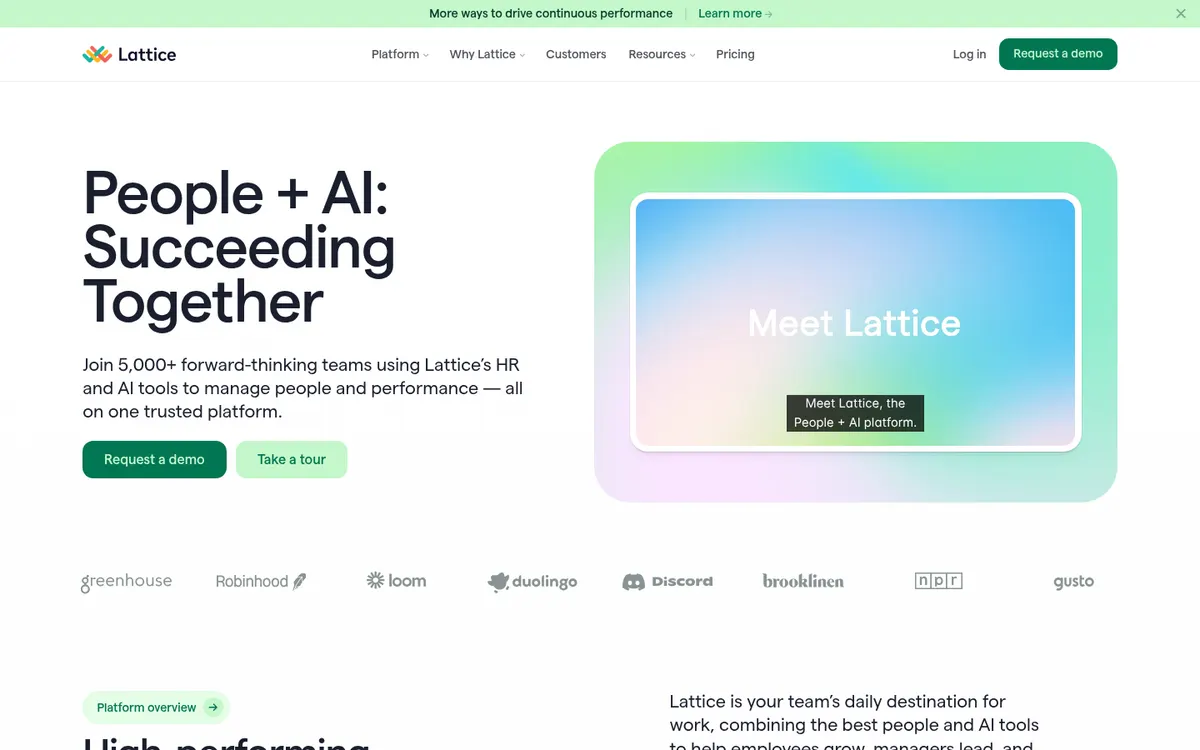
The deepest connected review system here, if you can clear the $4,000 annual minimum and staff the implementation.
Lattice is the most complete review engine in this list. Review cycles, goals and OKRs, peer feedback and compensation review all draw on the same employee record, so a manager who closes a review cycle can move straight into a calibration or pay decision without re-entering context. Analytics connect review outcomes to engagement and attrition trends. Granular permissions and approval workflows exist for larger headcounts, and structured calibration sessions are supported natively rather than bolted on. The catch is commitment. Lattice applies a $4,000 annual minimum, so small companies should run the yearly total before choosing the $13 per seat per month Foundations rate. Implementation takes real HR time: cycle design, form building, manager training and a pilot group all land on your team. Engagement surveys and advanced analytics are separate modules, so the base review workflow does not include everything the demo shows. Pricing sits at Foundations $13 per seat per month, and a la carte base products are listed at $10, $8 and $4 per seat per month, which makes the configuration somewhat confusing to price without a call. There is no free plan and no trial, so evaluation runs through a sales-led demo. Seat pricing also shifts with the module mix, so ask for a written quote that names every module you need. Pick it if you run structured cycles across a mid-market or enterprise headcount and want reviews, goals, feedback and pay decisions in one place. Smaller companies should run the $4,000 floor against a lighter tool before signing.
You run structured cycles across a mid-market or enterprise headcount and want reviews, goals, feedback and compensation in one system.
You are a small company or cannot spare HR time for configuration and a pilot.
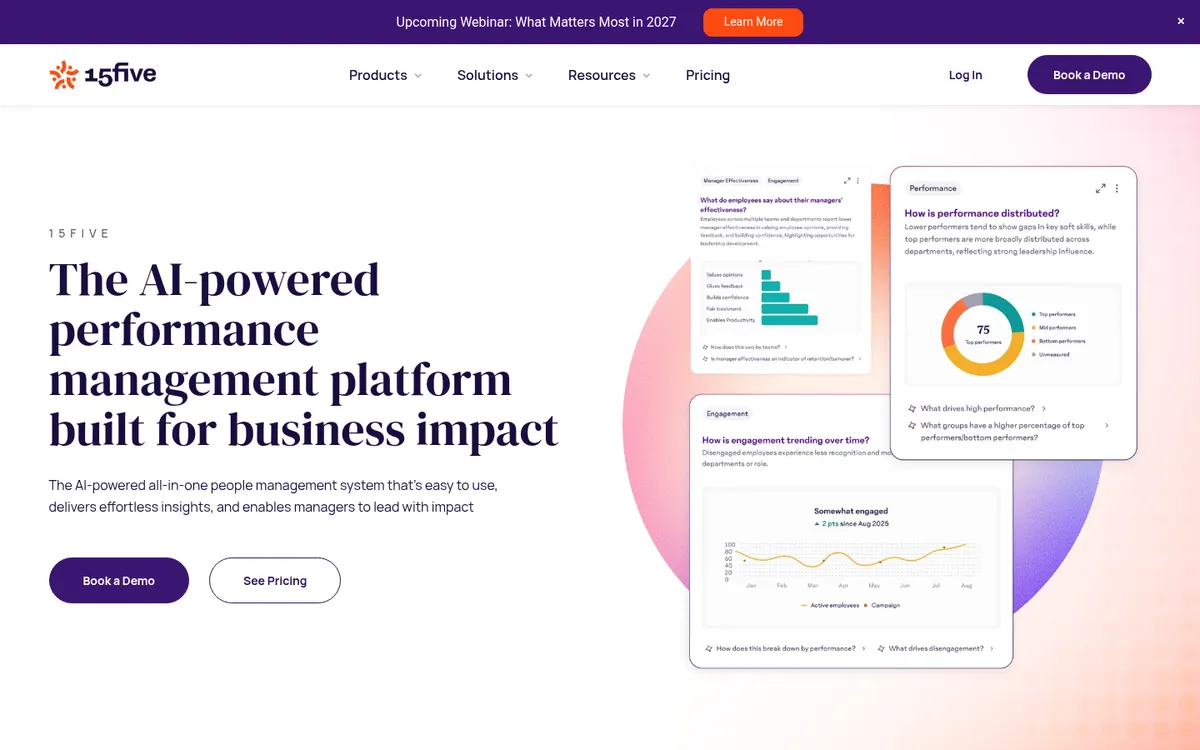
Best when managers adopt weekly check-ins; the review cycle is solid, and the annual-only Perform tier rewards real usage.
15Five is built around a weekly habit rather than a once-a-year event. Check-ins, 1-on-1 agendas and manager coaching prompts create the running record that formal reviews later draw on, and the review module pulls that history into structured cycles. The weekly check-in is designed to be lightweight, so the habit can fit into a manager's week. AI-assisted drafting shortens the writing side of reviews, which is where managers lose the most time. Integrations cover BambooHR, Workday, Slack and Jira, so the tool sits alongside an existing HRIS rather than replacing it. The Perform tier is billed annually only at $11 per user per month, and there is a 14-day free trial. A cheaper Engage module is listed at $4 per user per month; check which workflows it includes. The economics only work if managers actually use the weekly rhythm: a team that logs check-ins once a month pays full price for a habit it never formed. Where 15Five wins is coaching. Prompts surface questions a new manager would not think to ask, and 1-on-1 agendas keep conversations from drifting into status updates. Review cycles are supported, with weekly check-ins and manager coaching as the main focus. Compensation review is not listed among its features. Reporting and engagement survey depth are not listed among its core features. Pick it if your managers are the bottleneck and you want feedback to happen between cycles. Skip it if reviews are a compliance exercise with fixed forms and audit trails.
Your managers need structure between cycles and you want feedback feeding into formal reviews.
Reviews are a fixed compliance process with audit documentation at its core.
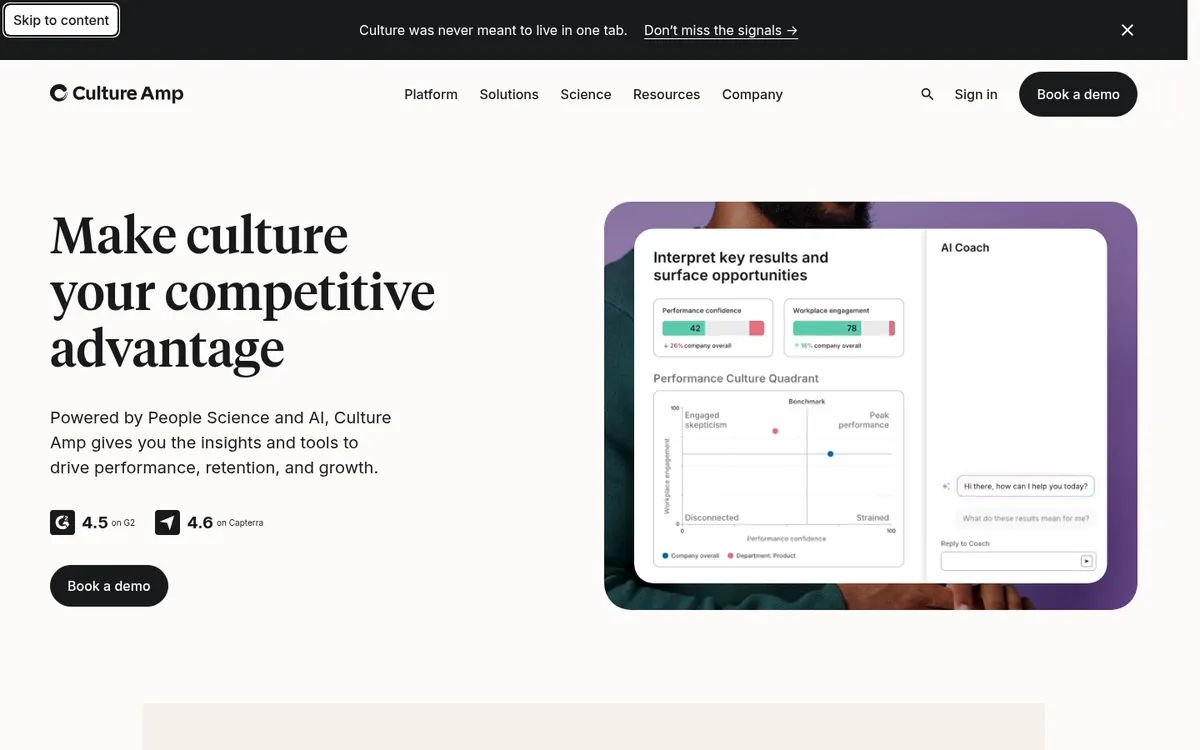
A research-backed engagement engine with reviews attached, priced by quote and built for enterprise buyers, not review-only teams.
Culture Amp leads with engagement and folds performance into it. The survey engine is the core: engagement surveys, lifecycle surveys, industry benchmarks and a question bank built from people-science research. Performance reviews sit alongside that data, so a manager can see how a team's review outcomes track against how that team says it feels. AI coaching tools point managers at specific behaviors surfaced in survey results rather than generic advice. Performance reviews sit alongside engagement surveys, lifecycle surveys and industry benchmarks. Review buyers should be clear about what they are getting. There is no standalone review product here at a list price: every deal runs through sales, contracts are annual, and commitments are enterprise-sized. Companies that only need forms, ratings and calibration will pay for a research and benchmarking engine they may not use. Those that already run an annual engagement survey and want review data in the same system get a coherent picture that standalone review tools cannot produce. Deals run through sales with annual contracts, which suits firms with an HR analytics owner and hurts teams without one. No public pricing is published. The page offers quote requests only, with no published seat price, so a budget conversation has to happen before you can compare it with the per-seat tools in this list. Expect a sales-led procurement process, and check what the quote covers before comparing it with per-seat tools. Pick it if engagement measurement is already central to your people strategy and you want reviews to inform it. Skip it if you need a published per-seat price and a fast launch.
You already run engagement surveys and want review outcomes read against that data.
You need a published seat price and a review cycle live quickly.
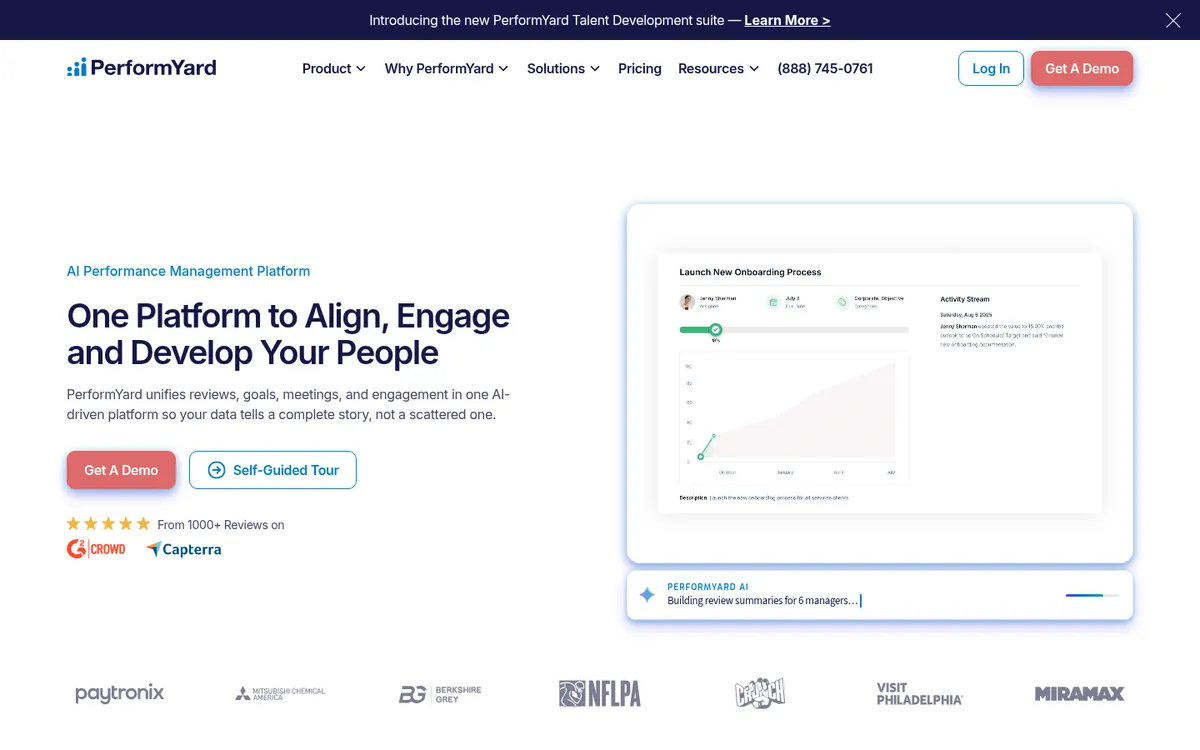
The pick for review processes that do not fit a template, at $5 to $15 per person per month plus setup effort.
PerformYard sells configurability. Review cycles, forms, rating scales and approval chains are all editable, which matters when your process does not match the vendor's default. 360 feedback and goal tracking are included, and the product is sold as modular pieces so a buyer can take reviews without the engagement or compensation modules. Matrix structures, union rules and academic review calendars are the cases where this flexibility earns its keep. Custom review forms, rating configuration and approval chains are part of the standard build. That flexibility has a cost in setup. Someone has to map the current process into the tool, test approval routing and train admins, and configuration decisions made early are hard to unwind later. The payoff is that the system matches how you actually run reviews instead of forcing a rewrite of a process that works. Plan for a pilot group and a parallel run against your old process before switching everyone over. Pricing is published as a range: $5 to $15 per person per month when billed annually, with the entry point still $5. Engagement and compensation modules cost extra, so the headline rate covers the performance pieces only. There is no free plan and no trial listed. Ask for the range in writing against your actual headcount and the modules you want, since the low end assumes the smaller configuration. Deep people analytics are not listed among its strengths. Pick it if your review process is genuinely unusual and off-the-shelf cycles would force compromises. Skip it if you want a default that works out of the box.
Your review process has unusual approval chains, rating rules or job structures that a default template cannot hold.
Nobody on your HR team has time to configure and maintain forms.
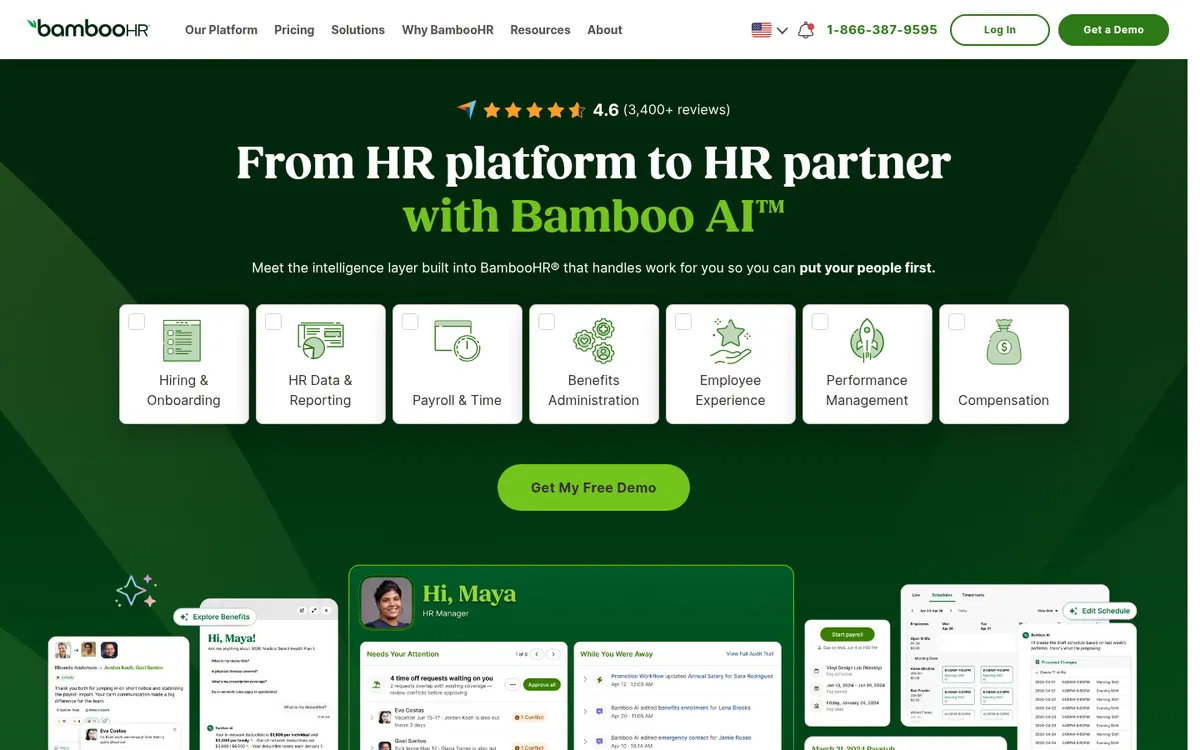
Reviews ride along inside a full HRIS, which suits small HR teams and shortchanges complex multi-rater cycles.
BambooHR is an HRIS first, and performance is one room in a larger house. Reviews, goal tracking, 1-on-1s and automated reminders all run from the same shared employee record that also supports time off, onboarding and benefits administration. For a small HR team, that means one login, one source of truth for headcount and one place to answer an employee question about their review status. Shared employee records support lean HR administration, which suits small HR teams. The performance layer is competent rather than deep. You get performance reviews, goal tracking, 1-on-1s and automated review reminders. What you do not get is the multi-rater depth and advanced analytics of specialist platforms. Managers who have used a dedicated review tool may notice less depth for complex cycles. Pricing matters here because performance is gated. The Pro tier is $17 per employee per month and includes the performance features; Core is $10 and Elite is $25. A buyer comparing BambooHR's review module against a dedicated tool should price the full HRIS, not the review feature alone. There is a free trial. Buyers should evaluate the full HRIS cost rather than reviews alone. Pick it if you are an SMB, your HR admin runs on spreadsheets today and you want reviews without a second system. Small teams that already use an HRIS may find reviews easier to add in the same platform. Skip it if review depth, multi-rater sophistication or analytics are the deciding factors.
You need HR administration and basic reviews from one system and one employee record.
Calibration, compensation review or deep review analytics drive the purchase.
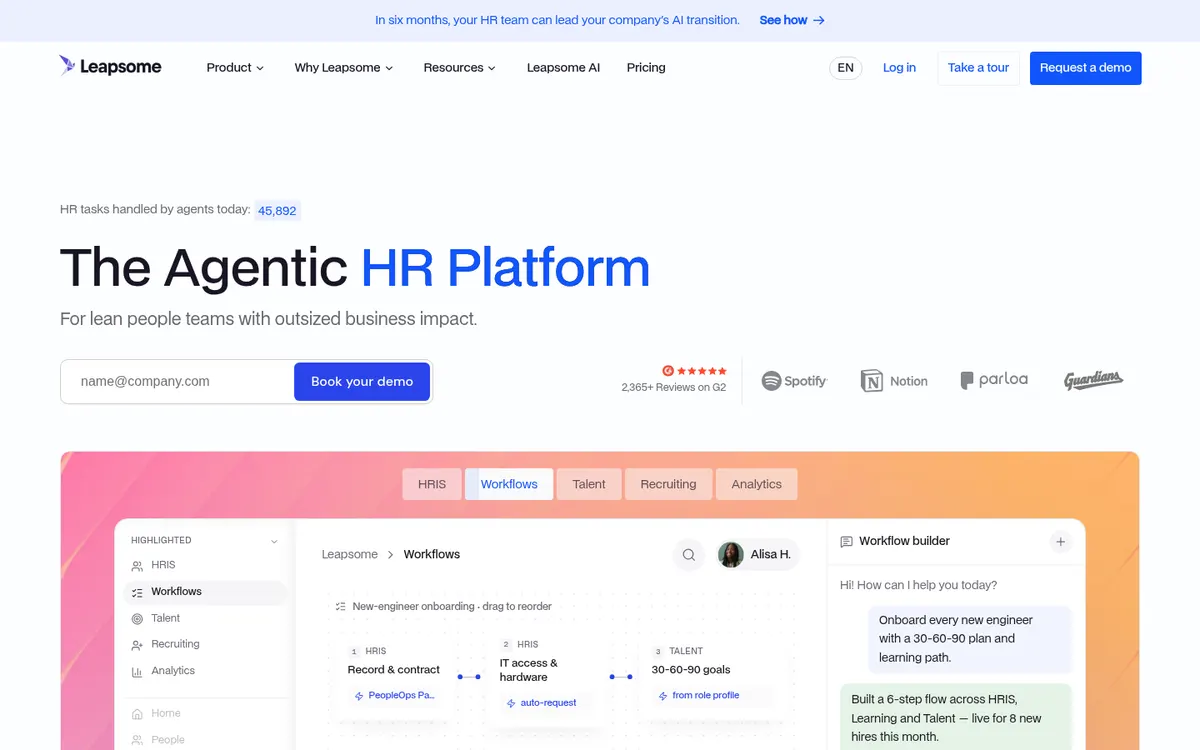
One suite for reviews, goals, surveys and learning, strongest in Europe, with a one-year minimum and quote-based module pricing.
Leapsome bundles performance, engagement and learning into one suite, and it is the learning piece that separates it. Review cycles, OKRs and engagement surveys sit alongside learning paths and an LMS. AI agents assist with reviews, goals and feedback. Shared people data means a manager sees the same employee in a review, a survey and a learning assignment. Review cycles, OKRs and engagement surveys share people data across modules. The tradeoff is breadth. Teams that only need review forms pay for survey and learning machinery they will not configure, and the suite takes longer to roll out because each module has its own setup. European buyers get a strong data-protection posture, which is often the deciding factor for firms with works councils or EU employee data. Adoption is the real risk because each module adds its own setup work. Pricing is partly published: the Agentic HRIS Foundation shows $7 per employee per month, but module pricing is not shown and contracts carry a one-year minimum term. Expect to negotiate the rest. Check whether performance is priced per module or as part of the foundation before you assume the $7 figure is your rate. Pick it if learning and development sits inside your performance strategy and you want one vendor for reviews, goals, surveys and courses. Small teams without a dedicated people operations lead should start narrower. Skip it if you want a narrow review tool with a published per-seat price.
You want reviews, OKRs, surveys and learning under one contract, especially with EU employee data.
You need only reviews and want a fully published per-seat price.
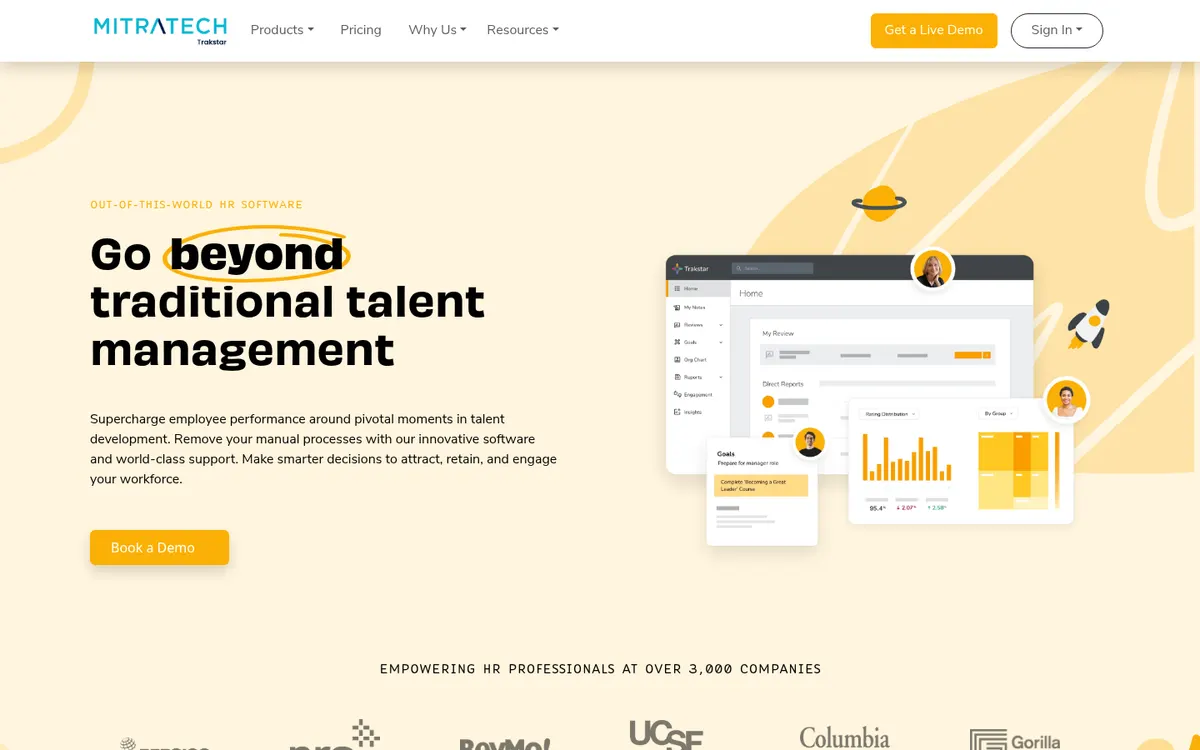
Dependable, audit-ready appraisal records for regulated employers, with an older interface and thin continuous feedback.
Trakstar is built for documentation. Appraisal templates are deeply customizable, approval chains route forms through the right sign-off levels, and completed reviews stay on file in a form that holds up to scrutiny. 360 feedback, goal tracking and succession planning round out a traditional talent management feature set. Regulated and compliance-sensitive employers tend to end up here because a review file has to answer a question from an auditor, not just inform a pay conversation. Customizable appraisal templates support structured documentation and approval routing. The interface shows its age. The interface feels older than newer competitors, and engagement and continuous feedback features are thinner, so a team that wants weekly check-ins may need a second tool or a process change. What Trakstar does well it does reliably: fixed forms, clear routing and records that do not move. Reporting depth is not listed among its core strengths. Trakstar is now part of Mitratech. Pricing is quote-based; the pricing page is a quote form with no published plan prices, so you cannot benchmark cost without a conversation. A free trial is available, which is the fastest way to judge whether the interface works for your managers. Ask about implementation services for complex approval structures. Pick it if you need defensible appraisal records in a regulated or unionized environment and your process is stable. Trial it for a single cycle before committing a whole population. Skip it if manager experience and continuous feedback are priorities.
Your review file must survive an audit and your process is already fixed and documented.
Managers want a modern interface and weekly feedback loops.
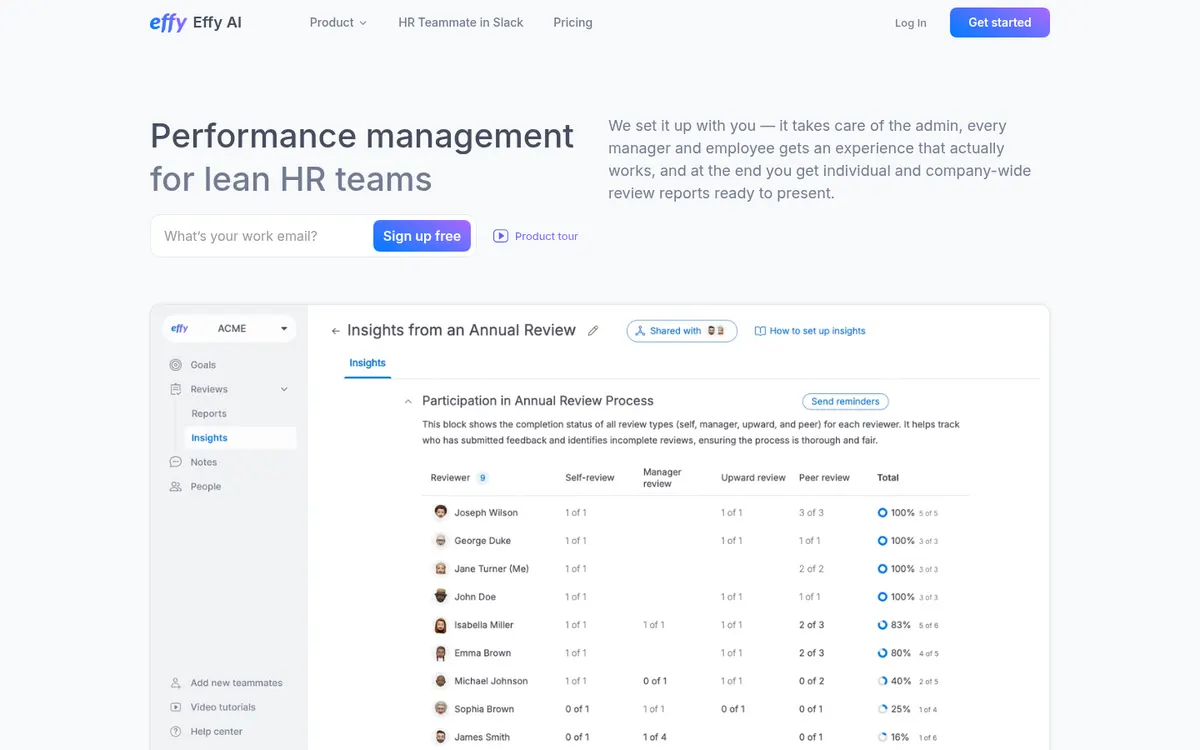
The cheapest fast start here at $3 per seat per month, with a free tier for five users and no ambition beyond reviews.
Effy AI is the cheapest way into a review cycle on this list. The 360 Reviews product runs at $3 per seat per month billed annually, with Goals and OKRs as an optional $2 module. AI-generated drafts and review templates reduce writing work, and cycle setup is designed for small teams. Review templates and AI-generated drafts are included. There are no seat minimums. Scope is narrow by design. This is not a talent suite: succession planning, compensation review and engagement surveying are absent, and analytics stop well short of what Lattice or Culture Amp produce. The integration ecosystem is smaller, so check available connections before you rely on data flows from a payroll or HR system. Support is not listed as an enterprise-grade feature here, which fits small teams and may not suit larger ones. The free tier covers up to five users, which lets a very small company run a cycle at no cost before paying anything. There is no separate trial because the free plan does that job. Paid seats have no minimum, so a small team pays only for its seats. Billing is annual on paid seats, so budget the full year rather than a monthly commitment, and ask whether mid-year seat additions are prorated. Pick it if you need a first formal review cycle, a small budget and speed above depth. Skip it if you need compensation, engagement or deep analytics in the same system.
You are a small team that wants a first review cycle live this month on a tiny budget.
You need compensation review, engagement surveys or deep reporting.
Lightweight reviews, 360 feedback, goals and praise that teams finish, above a 20-user minimum and with unconfirmed pricing.
Small Improvements does the basics without ceremony. Review cycles, 360 feedback, goal tracking and peer praise are grouped into workflows designed to get reviews finished rather than to model every possible process. The peer praise feature is a lightweight recognition addition. Completion workflows nudge employees and managers through each stage. Simple workflows are designed to help teams finish reviews. Reviews, 360 feedback, goals and peer praise are combined in one product. The tradeoffs are explicit. A 20-user minimum excludes very small teams, configuration is limited compared with PerformYard, and reporting stops at the operational level rather than offering predictive or attrition analytics. Companies with complex multi-stage approval needs will run out of room quickly. The interface is clean and plain, and managers need little training before their first cycle. Integrations are not listed among its features, so check connections before you rely on data flows. Pricing sits behind a page that would not load during this check, so the October price could not be confirmed and no seat figure is quoted here. Annual billing applies and the plan requires at least 20 users. The vendor describes pricing as transparent and low above the minimum, but without a live page that claim cannot be verified here. Buyers should get a written quote and confirm the current rate directly rather than relying on older figures. Pick it if you have 20 or more staff and want reviews, feedback, goals and praise in a tool your managers will actually finish using. Skip it if you need deep configurability or advanced analytics.
You want a lightweight cycle that managers complete without a training program.
You have fewer than 20 staff or need complex approval routing.
Performance review software runs the review cycle: it collects self assessments, manager assessments, peer and upward feedback, applies a rating scale, routes the results through calibration and sign-off, and stores the finished record against the employee. The point is not the form. The point is that a larger company can run the same process with the same questions at the same time and end up with comparable data instead of private documents. A typical cycle has several moving parts: - Review design: templates, competencies, rating scales and who reviews whom.
This comparison sits on the Software desk. Readers comparing neighbouring stacks often check our guides to demand forecasting software and glp 1 companies next.
Pricing in this category falls into a few recognizable shapes, and the shape matters more than the number. A published seat price tells you what a demo will cost. A quote-only process tells you a procurement cycle is coming.
| Model | How it bills | Typical fit | Example from this list |
|---|---|---|---|
| Per-seat subscription | A rate per user per month, often billed annually | Teams that know headcount and want a predictable line | 15Five Perform at $11 per user per month, billed annually |
| Low-cost seats with a free tier | Small per-seat rate, free below a user cap | Very small teams starting a first cycle | Effy AI at $3 per seat per month, free up to 5 users |
| Annual minimum | Seat rate plus a floor on the yearly contract | Mid-market and enterprise buyers | Lattice Foundations at $13 per seat per month with a $4,000 yearly floor |
| Published range | A per-person range depending on configuration | Teams with non-standard workflows | PerformYard at $5 to $15 per person per month, billed annually |
| Quote only | Custom contract after a sales process | Enterprise firms with procurement or compliance review | Culture Amp and Trakstar |
| Bundled into an HRIS | Per-employee rate for the whole platform | SMBs that also need HR administration | BambooHR Pro at $17 per employee per month |
Every price above was checked on the vendor's own pricing page on November 25, 2026. Where a vendor does not publish a figure we write "See website" instead of guessing. To compare annual and monthly billing quickly, try the free percentage calculator.
Published rates in this list include $3 per seat per month for Effy AI, $13 per seat per month for Lattice and $17 per employee per month for BambooHR Pro. Effy AI starts at $3 per seat per month billed annually, 15Five Perform is $11 per user per month billed annually, and BambooHR Pro is $17 per employee per month. Culture Amp, Trakstar and Small Improvements publish no seat price, so those deals depend on a quote.
Buyers often want both, but the tool only needs to do one of them well. Continuous check-ins feed context into formal reviews, while the review cycle produces the comparable rating and the record. If managers already meet weekly, pick a tool with strong check-ins and adequate review cycles, such as 15Five, and let the formal cycle stay simple.
Performance management runs the review cycle and the record behind pay and promotion decisions. Engagement surveying measures how employees feel about their work and the company. Culture Amp is built around engagement data with reviews attached, while Effy AI and Trakstar focus on the review itself. Buy the one that matches the decision you need to support.
A single review cycle can be set up quickly on Effy AI or Small Improvements. Mid-market suites with custom forms, calibration and compensation need HR time plus a pilot group. Lattice, PerformYard and Leapsome all require configuration work before the first live cycle, and buyers should expect a pilot group before a full rollout.
Yes. Standalone tools in this list may connect to an HRIS through integrations. 15Five integrates with BambooHR, Workday, Slack and Jira. BambooHR is the exception: it bundles reviews into an HRIS, so you buy the platform rather than the review feature alone.
It can be, for one cycle. Effy AI covers up to 5 users free with no seat minimum, which handles a small company's first round of reviews. Beyond five users, paid seats start at $3 per seat per month billed annually. Teams that need compensation review or engagement data should look at broader suites.
Browse every comparison on the Software desk, with the same rubric and dated prices.