Ranked #1
Zenoti
Franchise reporting
See websiteCustom quote based on locations, providers and modules
- Best for
- Multi-location medspa chains
- Free plan
- No
- Rubric
- 7.8 / 10
We compare nine medspa platforms on charting depth, booking, CRM, pricing transparency, and fit for single-site clinics and multi-location groups.
 Prices checked November 25, 2026

As of November 2026, the best medspa software for most multi-location groups is Zenoti, because it combines HIPAA charting, injectable inventory, memberships, and franchise reporting. AestheticsPro suits clinics that need deep aesthetic EMR documentation, while PatientNow fits practices that treat lead capture and retention as the core workflow. Single-site clinics can start with lower-cost charting or booking tools, but they should confirm pricing on the vendor site before shortlisting a vendor.
Franchise reporting
See websiteCustom quote based on locations, providers and modules

Aesthetic charting depth
See websiteQuote-based pricing

UK and EU fit
See websiteQuote-based tiers from solo to enterprise
Disclosure for this page: All 9 tools here are unpaid editorial picks. The position of a paid listing can be part of what the vendor pays for. How we handle paid listings.
| Tool | Best for | Free plan | Actions | |||
|---|---|---|---|---|---|---|
| 1 | Zenoti | Multi-location medspa chains | See websiteCustom quote based on locations, providers and modules | No | ||
| 2 | AestheticsPro | Clinics needing deep aesthetic EMR charting | See websiteQuote-based pricing | No | ||
| 3 | Pabau | Growing clinic groups in the UK and EU | See websiteQuote-based tiers from solo to enterprise | No | ||
| 4 |  PatientNow | Aesthetic practices focused on CRM and marketing | See websiteFully custom pricing | No | ||
| 5 |  Aesthetic Record | Low-cost treatment charting for aesthetic practices | See websiteQuote-based pricing | No | ||
| 6 |  Symplast | Mobile-first aesthetic EMR for providers on the move | See websiteQuote-based pricing | No | ||
| 7 |  Vagaro | Affordable booking and point of sale for beauty services | See websiteOne bookable calendar, per month, additional calendars cost extra | No | ||
| 8 |  OptiMantra | Integrated EMR for small clinical aesthetic practices | $99Per month for first practitioner, month-to-month, 30 day cancellation notice | No | ||
| 9 |  Boulevard | Premium client experience for high-end spas | See websiteQuote-based pricing | No |
We checked vendor pricing pages on 2026-11-25 and built this list for buyers who need medspa software for booking, clinical records, payments, and retention. Where a pricing page could not be fetched, the entry keeps the starting price as See website and does not assert a number. The order is editorial: it reflects fit for the buyer described in each entry, plus any Featured placement. It is not a score sort, and a lower position does not mean a tool is weak.
Each tool was scored against five criteria with fixed weights. Clinical documentation carries 25 percent because charting, consent forms, and photos are central to a medspa record. Booking and front desk carries 20 percent, pricing transparency carries 20 percent, fit and scale carries 20 percent, and marketing and CRM carries 15 percent. The scores are diagnostic: they show where a tool is strong or thin, not a weighted total that sets the order.
A Featured listing is a paid placement. It is scored with the same rubric as every other tool, and the review keeps the same standard for pros and cons. We do not treat placement as proof of quality.
We used only the plan, trial, and free-plan facts available in the vendor data for this update. Quotes and custom pricing remain quotes until the vendor puts them in writing. Buyers should confirm implementation fees, add-ons, contract term, and support coverage before signing.
The full process, including how we handle corrections, is on the methodology page. Paid listings follow our advertising disclosure.
| Criterion | Weight | What we check |
|---|---|---|
| Clinical documentation | 25% | Measures charting, consent forms, photos, and clinical records for aesthetic treatments. |
| Booking workflow | 20% | Covers online booking, scheduling, reminders, and front-desk workflow. |
| Pricing transparency | 20% | Rewards published prices, clear plan terms, and trial access where available. |
| Fit and scale | 20% | Assesses fit for single-site clinics, growing groups, and multi-location chains. |
| Marketing and CRM | 15% | Measures lead capture, retention workflows, and campaign automation. |

The strongest fit for multi-location medspa groups that need clinical charting, inventory, memberships, and franchise reporting in one system.
Zenoti is built for medspa groups that need one system for the clinical record and the business. It combines online booking and front-desk scheduling with a HIPAA-compliant EMR, aesthetic treatment charting, before-and-after photo management, and injectable inventory tracking. Memberships and recurring billing sit alongside marketing automation, an AI receptionist for missed calls, and multi-location and franchise reporting. For a chain, that mix reduces the number of handoffs between the front desk, clinical team, and corporate reporting.
Its strengths are depth and scale. A multi-site operator can standardize charting, track injectable stock, run memberships, and compare location performance without stitching together separate tools. The AI receptionist is a practical add for busy phones because it can turn missed calls into bookings. Franchise reporting is another differentiator if owners need rollups by site. That matters when a group wants one dashboard for its owners and a different view for site managers.
The limits are real. Pricing is on the vendor site and custom quoted by location count, provider count, and selected modules, so there is no published rate to budget from. Contracts are long annual commitments, implementation is complex, and a single-location medspa will likely pay for capacity it does not use. Rollout is handled as an implementation project rather than a self-serve signup.
Zenoti fits multi-location medspa chains and franchise groups with staff to support a serious rollout. It is not the fastest choice for a solo injector or a small clinic that wants a simple booking and charting tool. Ask for a written quote that separates implementation, training, and module costs, and confirm the contract term before you commit.
You run multiple medspa locations and need clinical, inventory, membership, and franchise reporting in one system.
You run one site, need published pricing, or cannot support a complex implementation.
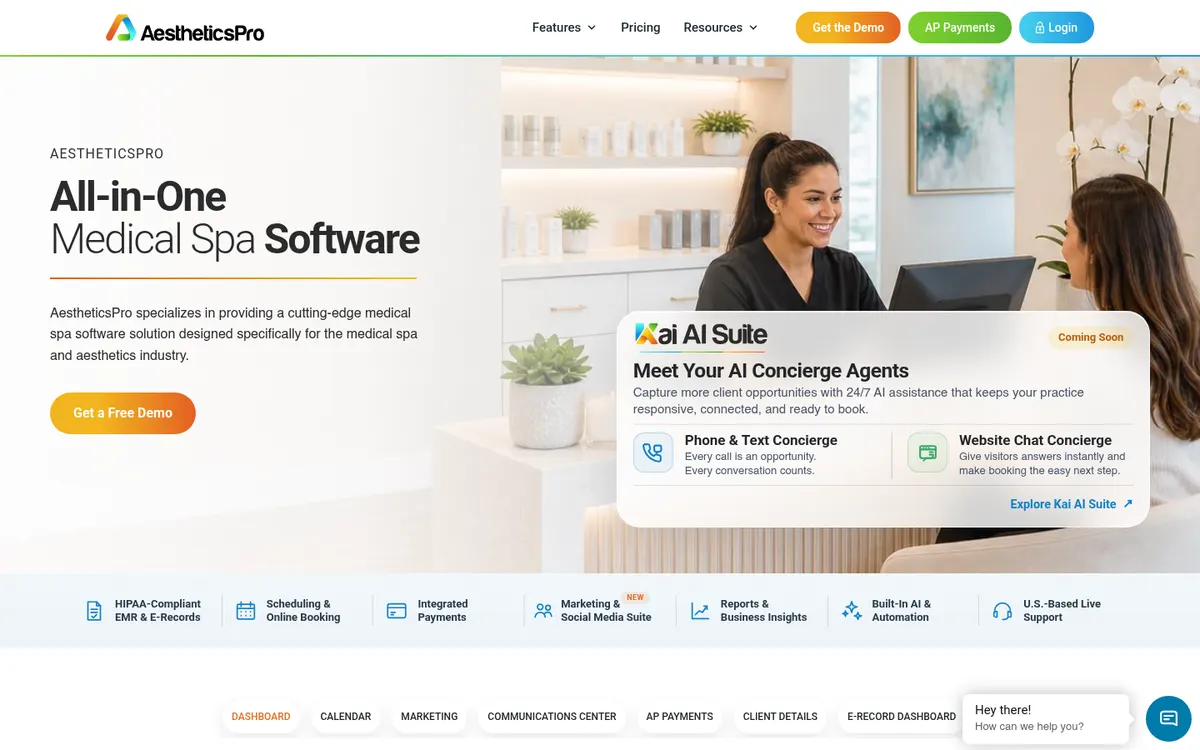
A clinical-first choice for medspas that need deep aesthetic charting, consent forms, and before-and-after records more than marketing automation.
AestheticsPro is a clinical documentation system for medical spas that need the treatment record to be the center of the software. It covers a HIPAA-compliant aesthetic EMR, treatment charting and clinical notes, consent form management, before-and-after documentation, scheduling, point of sale, and client records with clinical history. That set is narrower than an all-in-one marketing suite, but it speaks to the daily work of a provider who needs charting, consent, and photos in one place. The product makes most sense for clinics that prioritize medical workflows. Charting and consent management are first-class features, and the before-and-after documentation supports aesthetic treatment records. Scheduling and POS are included, so a practice can run the front desk and checkout without adding a separate booking tool. The trade-off is that the interface favors clinical function over polish, and marketing features are less developed than those in broader suites. Pricing is on the vendor site and quote-based. There is no free plan or trial, so buyers should book a demo and ask for a written quote that covers users, locations, data migration, and support. Ask for the quote in writing before you compare it with other tools. The vendor positions the product around clinical depth, not campaign automation. Choose AestheticsPro if your medspa needs deep aesthetic charting, consent forms, and before-and-after records, and you can pair it with a separate marketing tool if acquisition is a priority. Skip it if you want a polished all-in-one platform with strong campaign automation, or if you need published pricing before you will take a demo.
Aesthetic charting, consent, and before-and-after records are the core of your clinical workflow.
You need strong marketing automation or a polished all-in-one suite.
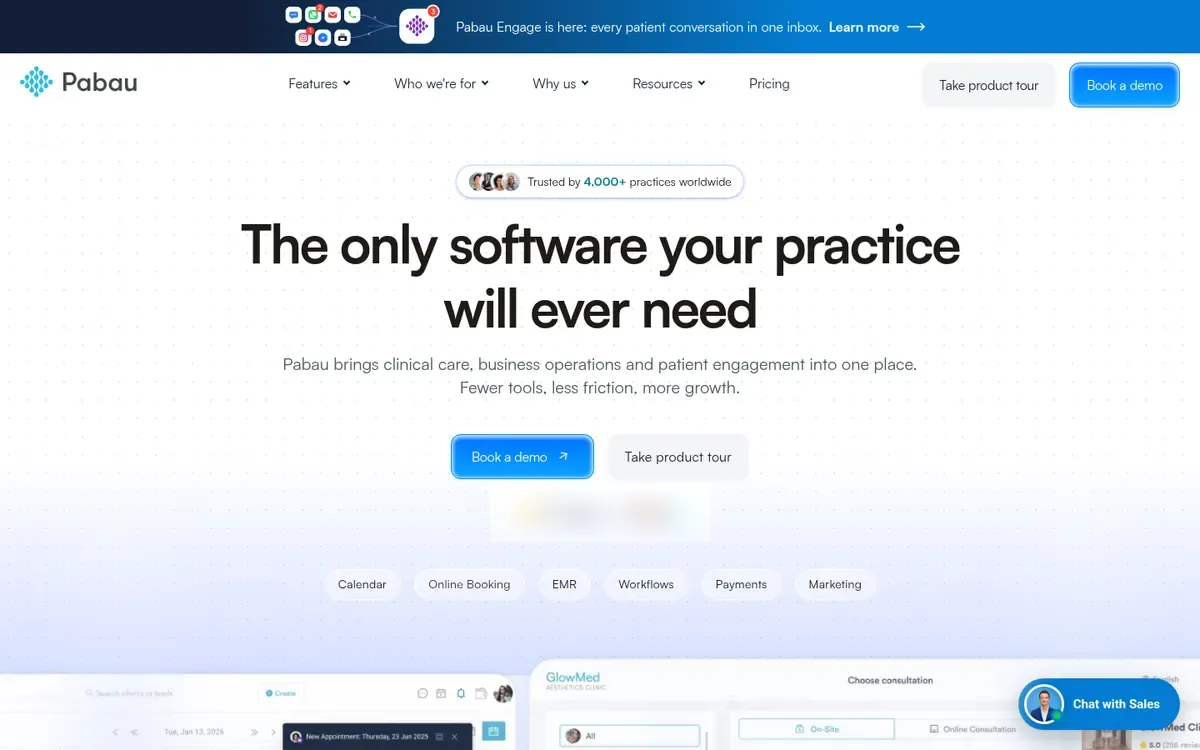
A broad clinic platform for growing UK and EU groups, with tiered plans and strong client experience features, though US support needs checking.
Pabau is a broad clinic platform aimed at growing clinic groups, with a feature set that spans online booking, treatment records and clinical notes, digital forms and consent, marketing automation, reporting and dashboards, and client management. The vendor says most tiers include unlimited clients, which matters for practices that do not want to count records as they grow. It is an all-in-one product rather than a single-purpose booking or charting tool.
The tiered structure is the main attraction. Plans run from solo practitioners to larger groups, with Team, Medium, Group, and Enterprise tiers, all quote-based. A small clinic can start with the workflow it needs, while a group can add locations and reporting as it expands. Strong client experience features help with booking, forms, and communication, and the reporting layer gives owners a view of clinic activity.
There are limits to check. Pricing is quote-based, so there is no public rate to compare, and there is no free plan or trial. Some advanced features require higher tiers, which can make the entry quote look better than the real cost. US buyers should confirm support hours, payment coverage, and local compliance needs because the company is strongest in the UK and Europe. Unlimited clients on most tiers does not mean every feature is included at every level.
Pabau fits growing clinic groups in the UK and EU that want one platform for booking, records, forms, marketing, and reporting. It can also suit a US practice that checks support and payments coverage before signing. Skip it if you need a US-first support model, a published price, or a narrow clinical EMR without marketing modules.
You are a growing UK or EU clinic group that wants booking, records, forms, marketing, and reporting in one platform.
You need US-first support, published pricing, or a narrow clinical EMR.
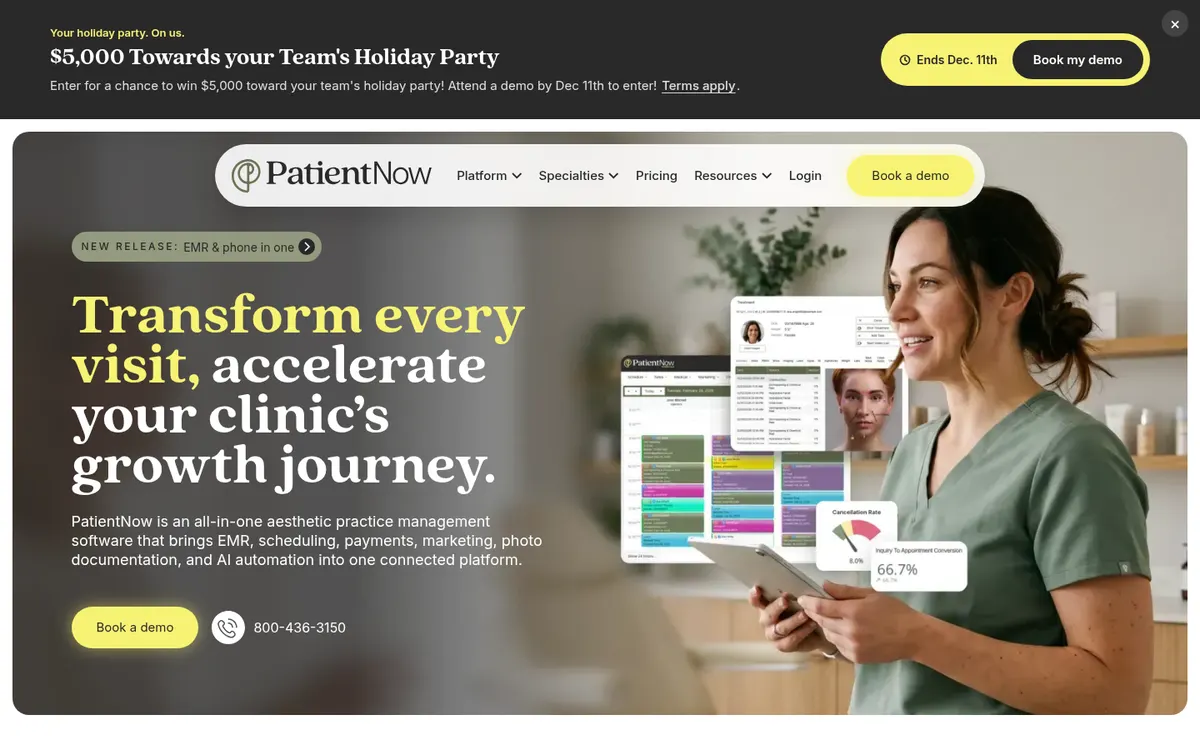
Best for aesthetic practices that run on lead capture, follow-up, and retention, with CRM depth that demands dedicated staff time.
PatientNow is built around the client journey, from first lead to repeat visit. It covers lead capture and pipeline tracking, consultation and treatment records, follow-up and rebooking workflows, marketing automation, CRM for client retention, and patient engagement tools. For aesthetic practices that treat marketing and retention as core operations, that combination is more useful than a standalone calendar or a thin EMR.
The strength is lead management. A practice can track inquiries, see where prospects sit in the pipeline, and trigger follow-up without exporting lists to another system. Consultation and treatment records keep the clinical history close to the CRM, and rebooking workflows support the next appointment. The product is built for aesthetic and cosmetic practices, so the vocabulary and workflows match the buyer. That focus is useful when consults drive revenue.
The limits follow from that depth. Pricing is on the vendor site and fully custom, with no published tiers and no free plan or trial, so budgeting requires a quote. The marketing layer adds complexity, and the platform only delivers value if staff run campaigns and keep the pipeline current. Smaller practices may find the CRM layer heavier than needed, especially if most bookings come from walk-ins or a simple online calendar.
PatientNow fits aesthetic practices with dedicated front-office or marketing staff who want lead capture, follow-up, retention, and treatment records in one system. It is less suitable for a small medspa that needs basic booking and charting, or for a buyer who will not use the CRM. Ask for a demo that follows a real lead from inquiry to consult to rebooking, and get the quote in writing.
Lead capture, follow-up, and retention are central to your medspa growth model and you have staff to run them.
You need simple booking and charting, or you cannot dedicate time to CRM campaigns.
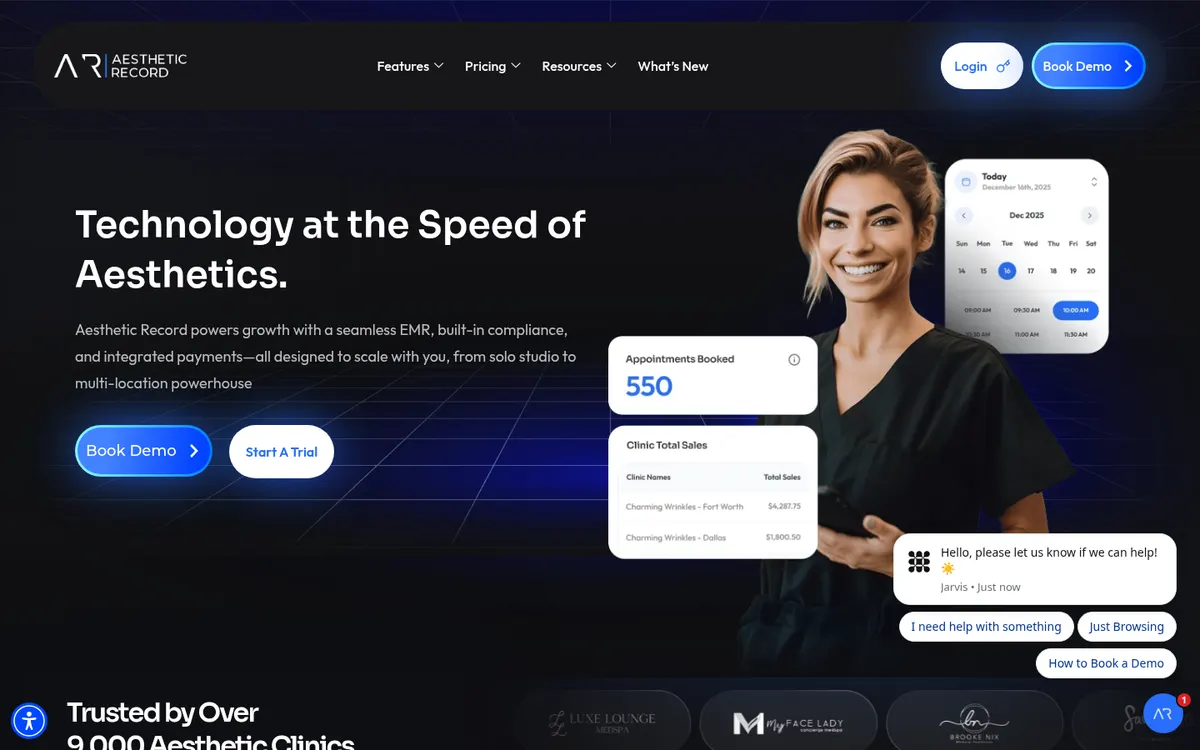
A focused, low-cost charting option for aesthetic practices that need mobile documentation and can pair it with booking or POS.
Aesthetic Record is a specialized aesthetic EMR for practices that need charting and photos more than front-office breadth. It covers aesthetic treatment charting, before-and-after photo management, client management, HIPAA-compliant clinical records, and mobile charting apps for iOS and iPad. Chairside documentation is the point: a provider can record a treatment close to the patient instead of returning to a desktop. That focus is useful for injectors and small aesthetic practices that already have a booking or POS tool. The mobile apps support charting on a phone or tablet, and the clinical record is built around aesthetic treatments rather than general medical notes. HIPAA compliance is part of the product positioning, which matters when photos and treatment details are stored in the system. The trade-offs are scope and price transparency. Pricing is on the vendor site and quote-based, so you need a quote for users, setup, and support. Ask for the quote to cover users, setup, and support. The product is narrower than full practice suites, with limited marketing and POS depth, so many practices pair it with a separate booking or payment tool. A free trial is listed, though the pricing page could not be checked. Choose Aesthetic Record if you need low-cost aesthetic charting, mobile documentation, and photo management, and you are willing to run booking and payments elsewhere. Skip it if you want one system for the whole clinic, or if you need strong marketing automation and point of sale without integrations.
You need mobile aesthetic charting and photo management at a low entry point and can use another tool for booking or POS.
You want one system for front desk, payments, marketing, and clinical records.
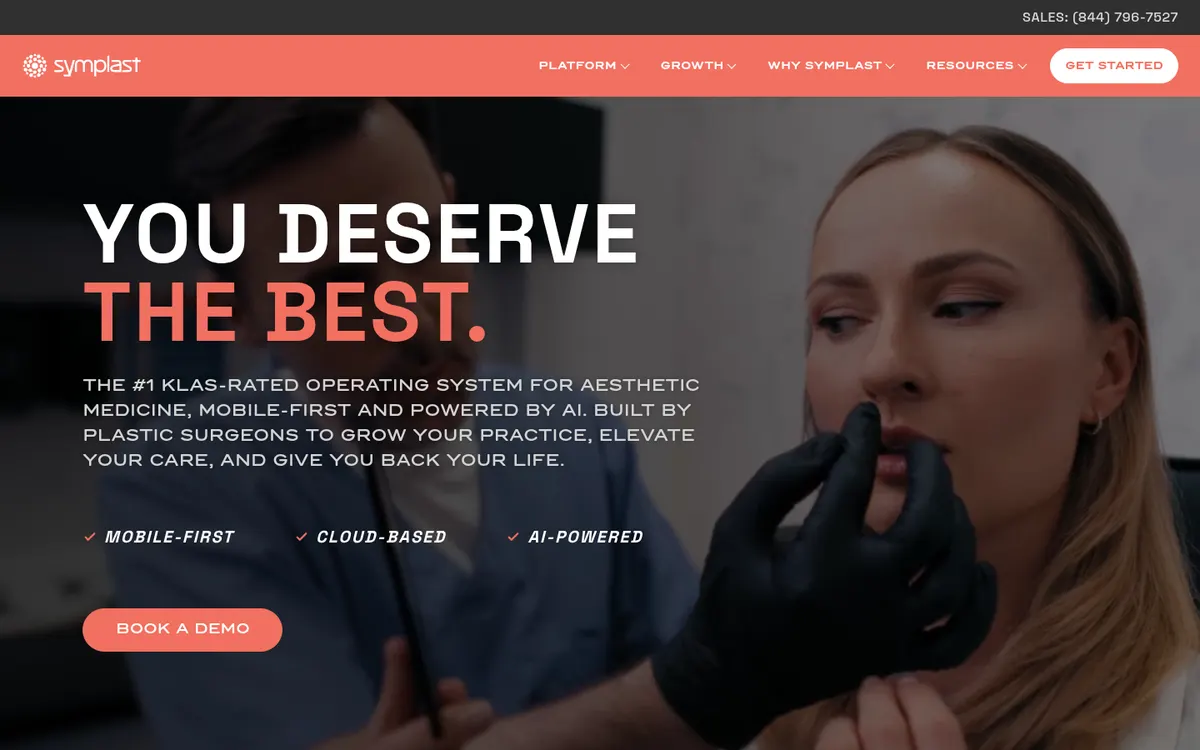
A mobile-first EMR for providers who chart on phones and tablets, with telehealth and engagement tools for cosmetic clinics.
Symplast is a mobile-first EMR for aesthetic and cosmetic providers who chart on the move. It covers clinical charting, patient records, patient engagement, telehealth, and provider mobile workflows. The design assumption is that the provider is often on a phone or tablet, not parked at a front-desk desktop. That makes it a different fit from platforms built around reception and checkout. The product is common in plastic surgery and cosmetic clinics, where providers need to review records, document visits, and communicate with patients across locations. Telehealth is included, and patient engagement tools support follow-up between visits. The mobile workflow can reduce the delay between seeing a patient and completing the note, which matters for clinical accuracy and billing. For a provider who moves between rooms and sites, that mobile access can be the deciding factor. The limits are the other side of that focus. Pricing is on the vendor site and quote-based, so there is no published rate, and there is no free plan or trial. The desktop experience is less developed than the mobile app, which can frustrate front-desk staff who work on larger screens. The ecosystem is smaller than larger platforms, so integrations and add-on options may be fewer. Ask for the quote to cover users, modules, and support. Symplast fits mobile-first providers, plastic surgery practices, and cosmetic clinics that want EMR, charting, engagement, and telehealth in one place. It is less suitable for a medspa that needs a polished front-desk and POS experience, or for a team that mostly works on desktop. Demo the provider app and the admin view with your own workflow before you commit.
Your providers chart on phones or tablets and you want EMR, telehealth, and engagement in one mobile-first system.
Your front desk lives on desktop or you need a broad front-office and POS suite.
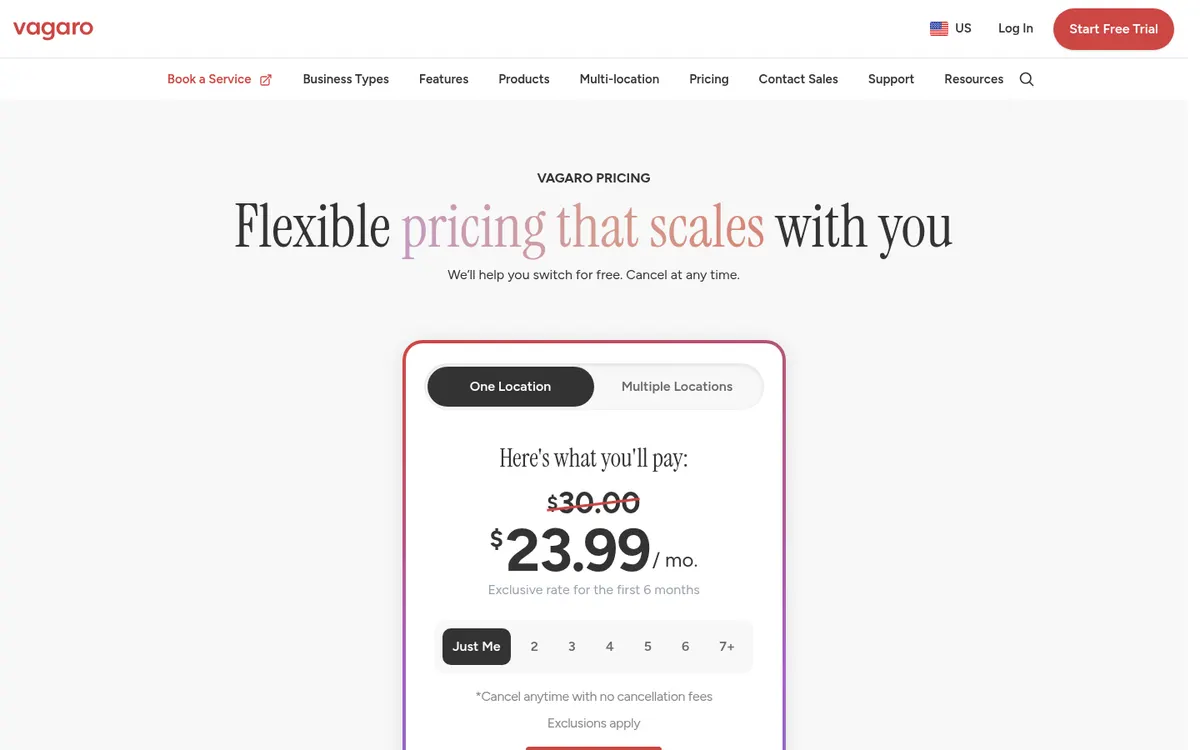
An affordable booking and POS platform for beauty services, but not a medical EMR and not a fit for clinical charting.
Vagaro is a booking and point-of-sale platform for beauty services, not a medical EMR. It covers online booking, point of sale, client management, automated reminders, email marketing, a marketplace listing, plus payroll and website builder add-ons. For a medspa that mainly needs a calendar, payments, and reminders, that package can be enough. For a clinic that needs clinical charting, it is the wrong category of tool. The strengths are price visibility and breadth at the front desk. A 30-day free trial is available without a credit card, which is useful for testing the booking flow. The marketplace listing can attract new clients, and the combination of booking, POS, marketing, and payroll covers a lot of daily administration. Automated reminders help reduce no-shows, and client management keeps contact history in one place. The limits are important for medspas. Vagaro is not a medical EMR, and it does not provide clinical charting or HIPAA-grade treatment records. Add-ons increase the real monthly bill, so the entry price is not the whole cost. The interface feels dated in places. Vagaro prices per bookable calendar, and additional calendars cost extra, so verify the current rate on the vendor site. Vagaro fits beauty-led spas and medspas that need affordable booking, POS, reminders, and marketing, and that will use a separate system for clinical records. Skip it if you need HIPAA-compliant charting, injectable inventory, or a clinical EMR. Before you buy, price the add-ons you need and confirm how additional calendars are billed.
You need affordable booking, POS, reminders, and marketing for a beauty-led spa and will chart in a separate system.
You need HIPAA-compliant clinical charting or a medical EMR.
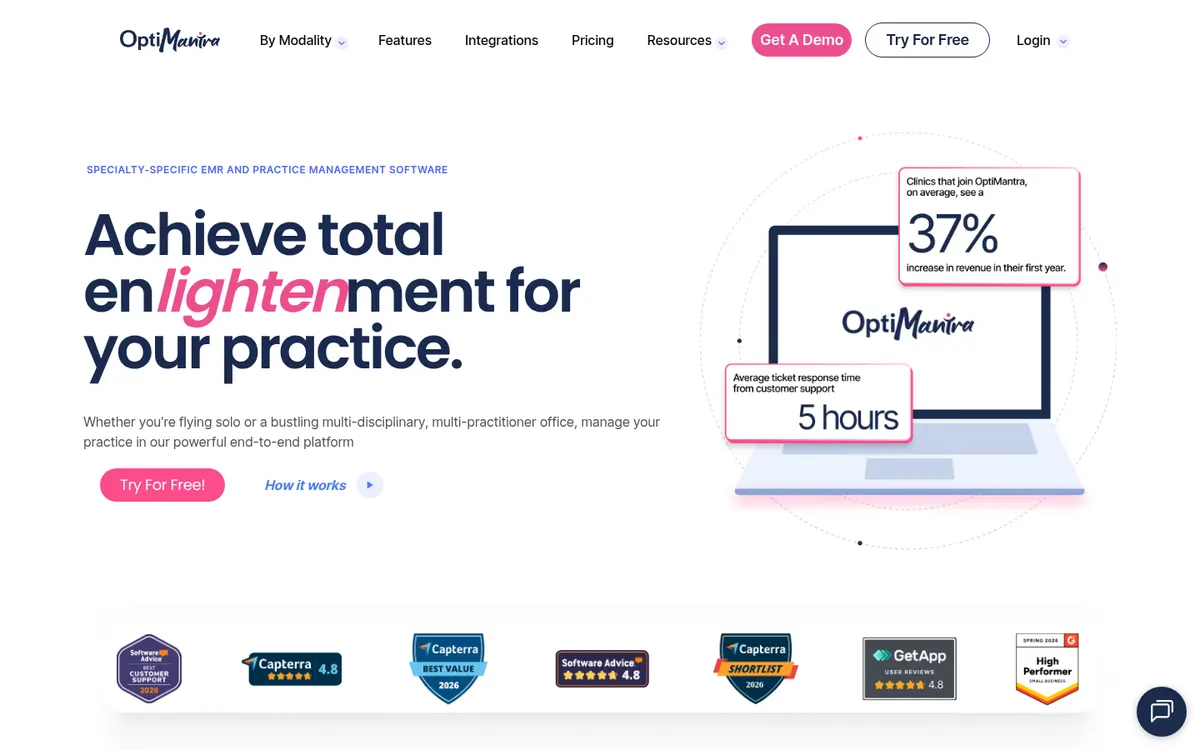
The clearest published price here: $99 per month for the first practitioner, with integrated EMR, scheduling, POS, billing, and telehealth.
OptiMantra is an integrated EMR for small clinical aesthetic practices, with a published price that makes it easier to budget. The listed $99 per month covers the first practitioner on a month-to-month plan with 30-day cancellation. The feature set includes customizable charting templates, online booking, a patient portal, messaging, point of sale, insurance billing, telehealth, and HIPAA and PHIPA compliance. That is a wide footprint for a small practice.
The appeal is the combination of clinical and front-office tools at a visible entry price. A provider can chart with templates, book patients, collect payments, bill insurance, and run telehealth without buying four separate systems. The month-to-month term lowers commitment risk, and a free trial lets a practice test the workflow. For a small clinical aesthetic practice, that can be a practical middle ground between a booking tool and an enterprise EMR.
The limits are cost at scale and usability. The $99 price is for the first practitioner, and additional practitioners cost more. Two-way texting and e-prescribing carry extra costs, so the real bill depends on how you work. The broad feature set can overwhelm solo providers, and the design is functional rather than polished. Buyers should ask which modules are included and which are add-ons before comparing the headline price.
OptiMantra fits small clinical aesthetic practices that want EMR, scheduling, POS, billing, and telehealth in one system with a published starting price and no long-term commitment. Skip it if you need a highly polished interface, a large multi-location reporting layer, or a simple booking-only tool. Confirm the all-in cost for your practitioners and add-ons.
You are a small clinical aesthetic practice that wants EMR, scheduling, POS, billing, and telehealth at a published price.
You need a highly polished interface, large multi-location reporting, or a booking-only tool.
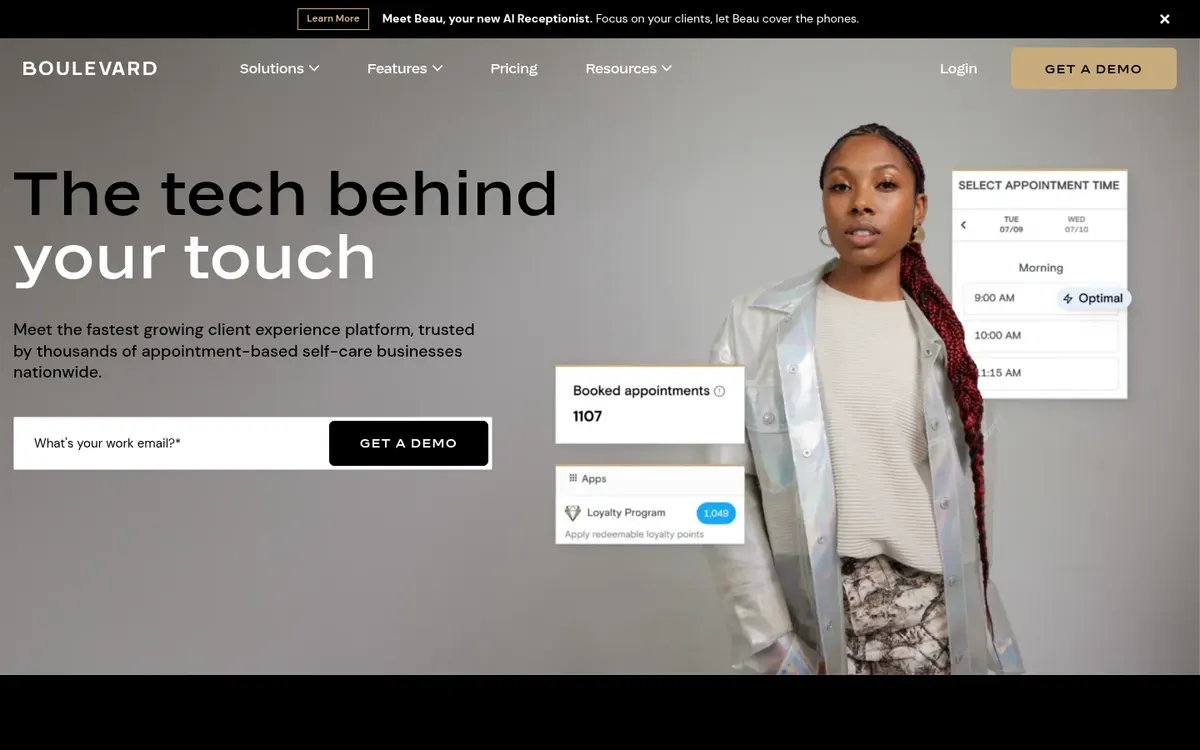
A premium client experience and booking platform for high-end spas, with thinner clinical charting than EMR-first medspa tools.
Boulevard is built for the client experience at high-end spas and medspas. It covers a polished online booking experience, scheduling automation, client profile management, business reporting, and front-desk workflow tools. The product is strongest when the booking flow and the front desk are the center of the operation, and when the brand experience matters as much as the transaction. The client-facing booking experience is the main draw. Scheduling automation reduces manual work, client profiles keep preferences and history together, and reporting gives owners a view of business performance. Front-desk tools support check-in and daily operations. For a premium spa, that combination can make the software feel like part of the service rather than an administrative burden. The limits are pricing and clinical depth. Pricing is on the vendor site and quote-based, so there is no public rate, and there is no free plan or trial. The premium positioning carries a premium cost, so confirm the quote for your locations, users, and payment volume. It is not an EMR-first product, so clinical charting is thinner than in tools built for medical records. Practices with heavy documentation may need a separate charting system. Boulevard fits high-end spas and medspas that compete on booking experience, client service, and front-desk workflow. Skip it if you need deep aesthetic charting, consent management, and clinical records in the same platform, or if you need published pricing before a demo. Ask how the quote changes with locations, users, and payment volume, and confirm what clinical documentation is included.
Your medspa competes on a premium booking experience, client service, and front-desk workflow.
You need deep clinical charting, consent management, or published pricing before a demo.
Medspa software is the operating system for a medical aesthetics practice. It combines booking, clinical records, payments, and client follow-up in one place, or connects those jobs through integrations. The category matters because a medspa is not a salon: injectables, lasers, and other treatments create clinical documentation, consent, and inventory needs that a standard beauty booking tool does not handle.
A full platform usually covers online booking, front-desk scheduling, a HIPAA-compliant EMR, treatment charting, before-and-after photos, consent forms, point of sale, memberships, and marketing automation. Some tools add injectable inventory tracking, telehealth, insurance billing, or multi-location reporting. Others specialize in one layer, such as charting or lead management, and rely on another product for the rest. Buyers should map the workflow from inquiry to consult to treatment to rebooking, then mark which steps need a clinical record.
Use this short checklist to decide which layers you need:
The boundary with salon software is clinical risk. Salon tools can handle appointments, payments, and client contact, but they are not built for medical records or HIPAA-grade charting. A medspa that only needs a calendar may start with a booking and POS tool, then add a charting system as clinical volume grows. A practice that already handles injectables, lasers, or prescription treatments should start with the clinical record and make booking fit around it.
Pairing is a valid strategy. A booking and POS tool can run the front desk while a focused EMR handles charting and photos. The risk is duplicate client records and manual reconciliation, so confirm that the two systems share client data or that staff can keep one source of truth. The best choice depends on treatment mix, site count, and whether you need one vendor or are willing to manage integrations.
This comparison sits on the Software desk. Readers comparing neighbouring stacks often check our guides to demand forecasting software and glp 1 companies next.
Medspa software mostly bills on quote, not a public pricing sheet. Only OptiMantra in this list shows a confirmed starting price: $99 per month for the first practitioner on a month-to-month plan with 30-day cancellation. Every other entry says See website, so the real cost depends on locations, providers, modules, implementation, and contract term. A low headline can hide setup, training, add-ons, or annual commitment.
| Model | How it bills | Typical fit | Example from this list |
|---|---|---|---|
| Published per practitioner | Monthly for the first practitioner, month-to-month with 30-day cancellation | Small clinical practice | OptiMantra at $99 per month for the first practitioner |
| Per-calendar booking plan | Per bookable calendar, per month, with add-ons extra | Beauty and booking-led spa | Vagaro: one bookable calendar, additional calendars cost extra |
| Custom quote by location | Per location, provider, and module | Multi-location chain | Zenoti |
| Quote-based EMR | Custom quote for clinical users and setup | Clinical documentation | AestheticsPro and Symplast |
| Quote-based CRM | Custom quote for marketing and retention | Lead-led aesthetic practice | PatientNow |
| Quote-based premium booking | Custom quote for booking and front desk | High-end spa | Boulevard |
Every price above was checked on the vendor's own pricing page on November 25, 2026. Where a vendor does not publish a figure we write "See website" instead of guessing. To compare annual and monthly billing quickly, try the free percentage calculator.
Start with the clinical record, then the front desk, then price. That order keeps a booking demo from hiding a charting gap.
Most medspa software purchases go wrong because the buyer compares a booking price with an EMR quote, or because the demo skips a real workflow. Avoid these five mistakes. - Buying on headline price. A $99 first-practitioner rate or a per-calendar booking rate can exclude setup, additional users, texting, e-prescribing, or implementation. Price the whole contract before you compare.
OptiMantra is the only tool in this list with a confirmed starting price: $99 per month for the first practitioner on a month-to-month plan. Vagaro prices per bookable calendar, and additional calendars cost extra; confirm the current rate on the vendor site. Zenoti, AestheticsPro, Pabau, PatientNow, Aesthetic Record, Symplast, and Boulevard say See website or quote-based pricing.
A small clinical practice can start at $99 per month for the first practitioner on OptiMantra. Larger groups should expect quote-based pricing that changes with locations, providers, modules, implementation, and contract term. A booking-led spa should confirm the per-calendar rate and add-ons, and a separate charting system can raise the real monthly bill. Confirm every cost in writing.
You need HIPAA-compliant charting when the software stores protected health information, including treatment notes, consent forms, photos, prescriptions, or clinical history. A booking and POS tool that only holds names, appointments, and payment details is not a clinical record. If you chart injectables, lasers, or medical treatments, make the EMR decision before you choose a booking tool.
Salon software centers on appointments, payments, and client contact. Medspa software adds clinical documentation, consent, photos, inventory, and HIPAA compliance for medical treatments. Some medspas run a salon-style booking tool for the front desk and a separate EMR for charting. That pairing works only if client records stay consistent and staff know which system is the source of truth.
Yes, but plan the handoff. A booking and POS tool can run scheduling, reminders, and checkout while a focused EMR handles charting and photos. The risks are duplicate client records, manual reconciliation, and unclear ownership when something goes wrong. Confirm whether the systems share client data, how consent is captured, and which product the clinical team treats as the record of truth.
Confirm subscription, implementation, data migration, training, support, and add-ons such as texting or e-prescribing. Ask how the price changes with additional practitioners, locations, and bookable calendars. Get the contract term and cancellation notice in writing. For See website vendors, do not budget from a headline number until the quote separates recurring fees from one-time setup.
Browse every comparison on the Software desk, with the same rubric and dated prices.