Ranked #1

Clio Manage
Native trust accounting
$49Starter, per user per month
- Best for
- small and mid-size firms wanting billing inside full practice management
- Free plan
- No
- Rubric
- 8.5 / 10
Nine law firm billing tools ranked by fit for the buyer, with checked prices, LEDES and trust accounting notes, and the cases where a dedicated billing product beats a full suite.
 Prices checked November 25, 2026

Clio Manage is the best fit for small and mid-size firms that want billing inside full practice management, MyCase suits small firms that want cases, billing and payments in one login, and TimeSolv is the pick for firms needing dedicated legal billing with native LEDES export. Prices below were checked on November 25, 2026, on vendor pricing pages. Nine tools are ranked by fit for the buyer each entry describes. Published entry prices run from $39 to $59 per user per month, and two tools publish no per-user rate at all.
Native trust accounting
$49Starter, per user per month

One login for all
$50Basic, per user per month, billed annually

LEDES in base plan
See website
Disclosure for this page: All 9 tools here are unpaid editorial picks. The position of a paid listing can be part of what the vendor pays for. How we handle paid listings.
| Tool | Best for | Free plan | Actions | |||
|---|---|---|---|---|---|---|
| 1 | Clio Manage | small and mid-size firms wanting billing inside full practice management | $49Starter, per user per month | No | ||
| 2 | MyCase | small firms wanting cases, billing and payments in one login | $50Basic, per user per month, billed annually | No | ||
| 3 | TimeSolv | firms that need dedicated legal billing with native LEDES export | See website | No | ||
| 4 | Bill4Time | solo attorneys needing simple time and billing | $39Time & Billing, per user per month, billed annually | No | ||
| 5 | CosmoLex | firms wanting built-in accounting and trust compliance without QuickBooks | $49Launch, per user per month | No | ||
| 6 |  PracticePanther | budget-conscious small firms wanting an all-in-one platform | $49Solo, per user per month | No | ||
| 7 |  Smokeball | small firms that want automatic passive time capture | See website | No | ||
| 8 |  LeanLaw | firms whose accounting already runs on QuickBooks Online | $55Core, per user per month | No | ||
| 9 |  Rocket Matter | attorneys who bill heavily from mobile devices | $59Essentials, per user per month, paid annually | No |
We scored each tool against five criteria weighted for the buyer this list is written for: a small or mid-size firm that bills by the hour or by matter and needs compliant records. Billing depth (25 percent) covers time capture, rate rules, invoicing and collections. Trust and compliance (20 percent) asks whether trust accounting, three-way reconciliation and LEDES or UTBMS export ship in the base product or sit behind a tier. Practice breadth (20 percent) measures how much matter management, calendaring, documents and reporting arrive with the billing engine. Price clarity (20 percent) rewards published per-user rates and penalizes quote-only pricing or entry tiers that exclude compliance features. Fit and workflow (15 percent) asks how well a tool serves one kind of firm instead of everyone.
Every price here was read from vendor pricing pages on November 25, 2026, and is repeated in the form the vendor publishes it. Where a vendor publishes no per-user rate, we say so and do not estimate. Where an internal note references an older price, the entry uses the current published figure and flags the difference.
The order is editorial. It follows fit for the buyer each entry describes, and a tool with strong scores can still sit lower because it suits fewer of the firms reading this. A listing marked Featured is a paid placement; where one appears, it is scored with the same rubric and carries the same kind of cons as every other entry. We do not award credit for marketing claims or for features a firm cannot buy at a published price.
The full process, including how we handle corrections, is on the methodology page. Paid listings follow our advertising disclosure.
| Criterion | Weight | What we check |
|---|---|---|
| Billing depth | 25% | How completely the product handles time capture, rate rules, invoicing and collections without a second tool. |
| Trust and compliance | 20% | Whether trust accounting, three-way reconciliation and LEDES or UTBMS export ship in the base product. |
| Practice breadth | 20% | How much matter management, calendaring, documents and reporting arrive alongside the billing engine. |
| Price clarity | 20% | Whether entry pricing is published per user, and what the entry tier actually includes. |
| Fit and workflow | 15% | How well the tool matches a specific kind of firm, from solo hourly billing to QuickBooks-based bookkeeping. |

The safest pick for firms that want time, trust accounting and matter management in one system and will grow into its higher tiers.
Clio Manage puts time capture and billing inside a full practice management system, so a firm records hours, manages matters, calendars and documents, and issues invoices without leaving one product. Timers attach to a matter, reviewed entries roll into an invoice, and trust accounting is native rather than a module bolted on later. Native LEDES export covers clients that demand the format, and the LawPay connection handles card and ACH collection. The third-party integration catalog is the largest of the nine tools here.
Pricing starts at $49 per user per month on the Starter plan. That rate buys core functions. Firms that need deeper reporting or automation move up a tier quickly, and cost rises sharply as they do: the vendor's own guidance notes that a ten-person firm on a mid-tier plan can exceed a thousand dollars per month. Budget for the tier you will actually need in month twelve, not the entry rate.
The trade-offs are specific rather than fatal. QuickBooks sync runs one way only, so firms with a bookkeeper working in QuickBooks should look at LeanLaw or CosmoLex instead, because reconciliation work stays with the firm here. Advanced reporting and automation sit above the entry tier. In exchange, one system covers time, billing, calendars and documents, and nothing has to be reconciled between a billing tool and a separate matter management tool.
That combination makes it the default choice for small and mid-size firms that want billing inside practice management and expect to grow into the deeper tiers. A 7-day free trial requires no credit card, and there is no free plan. Re-check the pricing page before you commit, since tier contents and rates move.
You want billing, trust accounting, calendars and documents in one product and expect to move up a tier within a year.
Your bookkeeper lives in QuickBooks or you only need a billing engine next to existing matter management.
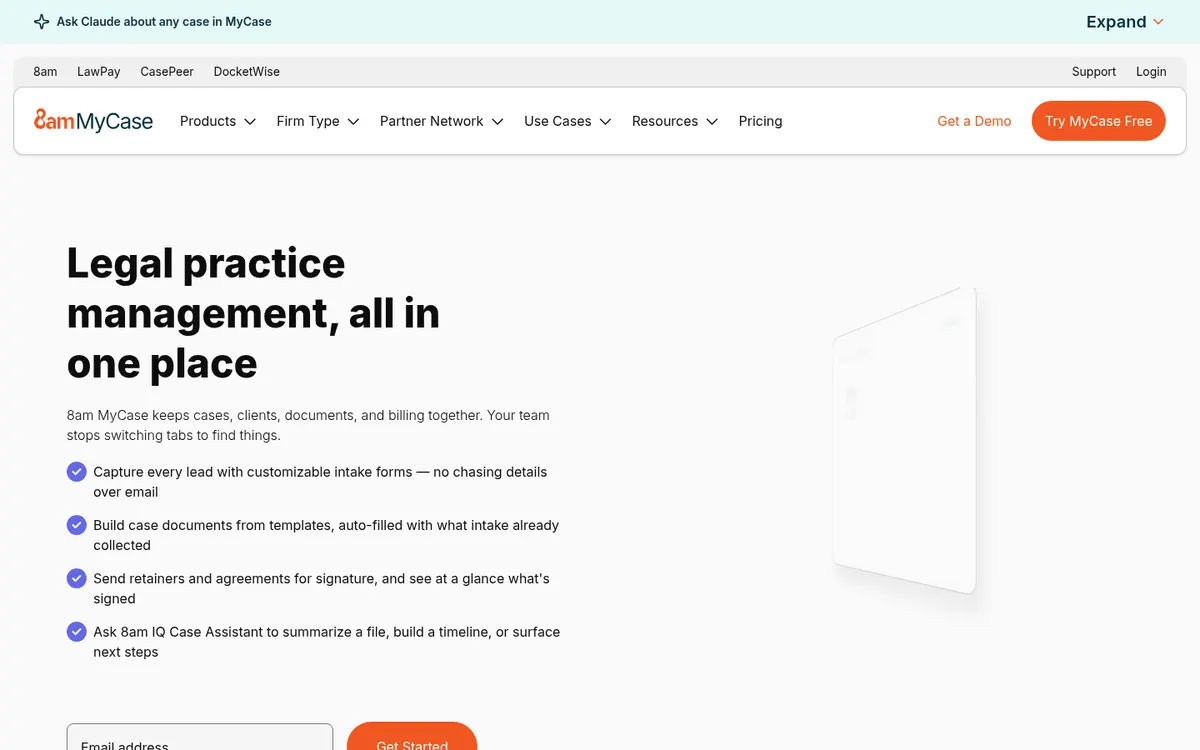
Best value for small firms that want cases, billing and trust-compliant payments behind one login rather than three subscriptions.
MyCase bundles case management, billing and a client portal behind one login, which removes a common source of duplicate entry at small firms. Timers capture time against a matter, rate rules set the right rate per matter type, and recorded entries become an invoice without rekeying. The client portal carries messages and documents, while online payments are native because the vendor shares ownership with a payment processor, with trust compliance built into the payment flow.
Pricing starts at $50 per user per month on Basic, billed annually. That places it within a dollar of Clio Manage's entry rate and makes the two direct competitors for the same buyer. LEDES export is restricted to the Pro tier and above, so firms billing corporate clients at mandated formats need to price that tier rather than the headline number, because the entry figure does not cover the requirement.
Against Clio Manage, reporting and customization are shallower. A firm that wants custom reports or unusual workflow automation will feel that limit within a few months of daily use. For a consumer-facing practice that wants cases, billing, payments and client communication in one place, the trade is usually worth taking, because collection speed matters more than report depth in that kind of work.
It fits small firms that want cases, billing and payments in one login, and it is a reasonable first system for practices moving off spreadsheets and email. The 10-day free trial requires no credit card and there is no free plan. Verify tier pricing and LEDES eligibility before purchase, since the plan boundary decides whether the product meets corporate billing requirements at all.
You want one login for matters, time, invoices, payments and client messages at a small firm.
You need LEDES on the cheapest plan or heavy custom reporting and automation.
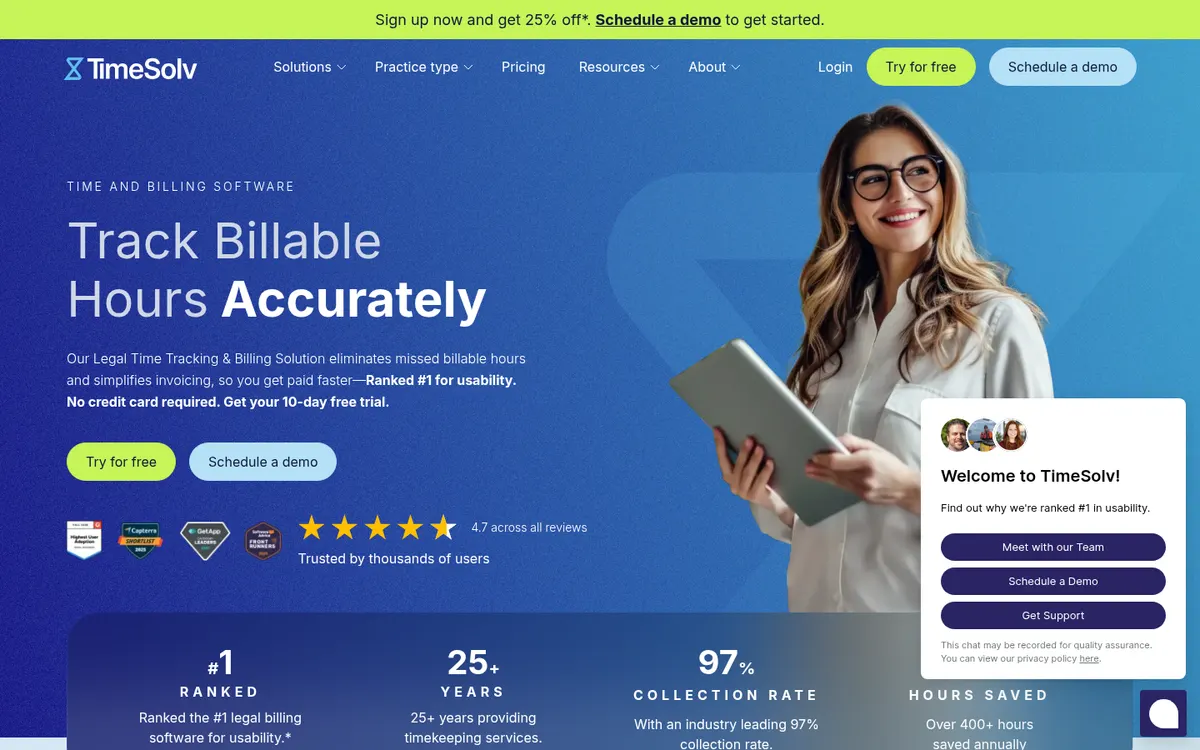
A billing-only engine that includes LEDES and trust accounting in the base product, for firms that manage matters elsewhere.
TimeSolv is a billing engine, not a practice management suite, and it is honest about that. Time is captured through desktop timers, rates can be structured in flexible ways, invoices can be run in batches, and budgets are tracked against recorded work. Native LEDES 1998B export and UTBMS task and activity codes ship in the base product, which matters for firms billing insurers and corporate clients that mandate those formats. Trust accounting is also in the base product rather than sold as an upgrade.
That packaging is the argument. Several tools on this list reserve LEDES export or trust accounting for a higher tier, so a firm has to buy up to get compliance features it cannot operate without. TimeSolv includes both at the base level and prices the product below the full practice management suites, which makes the arithmetic simple for a firm that already has its matters organized.
The limits are equally clear. There is no case management, no calendaring and no document management, so a firm still needs a system of record for matters, or at least a shared drive plus calendar discipline. The interface looks dated next to newer suites, and firms that want a client portal have to run a second product alongside it.
Pricing is on the vendor site. The page reviewed shows a feature matrix and add-on prices instead of a per-user plan rate, so a budget figure requires a conversation with sales and comparison shopping takes longer than with tools that publish a seat price. A 10-day free trial requires no credit card and there is no free plan. It fits firms that already handle matters elsewhere and want dedicated legal billing with native LEDES export.
Matters, calendars and documents already live in another system and you need compliant billing at a low price.
You want one product for cases, documents and a client portal, or you need a published rate to get budget approval.
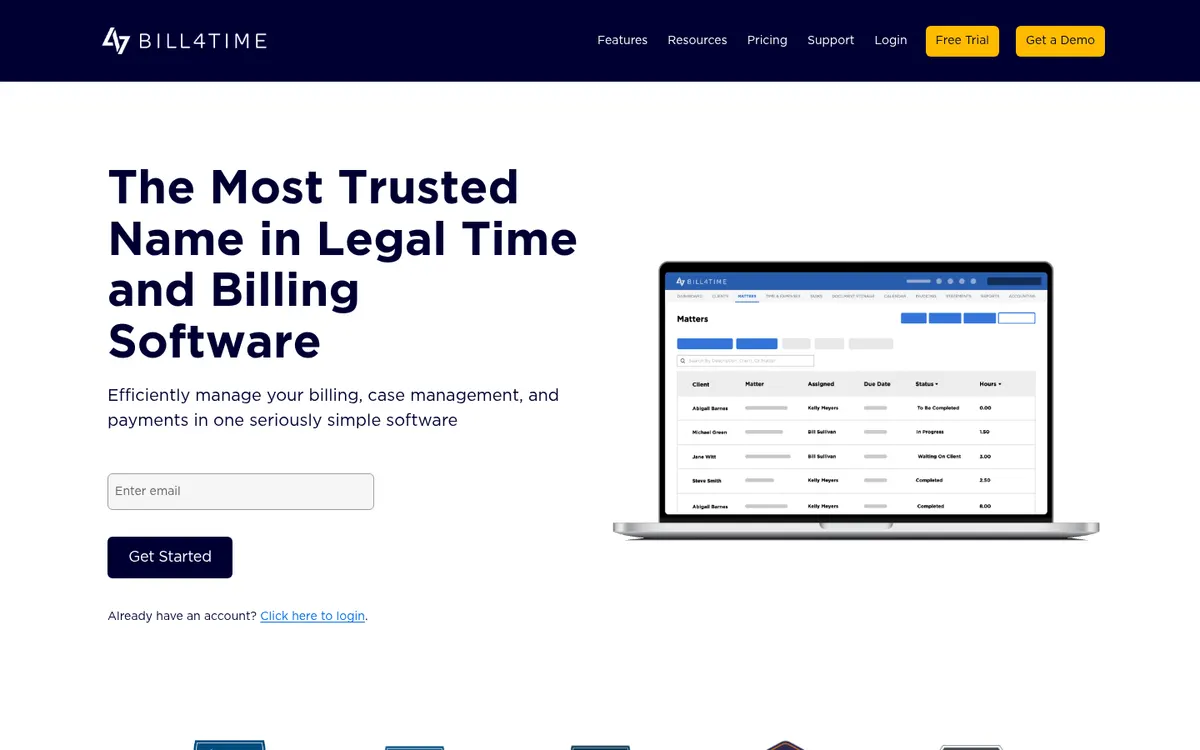
The cheapest route into hourly billing for a solo, provided no client funds and no LEDES requirement land in year one.
Bill4Time is the cheapest way into hourly billing on this list, and it behaves like it. Time entries, invoice creation and delivery, a mobile app for capture away from the desk, online payment collection and basic reporting cover the workflow a solo attorney actually runs. Setup takes hours rather than weeks, which is the point: a new practice can start billing the same week it signs up rather than at the end of a migration project.
Pricing starts at $39 per user per month on the Time and Billing plan, billed annually. That headline rate does not include trust accounting or LEDES export. Both sit on the higher Legal Pro plans, so a solo who holds client funds in trust, or who bills a corporate client that requires LEDES, has to price the higher tier before comparing it with Clio Manage or MyCase. People who set the $39 figure beside a full suite's entry rate are comparing two different products with different contents.
Reporting is basic. Firms that want realization, utilization or profitability by attorney will exhaust the reports quickly and export to a spreadsheet, which is workable for one attorney and painful for five. Feature depth trails the full suites, and that gap shows up as the firm adds staff and needs shared workflows, document management and a client portal.
The product fits solo attorneys who need simple time and billing, want a short learning curve and do not need case management on day one. A 14-day free trial requires no credit card and there is no free plan. Check tier contents on the vendor site before purchase, because the difference between the headline price and the price of the tier you actually need decides the purchase.
You bill hourly, work alone and want a low entry price with a fast start.
You hold client funds in trust, bill corporate clients in LEDES, or need reports beyond the basics.
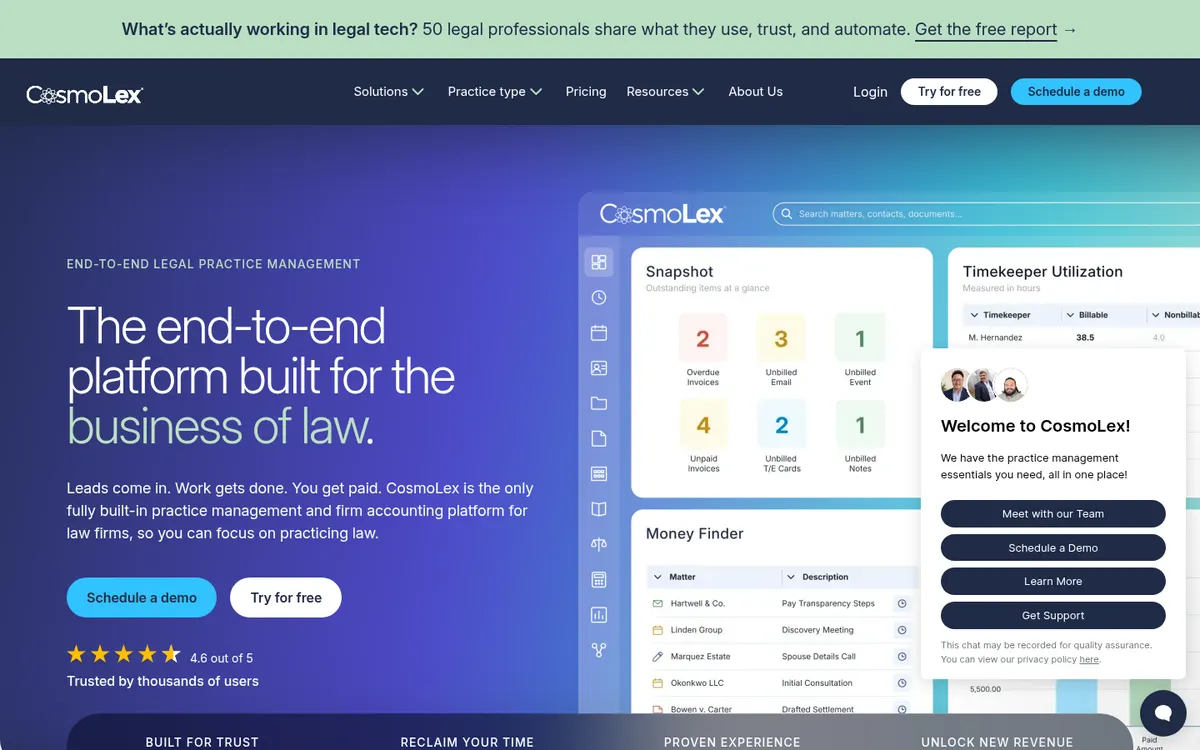
A genuine QuickBooks replacement with native three-way trust reconciliation, worth the workflow change where trust audits are strict.
CosmoLex is built around a full general ledger rather than a sync to someone else's accounting product. Operating and trust accounts, a native three-way trust reconciliation, time tracking and billing that post directly into the books, and compliance-focused reporting all live in one system. There is no QuickBooks dependency, which means no mapping table to maintain and no duplicate entry between the billing side and the bookkeeping side.
Pricing starts at $49 per user per month on the Launch plan, which sits below the Core tier. That entry rate is above several all-in-one competitors at headline level, though the comparison is unfair in one respect: the rate covers accounting a firm would otherwise buy separately as an accounting subscription plus bookkeeper time.
The real cost is workflow change. A bookkeeper who has run QuickBooks for years will need to learn a different set of screens, and some firms keep QuickBooks for payroll and tax work regardless. Scope and cost can exceed what a very small firm needs, particularly a solo who does not hold client funds and bills a handful of clients a month. Adopting it changes how the month closes, which is a change to plan for rather than a defect in the product.
Where trust account audits are strict, the native three-way reconciliation is the reason to buy, and it is the strongest trust story on this list alongside LeanLaw's QuickBooks-based approach. It fits firms that want built-in accounting and trust compliance without QuickBooks. There is no free plan and the trial requires no credit card. Discuss the bookkeeper's workflow before purchase, then verify current pricing on the vendor page.
Trust account audits are strict and you want accounting plus billing in one system without QuickBooks.
Your bookkeeper and CPA are committed to QuickBooks, or you only need billing.
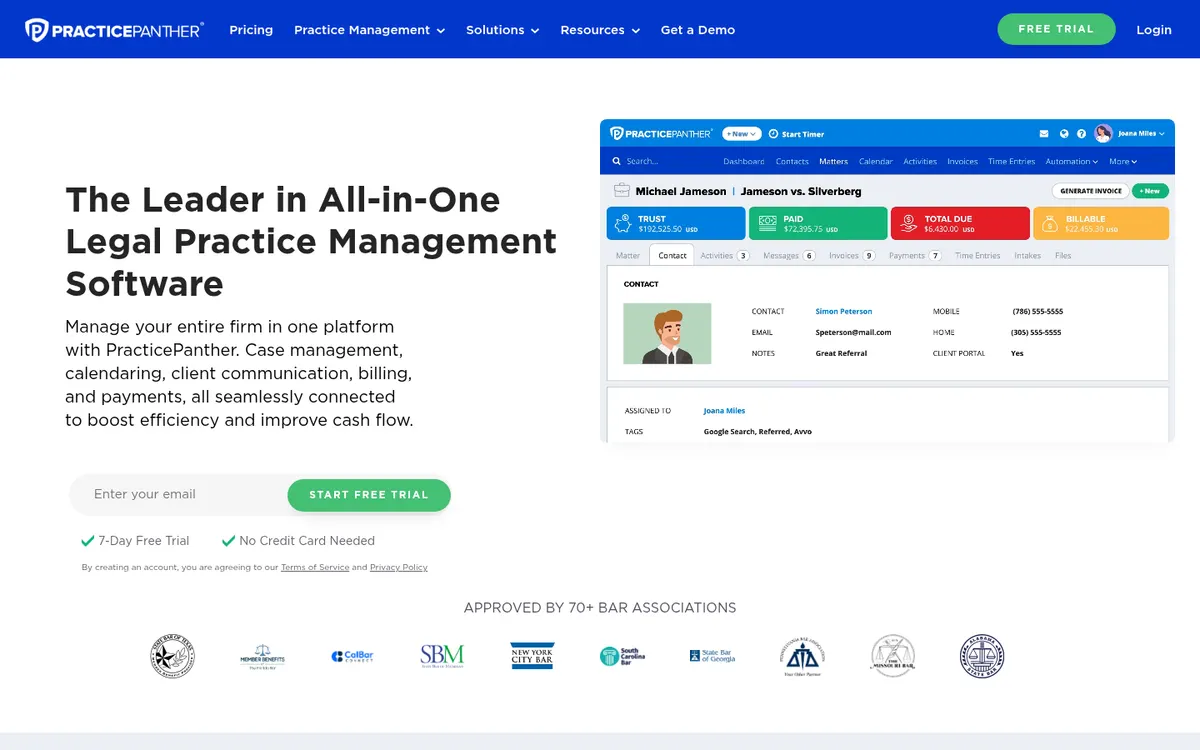
A modern all-in-one at a competitive entry rate, though corporate billers must budget for the Business tier to get LEDES.
PracticePanther sells the all-in-one promise at an entry rate below comparable suites. Time tracking and invoicing, trust accounting, online payments, matter management and Kanban-style task workflows arrive in one product, and two features stand out for small firms: email filed automatically to the correct matter, and intake automation with follow-ups that keeps a new inquiry from going cold.
Pricing starts at $49 per user per month on the Solo plan. LEDES export, however, only appears on the Business plan. A firm that bills corporate clients at mandated formats must budget for the higher tier, and comparing the Solo rate with a competitor's corporate-ready tier misleads. Firms doing consumer work such as family law, immigration, personal injury or small business advising rarely need LEDES and can stay on the lower tier without a gap.
Trust features are present but less deep than CosmoLex or Clio Manage. A firm with complex trust activity, multiple trust accounts or frequent three-way reconciliation should test that area carefully during the trial rather than assume parity with accounting-led products.
The modern workflow feel is genuine. Kanban boards for tasks and matters suit practices that track cases by stage, and automatic email filing removes a chore that consumes hours a week at firms still dragging messages into folders by hand. It fits budget-conscious small firms that want one platform for matters, time, billing and payments and do not need corporate LEDES formats on day one. There is no free plan and the 7-day free trial is shorter than most here. Confirm tier limits on the vendor site before committing.
You want one affordable platform for matters, time and payments and bill consumers rather than corporations.
You need LEDES at entry level, deep trust reconciliation, or a longer trial before committing.

Passive capture recovers hours other tools lose, but quote-only pricing makes it the hardest product here to budget for.
Smokeball attacks the oldest problem in legal billing: hours that were worked but never recorded. Passive time capture watches activity in Word and Outlook and turns recorded activity into suggested time entries, so an attorney reviews a list instead of starting a timer from memory. Invoice generation is largely automated after capture, and a secure client portal handles file sharing and client communication. Matter and document management come with the product, so a firm can consolidate a document store and a billing tool.
That design suits high-volume small practices where attorneys move between documents and email all day: family law, conveyancing and personal injury. Firms in that shape typically recover additional billable time in the first months, which is the vendor's central claim and the reason to run the free trial on real work rather than on a demo file.
Pricing is quote based with no published rates. That is the main obstacle for a buyer. Comparison shopping requires a sales conversation, budget approval takes longer, and a firm cannot check a rate sheet at renewal without asking. The integration ecosystem is smaller than Clio Manage's, so firms that depend on a specific accounting or document product should confirm support before trialing.
It fits small firms that want automatic passive time capture and will accept a sales-led buying process to get it. There is no free plan and the trial is available. If published per-user pricing and a wide integration catalog are requirements, look at Clio Manage or Rocket Matter instead.
Your attorneys work in Word and Outlook all day and lose billable time they never recorded.
You need a published per-user rate before you can compare tools.
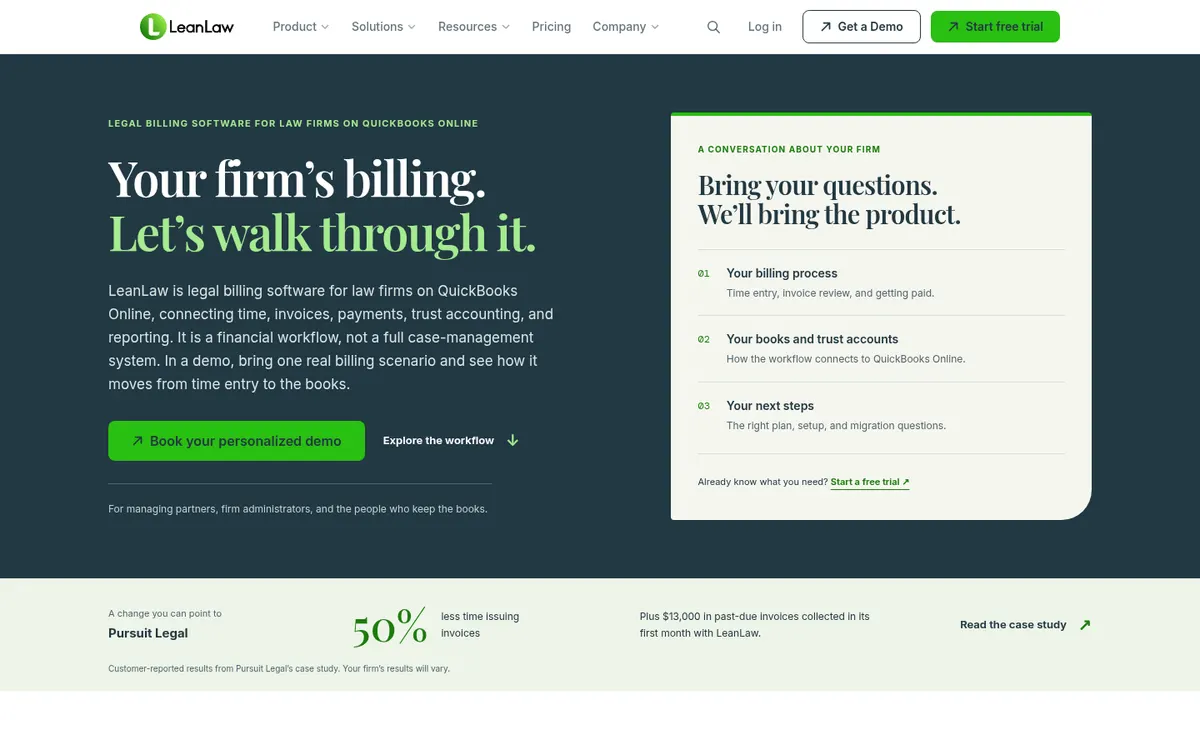
The right answer for QuickBooks Online firms that want legal billing and two-way sync without a second ledger.
LeanLaw treats QuickBooks Online as the accounting core and layers legal billing on top. Time entries and invoices are legal-specific, but they post through a real-time two-way sync, so the bookkeeper sees the same numbers the attorney bills from. Native three-way trust reconciliation and trust transaction posting into the books mean trust activity is not tracked in a spreadsheet on the side. Financial reporting leans toward accounting accuracy rather than practice analytics.
Pricing starts at $55 per user per month on the Core plan. That is higher than several full suites' entry rates, and the comparison only makes sense if the firm already pays for QuickBooks Online and values the two-way sync. For a firm with a CPA or bookkeeper already working in QuickBooks, the arithmetic usually works: no duplicate entry, no reconciliation project at month end, and no second ledger to audit.
The requirement is absolute. LeanLaw needs QuickBooks Online, so a firm on desktop QuickBooks, on another ledger, or on no accounting product at all cannot use it. Case management is lighter than Clio Manage or MyCase, and firms that want deep matter workflows, document automation or a client portal must pair it with another tool. Billing sits on top of QuickBooks rather than replacing it, which is the whole point and also the whole limit.
It fits firms whose accounting already runs on QuickBooks Online and that want billing built for law firms rather than a generic invoicing app. There is no free plan and a free trial is offered. Confirm current per-user pricing on the vendor page, since the Core tier rate has moved.
QuickBooks Online is already your accounting core and you want trust-safe legal billing on top of it.
You do not run QuickBooks Online or you want case management and a client portal in the same product.
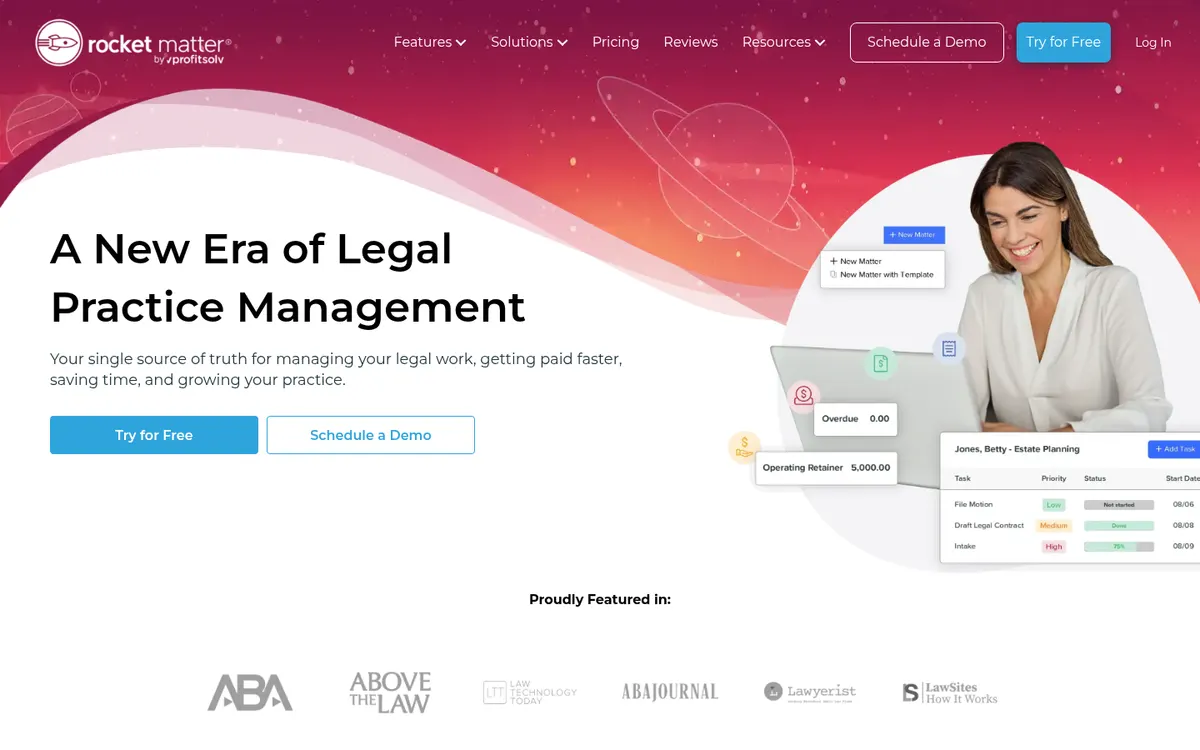
A mobile-first billing tool that includes trust accounting and LEDES in its entry tier, at the highest published rate here.
Rocket Matter has been in the category a long time, and its mobile experience is the reason many attorneys stay. One-click timers and quick time entry work on a phone, matter details are reachable from a courtroom or a client site, and captured time flows into invoicing without a desktop step. For attorneys who bill from the road, that is not a convenience, it is the difference between recorded and lost hours.
Pricing starts at $59 per user per month on the Essentials plan, paid annually. That is the highest published entry rate on this list, above Clio Manage, MyCase, CosmoLex and PracticePanther. Trust accounting and LEDES support are included rather than tiered up, which partly explains the rate and matters to firms holding client funds or billing corporate clients at mandated formats.
Kanban boards organize matters by stage, and reporting is functional rather than advanced. A firm that wants utilization dashboards and custom report building will find reporting thinner than Clio Manage's higher tiers and will export to a spreadsheet to get the view it wants. The integration catalog is also smaller than Clio Manage's, so firms that run on a specific accounting, document or e-signature stack should review the list before committing.
The vendor footprint is smaller overall, which affects how much third-party material and peer community a buyer can find when something breaks. It fits attorneys who bill heavily from mobile devices and want trust accounting and LEDES support included in the entry tier. There is no free plan and a free trial is offered. Verify pricing on the vendor page before purchase.
You capture most billable time on a phone and want trust accounting and LEDES without buying up a tier.
You need advanced reporting, a wide integration catalog or the lowest entry price.
Legal time and billing software records billable work, turns it into invoices and keeps the money movement compliant with bar rules. That last part is what separates it from a general-purpose time tracker. A law firm does not just need hours counted; it needs hours tied to a matter, rates that vary by client and by task, invoices a client will actually pay, and a trust account ledger that survives an audit.
Four things show up in almost every serious product:
The category splits into two shapes. All-in-one practice management suites such as Clio Manage, MyCase, PracticePanther and Rocket Matter run time and billing alongside matters, calendars and documents. Dedicated billing products such as TimeSolv do billing only and are meant to sit beside a separate system of record for matters.
Accounting is the second fault line. Some products replace QuickBooks with a built-in general ledger, as CosmoLex does. Others treat QuickBooks Online as the accounting core and sync in both directions, which is LeanLaw's approach. A third group syncs one way only, which shifts reconciliation work back to the firm and its bookkeeper.
General-purpose time trackers fall short on all of this. They count minutes but know nothing about matters, trust compliance, rate rules or LEDES, so the firm ends up rebuilding the invoice in a spreadsheet and hoping the trust ledger matches.
None of the nine tools here offers a free plan. Trials are common and run from 7 to 14 days, which is long enough to record real time and produce a real invoice before signing.
This comparison sits on the Software desk. Readers comparing neighbouring stacks often check our guides to demand forecasting software and glp 1 companies next.
Pricing in legal billing software is per user per month, with two exceptions on this list, and the entry rate almost never covers what a corporate client or a trust account requires. Published entry rates for the nine tools run from $39 to $59 per user per month. TimeSolv and Smokeball publish no per-user rate, so a budget figure requires a sales conversation.
The trap is tier gating. Bill4Time at $39 excludes trust accounting and LEDES, which sit on the Legal Pro plans. PracticePanther at $49 puts LEDES on the Business plan. A firm comparing entry rates across this list is comparing products with different contents, and the honest comparison prices the tier that includes the compliance features the firm actually needs.
| Model | How it bills | Typical fit | Example from this list |
|---|---|---|---|
| Per user, per month, entry tier | Published seat rate, features gated by tier | Solos and small firms starting out | Bill4Time at $39, Clio Manage at $49 |
| Per user, per month, billed annually | Seat rate with an annual commitment | Firms comparing entry cost across tools | MyCase at $50, Rocket Matter at $59 |
| Per user, per month, upper tier | Higher seat rate buys compliance and reporting | Corporate billing and multi-attorney firms | PracticePanther LEDES on the Business plan |
| Accounting replacement | One rate covers billing and a general ledger | Firms replacing QuickBooks | CosmoLex at $49 on Launch |
| Accounting add-on | Billing rate layered on an existing QuickBooks Online subscription | Firms with a bookkeeper already on QuickBooks | LeanLaw at $55 on Core |
| Quote only | Sales conversation sets the rate | Firms with complex or larger deployments | TimeSolv and Smokeball |
Two structural costs sit outside the subscription. CosmoLex replaces QuickBooks, so its $49 per user rate covers accounting a firm would otherwise buy separately; the firm drops a subscription but changes a bookkeeper's workflow. LeanLaw requires QuickBooks Online, so its $55 per user rate is additive to an existing QuickBooks bill.
The billing term also moves the number. MyCase at $50 and Rocket Matter at $59 are quoted billed annually, while several competitors publish monthly rates, so a like-for-like comparison needs the same term in every row. Watch renewals too: Clio Manage's guidance notes a ten-person firm on a mid-tier plan can exceed a thousand dollars per month, far from the $49 entry figure.
Every price above was checked on the vendor's own pricing page on November 25, 2026. Where a vendor does not publish a figure we write "See website" instead of guessing. To compare annual and monthly billing quickly, try the free percentage calculator.
Start with trust. If you hold client funds, trust accounting and three-way reconciliation are requirements, not upgrades. Confirm they ship in the tier you price, since Bill4Time and PracticePanther hold some compliance features above entry level.
Decide who owns the books. If a bookkeeper or CPA already works in QuickBooks Online, LeanLaw at $55 adds legal billing on top. If you want one system and no sync, CosmoLex replaces QuickBooks with a general ledger.
Answer the LEDES question. Corporate clients and insurers often mandate LEDES invoice formats. TimeSolv includes LEDES 1998B in its base product, while Bill4Time, PracticePanther and MyCase put LEDES on higher tiers. Price that tier before comparing.
Choose a suite or a billing engine. TimeSolv does billing only and needs a separate system for matters, calendars and documents. If you have no such system today, start with a suite such as Clio Manage, MyCase or PracticePanther.
Test capture on real work. Run the trial on live matters, not sample data. Watch whether attorneys record time without reminders. Smokeball's passive capture and Rocket Matter's mobile timers target that problem directly.
Price year two, not day one. Entry rates run from $39 to $59 per user per month, but reporting, automation and compliance tiers cost more. A ten-person firm can exceed a thousand dollars a month on a mid-tier plan at Clio Manage.
Buy all-in-one unless you already run matter management you like. A suite such as Clio Manage, MyCase or PracticePanther keeps time, trust accounting, calendars and documents in one system, which removes duplicate entry. A billing-only product such as TimeSolv makes sense when matters, calendars and documents already live somewhere else and you mainly need LEDES and trust accounting.
LEDES is an electronic invoice format that corporate clients and insurers use to load legal bills into their own systems. UTBMS codes label tasks and activities so those clients can analyze spending by phase. If you bill a company that mandates either format, LEDES export is a buying requirement rather than an extra. On this list it is native to TimeSolv and included at Rocket Matter, while Bill4Time, MyCase and PracticePanther gate it to higher tiers.
Client funds go into a trust account and cannot be treated as firm revenue until they are earned. Three-way reconciliation proves that the trust ledger, each client's ledger and the bank statement agree, and it is the check bar auditors ask for. CosmoLex and LeanLaw build it in natively. Clio Manage, MyCase, TimeSolv and Rocket Matter also cover trust accounting, so confirm the tier contents.
Replacing means the billing product keeps the general ledger, so there is one book and no sync. CosmoLex takes that route. Syncing means QuickBooks stays the accounting core and billing posts into it. LeanLaw syncs both ways in real time. Clio Manage syncs one way only, which leaves reconciliation work with the firm. Choose based on who closes the books today.
Published entry rates on this list run from $39 to $59 per user per month, checked on November 25, 2026. Bill4Time starts at $39, Clio Manage, CosmoLex and PracticePanther at $49, MyCase at $50, LeanLaw at $55 and Rocket Matter at $59. TimeSolv and Smokeball publish no per-user rate. Compliance features and reporting usually sit above the entry tier.
None of the nine tools here has a free plan, but all offer a trial. Lengths vary: Clio Manage and PracticePanther give 7 days, MyCase and TimeSolv give 10 days, and Bill4Time gives 14 days, all without a credit card. Smokeball, LeanLaw, CosmoLex and Rocket Matter also offer a free trial, with CosmoLex stating no credit card is required.
Browse every comparison on the Software desk, with the same rubric and dated prices.