Ranked #1

Second Nature
Certification tracking
See website
- Best for
- Enterprise onboarding and certification at scale
- Free plan
- Trial only
- Rubric
- 7.7 / 10
Hyperbound splits practice from call scoring. These nine tools each take a different route to the same job: getting reps ready before the call and better after it.
 Prices checked November 25, 2026
Second Nature is the strongest fit for enterprise onboarding and certification at scale, Mindtickle suits teams consolidating roleplay, content and coaching into one suite, and PitchMonster fits SDR and AE onboarding where reps must clear a score gate before going live. That order is editorial, based on fit for the buyer each entry describes, as of November 2026. Pricing was checked on 2026-11-25. Most of the nine tools below center on AI sales roleplay, though Showpad is a field enablement platform with coaching attached. They differ most on compliance depth, certification tracking, seat pricing and how much of a manager's job they take on.
Certification tracking
See website

Suite consolidation
See website

Two-way AI debrief
See website (custom quote)
Disclosure for this page: All 9 tools here are unpaid editorial picks. The position of a paid listing can be part of what the vendor pays for. How we handle paid listings.
| Tool | Best for | Free plan | Actions | |||
|---|---|---|---|---|---|---|
| 1 | Second Nature | Enterprise onboarding and certification at scale | See website | No | ||
| 2 | Mindtickle | Consolidating revenue enablement into one suite | See website | No | ||
| 3 | PitchMonster | Onboarding and certifying SDRs and AEs, from growing teams to enterprise | See website (custom quote) | No | ||
| 4 |  Allego | Video practice and peer learning | See website | No | ||
| 5 | Yoodli | Affordable communication coaching for smaller teams | Pro $8 per month billed annually | Yes | ||
| 6 |  Quantified | Regulated life sciences and pharma commercial teams | See website | No | ||
| 7 |  Kendo | Fast-moving SMB and mid-market sales teams | See website | Yes | ||
| 8 |  Outdoo | Teams that want practice tied to real-call results | See website | No | ||
| 9 |  Showpad | Field enablement and coaching | See website (custom quote) | No |
Each tool was scored against five criteria, weighted for what decides a purchase in this category. Roleplay realism takes 25 percent: how convincing the AI buyer is and how much control a manager has over the scenario. Coaching depth takes another 25 percent, because a score without an explanation does not change behavior. Certification tracking takes 20 percent, covering score gates, audit trails and LMS connectors. Integrations take 15 percent, weighted toward CRM, dialer, conferencing and learning systems already in place. Pricing clarity takes the last 15 percent: whether a buyer can see a price, a free plan or a trial before booking a call.
Prices, plans, free tiers and trial terms come from vendor pricing pages checked on 2026-11-25. Where a page listed no figure, this article says so rather than estimating. Several entries quote per seat after a demo, and two state that no pricing page exists at all.
The order is editorial. Each entry is placed by fit for the buyer it describes, together with the disclosed Featured position, not by a weighted total. One position in this list is a paid Featured placement. It was scored with the same rubric as every other entry, and its cons are listed as plainly as anyone else's.
Every strength and limitation above comes from vendor material or the pricing page reviewed on the date shown. Where a vendor makes a claim we could not verify, the review says that too.
The full process, including how we handle corrections, is on the methodology page. Paid listings follow our advertising disclosure.
| Criterion | Weight | What we check |
|---|---|---|
| Roleplay realism | 25% | How convincing the AI buyer personas are and how much scenario control a manager actually gets. |
| Coaching depth | 25% | Whether feedback goes past a score to explain the specific error and the next step. |
| Certification tracking | 20% | Score gates, audit trails and LMS connectors that let a team prove readiness before reps go live. |
| Integrations | 15% | Connections to the CRM, dialer, conferencing and learning systems a team already runs. |
| Pricing clarity | 15% | Whether a buyer can see a price, a free tier or a trial before sitting through a demo. |
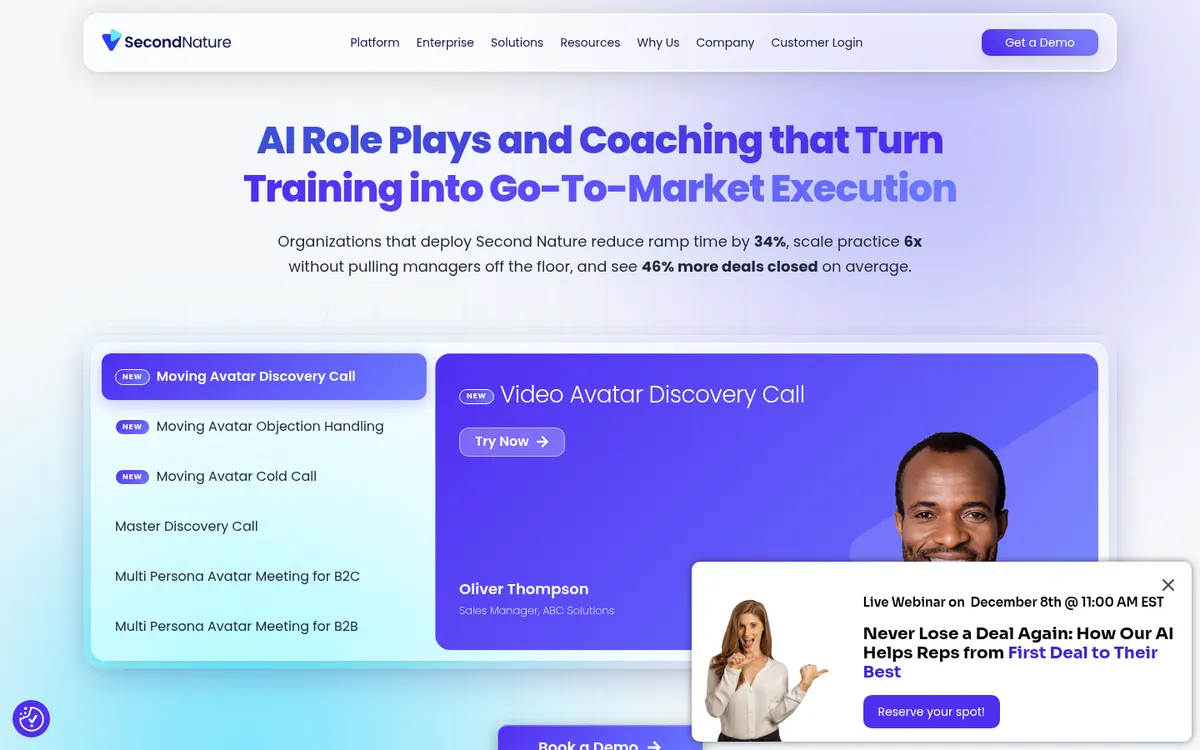
Best when you must certify a large, distributed field force and need proof of readiness, not just practice reps.
Second Nature runs conversational AI buyer personas that talk back. A rep opens a session, gets a buyer with an objection pattern and a goal, and has to work through discovery, pitch and close in something close to a real call. The vendor reports scenarios can be assembled in roughly 15 minutes, which matters when a product launch lands and enablement has a week to build practice for it.
Feedback is the part that separates it from a recording tool. The system flags specific errors in the moment, including the familiar one where a rep pitches before asking a single discovery question. Managers get a dashboard that surfaces where each rep keeps slipping, so coaching time goes to the pattern rather than the last call someone happened to hear. Certification programs are gamified, which the vendor uses to lift completion across large teams.
The certification tracking is the strongest reason to buy it. Records can flow into an existing learning system through SCORM or LTI connections, so a compliance or launch certification lives where the rest of the training lives. That saves the enablement team from maintaining a second record set, and it gives auditors a single place to look.
Pricing is the friction. The vendor publishes no rates, quotes are built for large organizations, and the pricing page returned no readable text when checked on 2026-11-25, so no number could be confirmed. A small team that wants a fast practice tool will find the scope larger than it needs, and a trial is the only way in without a sales conversation. Enterprise buyers with a certification deadline are the natural fit.
You need defensible certification records for a large field force and already run an LMS.
You want a self-serve tool you can price and start this week.
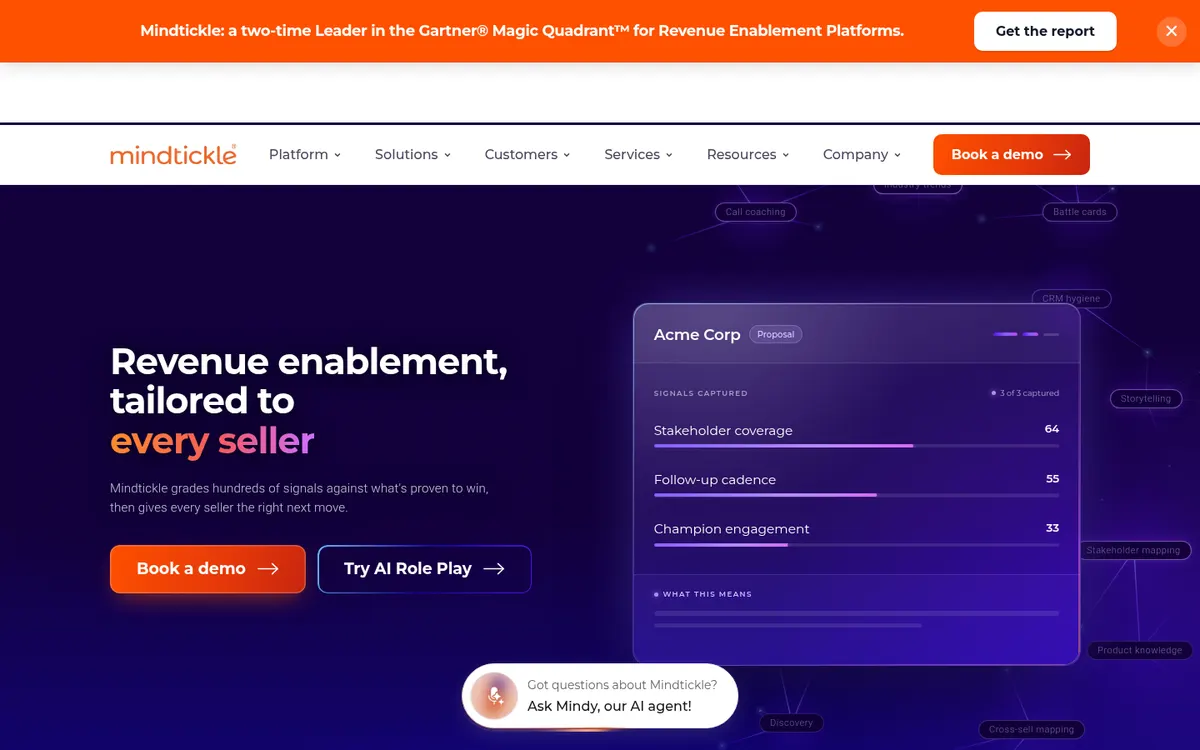
The pick when roleplay is one part of a wider enablement consolidation and you want live call data feeding practice.
Mindtickle is the broad option: roleplay, a content library, certification and readiness scoring, coaching on active deals and conversation intelligence on live calls, all under one contract. The AI roleplay module lets reps practice against buyer personas, and the pitch is that roleplays can be wired to live deal data, so a practice scenario reflects the account a rep is actually working this week.
The coaching layer is where the suite earns its keep. Instead of a separate manager dashboard for practice and another for calls, scores from real conversations sit next to scores from simulations. A manager can see that a rep handles a simulated pricing objection well and folds on the real ones, which is a harder pattern to spot when the two systems live apart. Certification and readiness scoring cover the onboarding case.
The cost of that breadth is implementation. A suite touching content, learning and call recording needs a rollout plan, an admin owner and integration work, and quote-based pricing means you cannot size the deal from the website. The entry point is a demo, and the evaluation usually involves several stakeholders beyond sales enablement.
Mindtickle fits organizations that already know they want to replace a content system or an LMS at the same time as they buy practice. If you only need reps to run five roleplays a week before a launch, the suite is more machinery than the job requires. Pricing was not published on the page checked on 2026-11-25, and there is no free plan or self-serve trial.
You plan to retire a content or learning system in the same buying cycle.
Roleplay is the only problem you are trying to solve.
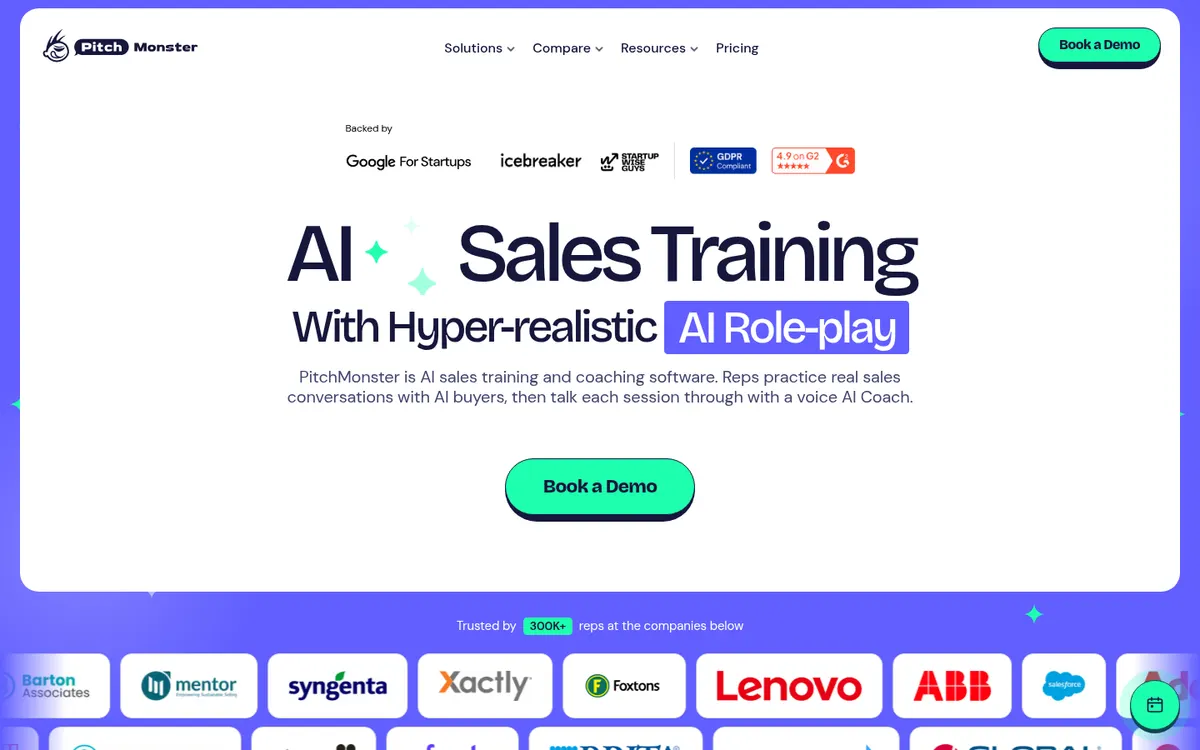
Best for SDR and AE onboarding where a minimum score gate decides whether a rep talks to buyers.
PitchMonster is built around a specific sequence: practice, debrief, then score. After each roleplay the AI Coach gives a spoken debrief before the rep sees the number, so feedback lands as a conversation about what happened rather than a grade with no explanation attached. The rep then sees the score and what drove it.
Scenarios can come from the team's own material: call recordings, transcripts, scripts and objection libraries, plus files, website content or CRM data, or a rep can describe a scenario by voice. Roleplays run over phone, video avatar or screen share, which covers the three ways reps actually talk to buyers. The AI buyer's difficulty is adjustable from Easy to Insane, useful when you want a new rep to survive a first session and a tenured rep to be genuinely tested.
The certification mechanism is a minimum score gate on key scenarios before a rep goes live. That is a stronger commitment than a dashboard nobody reads, and it is why the tool suits SDR and AE onboarding. Real call analysis sits on the same scorecard on the larger plan, so practice and live conversations can be read the same way.
Practice runs in 29 languages. Salesforce and SSO are on both plans, with Gong, LMS and webhook connections on the larger one. The vendor lists GDPR, EU data residency and SOC 2, and names SThree, Mentor Group and PRN Health Services as customers. Pricing is the catch: both plans are per seat and only quoted after a 15 minute demo call, and there is no single user plan. A trial exists, but it is arranged through that demo.
You want reps blocked from live calls until they clear a real score threshold.
One person needs a cheap practice tool with a card checkout.
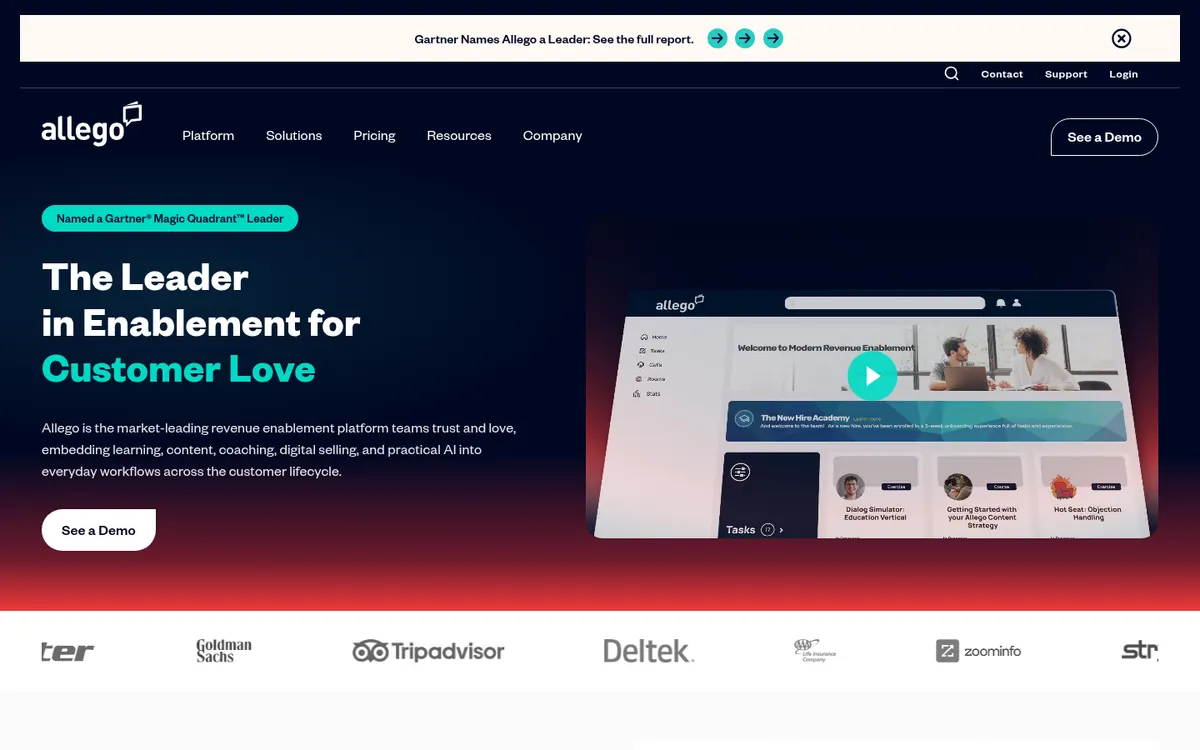
Best when your team already believes peer video is how coaching happens and wants it inside a wider enablement platform.
Allego comes at practice from video. Reps record themselves handling a scenario or a pitch, peers and managers review, and top performer recordings become the benchmark everyone else is measured against. It is a different mechanic from a conversational AI buyer: the rep is not reacting to a live counterpart, but video lets a team show what good looks like rather than describe it in a rubric.
AI pre-scoring sits in front of manager review, so a manager sees a summary and the flagged moments instead of scrubbing through every submission. Coaching workflows, a content and learning hub, and a digital selling workspace sit around that core. The vendor says teams can go live in as little as six weeks and consolidate seven or more tools, which is the consolidation argument rather than the pure practice argument.
That framing matters. Allego is closer to a revenue enablement platform with a strong practice component than to a dedicated AI roleplay tool, and buyers who want reps arguing with a simulated buyer will notice the difference in a demo. Customer success support is included rather than billed separately, which is unusual enough to confirm in the contract before you sign.
Pricing is per user per month billed annually, but no actual price points are published, so the page checked on 2026-11-25 confirmed the billing model and nothing more. There is no free plan and no trial. The best fit is a team that already runs peer video review, or wants to start, and prefers one platform for learning, content and practice over a narrower roleplay specialist.
Peer video review is already how your managers coach and you want it formalized.
Reps need to rehearse against a talking AI buyer, not record themselves.
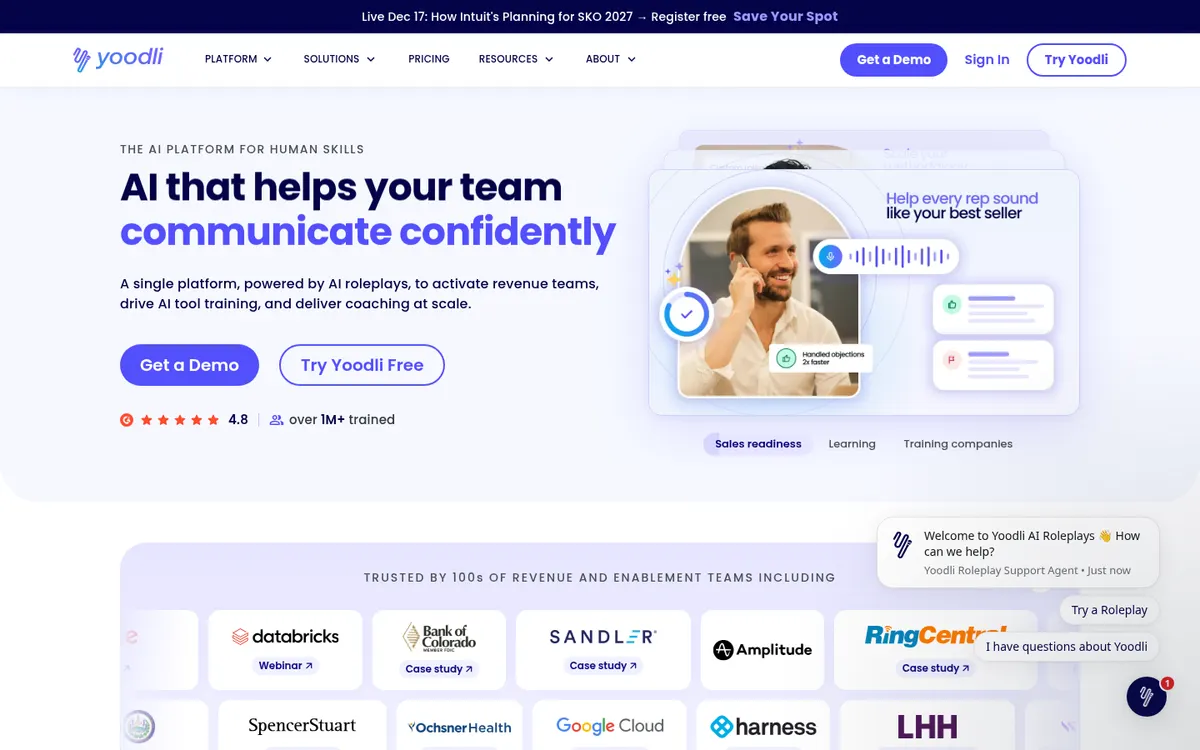
The clear value pick: a published $8 per month Pro plan, a free tier and a broad set of integrations.
Yoodli is the value entry on this list and the only one with a published starting price: Pro at $8 per month billed annually, alongside a free Starter plan. There is no separate trial because the free tier does that job. Team plans stay quote based, so larger buyers still follow the usual demo path when seats go past a handful. The product covers three jobs. Graded AI roleplays handle practice. Coaching tied to real calls handles what happens on live conversations. Screen-based guidance walks a rep through learning material while they work in an application, and full learning programs can be generated from a single prompt, which shortens the build for a manager who has the content but not the time to assemble a course. Integrations cover the tools most teams already run: Zoom, Google Meet, Teams, Slack, Salesforce, HubSpot and Gong. It is also usable beyond sales, so customer success, partner and leadership teams can share one tool rather than buying a second product for each function. The trade off is methodology. Yoodli leans toward general communication skills, filler words, pace, clarity and structure, rather than a specific sales framework with stage gates and formal certification. A team that must prove every enterprise AE cleared a discovery certification will find that side thinner than Second Nature or PitchMonster. The vendor positions it as the lower cost option with the most capability per dollar, a claim worth testing against your own scenarios. Free tier availability is referenced rather than confirmed on the page checked on 2026-11-25, so verify it before you plan a pilot around it.
You want to start this week on a small budget and expand later.
You need audited certification gates for a regulated field force.
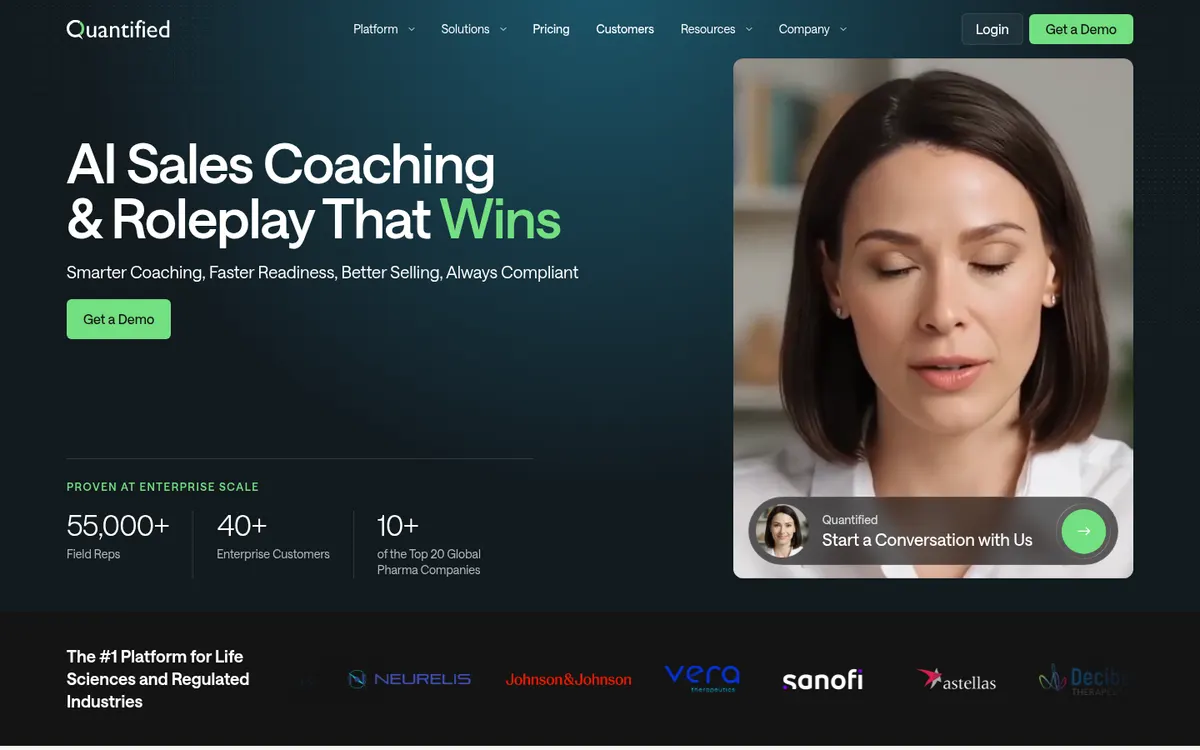
The only entry built for life sciences compliance, and it is worth little outside regulated commercial teams.
Quantified is the specialist. It is built for life sciences commercial teams, where the risk of practice is not a badly handled objection but a rep saying something off-label in front of a physician. The compliance AI checks every response against approved messaging, flags off-label language, and verifies fair balance and safety language in the same pass.
Personas are written for the audience those reps face: physician specialties, payers and formulary committees. Scenarios and rubrics can be self authored from approved material, so medical, legal and regulatory review happens once on the source content rather than on every scenario a manager writes. Certification records carry an audit trail, which is the difference between saying the field force was trained and being able to show it to a reviewer.
The vendor's established pharma customers use it for launch certification of large field forces inside short windows, which is the use case the product is shaped around. A launch date does not move, and a certification program that cannot be audited is a liability rather than an asset.
The feature list stays deliberately narrow, with no integrations described in the material reviewed, so expect it to sit alongside the sales stack rather than replace part of it. Outside regulated industries there is little reason to buy, and the white glove service model means a higher touch sales process than a self-serve tool. No pricing page exists, so no price could be confirmed when checked on 2026-11-25, and there is no free plan or self-serve trial. Budget for a considered purchase and a scoped pilot.
Medical, legal and regulatory review is a hard gate on every word a rep says.
You sell software and just want reps to handle objections better.
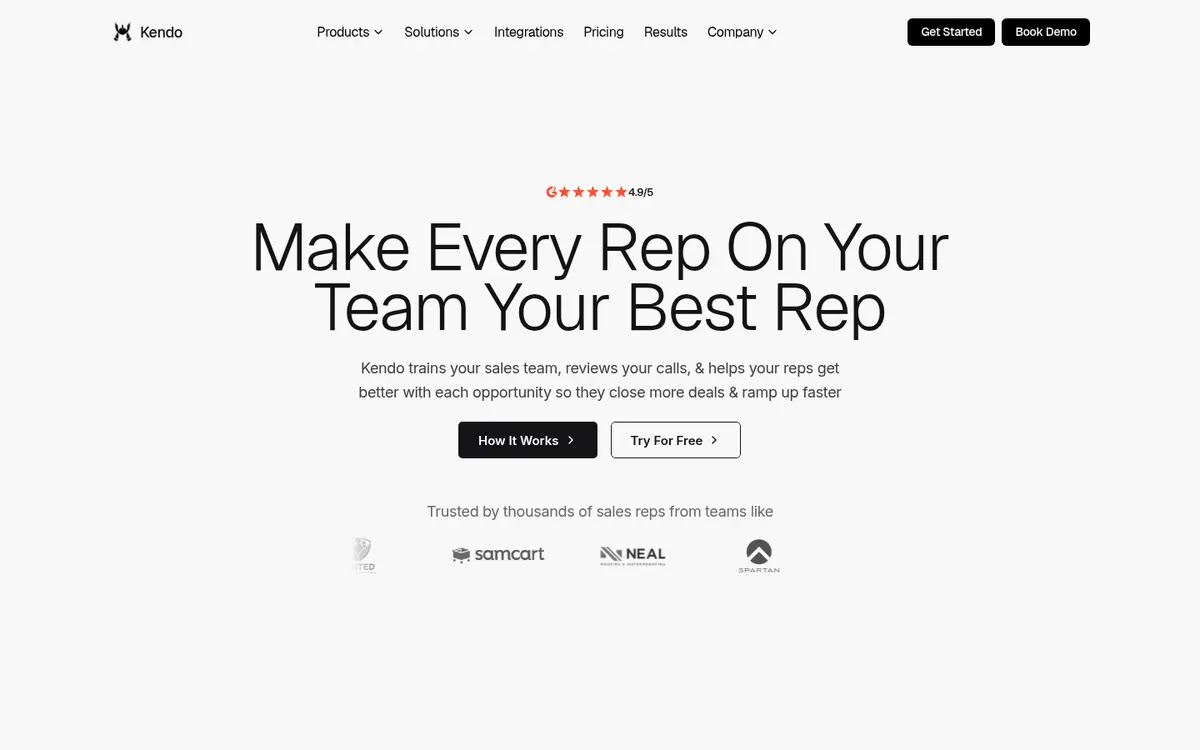
Best free entry point for an SMB that wants roleplay, call review and an AI manager without a procurement cycle.
Kendo bundles three things usually sold separately: AI prospect roleplay, automatic review of real calls, and an AI sales manager that tracks performance and assigns training. Roleplays are configurable by personality, call type and objective, so a manager can set up a discovery call with a skeptical operations director without writing a script from scratch.
Call review works against custom scorecards, and recordings import from most dialers and phone systems. The analysis sorts calls into objections, sentiment, transcripts and missed opportunities, which is output a manager can act on Monday morning rather than export to a spreadsheet and read later. The AI sales manager then assigns training from what it finds, closing the loop from live call to practice without a human doing triage.
The free signup path is the practical difference. Most entries here require a demo before you see anything, and Kendo lets a small team start and evaluate on its own terms. The vendor's pricing approach is described as more transparent than most rivals in this pack, though no pricing page exists, so no figure could be confirmed on 2026-11-25.
Two limits matter. Kendo is a smaller vendor than Mindtickle, Allego or Showpad, which is a procurement question as much as a product one, and SOC 2 Type II certification is still in progress. That status can stall an enterprise security review even when the product wins on features, so start the conversation early if you are regulated or publicly listed. SMB and mid-market teams that move fast, want customizable scoring and do not need a signed compliance pack on day one are the best fit.
You are a small team that wants to test roleplay and call review this week without a call.
A completed SOC 2 Type II report is a hard requirement for your security team.
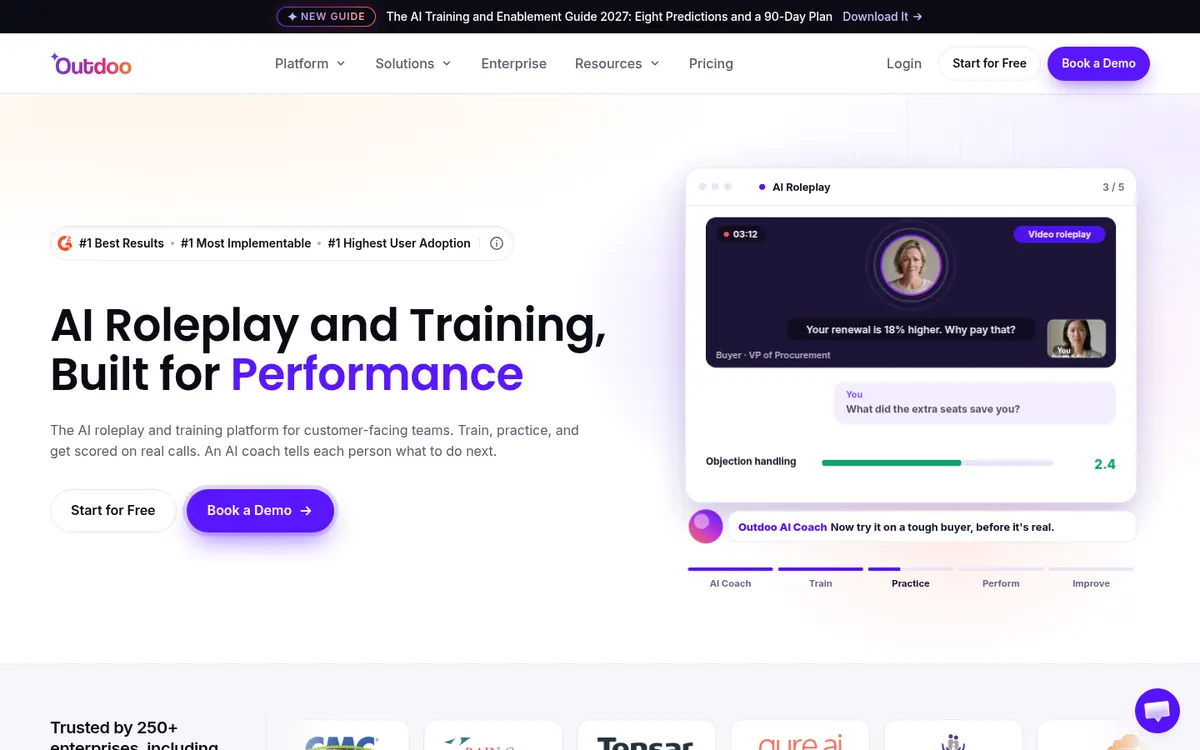
Best when practice must be built from your own recorded calls and measured on the same rubric as live deals.
Outdoo's central claim is that practice and live performance should be measured with one rubric. Roleplays are built from the calls a team actually faces, and the same scorecard scores the simulation and the real conversation. That makes it possible to check whether a rep who scores well in practice is also scoring well with buyers, which is the question most practice tools leave unanswered.
The coaching layer runs continuously. AI coaching summaries and CRM updates are written after every call, and an always-on coach queues each rep's next step, so a rep is not waiting for a manager to notice a pattern across five calls. Scenarios come from the team's own calls and knowledge base, which keeps practice material current as the product and the objections change.
The integration surface is wide: more than 140 integrations, SCORM sync with learning platforms, and support for more than 120 languages. Compliance coverage lists SOC 2, GDPR, HIPAA and CCPA, which changes the procurement conversation compared with the smaller entries here and usually shortens a security review rather than lengthening it.
Outdoo is enterprise focused and demo led, with no published pricing, so no figure could be confirmed on 2026-11-25 and there is no free plan or self-serve trial. It is a newer brand than Mindtickle or Allego, which matters if your security team asks for a long operating history. Named customers include Globe Life and Cloudflare, and the vendor reports faster ramp and less call admin time. Teams that already record calls and want practice built from them are the right buyers.
You already record most calls and want that material turned into practice automatically.
You have no call recordings and no appetite for an enterprise rollout.
A field enablement platform with coaching attached, not a roleplay tool, and priced accordingly behind a quote.
Showpad is a revenue effectiveness platform, and roleplay is a small piece of it. The core is content management for field teams: the right deck, the right case study and the right approval state, delivered to a rep standing in a hospital corridor rather than sitting at a desk. Coaching signals, deal stage context and mobile-first design sit around that core, which is why field organizations shortlist it. Practice exists mainly as one activity inside a wider coaching model. The product page offers limited roleplay detail, so a buyer who wants to see a conversational AI buyer should ask for it directly in a demo rather than assume parity with Second Nature or PitchMonster. What Showpad does have is deal stage awareness, so coaching and content can be tied to where an opportunity actually sits in the pipeline. Content, coaching signals and deal context in one system is a genuine advantage for field teams. All three packages show Request a quote with no published per user price, so nothing could be costed from the site checked on 2026-11-25. There is no free plan and no trial, and the buying process runs through sales. Buy it if the problem you are solving is field enablement and content sprawl, with coaching attached. Do not buy it as a dedicated AI roleplay tool. A team whose whole requirement is reps practicing objection handling against a simulated buyer will get more depth, and less unused scope, from Second Nature, PitchMonster or Quantified, and will not pay for content management nobody opens.
Field reps cannot find the right approved content and coaching needs to live beside it.
AI roleplay is the actual requirement rather than a side benefit.
AI sales roleplay and coaching software does two jobs. The first is rehearsal: a rep talks to a simulated buyer, by voice, video avatar, phone or screen share, and works through discovery, objection handling or a full pitch without risking a real deal. The second is review: the system scores practice sessions and, in many products, real calls, then turns the scores into feedback a rep can act on. The category has split in two directions. Dedicated practice tools, such as PitchMonster and Kendo, put the roleplay engine and the scorecard at the center. Revenue enablement suites, such as Mindtickle, Allego and Showpad, treat practice as one module beside content management and coaching. A third group, which includes Quantified, narrows further into one regulated industry where compliance checking is the product. What separates a good implementation from a shelfware purchase: - Scenario build time: if a manager needs a week to create a roleplay, the tool gets used once.
This comparison sits on the Software desk. Readers comparing neighbouring stacks often check our guides to demand forecasting software and glp 1 companies next.
Pricing in this category is mostly hidden, and that is the first thing to plan around. Eight of the nine tools here publish no price on their website. Two of them, Quantified and Kendo, have no pricing page at all. One, Yoodli, publishes a real per user number. The rest confirm a billing model, such as per user per month billed annually, and then send you to a demo for the figure. The common shapes:
| Model | How it bills | Typical fit | Example from this list |
|---|---|---|---|
| Per seat, published | Monthly per user, with an annual billing option | Small teams that want to start without a call | Yoodli Pro at $8 per month billed annually |
| Per seat, quoted | Quoted per seat after a short demo | Growing SDR and AE teams with onboarding gates | PitchMonster |
| Suite subscription | Quoted after scoping | Enterprises consolidating content, coaching and practice | Mindtickle |
| Enterprise quote | Scoped to seats and rollout, quote only | Large field forces with certification deadlines | Second Nature |
| Custom enterprise | Quote only, white glove onboarding | Regulated industries with audit requirements | Quantified |
Every price above was checked on the vendor's own pricing page on November 25, 2026. Where a vendor does not publish a figure we write "See website" instead of guessing. To compare annual and monthly billing quickly, try the free percentage calculator.
Buying a suite for roleplay alone. Mindtickle, Allego and Showpad are all strong, and all of them expect you to use content, coaching and certification too. Paying for modules you never configure is the most common way this purchase fails a renewal review.
Leaving the security review to the last week. SOC 2 status, data residency and audit trails take time to verify, and one entry here has SOC 2 Type II still in progress. Start the questionnaire during the pilot, not after the contract is drafted.
Assuming the free tier covers the team. Yoodli's free Starter plan and Kendo's free signup are good ways to evaluate, and neither is a team rollout. Check seat limits, feature limits and whether the free tier includes the scorecards and call analysis you actually need.
Treating a score as coaching. A rep who sees 62 out of 100 learns almost nothing. PitchMonster gives a spoken debrief before the score appears, and Second Nature flags the specific error. Ask to see the feedback screen before anyone shows you the dashboard.
Skipping the rubric work. Default scorecards produce generic advice. Teams that spend a week encoding their own methodology, real objections and buyer types get sharper feedback from the same subscription. A tool configured around your deals beats a bigger tool configured around nothing.
Check Hyperbound's site for how its practice and call-scoring products split. The split matters at buying time: teams that only need rehearsal can weigh lighter tools, while teams wanting practice and live call analysis on one scorecard need to confirm both are included. Ask in the demo whether practice and live calls share a rubric.
Second Nature, Mindtickle and PitchMonster are the three to shortlist. Second Nature is the certification specialist, with gamified programs and SCORM or LTI connectors so records land in an existing LMS. Mindtickle covers certification inside a wider enablement suite. PitchMonster uses minimum score gates on key scenarios before a rep goes live, plus a spoken AI debrief before the score appears.
Yoodli and Kendo are the only two entries with a free plan: Yoodli has a free Starter plan beside Pro at $8 per month billed annually, and Kendo offers self-serve free signup. PitchMonster arranges a free trial through a demo, and Second Nature is trial only. Everything else is demo only, and several entries publish no pricing page at all.
Quantified is built for it. Every response is checked against approved messaging, off-label language is flagged, and fair balance and safety language are verified in the same pass. Personas cover physician specialties, payers and formulary committees, and certification records carry an audit trail. Outside life sciences the compliance layer adds cost without adding value, and there is no published pricing or self-serve trial.
No. They replace the least useful part of a manager's week, which is listening to a sample of calls and guessing where a rep is weak. Practice scoring, call analysis and queued next steps give a manager a starting point, and tools such as Outdoo and Kendo go further by queuing each rep's next step or assigning training automatically. Judgment, deal strategy and hard coaching conversations stay with the manager.
Start with the standalone unless you already plan to replace a content or learning system. Mindtickle, Allego and Showpad are suites, and each takes a longer implementation because they touch content, coaching and sometimes call recording. Second Nature and PitchMonster do practice and certification without the full enablement stack. A suite bought for roleplay alone tends to be underused at renewal.
Browse every comparison on the Software desk, with the same rubric and dated prices.