Ranked #1

MaxLife
Flat price, every dose
See website
- Best for
- Flat-priced compounded GLP-1 without insurance
- Free plan
- No
- Rubric
- 6.2 / 10
Nine GLP 1 telehealth providers compared on medication access, price clarity, clinical support and insurance help, with the tradeoffs of compounded drugs spelled out.
 Prices checked November 25, 2026

MaxLife is the best fit for flat-priced compounded GLP 1 without insurance, Ro suits buyers who want a broad brand-name lineup, and Hims and Hers works best if you want weight care inside a wider telehealth membership. We ranked nine providers in November 2026, checked pricing pages on 2026-11-25, and scored each on medication access, price clarity, clinical support, insurance help and program depth. Several prices sit behind an intake form, so treat every number here as a starting point and confirm it before you sign up.
Flat price, every dose
See website
Widest brand menu
See website
One account, many needs
See website
Disclosure for this page: All 9 tools here are unpaid editorial picks. The position of a paid listing can be part of what the vendor pays for. How we handle paid listings.
| Tool | Best for | Free plan | Actions | |||
|---|---|---|---|---|---|---|
| 1 | MaxLife | Flat-priced compounded GLP-1 without insurance | See website | No | ||
| 2 | Ro | Broad brand-name GLP-1 selection | See website | No | ||
| 3 | Hims and Hers | Weight loss within broader telehealth | See website | No | ||
| 4 |  WeightWatchers Clinic | Medication combined with behavior change | See website | No | ||
| 5 |  Found | Insurance-friendly weight care plans | See website | No | ||
| 6 |  Mochi Health | Low-cost compounded GLP-1 medication | See website | No | ||
| 7 |  Noom Med | Behavior program plus prescribed GLP-1 | See website | No | ||
| 8 |  Calibrate | Metabolic health with intensive coaching | See website | No | ||
| 9 |  PlushCare | General telehealth that includes weight care | See website | No |
We scored nine GLP 1 telehealth providers against five criteria and weighted them for the decision most buyers actually face: can I get the medication, and can I afford it. Medication access (25 percent) looks at which drugs a provider can prescribe, brand and compounded, plus oral options. Price clarity (25 percent) rewards published, per-drug numbers over figures you only see after an intake form. Clinical support (20 percent) covers provider messaging, check-ins and care teams. Insurance help (15 percent) covers coverage checks and prior authorization support. Program depth (15 percent) covers behavior curriculum, coaching and habit tools. Every price in this list was checked on 2026-11-25. Where a page returned no content, we say so and do not present a number as confirmed, which is why several entries list pricing as See website. We did not use third-party review scores and we did not test the medication itself: this is an evaluation of how each service sells, prescribes and supports GLP 1 treatment. The Featured position in this list is a paid placement. Where a listing carries it, we score that vendor with the same rubric and keep the same honest cons, so placement changes where an entry appears, not what we say about it. No entry in the current list carries a Featured placement. The order is editorial. It reflects fit for the buyer each entry describes, then the disclosed Featured position, not a weighted total. Two providers with similar scores can sit in different places because they suit different people.
The full process, including how we handle corrections, is on the methodology page. Paid listings follow our advertising disclosure.
| Criterion | Weight | What we check |
|---|---|---|
| Medication access | 25% | How many GLP 1 drugs a provider can prescribe, including brand, compounded and oral options. |
| Price clarity | 25% | Whether the provider publishes real numbers you can compare before an intake form. |
| Clinical support | 20% | Provider messaging, check-ins, care teams and how quickly dose questions get answered. |
| Insurance help | 15% | Coverage checks, copay estimates and prior authorization support for the medication. |
| Program depth | 15% | Behavior curriculum, coaching and habit tools that carry past the prescription. |
Best for uninsured buyers who want one flat compounded price and no membership fee stacked on top.
MaxLife sells compounded semaglutide and tirzepatide through an online intake, with a licensed provider reviewing each request before anything ships. The draw is a flat monthly price at every dose, so a higher dose costs the same as a starting dose, and no membership fee sits on top of the medication. Consultation, provider messaging, supplies, cold-pack insulated shipping and the medication itself are quoted as one number. The company says it operates in all 50 states, and the medication is FSA and HSA eligible. Intake review is usually within 24 hours, though some states require a video visit before a prescription is written.
Provider messaging covers dose changes and side effects, which matters in the first months when titration schedules move and nausea is common. Prescriptions are filled by licensed partner pharmacies, not by MaxLife, so the pharmacy named on your label may differ from the one you read about on the site. Refills ship every 90 days, which cuts delivery frequency but gives you less room to stop quickly if you change your mind or your clinician changes the plan.
The limits come with compounded drugs. Compounded semaglutide and tirzepatide are not FDA approved, they are made to a compounding pharmacy's formula, and potency depends on that pharmacy's process and sourcing. A prescription is not guaranteed: a provider can decline if your history or current medications make GLP 1 treatment unsafe. This is telehealth only, with no clinic to visit in person.
Pricing is on the vendor site. A $89 per month figure appears in some listings, but the MaxLife page returned no text when we checked on 2026-11-25, so we cannot confirm it and do not treat it as current. Ask for the dose, the refill interval and the total in writing. It fits uninsured buyers who want one predictable number and are comfortable with a compounded product.
You are paying cash and want one flat compounded price with consultation, support and shipping inside it.
You need an FDA-approved brand drug or want an in-person clinic.
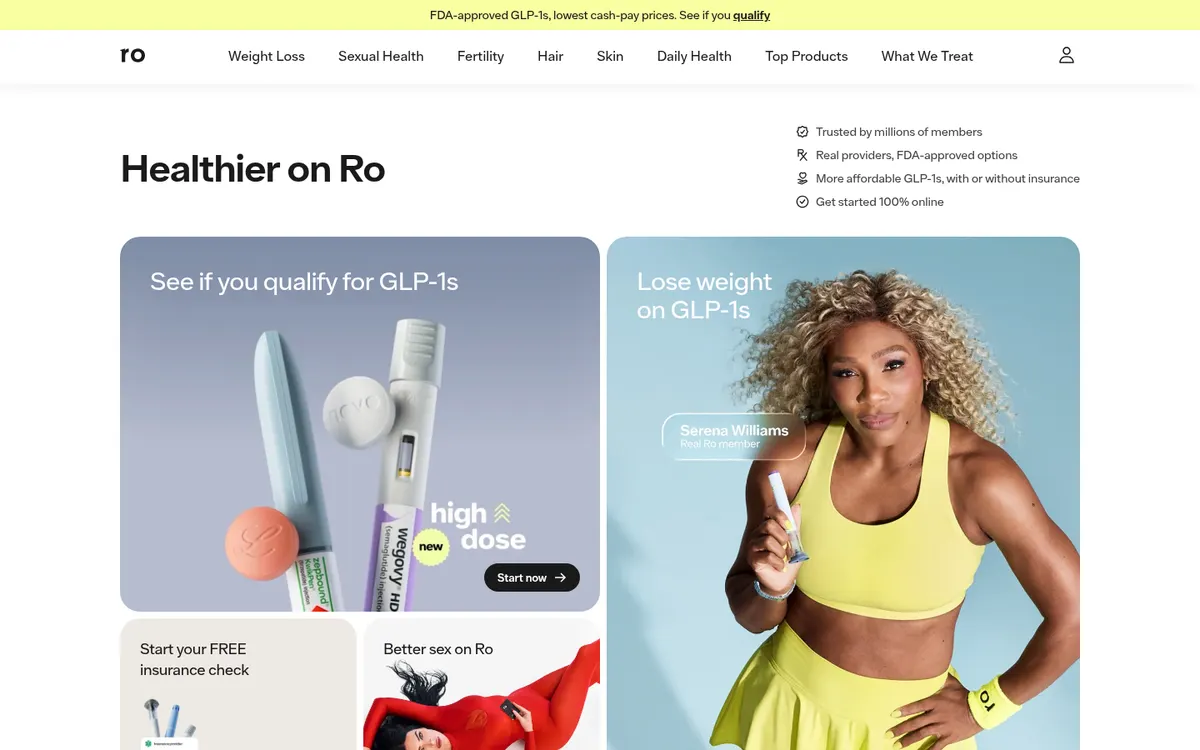
Best for brand-name choice, with the widest GLP 1 menu here and round-the-clock messaging, though list prices can hit $1,349.
Ro runs a telehealth weight loss service with one of the widest brand-name GLP 1 menus in this list, including Wegovy, Zepbound and Ozempic, plus newer pill-form GLP 1 options. Prescriptions come after an online consultation with a licensed provider, and provider messaging runs 24 hours a day. Compounded alternatives sit alongside the brand drugs for people who cannot get coverage or cannot meet the brand price. The company says it has more than 3 million members.
The strength is breadth. If your plan covers Wegovy but not Zepbound, or your clinician wants to try an oral option first, Ro can usually write for it without sending you to a second service. Round-the-clock messaging helps during titration, when questions about nausea, constipation and dose timing tend to arrive at odd hours.
Cost is where it gets complicated. Ro advertises starting prices from $149 per month and savings of up to 88 percent off list prices on some options, but those numbers apply to selected products, not the whole catalog. Brand-name list prices reach $1,349, so an uninsured buyer can face a very different bill from the advertised entry point. Compounded products are not FDA approved. A prescription still requires a consultation, and the consultation does not guarantee one. Ro's own safety information flags thyroid tumor risk and advises against use in people with certain thyroid cancer histories.
Pricing is on the vendor site; the $149 per month figure was listed in our notes but the pricing page returned no content when we checked on 2026-11-25, so we could not confirm it. Ro fits people who want brand-name medication and a large, established operation behind it, and who have insurance or a budget that can absorb list prices.
You want the widest brand-name menu, including oral options, and will use the round-the-clock messaging.
You are uninsured and cannot absorb brand list prices that reach $1,349.
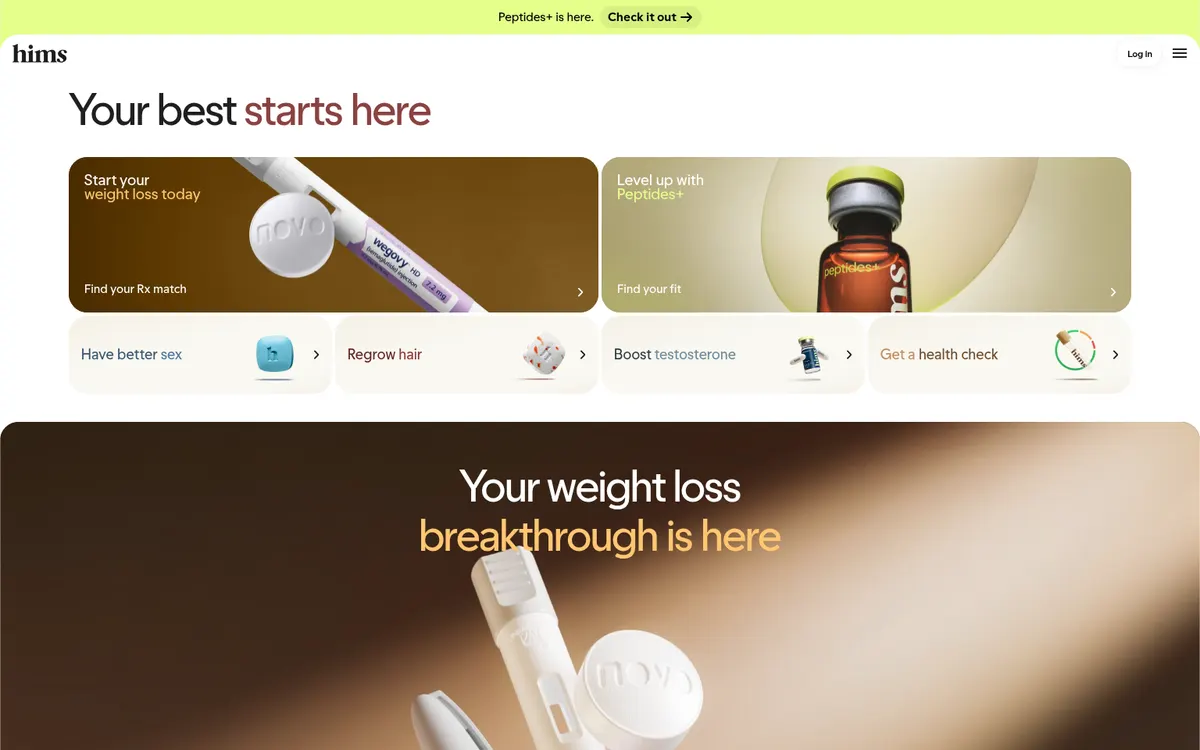
Best if you want weight care inside a wider telehealth membership, though the monthly fee does not include medication.
Hims and Hers treats weight loss as one service inside a much larger telehealth business. You join a membership, complete an intake, and a provider decides whether a GLP 1 is appropriate. The weight program covers Wegovy and Zepbound and, where a brand drug is out of reach, compounded options. The same account also reaches hair, skin, sexual health and mental health treatment, which is the real reason many people pick it. The membership is the catch. It starts at $39 for the first month and renews at $149 per month, and that fee covers membership only. Medication is billed separately, on top of the membership, so the advertised entry price is not the cost of treatment. Membership does not guarantee a prescription either: if the provider decides a GLP 1 is not right for you, you have paid for a membership you may not want. On features, the GLP 1 lineup is genuinely complete, and combining several health categories under one subscription saves money for households already paying for hair or skin treatment. Compounded products offered through the service are not FDA approved, and the usual warning applies: potency and pharmacy standards vary by supplier. Pricing is on the vendor site. Our notes list a $39 first month and a $149 monthly renewal, but the pricing page returned no text on 2026-11-25, so confirm the current numbers and the medication cost before you commit. It fits people who want one telehealth account for several needs, and it is a poor fit for anyone who only wants the cheapest possible GLP 1.
You already want hair, skin or mental health treatment and weight care in one membership.
You want medication included in the monthly fee rather than billed separately.
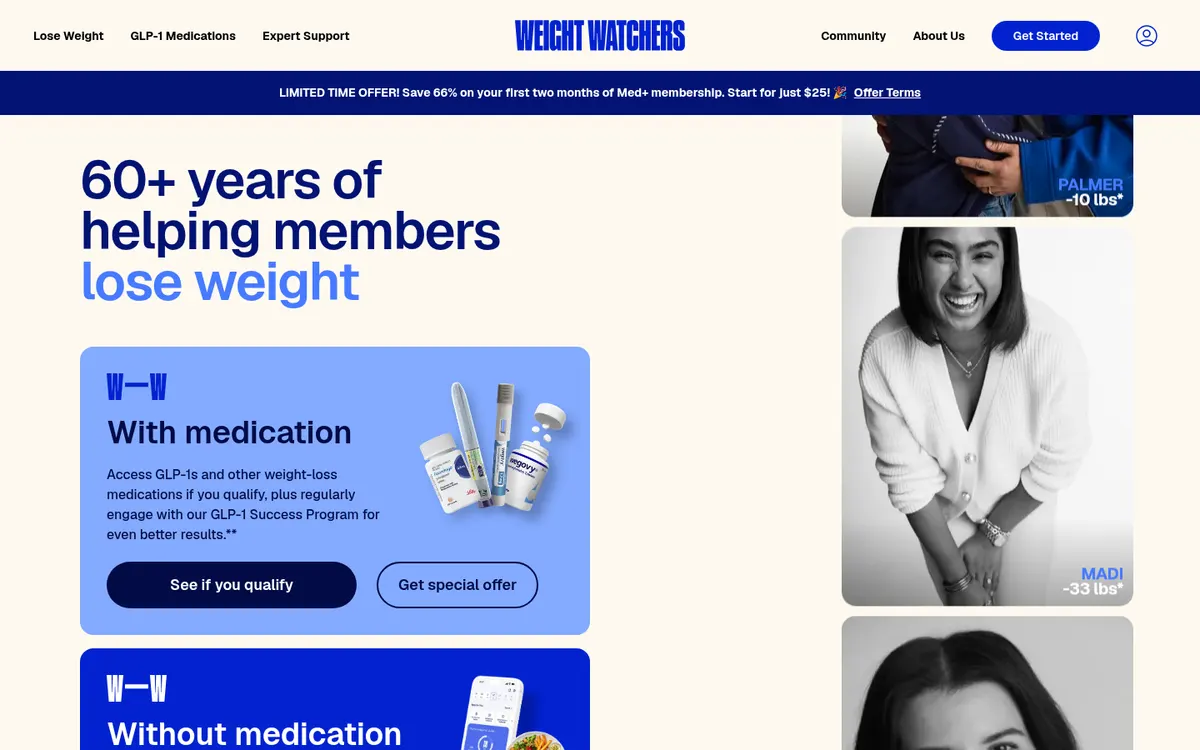
Best for combining medication with a structured behavior program and a care team, if you will attend the required clinician call.
WeightWatchers Clinic pairs FDA-approved GLP 1 medication with the company's long-running points program. Instead of a prescription alone, you get a behavior curriculum, clinician oversight, dietitian input and fitness coaching, which is a different proposition from a pure dispensing service. The Med+ program sits at the center of it, and the company runs insurance coverage checks before you commit to a medication path.
The clinical side includes a required call with a clinician after signup. That call is where eligibility, history and medication choice get settled, and it is not optional. For some people this is the most useful part of the service, a real conversation with a licensed professional rather than a form. For others it is a scheduling hurdle between payment and treatment.
The evidence the company cites is its own: an internal analysis reports that Med+ members lost an average of 7.4 pounds in their first four weeks. That is early-stage weight, not a long-term outcome, and it is not independently verified. Medication is not guaranteed, and program costs sit on top of medication costs, so the total usually runs higher than the membership headline suggests.
Pricing is not shown on the homepage, so you need to go through intake or ask support for a full quote including medication. The behavior program is the differentiator, and it is a real one: habits built during treatment are what people rely on when the drug stops. It fits people who know they want structure and coaching around the medication, not just a vial in the mail.
You know habits are your weak point and you want a care team plus a structured program.
You want a published price and a fast start without a required clinician call.
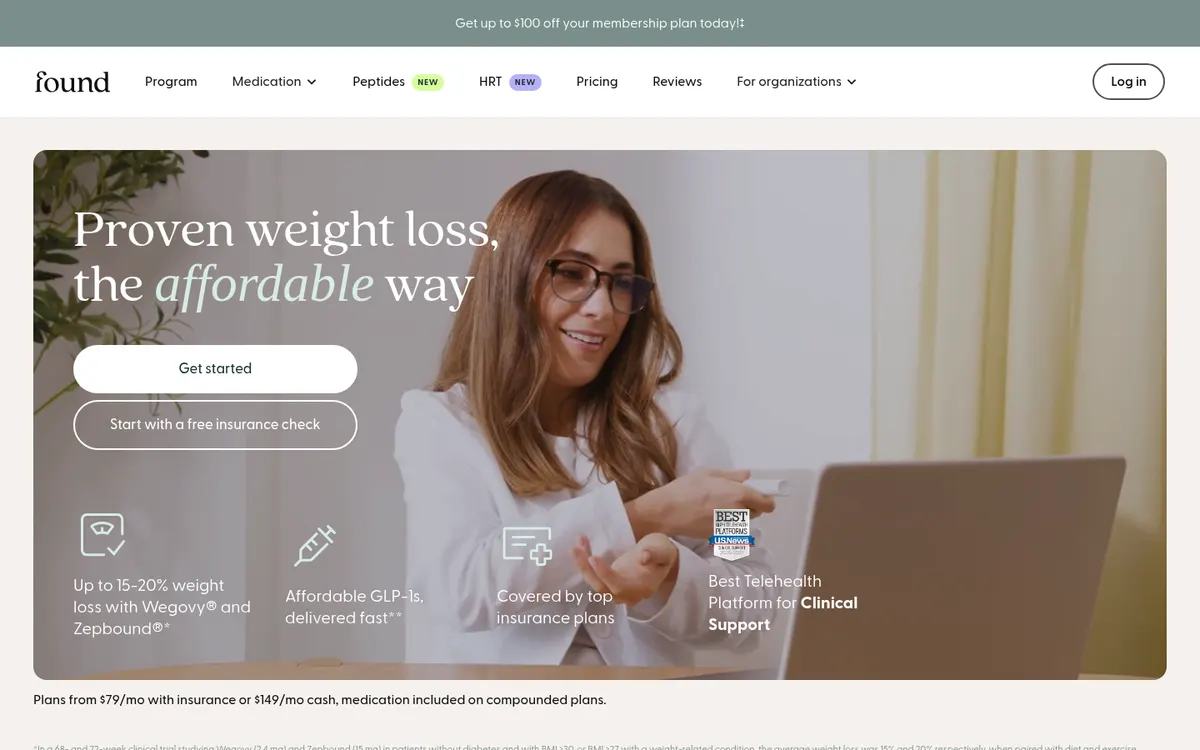
Best when you have insurance and want help using it; cash buyers pay more and the service skips some states.
Found builds weight care plans around insurance, which is unusual in this category. The service runs coverage checks, estimates copays for covered visits, and helps members navigate prior authorization and plan rules. Cash-pay plans exist for people without coverage, starting at $169 per month according to the company, but the insured path is the one Found is designed around.
Compounded plans include the medication in the price, which simplifies budgeting compared with services that bill membership and medication separately. Monthly clinician check-ins keep the plan reviewed rather than refilled on autopilot. Brand-name options are available too, listed from $650 per month for Wegovy and Zepbound, which puts them out of reach for many cash buyers and makes the insurance work the point of the service.
Two structural limits matter. Subscription and clinical fees may be billed separately from medication, so the number you see first is not always the number you pay monthly. And Found is not available in every state, which you may only discover during intake. The cash price is higher than the insured price, sometimes by a wide margin.
Pricing is on the vendor site. The $99 per month insured figure in our notes could not be checked because the page returned no content on 2026-11-25, so confirm your own copay rather than relying on an advertised starting point. Found fits people with employer or marketplace coverage who want help getting a GLP 1 paid for, and it fits cash buyers less well than flat-price compounded services do.
You have insurance and want a service that checks coverage and handles the paperwork.
You are paying cash, live in a state it does not serve, or want the lowest monthly number.
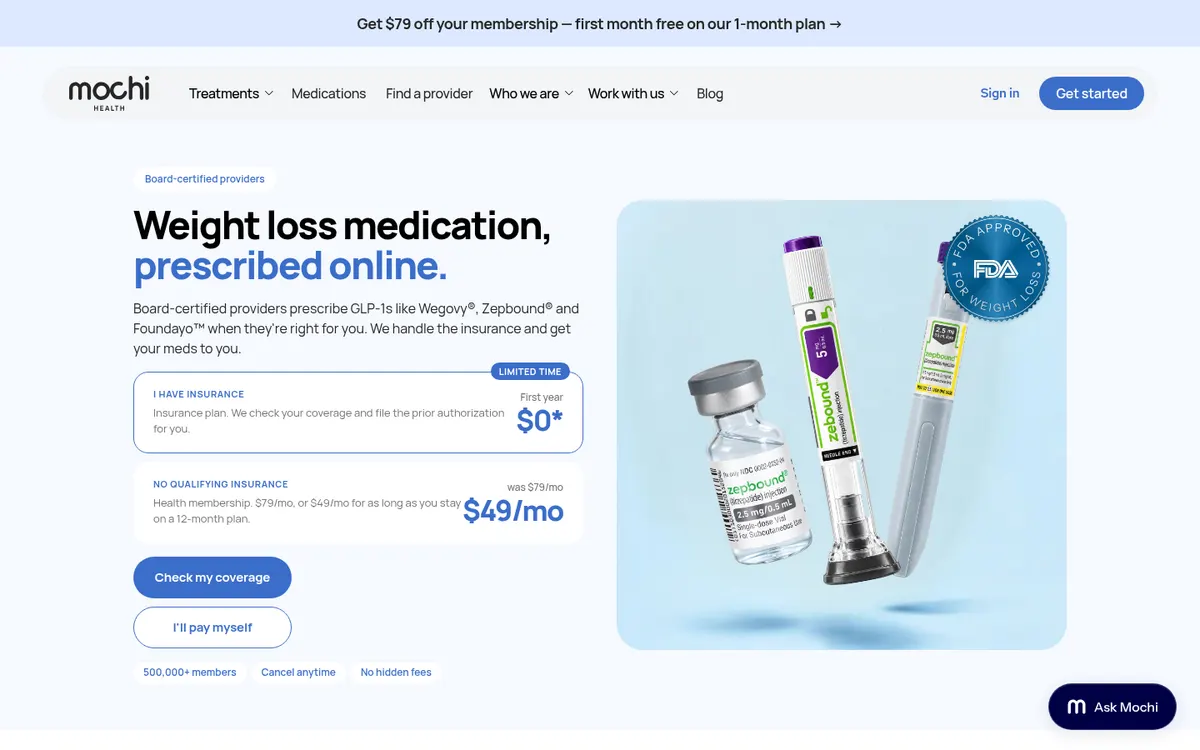
Best for cost-focused buyers: published per-drug prices make total cost easy to compare before you sign up.
Mochi Health publishes a per-drug price list, which makes it the easiest provider here to cost out before you sign up. Compounded semaglutide starts at $60 per month, compounded tirzepatide at $90, Wegovy at $199 and Zepbound at $299. Oral options include a Wegovy pill from $149 and a compounded orforglipron pill from $31. Prices vary by state.
The model is a membership subscription plus medication billed separately. That split is worth understanding before you compare totals: a low membership fee plus a high medication price can cost more than a flat bundle, and the reverse is also true. Mochi's transparency makes the comparison possible, which is more than most competitors offer.
The medication menu is broad for a low-cost provider. Compounded semaglutide and tirzepatide are there for people without coverage, brand-name Wegovy and Zepbound for people who have it, and oral GLP 1 choices for people who do not want injections. Compounded drugs are not FDA approved, and the compounded orforglipron pill deserves a question from your provider: orforglipron is an investigational molecule, and a compounded version is not the same product studied in trials.
Pricing is on the vendor site. The $60 per month compounded semaglutide figure was listed in our notes but the pricing page returned no text when we checked on 2026-11-25, so verify the current number and your state rate. Mochi fits cost-focused buyers who want the numbers up front and are comfortable with compounded medication, and it fits people who need insurance handled less well.
You want to see per-drug prices before signing up and are open to compounded medication.
You want insurance handled for you or need an FDA-approved product only.
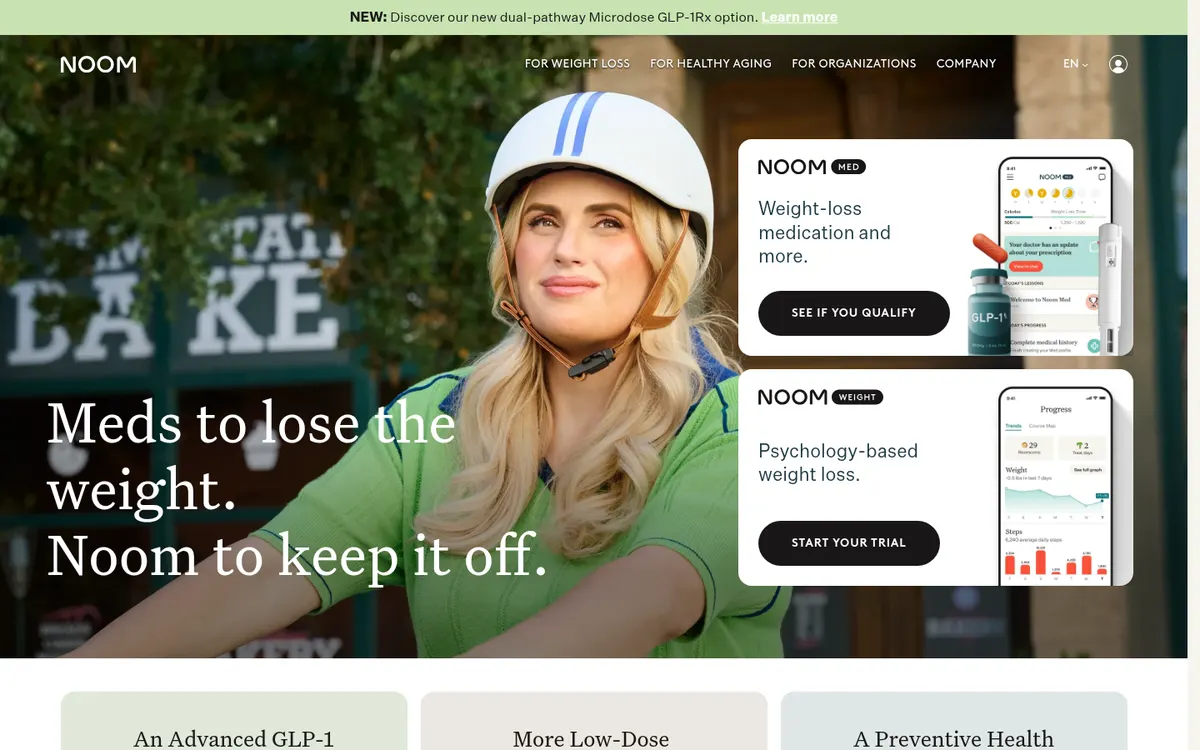
Best for people who want daily habit lessons alongside a prescription, though medication pricing stays hidden until intake.
Noom Med takes the Noom app and adds clinician-prescribed GLP 1 medication on top of it. The app side is a psychology-based behavior program with daily lessons of about 10 minutes, habit tracking and food logging. The medical side is an eligibility review followed by a prescription if a clinician decides one is appropriate. The combination is the product: medication for the biology, lessons for the habits. That pairing addresses a real problem. People who stop GLP 1 medication often regain weight, and the behavior work aims at the months after treatment as much as the months during it. Ten minutes a day is a low bar compared with weekly coaching or a full curriculum, though it does require daily engagement, and results depend on whether you actually do the lessons rather than just pay for them. The limits are transparency and control. Medication pricing is not published on the homepage, so you cannot compare total cost without going through intake. Medication is only available to eligible members, and eligibility is decided by the clinician, not by the subscription. The program is also lighter on clinical infrastructure than services built around a care team. Pricing is on the vendor site; the page did not load for us on 2026-11-25, so we have no figure to quote and will not invent one. Ask for the medication price separately from the app subscription before you commit. Noom Med fits people who want a structured habit program alongside treatment and will show up daily, and it fits people who want intensive clinical management poorly.
You will do a short lesson every day and want habit work alongside the prescription.
You want published medication pricing or intensive one-to-one clinical support.
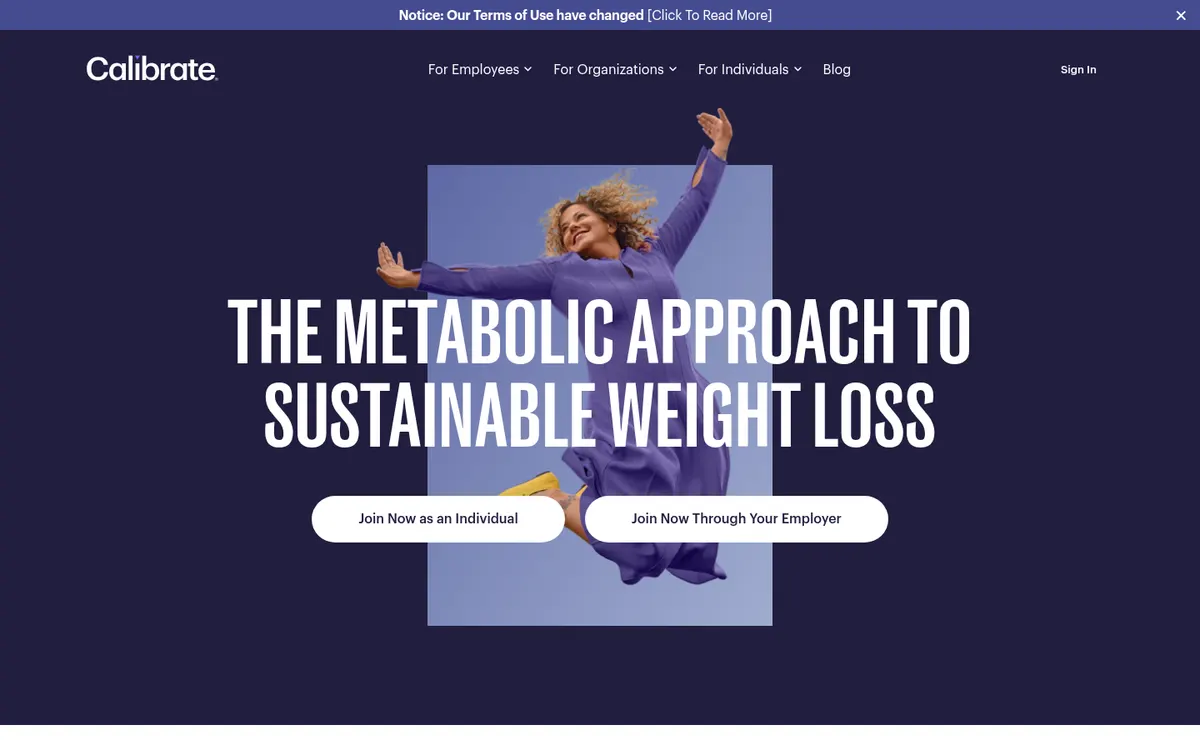
Best for intensive coaching and a metabolic health curriculum, especially with employer coverage, but it asks for a longer commitment.
Calibrate frames weight loss as metabolic health rather than willpower, and it charges for a structured program rather than a prescription alone. Members get clinician-prescribed GLP 1 medication where eligible, one-to-one video coaching, a metabolic health curriculum and a longer program structure than most competitors run. The company reports an average 20 percent body weight loss over three years among members.
Many employers cover Calibrate for employees and dependents, which changes the math considerably. If your employer is one of them, the program can cost you far less than signing up independently, and the coaching and curriculum come with it. Independent signup is available, but pricing is not shown on the homepage, so you have to ask before you can compare it with anything else in this list.
The tradeoffs are commitment and cost. This is a longer program, not a monthly refill you can cancel after four weeks, and independent signup usually costs more than the employer-covered route. Medication eligibility still applies: the curriculum does not guarantee a prescription, and a clinician can decide a GLP 1 is not appropriate for you. The 20 percent figure is the company's own reporting over three years, which is a longer horizon than most vendors publish but still vendor-reported.
Pricing is on the vendor site. We found no starting price to quote, and the page returned no content on 2026-11-25. Calibrate fits people who want coaching, education and a multi-year frame, and who have employer coverage or a budget for a premium program. It fits people who want the cheapest monthly injection poorly.
You have employer coverage and want coaching, education and a multi-year metabolic frame.
You want a cheap monthly refill or you are not ready to commit to a longer program.

Best if you want a same-day doctor visit, insurance billing and a local pharmacy rather than a weight program.
PlushCare is a general telehealth practice, not a GLP 1 specialist. You book a virtual visit, often same day, with a licensed doctor, and the visit can cover primary care, urgent care or weight management. Prescriptions go to your local pharmacy rather than a partner dispensing service, and the practice accepts insurance. It reports more than 1 million members. That generalist position is the appeal. If you want a doctor who can look at blood pressure, thyroid history and current medications together, and who can also handle an ear infection in the same relationship, PlushCare does that. For weight care specifically, the visit is the product: assessment, a prescription if appropriate, and a local pharmacy to fill it. The limits follow from the same design. Weight-care pricing is not published on the homepage, so the cost of a weight visit is something you confirm at booking. Program features are lighter and less structured than dedicated weight services. Whether that matters depends on how much support you want between visits. Insurance is accepted, which is a real advantage for people whose plan covers GLP 1 medication and who mainly need a prescriber in the network. Pricing is on the vendor site; the page was empty when we checked on 2026-11-25, so there is no figure to quote. PlushCare fits people who want a doctor, insurance billing and a local pharmacy, and it fits people who want a wrapped weight program poorly.
You want a same-day doctor visit, insurance billing and a prescription sent to your local pharmacy.
You want a structured weight program, coaching or help with prior authorization.
A GLP 1 telehealth company connects you to a licensed provider online, gets a prescription written if you qualify, and ships or routes the medication to you. It replaces the traditional path of booking an in-person appointment, driving to a pharmacy and repeating the process for every dose change. The clinical work is real: a provider reviews your history, medications and risk factors, and decides whether a GLP 1 is appropriate.
The category splits by what is being sold. Some companies sell access to brand-name drugs such as Wegovy, Zepbound and Ozempic. Others sell compounded semaglutide or tirzepatide, which are mixed by compounding pharmacies and are not FDA approved. A third group sells a program, meaning coaching, curriculum and habit tools around the medication. Many providers now do two or three of these at once.
Billing models vary as much as the medicine:
What you are really buying is the supply chain and the support layer. Compounded medication has to come from a licensed pharmacy, brand drugs have to clear insurance, and dose changes have to be reviewed by someone. A provider that answers messages quickly and adjusts doses without a fight is worth more than a few dollars a month.
Two limits apply to the whole category. First, no telehealth service can guarantee a prescription; a clinician can decline. Second, medication alone does not build habits. Providers that combine the drug with behavior work, such as WeightWatchers Clinic, Noom Med and Calibrate, are selling the months after treatment as much as the months during it.
This comparison sits on the Software desk. Readers comparing neighbouring stacks often check our guides to demand forecasting software and appointment scheduling software next.
GLP 1 pricing usually comes in two parts, and the headline number rarely covers both. Most providers charge either a flat monthly bundle that includes the medication, or a membership fee plus a separate medication charge. Brand-name drugs add a third layer, because their list prices sit far above compounded alternatives and insurance may or may not apply.
| Model | How it bills | Typical fit | Example from this list |
|---|---|---|---|
| Flat monthly bundle | One recurring price covers consultation, medication, supplies and shipping | Uninsured buyers who want a predictable number | MaxLife |
| Membership plus medication | Subscription covers access and support; the drug is billed separately | People who want ongoing clinical access | Hims and Hers, Mochi Health |
| Insurance-first | Coverage checks and copay estimates, then plan billing | People with employer or marketplace coverage | Found |
| Per-visit care | Appointment fee or insurance claim, pharmacy fills separately | People who mainly need a prescriber | PlushCare |
| Program plus medication | Coaching or curriculum charges plus medication costs | People who want structure and accountability | Calibrate, WeightWatchers Clinic, Noom Med |
Published examples show the spread. Mochi Health lists compounded semaglutide from $60 and compounded tirzepatide from $90 per month, with Wegovy from $199 and Zepbound from $299. Found lists cash plans from $169 per month and brand drugs from $650. Hims and Hers starts membership at $39 for the first month and renews at $149, with medication billed on top. Ro advertises starting prices from $149 per month but says brand list prices reach $1,349.
All prices here were checked on 2026-11-25 and several vendor pages returned no content, so entries show See website. Treat every figure as a starting point, ask for the total including medication at your dose, and confirm whether shipping and follow-up visits sit inside the price.
Every price above was checked on the vendor's own pricing page on November 25, 2026. Where a vendor does not publish a figure we write "See website" instead of guessing. To compare annual and monthly billing quickly, try the free percentage calculator.
Set your budget ceiling. Decide what you can pay monthly including medication, not just membership, then compare only providers whose published numbers fit. If a provider hides pricing until intake, ask support for a full quote in writing before you start.
Check your insurance first. Call your plan and ask whether GLP 1 drugs are covered for weight loss, what prior authorization requires, and what the medication copay is. Found, WeightWatchers Clinic and PlushCare are built to work with that answer.
Decide on brand versus compounded. If a brand drug is covered, start there. If it is not and the cost is impossible, compounded is the cheaper path, with the caveat that compounded products are not FDA approved and potency varies by pharmacy.
Match the support you need. Message-only support suits people who tolerate the drug well. Daily lessons, coaching or a care team suit people who want help with habits, and those programs cost more because they sell more than a prescription.
Confirm state availability and refill terms. Found does not operate in every state, MaxLife requires a video visit in some, and refill intervals differ. Check these before paying, because they decide how quickly you can change dose or stop.
Ask what happens if you stop. Weight regain after stopping is common, so ask how the provider handles tapering and maintenance, and whether behavior support continues if the prescription ends. That answer separates a dispensing service from a care program.
Comparing membership fees instead of totals. A $39 first month or a $149 membership can look cheap next to a bundle, but medication is billed separately. Add the drug at your dose, shipping and any follow-up fees before you compare.
Assuming a consultation guarantees a prescription. Providers can and do decline when history, medications or thyroid risk factors make a GLP 1 unsafe. Read the refund terms before paying, since a membership fee may not come back.
Treating compounded drugs as identical to brand. Compounded semaglutide and tirzepatide are not FDA approved, and potency depends on the pharmacy. A compounded orforglipron pill is not the same product as the investigational drug in trials.
Ignoring the refill and cancellation terms. MaxLife ships refills every 90 days and Calibrate asks for a longer commitment. If you might stop or change dose soon, check how much notice you need before you are charged again.
Skipping the insurance check. Many plans cover GLP 1 drugs for diabetes but restrict them for weight loss, and prior authorization is common. A five minute call to your plan can save hundreds a month or rule the drug out early.
Yes. Every GLP 1 medication for weight loss in the United States, brand-name or compounded, requires a prescription from a licensed provider. Telehealth services handle this with an online intake and, in some cases, a video visit. A consultation does not guarantee a prescription: a clinician can decline if your history, current medications or thyroid risk factors make treatment unsafe. Expect at least one review step before any medication ships.
FDA-approved GLP 1 drugs such as Wegovy, Zepbound and Ozempic have been reviewed for safety, potency and manufacturing consistency. Compounded versions are mixed by a compounding pharmacy and are not FDA approved, so potency can vary between pharmacies and batches. Compounded products can be cheaper and more available during shortages, but they carry more uncertainty. If a brand drug is covered by your insurance, it is usually the safer starting point.
Costs range widely and most providers do not publish a single number. In this list, Mochi Health publishes compounded semaglutide from $60 and compounded tirzepatide from $90 per month, plus a separate membership. Found lists cash plans from $169 per month and brand drugs from $650. Hims and Hers charges $149 per month for membership with medication billed separately. Brand-name list prices can reach $1,349, so confirm the total, not the headline.
Sometimes. Coverage depends on your plan, your employer and how the prescription is coded. Many plans cover GLP 1 drugs for diabetes but exclude or restrict them for weight loss, and prior authorization is common. Services such as Found and WeightWatchers Clinic run coverage checks and help with paperwork. PlushCare accepts insurance for visits and sends prescriptions to a local pharmacy. Always confirm the medication copay, not just the visit copay, before you start.
Most people notice gastrointestinal effects first: nausea, vomiting, diarrhea, constipation and reduced appetite, usually strongest during dose increases. Many providers warn about thyroid tumor risk and advise against use in people with a personal or family history of certain thyroid cancers. Serious problems are less common but include pancreatitis and gallbladder issues. Report severe abdominal pain, persistent vomiting or signs of dehydration to your provider rather than waiting for the next refill.
Weight regain after stopping is common, which is why several providers here pair medication with a behavior program. WeightWatchers Clinic, Noom Med and Calibrate all build habits alongside the prescription, and Calibrate reports an average 20 percent body weight loss over three years among members. Those figures are company-reported, not independently verified. Planning the maintenance phase at the start, including a tapering conversation with your clinician, gives you a better chance than stopping abruptly.
Browse every comparison on the Software desk, with the same rubric and dated prices.