Ranked #1
OneTrust
Shared risk data model
See website
- Best for
- Teams consolidating privacy, GRC and vendor risk
- Free plan
- No
- Rubric
- 5.6 / 10
Ten platforms for vendor risk, from rating services to full GRC suites, scored on workflow depth, pricing clarity and how fast a team can actually go live.
 Prices checked November 25, 2026

OneTrust is the best fit for teams folding vendor risk into a wider privacy and GRC program, UpGuard is the pick for mid-market and enterprise buyers who want published pricing, and BitSight suits security teams that need continuous outside-in monitoring of suppliers. That ranking reflects fit for the buyer each entry describes, checked against vendor pricing pages on November 25, 2026. Nine of the ten tools publish no price at all, so expect a sales cycle before you can compare real numbers.
Shared risk data model
See website

Published entry pricing
$600Trust Exchange Paid, per month, billed annually
Continuous external ratings
See website
Disclosure for this page: All 10 tools here are unpaid editorial picks. The position of a paid listing can be part of what the vendor pays for. How we handle paid listings.
| Tool | Best for | Free plan | Actions | |||
|---|---|---|---|---|---|---|
| 1 | OneTrust | Teams consolidating privacy, GRC and vendor risk | See website | No | ||
| 2 | UpGuard | Mid-market and enterprise teams wanting published pricing | $600Trust Exchange Paid, per month, billed annually | Yes | ||
| 3 | BitSight | Continuous outside-in security monitoring of vendors | See website | No | ||
| 4 |  SecurityScorecard | Teams wanting a free self-scorecard before buying | See website | Yes | ||
| 5 |  Prevalent | End-to-end vendor lifecycle with service support | See website | No | ||
| 6 |  LogicGate Risk Cloud | Teams wanting configurable, no-code GRC workflows | See website | No | ||
| 7 | ServiceNow TPRM | Organizations already standardized on the Now platform | See website | No | ||
| 8 |  Archer | Large regulated firms with complex GRC requirements | See website | No | ||
| 9 |  Panorays | Security teams buried in vendor questionnaires | See website | No | ||
| 10 |  Venminder | Firms without staff to run a vendor risk program | See website | No |
We scored ten tools against five criteria, then ordered the list by fit for the buyer each entry describes. Lifecycle coverage carries 25 percent, pricing clarity 20 percent, time to value 20 percent, assessment automation 20 percent and ecosystem fit 15 percent. Each review was written against those five criteria only, using the vendor's own product documentation and pricing page rather than a demo script.
Prices come from vendor pricing pages checked on 2026-11-25. Where a vendor publishes an entry price, we use it exactly as listed with the plan name and billing term from that page. Where a vendor publishes nothing, we record no figure rather than estimating one. That is why nine of the ten entries read "See website": the absence of published pricing is itself a buying signal, because it tells you a qualification call stands between you and a budget number.
Featured placements on this page are paid positions. A Featured entry is scored with the same rubric, reviewed with the same skepticism and carries the same kind of cons as every other tool here. Placement affects where an entry appears, not what we conclude about the product.
Two things we deliberately did not do. We did not treat a security rating as equivalent to an assessment, because a score and an evidence trail answer different questions. And we did not rank by company size or installed base, since a large vendor with a multi-month deployment is a poor recommendation for a team that needs assessments running this quarter.
Readers should read the pick and skip lines as the most useful part of each entry. A tool that scores well on paper still fails if it assumes an administrator you do not have, or a platform license you are not renewing.
The full process, including how we handle corrections, is on the methodology page. Paid listings follow our advertising disclosure.
| Criterion | Weight | What we check |
|---|---|---|
| Lifecycle coverage | 25% | How much of onboarding, assessment, monitoring, remediation and offboarding one system handles. |
| Pricing clarity | 20% | Whether entry pricing is published or only available through a sales quote. |
| Time to value | 20% | How much configuration and internal admin effort is needed before the tool produces usable risk output. |
| Assessment automation | 20% | How far questionnaires, chasing, evidence review and outside-in validation are automated. |
| Ecosystem fit | 15% | How well the tool slots into the platforms and data sources a buyer already runs. |
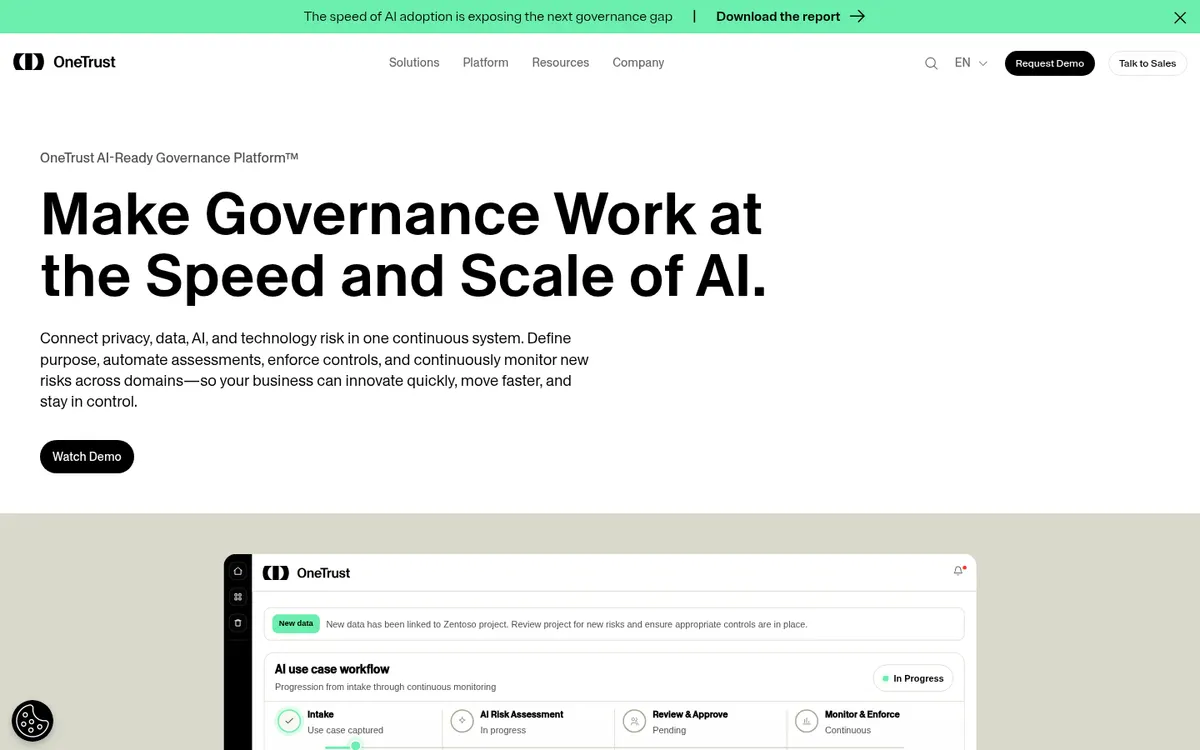
Widest coverage in the pack and the heaviest to run; a platform decision, not a quick vendor risk fix.
OneTrust treats third-party risk as one module inside a much larger trust platform. If your organization already owns privacy management, data governance or a broader GRC program, vendor assessments can sit on the same data model as your privacy and data governance records, which removes a common source of duplicate vendor inventories. The module itself covers vendor inventory and tiering, configurable assessment and remediation workflows, and a regulatory and compliance content library that saves legal and security teams from drafting every questionnaire from scratch. The trade-off is weight. Nothing here behaves like a point tool, and module breadth means an implementation touches legal, security, procurement and IT at once. Expect a multi-month deployment and at least one dedicated administrator before the third-party risk module produces reporting anyone trusts. A team that wants assessments live quickly will find the pace frustrating, and a team that buys the third-party module alone while ignoring the rest of the platform gets less value than the pitch implies. Pricing is not published. OneTrust quotes each deal after a scoping conversation, so there is no way to benchmark cost without talking to sales. Nothing here should be read as a price estimate. Ask for written scope that separates the third-party risk module from privacy modules you may not need, and ask what renewal uplift looks like. The real argument for OneTrust is consolidation: one vendor record, one assessment history, one place where privacy and vendor risk agree about who holds your data. Buyers who need a narrow assessment tool will pay for capability they never switch on.
Vendor risk is one workstream inside a wider privacy or governance program you are already consolidating.
You need assessments running this quarter and have nobody to own platform configuration.
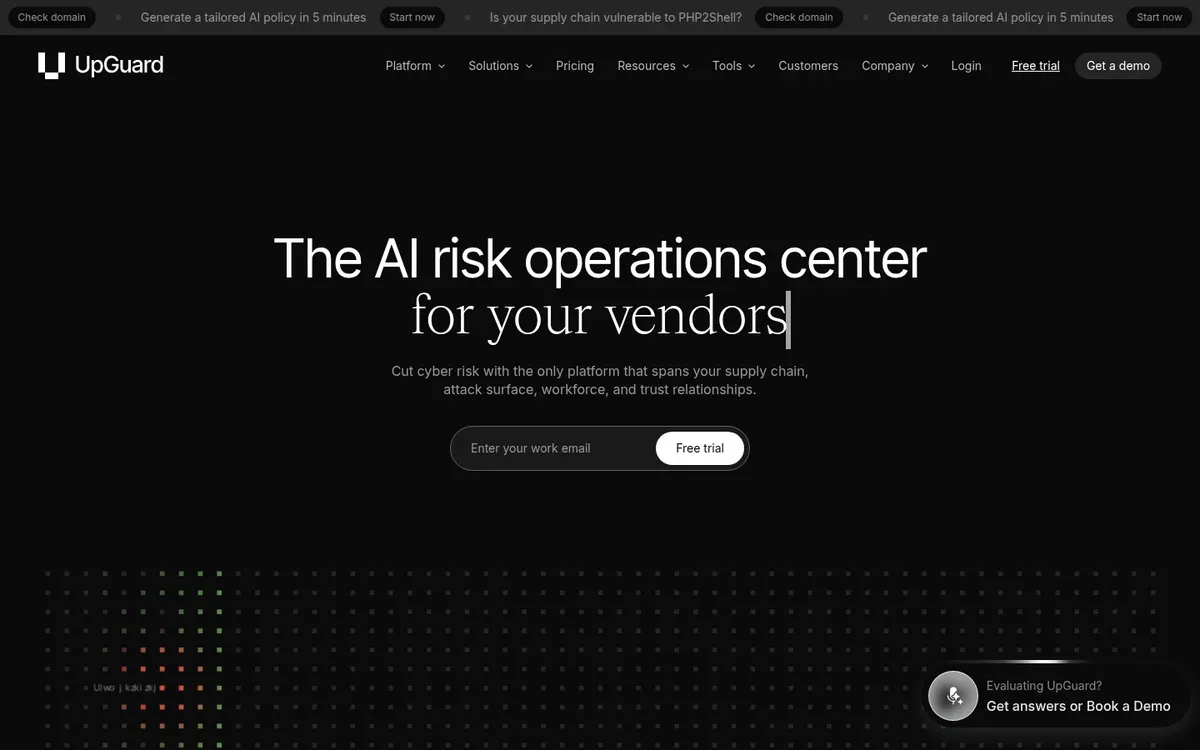
The only published entry price here, paired with ratings and questionnaire workflow that work best together.
UpGuard is the only vendor in this list that publishes an entry price, which changes the buying conversation before a demo ever happens. Trust Exchange Paid starts at $600 per month billed annually, and higher tiers are quote based. That entry price is not small, but it lets a mid-market team build a budget line without contacting sales first, and the free Trust Exchange tier at $0 per month lets a company publish its own security posture while it evaluates the paid product. A free trial makes a short pilot practical. The product pairs security ratings with questionnaire workflow. Ratings give an outside-in view of a vendor's internet-facing posture; questionnaires capture what a scan cannot see, such as internal controls, data handling and contractual commitments. Used together they work. Used as substitutes they mislead, and the way the product is positioned treats the two as complementary rather than interchangeable. Attack surface monitoring and questionnaire templates with response review round out the workflow, and remediation tracking keeps each finding attached to an owner. Teams moving off spreadsheets tend to land here because the interface is legible to procurement and legal, not only to security analysts. Portfolio dashboards help a manager explain to an executive why three suppliers moved into the review queue this month. The limits are real. $600 per month is a serious number for a small firm, higher tiers go quote only, and ratings without assessment context can produce confident conclusions the evidence does not support. Confirm current pricing on the vendor page before publishing a budget, because plan names and list prices change between checks.
You want a budget number before a sales call and need ratings and assessments in one system.
$600 per month is beyond your budget or you only need external ratings with no questionnaire work.
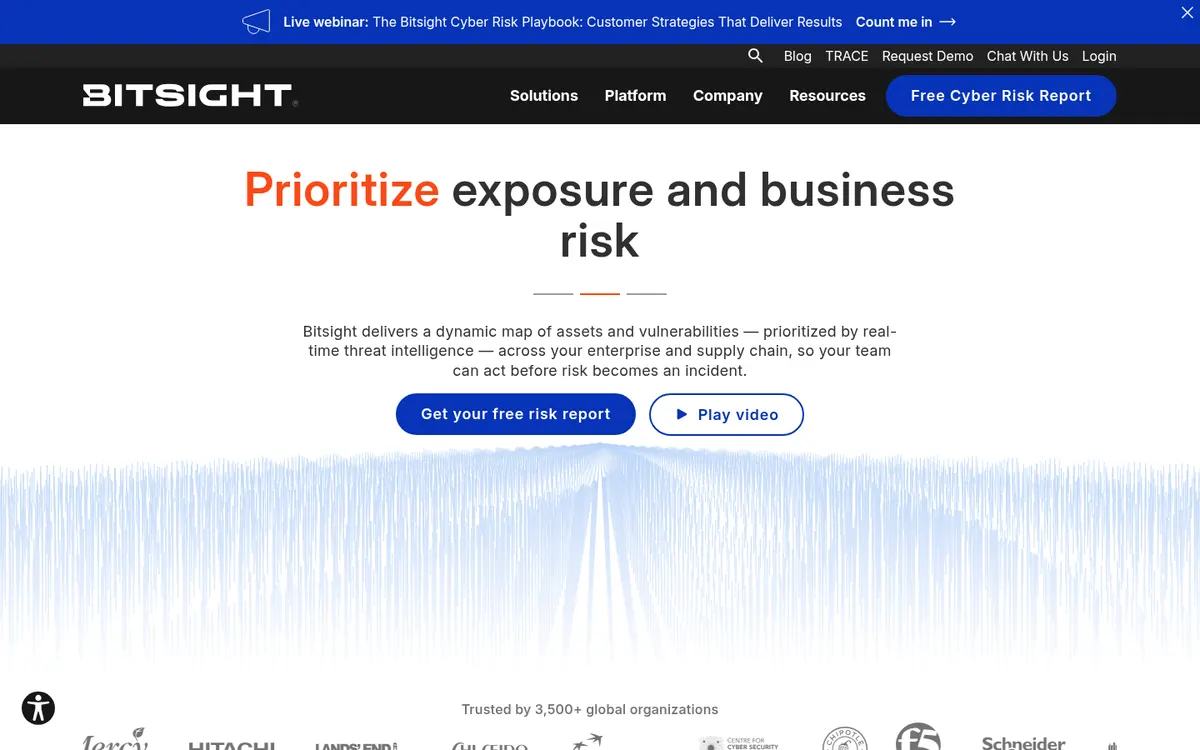
Best continuous outside-in monitoring in the list, but a visibility layer that needs a lifecycle platform beside it.
BitSight built the security ratings category and still sells the clearest version of it. The platform continuously scans internet-facing assets and converts what it finds into ratings, then tracks changes so a supplier that opens a risky service shows up in a dashboard before an incident does. Alerts on posture changes mean you hear about deterioration between annual reviews rather than after a breach disclosure. Peer and industry benchmarking gives procurement a defensible way to say a vendor sits below its cohort. Fourth-party and supply chain visibility extends the same logic one layer deeper, which matters for firms whose critical suppliers are themselves aggregators. What BitSight does not do is run your vendor lifecycle. There are no questionnaires to distribute, no evidence review, no remediation workflow that closes the loop with a contract owner. It is a monitoring layer, and it works best when it feeds a lifecycle platform or GRC suite that handles assessment and remediation. Buyers expecting one purchase to cover both will be disappointed, and buyers who skip the second purchase end up with a dashboard and a separate spreadsheet of what they did about it. Deployment is comparatively quick because there is little to configure: import a vendor portfolio and ratings appear. Integration depth with other systems is limited, so plan on exports or light API work if findings need to land inside a ticketing system. Pricing is quote based and no figure is published, so budget approval requires a conversation with sales. Ask how the quote is scoped before you budget.
You need continuous external visibility of a large supplier base and already have a system for assessments.
You need one tool to run questionnaires, evidence and remediation end to end.
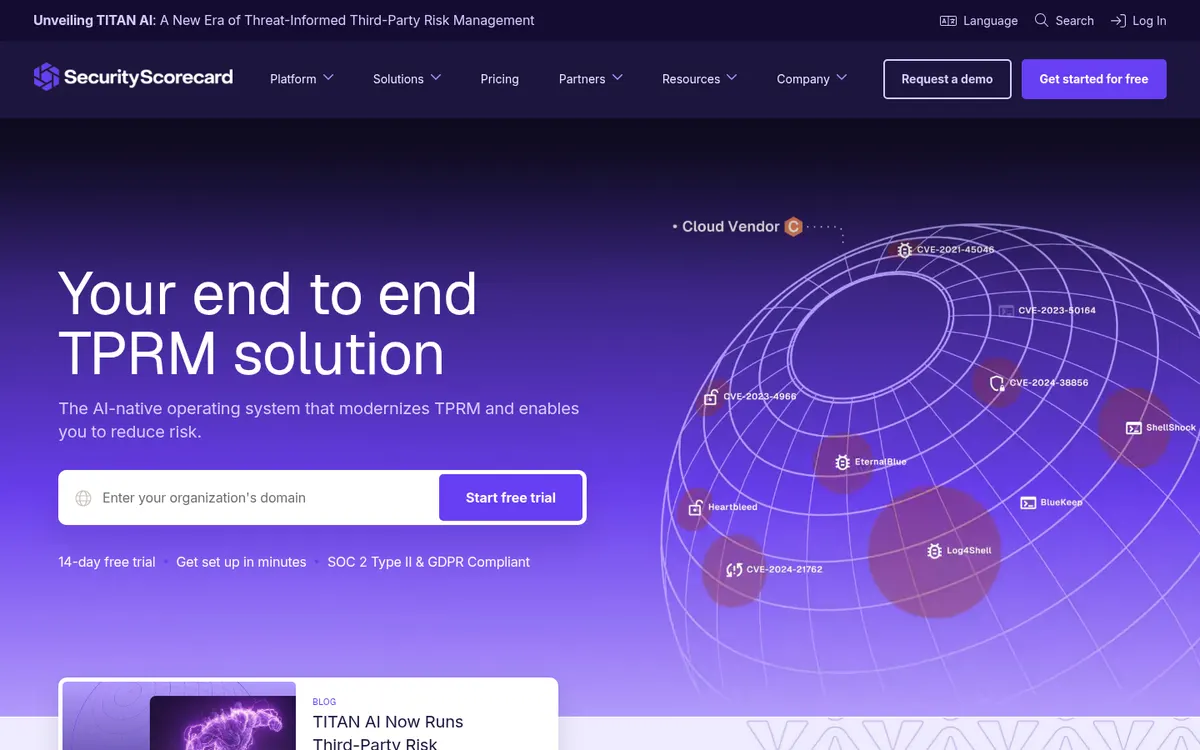
A free scorecard makes the ratings model easy to test before you commit to a quoted portfolio contract.
SecurityScorecard sells ratings and gives one away. A free claimable scorecard for your own company lets a buying team see how the scoring model behaves before committing budget, which is a lower-friction evaluation than most vendors in this category offer. The same model then extends to portfolio monitoring across suppliers, with threat and breach intelligence, peer benchmarking and issue prioritization layered on top. The free self-monitoring tier also gives a security team something concrete to show an executive who asks how the company looks from outside.
The paid product is where portfolio work happens, and it is quote based with no published figure. Treat the free scorecard as an evaluation aid, not a proxy for how the paid platform will cover a supply chain of several hundred vendors. Ratings coverage across rated companies is broad, which helps when your supplier list includes smaller firms that publish little about themselves.
Scores are an outside-in signal built from observable evidence. They cannot see internal controls, contract terms, data residency arrangements or the quality of a vendor's own third-party program. Teams that treat a score as an assessment decide on thin evidence; teams that ignore scores miss early warning signs. The workable pattern is to use the score to decide which vendors deserve a questionnaire this quarter.
Disputes are a known friction point. When a score looks wrong, correcting it takes correspondence and evidence, and the vendor on the other side may not have staff to chase it. Build time for that into your process and tell suppliers what to expect.
You want to test a ratings model free and then extend it across a supplier portfolio.
You need questionnaire management, evidence review and remediation from the same vendor.
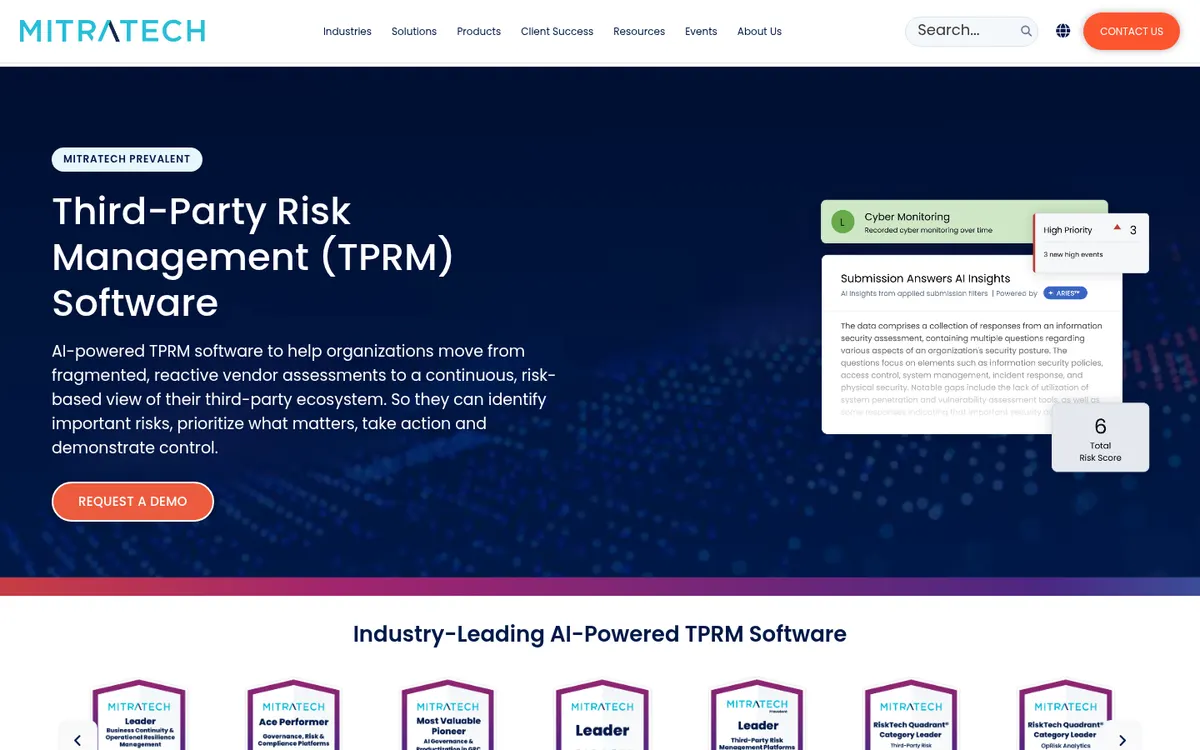
Full lifecycle coverage backed by a services team and a vendor intelligence network spanning more than 10,000 vendors.
Prevalent covers the full vendor lifecycle in one system: intake, onboarding, risk assessment and questionnaires, continuous monitoring, remediation tracking and offboarding. That end-to-end span is why it lands on shortlists for enterprise programs that have outgrown a spreadsheet plus a ratings feed. The risk intelligence network supplies pre-populated vendor data, described by the company as spanning more than 10,000 vendors and data from hundreds of thousands of sources, which cuts the number of questions you send to a supplier you have never assessed. The network helps fill gaps in supplier data before you send a questionnaire. The services layer is the differentiator buyers underestimate. Prevalent's team can take on onboarding and remediation tasks, so a lean vendor risk function can run a program that would otherwise need several analysts. AI-assisted assessment review reduces the reading load on questionnaire responses, though it does not remove the need for a reviewer with judgment about whether a control is adequate. Prevalent is now part of Mitratech, which matters for buyers weighing long-term roadmap risk and for procurement teams that check corporate stability before signing a multi-year deal. Pricing is quote based with no published figure, and the product is built for enterprise buyers with enterprise scopes. Implementation requires planning: data migration, workflow design and internal change management all land on your side. Budget for a program manager, not just a license.
You want lifecycle coverage plus a services team that can absorb assessment and remediation workload.
You are a small team that needs a working tool in weeks rather than a program stood up over a quarter.
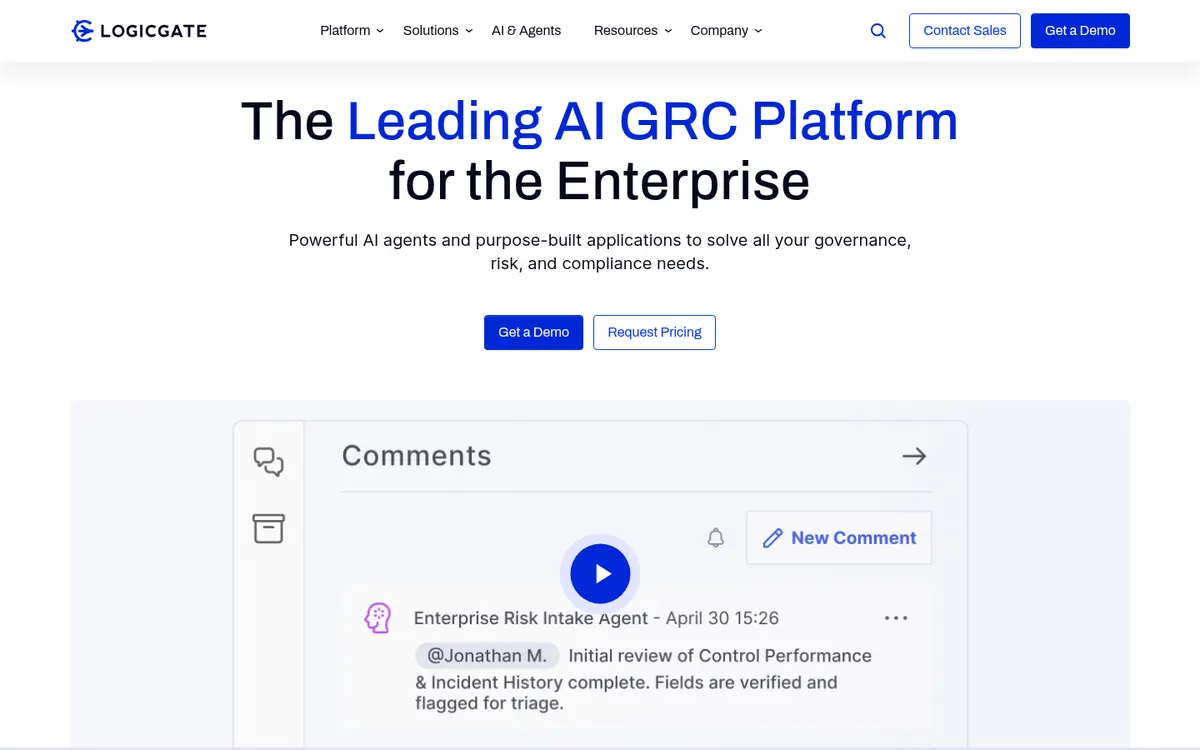
Configurable no-code GRC that fits bespoke methodologies, at the cost of design work you own.
LogicGate sells configurability. The no-code workflow builder lets a risk team model its own process rather than adopting a vendor's opinion about how vendor risk should work, and that is a genuine advantage for organizations with bespoke methodologies, regulator-specific steps or an approval chain no template matches. The third-party risk application ships as one of several GRC use cases on the same platform, alongside a risk register, control mapping and custom reporting and dashboards.
The cost of that flexibility is design work. Somebody has to decide what the workflow should be, build it, test it and maintain it as the program changes. Teams with no dedicated risk operations owner tend to build something in month one and leave it untouched in month twelve, which erodes value quickly and makes the next renewal awkward. Integrations with common business systems exist, but each one needs configuration and an owner.
Packaged vendor risk content is thinner than what the specialists ship. If you want a mature questionnaire library mapped to common frameworks out of the box, LogicGate asks you to assemble more of it yourself. If you want your own methodology encoded precisely, that is exactly the trade you are making, and it is a reasonable one for a firm whose process is a competitive or regulatory requirement.
Pricing is quote based and no figure is published. Value depends heavily on how many GRC domains you consolidate onto the platform; buying it for third-party risk alone rarely justifies the configuration effort. Ask for a fixed-scope implementation quote before signing.
Your vendor risk methodology is bespoke and multiple risk domains need one configurable home.
You want questionnaires, content and workflow ready on day one without design work.
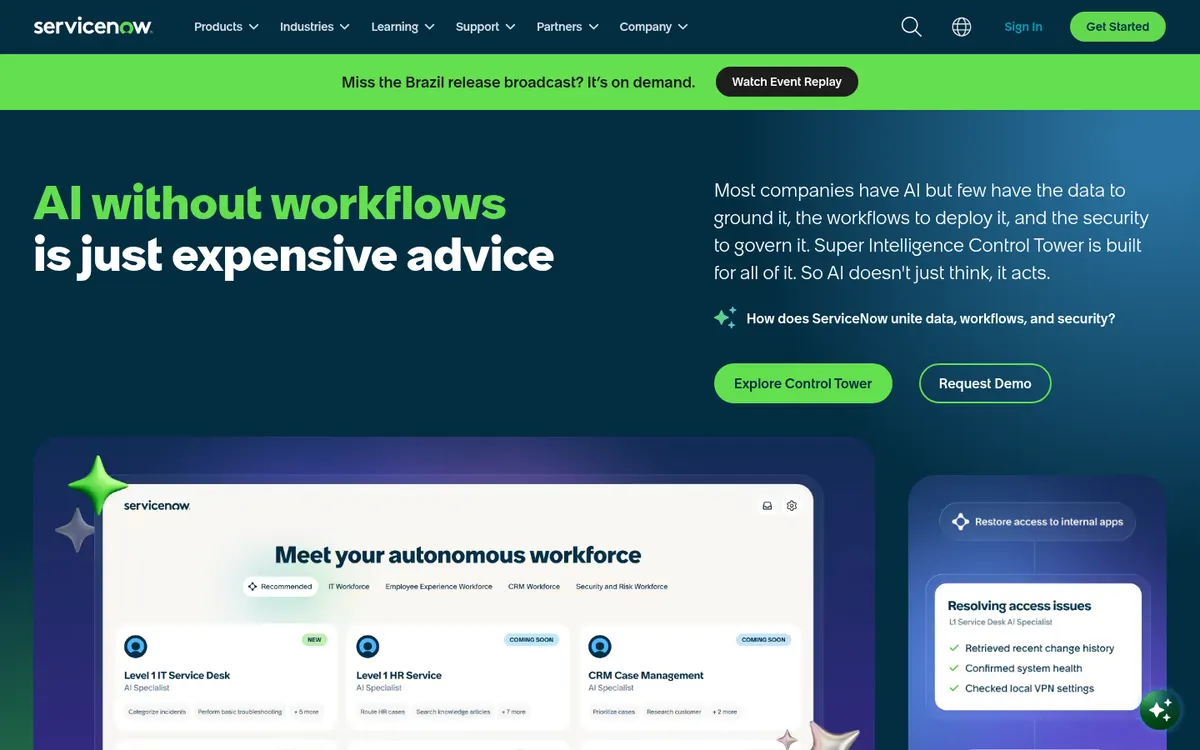
Excellent inside a ServiceNow estate, hard to justify outside it, and a heavy implementation either way.
ServiceNow's third-party risk module makes sense in one context: you already run the Now platform. Vendor onboarding workflows, risk assessment and scoring, and remediation task management then sit on the same data model as your IT service management records, so a vendor record and a configuration item can reference each other without an integration project. Security operations data can flow into the same risk view, which shortens the path from a finding to a tracked task with an owner. Unified GRC records across the platform mean one reporting layer instead of three. Outside that context, the appeal drops sharply. Buyers with no ServiceNow estate face a platform purchase plus a module purchase plus an implementation, and they inherit a configuration model designed for large IT organizations. Specialist vendor risk tools deploy faster for standalone needs and cost less to operate, even when the license line looks similar on paper. Implementation is heavyweight. Expect a program with internal platform owners, an external implementation partner and a phased rollout across business units. The payoff is consistency: one record set, one workflow engine, one place where audit evidence lives. Firms that run the platform well tend to be satisfied; firms that bought it for one module tend to be the ones complaining at renewal. Pricing is quote based and not published, and the total depends on the modules you add and the agreement you already hold. Nothing here estimates a figure. Ask what the module adds to your existing contract rather than what it costs standalone.
ServiceNow is already your system of record and you want vendor risk on the same platform.
Vendor risk is the only problem you are solving this year and you have no Now investment.
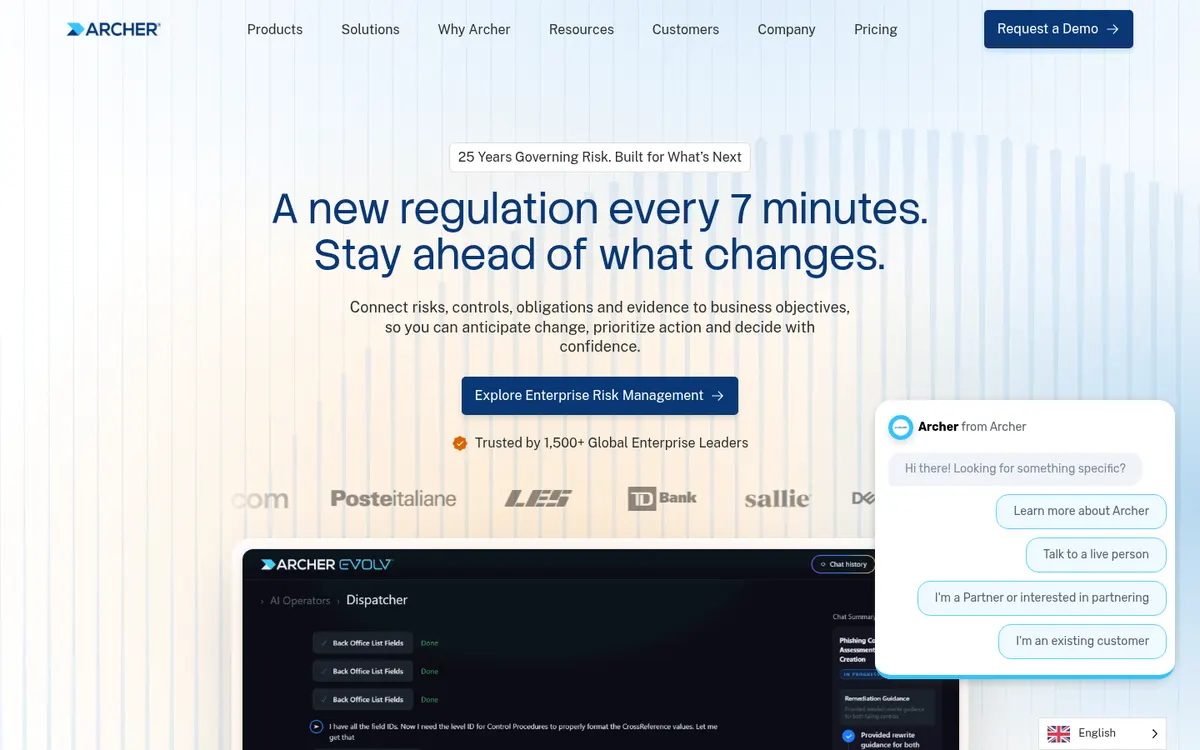
Deep enterprise configurability for complex regulated requirements, with an administration burden that never goes away.
Archer is the long-standing enterprise GRC product from RSA, and it behaves like one. Vendor risk management is a module inside a platform built for deep configuration of risk and compliance processes, with policy and control management, issue and remediation tracking and executive reporting sharing one underlying structure. Coverage of risk domains is broad, which is why it lands in large firms that want a single system across risk domains rather than separate tools with separate data models. Organizations with unusual regulatory obligations can model them here instead of bending their process to fit a template. The price of that power is implementation. Archer engagements run long, demand configuration specialists and leave you with a system that needs dedicated administrators to keep working as the business changes. Buyers who underestimate the administration load end up with an expensive register nobody trusts, and the renewal conversation becomes a debate about whether the tool earned its keep. Reporting and dashboards are strong once the data model is right, and integrations for enterprise data sources let risk records pull from systems of record instead of being rekeyed by an analyst each quarter. Pricing is quote based and no figure is published. Archer is seldom a fit below large enterprise scale: operating cost is the bigger issue, because the tool assumes a team. Ask comparable organizations how long implementation actually took before you commit a budget cycle to it.
You must encode complex, bespoke risk requirements at scale and can staff the platform properly.
Your program is still maturing or you need visible results inside a single quarter.

Cuts questionnaire turnaround time with automated chasing and outside-in validation, and stays deliberately narrow.
Panorays attacks the part of vendor risk that consumes the most hours: getting questionnaires out, getting them back and checking whether the answers are true. Automated distribution and chasing removes the manual follow-up that stalls assessments for weeks, and outside-in validation compares what a vendor claims against what is observable from the internet. Where a team needs deeper evidence, hacker-powered security testing is available as an option. Risk scoring and reporting sit on top of the same record. The result is a shorter onboarding cycle for new suppliers, which matters most where procurement is blocked behind a security review queue. Onboarding workflow automation routes a new supplier to the right assessment depth without a manual triage meeting, and continuous posture monitoring keeps the vendor record current between formal assessments so a change does not wait for next year's questionnaire. Scope is deliberately narrow. Panorays does not try to be a governance suite, and teams needing policy management, control mapping and a cross-domain risk register will need another system alongside it. That narrowness is also why the business case usually rests on analyst hours saved rather than on consolidation. Pricing is quote based with no published figure. The company is newer to market than the large GRC vendors, so buyers weighing long-term stability should ask directly about roadmap, support commitments and what happens to your data if the contract ends.
Questionnaire chasing is the bottleneck and you want answers validated against observable evidence.
You need policy management, control mapping and a full risk register from one vendor.
Outsources the assessment work to analysts, which suits regulated firms short on staff and long on examiner scrutiny.
Venminder sells an outcome rather than a license. In-house analysts perform the vendor assessments, collect questionnaires and evidence, maintain documentation and run ongoing monitoring, so a firm with a small compliance team can show examiners a working vendor risk program without hiring a bench of analysts. For regulated buyers facing periodic examination, that operating model is the entire argument, and support for audit and exam preparation is part of what you buy. The trade is control. You cannot tune every step the way you would with a configurable platform, and assessment work happens in someone else's queue with someone else's priorities. Firms that want to build internal capability over time will find the model slows that development, because the work never lands on their own staff. Documentation maintenance matters more than it sounds: examiners ask what you checked and when, and a maintained file answers that without a scramble. Cost is higher than software-only options as a result, though the honest comparison is against the loaded cost of hiring and retaining analysts. Buyers should price the service against a realistic staffing plan rather than against a tool subscription, because those are different purchases with different risk profiles. Pricing is quote based and no figure is published. Monitoring is included in the service rather than sold as a separate module, which simplifies the budget conversation but makes apples-to-apples comparison with software harder.
You have budget but not people, and examiners expect a documented vendor risk program.
You want the process fully in house or you cannot justify the fee against headcount.
Third party risk management software is the system a company uses to decide which suppliers it can trust with data, money or uptime, and to keep that decision current. It replaces a spreadsheet and a shared inbox with a structured record of every vendor, the tier it sits in, the assessment it went through, the issues found and who owns the fix. The category splits into three groups buyers often conflate. - Ratings and monitoring services observe a vendor from outside, scanning internet-facing assets and scoring what they find on a schedule.
This comparison sits on the Software desk. Readers comparing neighbouring stacks often check our guides to demand forecasting software and glp 1 companies next.
Publishing a price is the exception in this category, so build your budget process around that fact. Nine of the ten tools here list no starting price on their website. Only UpGuard publishes entry numbers: Trust Exchange Paid at $600 per month billed annually; higher tiers are quote based. Four billing shapes show up in this list.
| Model | How it bills | Typical fit | Example from this list |
|---|---|---|---|
| Published subscription | Monthly rate billed annually, tied to a named plan | Mid-market teams that need a budget number before a call | UpGuard, $600 per month for Trust Exchange Paid |
| Quote-based platform | Annual contract scoped by modules, vendor count, seats and term | Enterprise programs with variable scope | OneTrust, Archer, ServiceNow TPRM |
| Free tier plus paid expansion | No-cost entry product, paid tiers quoted separately | Teams evaluating the ratings model before committing | SecurityScorecard free company scorecard, UpGuard free Trust Exchange tier |
| Managed service | Recurring fee that includes analyst labor, not just software | Regulated firms without staff to run assessments | Venminder |
Every price above was checked on the vendor's own pricing page on November 25, 2026. Where a vendor does not publish a figure we write "See website" instead of guessing. To compare annual and monthly billing quickly, try the free percentage calculator.
It covers the vendor lifecycle: intake and onboarding, tiering, assessments and questionnaires, continuous monitoring, remediation tracking and offboarding, with reporting on top. Some tools cover all of those steps in one system. Others cover one slice, such as security ratings or questionnaire automation, and expect you to connect them to something else. Know which slice you are buying before you compare prices.
Because deals are scoped per buyer. Vendor counts, module selection, user seats and contract length all move the number, so vendors quote after a qualification call. Nine of the ten tools here publish no entry price. The practical effect is that you cannot budget from a website, so ask for written scope and a first-year total before you invest time in a demo.
Ratings services observe a vendor from outside, scanning internet-facing assets and scoring what they find. Lifecycle platforms run the paperwork: onboarding, questionnaires, evidence, remediation and offboarding. Ratings tell you where to look; lifecycle tools record what you did about it. BitSight and SecurityScorecard sit in the first group, Prevalent and Venminder in the second, and UpGuard sells both together.
Usually not. An enterprise GRC suite brings configuration work and administrator overhead a small compliance team cannot absorb. Smaller firms are better served by a published-price tool with a free tier to test, or by a managed service that performs assessments on their behalf. Buy the smallest thing that produces evidence you can show a customer or an auditor.
It depends on the category. Ratings tools go live quickly because there is little to configure: import a vendor list and scores appear. Assessment specialists take longer, mostly to design questionnaires and onboarding flows. Full GRC suites and broad trust platforms take months plus a dedicated administrator. OneTrust, Archer and ServiceNow sit at the long end; BitSight and SecurityScorecard at the short end.
Automation removes the chasing, not the judgment. Tools like Panorays automate distribution, reminders and evidence collection, and outside-in validation flags answers that contradict observable facts. Prevalent applies AI assistance to review. What remains is a human deciding whether a control is adequate for the data being shared. Expect a large cut in administrative hours and a smaller cut in analyst hours.
Browse every comparison on the Software desk, with the same rubric and dated prices.