Ranked #1
Otterly
Cheap daily prompt tracking
See website
- Best for
- Budget AI search monitoring for lean teams
- Free plan
- No
- Rubric
- 7.2 / 10
Ten AI search visibility tools ranked by fit, with pricing checked on 2026-11-25, honest limits and a clear pick for budget, enterprise and free-tier buyers.
 Prices checked November 25, 2026
The best AI search visibility optimization tools for November 2026 depend on your budget and depth. Otterly fits lean teams that want cheap daily prompt tracking across four major engines. Profound fits enterprise teams that need prompt-level analytics and citation attribution. AthenaHQ fits buyers who want a free tier with wide engine coverage and automated fix recommendations. Frontmost AI at $19 per month is the low-cost entry, and Peec AI at $95 per month includes unlimited seats. Prices below were checked on 2026-11-25.
Cheap daily prompt tracking
See website

Unlimited seats included
Starter $95 per month

Citation attribution depth
See website (custom quote)
Disclosure for this page: All 10 tools here are unpaid editorial picks. The position of a paid listing can be part of what the vendor pays for. How we handle paid listings.
| Tool | Best for | Free plan | Actions | |||
|---|---|---|---|---|---|---|
| 1 | Otterly | Budget AI search monitoring for lean teams | See website | No | ||
| 2 | Peec AI | Specialist AI search analytics with unlimited seats | Starter $95 per month | No | ||
| 3 | Profound | Enterprise prompt-level analytics and citation attribution | See website (custom quote) | No | ||
| 4 |  Brandlight | Enterprise platform with hands-on execution support | See website | No | ||
| 5 |  AthenaHQ | Free tier with wide engine coverage and fix recommendations | Starter $295 per month | Yes | ||
| 6 |  Semrush AI Visibility Toolkit | Semrush users adding AI visibility to existing SEO reporting | SEO $117.33 per month billed annually | Yes | ||
| 7 |  Ahrefs Brand Radar | Ahrefs users wanting a lightweight AEO signal | Brand Radar AI from $199 per month | No | ||
| 8 |  Writesonic GEO | Content teams already using Writesonic for generation | Starter $79 per month billed annually | No | ||
| 9 |  Slate | Teams wanting AI visibility, SEO, content and outreach together | Launch $99 per month | No | ||
| 10 |  Frontmost AI | Agent-run teams, solo founders and one-person marketing teams | Starter $19 per month | No |
We scored ten tools against five criteria: engine coverage, data depth, ease of use, price value and workflow fit. Engine coverage asks how many AI surfaces a tool tracks and whether entry plans restrict that list. Data depth looks at prompt-level reporting, citation attribution and source tracing. Ease of use covers setup time and how fast a non-specialist can read the dashboard. Price value compares what the entry plan includes against the number on the pricing page. Workflow fit asks whether the tool connects to how a team already works, such as an existing SEO suite or a content pipeline. Prices come from vendor pricing pages checked on 2026-11-25. Where a page was empty, showed only a demo contact or listed a figure that could not be verified, the entry says so in plain terms. We do not fill gaps with guesses. Where a figure could not be verified, the entry flags that rather than presenting it as settled. The order of this list is editorial. It reflects fit for the buyer each entry describes, plus a disclosed Featured position where one applies. Featured placement is paid, and a Featured entry is scored on the same rubric and carries the same honest cons as every other tool here. Weights are not a ranking formula. They exist so each entry can be compared on the same five questions, and every score is a judgment from the public feature and pricing information available, not a measurement of results. No scores, quotes, ratings, customer names or statistics in this article were invented. Where a number could not be confirmed on the vendor site, we say that rather than presenting it as settled.
The full process, including how we handle corrections, is on the methodology page. Paid listings follow our advertising disclosure.
| Criterion | Weight | What we check |
|---|---|---|
| Engine coverage | 20% | How many AI surfaces a tool tracks and whether the cheaper plans restrict that list. |
| Data depth | 25% | Whether you get prompt-level reporting, citation attribution and source tracing, or only a headline score. |
| Ease of use | 20% | Setup time and how quickly a non-specialist can read the dashboard and act on it. |
| Price value | 20% | What the entry plan includes measured against the number on the vendor pricing page. |
| Workflow fit | 15% | Whether the tool connects to how a team already works, such as an existing SEO suite or content pipeline. |
A cheap, quick way to watch brand mentions across four AI engines, if a small prompt set is enough.
Otterly is a low-cost way into AI search monitoring in this list. The entry plan covers 15 daily prompts across ChatGPT, Google AI Overviews, Perplexity and Copilot; pricing is on the vendor site. Setup is quick and the dashboard is clean, so a marketing generalist can read it without a training session. That matters more than it sounds. Most teams start monitoring to find out whether AI answers mention them at all, and Otterly answers that question in an afternoon rather than a procurement cycle. The trade-off is depth. Prompt sets are simpler than what enterprise tools offer, and reporting stays at visibility trends rather than citation-level attribution or source tracing. If you want to know which pages get cited, why a competitor gained mentions last week, or how a specific source type feeds answers, you will hit the ceiling quickly. For a small brand, a local service business or an agency running a first pilot, that ceiling is still a long way off. Pricing needs a caveat. The vendor pricing page was empty when checked, so the price could not be verified on 2026-11-25. No free plan is listed on the vendor site. Confirm pricing before you commit a card, and confirm whether trial access exists. Pick it when the job is simple: do AI answers mention us, and is that changing? It suits lean teams, solo marketers and agencies that need a cheap read on four major engines before spending on a specialist platform. Larger teams should expect to graduate to prompt-level analytics once the questions get specific.
You want a fast, cheap read on whether four major AI engines mention your brand.
You need citation attribution, source tracing or enterprise reporting depth.
Specialist AI search analytics with unlimited seats on the entry plan, which suits agencies watching several markets.
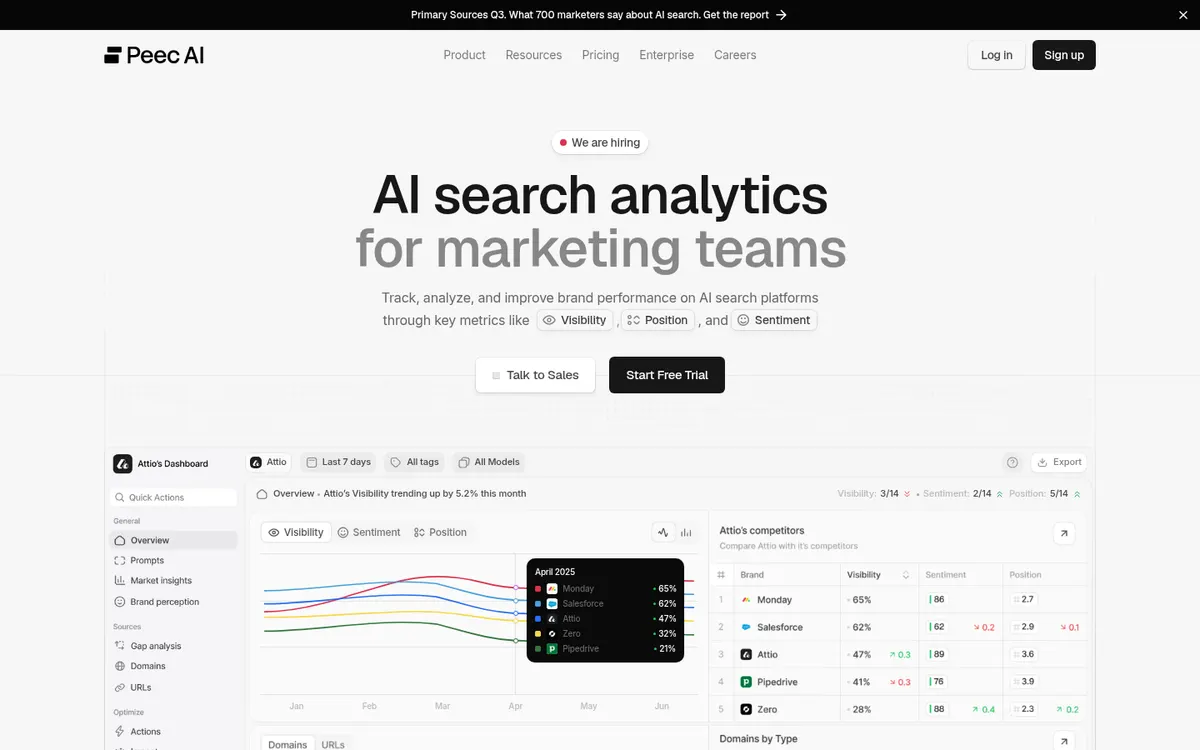
Peec AI does AI search analytics and little else, and it does the basics well. The Starter plan lists at $95 per month for 50 daily prompts and unlimited seats, which is the unusual part. Most rivals either cap users or charge per domain, so an agency or a multi-brand team can put every strategist inside the tool without a second line appearing on the invoice. For a team with several users, that can matter more than a small difference in the headline price. Coverage is where the plan boundaries show. Self-serve plans track three engines, and you add more up to seven through add-ons. Country-level visibility breakdowns are included, which suits teams selling in several markets and needing to know whether a weak answer set is a language problem, a content problem or a model behaviour. Setup is straightforward and the learning curve is low, so the first report does not need a specialist to interpret it. The reporting is directional. That is fine for trend work and less fine if you need to defend a precise number in a board pack. The vendor page confirms Starter at $95 per month. Confirm the currency, the billing term and the seat terms in writing before you sign, especially if you are buying from outside the United States. Pick it for agency or multi-market work where seats matter and three engines cover the client base. Skip it if you need citation-level forensics, a single-engine deep dive or seven engines on a self-serve plan without add-ons.
You are an agency or multi-market team that needs many seats at a predictable monthly price.
You need seven engines on a self-serve plan or deep citation attribution.
Deep enterprise prompt analytics and citation attribution, priced through a custom quote and built for a dedicated analyst.
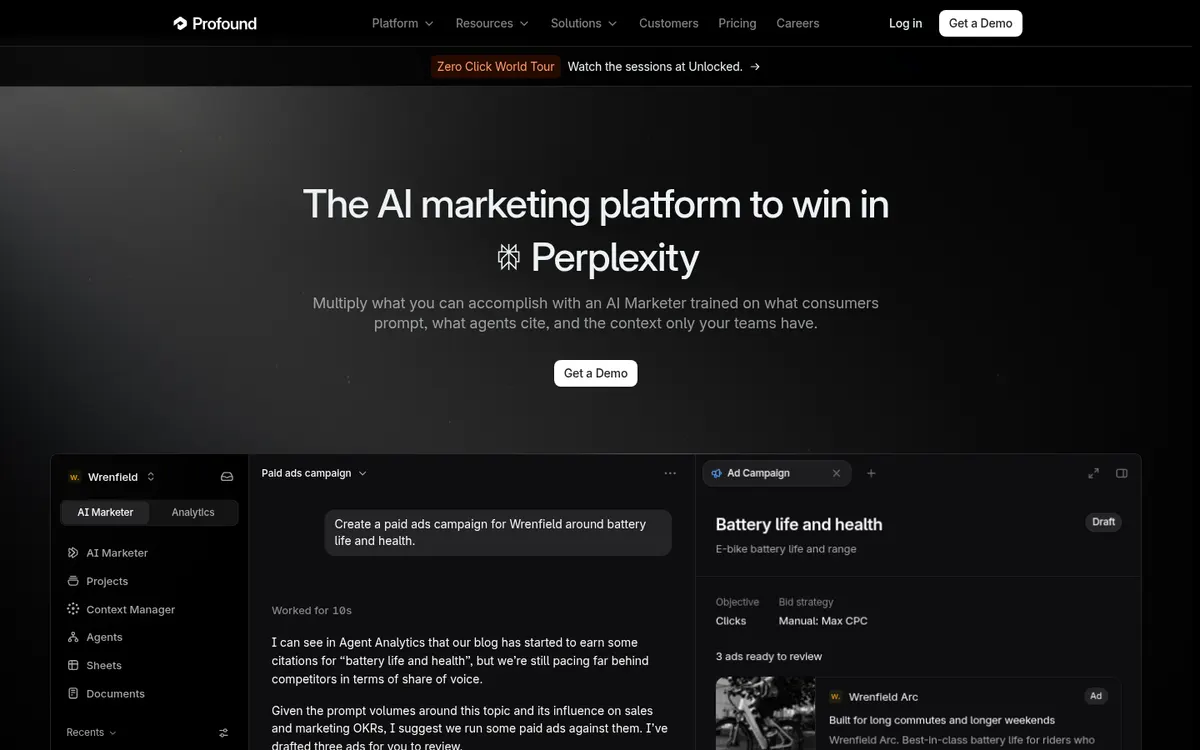
Profound is built for the analyst who wants to know exactly which prompt produced which answer and which source the engine cited. Prompt-level analytics, multi-engine prompt testing, citation attribution and source-level reporting are all core, and multi-brand portfolio support means an agency or a holding company can run several brands from one account without stitching spreadsheets together. That depth has a cost in usability. The interface is dense and oriented to people who will live in it, not to a marketing manager checking in on a Friday afternoon. Enterprise dashboards help, and multi-engine testing gives you a like-for-like view across engines, but the product rewards a dedicated owner. Hand it to someone who checks it monthly and you will get a fraction of what you paid for. Pricing is the awkward part. The vendor page shows only custom Enterprise pricing behind a demo request. A 7-day free trial is offered, which is the practical way in. If you need a budget line before you book a demo, the website will not give you one, and the older figures should not be treated as current. Pick it when citation attribution is the whole point, you have several brands to track and someone owns the tool week to week. Skip it for a first look at AI visibility, a single small brand, or a team with no analyst capacity to absorb a dense interface.
You need prompt-level analytics and citation attribution across several brands and have an analyst to run it.
You need a published price, a simple dashboard or a quick first look.
An enterprise platform bundled with hands-on execution, best for retail brands that want the work done with them.
Brandlight is a platform plus an execution partner, not a self-serve dashboard. AI visibility tracking sits alongside agency workspaces, retailer catalog support, merchant feed optimization and outreach features. That combination points at brands selling through retail and marketplaces, where a visibility gap is usually fixed by catalog and merchant feed work as much as by content, and where the measurement only pays off if someone does the follow-through. The platform lists coverage of five models in one comparison view. That is a narrower engine list than AthenaHQ claims, but the value here is meant to come from acting on the data rather than from watching a wider crawl. Agency workspaces suggest the tool is designed to be operated by a partner on the brand's behalf, which changes who you hire as much as what you buy. Everything runs through demos and custom pricing. No pricing page was available, so pricing could not be verified on 2026-11-25; confirm pilot terms with the vendor. Expect a scoped sales process with a defined engagement rather than a card checkout, and confirm pilot costs with the vendor. Pick it if you want a partner to run the work and you sell through retail catalogs or marketplaces where feed quality drives visibility. Skip it if you are a single-brand store looking for a cheap monitoring seat, where the platform and the engagement are both overkill.
You sell through retail catalogs and want tracking paired with people who execute the fixes.
You want a cheap self-serve dashboard or you have no appetite for a paid pilot.
A free Essential tier, with wide engine coverage and automated fix recommendations, but credit-based costs on paid plans.
AthenaHQ has a free Essential tier. Essential costs nothing and gives you a way to see whether AI answers mention you before any budget conversation starts. Paid self-serve Starter lists at $295 per month, and coverage is the widest here: eight or more engines, including Grok, Copilot and Google AI Mode. If your buyers use assistants beyond ChatGPT, that breadth is the reason to look at this one first. The recommendation engine is the differentiator. It turns visibility gaps into suggested fixes rather than leaving you with a chart and a shrug, and citation mix analysis shows which source types feed the answers you want. For a team that knows it needs to act but does not know which page to change, that is worth more than another dashboard. Usage is credit-based and varies with prompt volume and engine count, which adds a planning step before you scale up. The vendor page shows Starter at $295 per month for self-serve. Verify both the price and the credit allowance before budgeting, because the effective cost depends on how many prompts and engines you run. Pick it for a free start, the widest engine list in this comparison and fix guidance your team can act on next week. Skip it if you want predictable flat pricing on a small prompt set, or if $295 is above what a small team can justify.
You want to start free and need wide engine coverage plus recommendations you can act on.
You need flat, predictable pricing or you only care about ChatGPT and one other engine.
The practical choice if Semrush already runs your reporting, with four engines and moderate depth at a per-domain price.
Semrush AI Visibility Toolkit is the pragmatic choice for a team already paying for Semrush. AI visibility tracking, citation tracking and visibility trends sit inside the platform you use for keyword rankings, so search and AI reporting land in one place and one agency report. That consolidation is the product: no new login, no second data source to reconcile, no training session for a tool the team will forget by February. Coverage is four engines, which is modest next to AthenaHQ's eight or more, and depth is moderate. If you need to know exactly which page was cited for which prompt, this is not the tool for that job. What you get instead is a trend line next to your rankings, which is often enough to spot whether a category page is losing ground in AI answers while holding position in organic results. The vendor page shows SEO plus AI Search at $117.33 per month billed annually. Per-domain pricing adds up quickly for agencies with many client sites, so model the cost at your real domain count rather than at one. A free tier and a 7-day free trial let you test before committing. Pick it if Semrush is already your reporting backbone, four engines is enough and you value one consolidated report. Skip it if you need specialist depth, citation forensics or you do not use Semrush at all.
Your team already reports in Semrush and wants AI visibility in the same place.
You need citation-level depth or you do not otherwise use Semrush.
A lightweight AEO signal inside Ahrefs, convenient for existing users and expensive as a standalone purchase.
Brand Radar is an add-on to Ahrefs, and it behaves like one. Brand mention tracking and AI answer visibility reports appear inside the interface your team already knows, so an existing Ahrefs user can read the AEO signal without learning a new product or exporting data into a second dashboard. For teams that live in backlink and keyword reports, that familiarity is the feature. Which platforms you can select depends on your tier, which makes the headline price a starting point rather than the whole story. The vendor page confirms Brand Radar AI from $199 per month, so check the platform list for your tier before you commit. There is no trial, and Ahrefs Free is limited to Site Explorer and Site Audit, so testing Brand Radar means paying. Depth is moderate and it is not a dedicated GEO platform: no prompt-level attribution at the level Profound offers, no execution layer, and a narrower view of how answers are built. It is a signal sitting next to your existing reports, not a replacement for a specialist tool. Pick it if Ahrefs is home base and you want a lightweight AEO signal next to the link and keyword data you already trust. Skip it if you need deep citation analysis, a free way to test or a platform built entirely around AI answers.
You already pay for Ahrefs and want AI answer visibility in the same interface.
You need a free test, deep attribution or a standalone GEO platform.
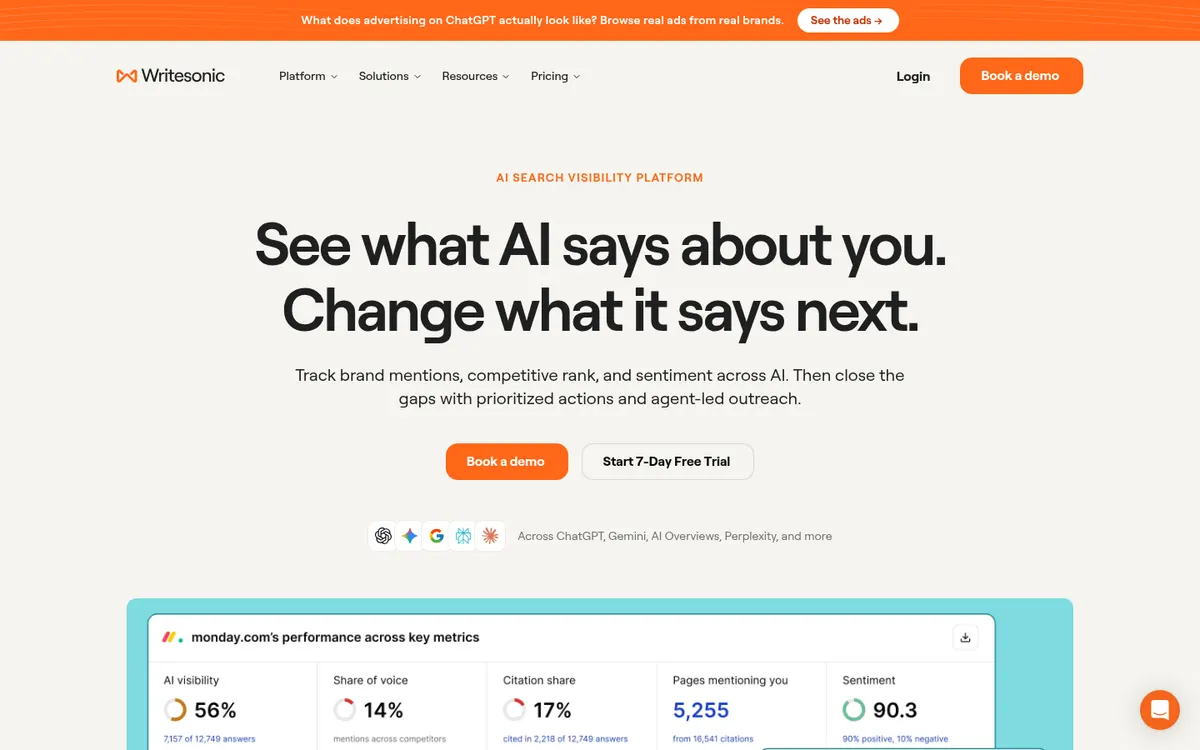
Cheap AI visibility tracking attached to a content platform, best where copywriting already happens in Writesonic.
Writesonic GEO bundles AI visibility tracking into a content generation platform. If your team already writes with Writesonic, tracking is one more tab rather than one more vendor, and copywriting workflows sit next to the visibility data. The practical loop is short: see a gap, draft the page, publish, check again, all inside one subscription. The trade-off is depth. GEO is one feature among many here, and it trails the specialists on attribution and prompt analytics. Brand mention monitoring covers the basics, and a single subscription for content and visibility keeps procurement simple, but you should not expect the prompt-level forensics Profound sells. Agencies get reseller margin, which is unusual in this category and worth asking about if you plan to resell reporting to clients. The vendor page shows Starter at $79 per month billed annually. A 7-day free trial is offered and there is no free plan. The gap between annual and monthly billing is the number to watch, because the headline price assumes you pay for a year up front. Pick it if content generation is already the center of your stack, you want cheap visibility tracking attached to it and you will act on the data with your own writers. Skip it if AI visibility is the primary job or you need deeper attribution than a bundled feature can give.
Your writers already use Writesonic and you want visibility tracking in the same subscription.
AI visibility is the main job or you need deep citation attribution.
Tracking plus execution in one workspace, useful when the team that reads the report also does the content work.
Slate combines tracking with execution: buying-intent prompt tracking, share of voice reporting, mentions and citations, source tracing for AI answers, competitor gain alerts, plus SEO content and outreach workflows with Search Console and GA4 connections. The pitch is that the person reading the visibility report is also the person who can fix the page, so the tool should not stop at the chart.
Source tracing and competitor gain alerts are the features worth noting. Tracing shows which pages the engines pulled from when building an answer, which is more actionable than a mention count. The alerts tell you when a rival picks up mentions, so you can respond in the same week rather than at the next quarterly review when the window has closed.
Pricing runs Launch at $99 per month, Growth at $499 with 10,000 AI answers and 1,000 monitored pages, Scale at $999, Agency at $2,000 and Enterprise on a custom quote. A 14-day trial is offered. Two things to check before buying: the entry plan lists one user, and platform coverage is not broken out by plan, so ask which engines you actually get at each tier.
Pick it if you want one workspace for tracking and the content and outreach work that follows, and you have at least one person to run it. Skip it if you only need measurement, or if a single-user entry plan will block your team on day one.
The team reading the AI visibility report also owns the content and outreach work.
You only need measurement or you need several seats on the cheapest plan.
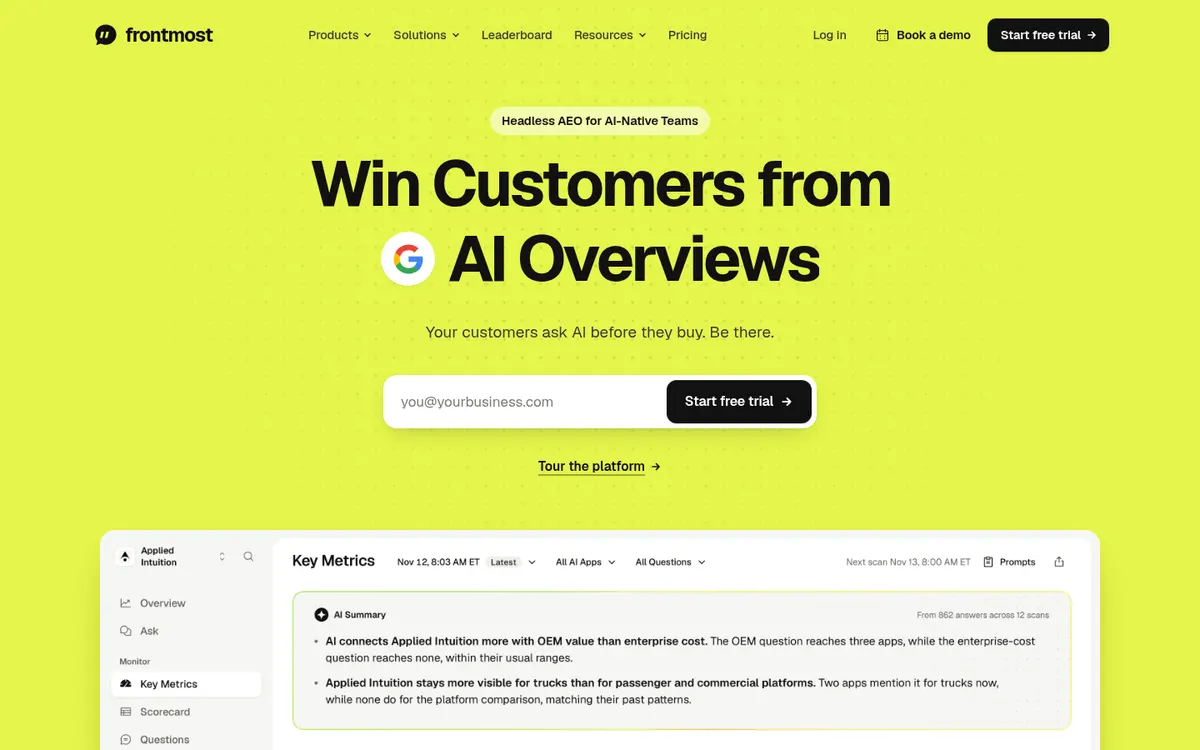
Low-cost, answer-level tracking with API access on every plan, ideal for solo operators and agent-run teams.
Frontmost AI is the low-cost, high-detail option here. Starter runs $19 per month for 1,000 credits and one project, Growth is $99 for 6,000 credits and six projects, annual billing takes 20 percent off, and unlimited users plus MCP API and CLI access are included on every plan. For a solo founder or a one-person marketing team, that combination is hard to beat on price per feature.
The data is answer-level rather than score-level. You get mentions with position and sentiment, full saved answers, competitor comparisons, branded and unbranded results kept separate, and cited page recommendations. Weekly Deep Dive reports summarize the week, which suits operators who check in on a schedule rather than living in a dashboard all day.
Credits need attention before you commit. Most apps use 1 credit per answer, Muse uses 4 and Claude uses 6, and monthly credits do not carry over. The 7-day trial of up to 1,500 credits requires a card, and there is no free plan. Heavy Claude users will burn through the Starter allowance faster than the headline suggests, so map your prompt volume to credits first.
Pick it for agent-run teams, solo founders and one-person marketing teams that want API access, unlimited users and detailed answers cheaply. Skip it if you need flat unlimited querying, a no-card trial or a plan where unused allowance rolls over.
You are a solo operator or small agent-run team who wants API access and rich answers at a low price.
You need unlimited querying, rollover credits or a no-card trial.
AI search visibility optimization software measures how often a brand appears inside AI-generated answers, then helps you change that. Instead of tracking a ranked list of links, these tools run a fixed set of prompts against engines such as ChatGPT, Perplexity, Google AI Overviews, Copilot, Grok and Google AI Mode. They record whether your brand was mentioned, which competitors appeared, and which pages were cited as sources. The output is usually a visibility score, a share of voice chart and a citation list. The category sits next to search engine optimization but is not the same job. Classic SEO optimizes for a ranked list of pages. Generative engine optimization, often shortened to GEO or AEO, optimizes for being quoted inside a synthesized answer. That changes the work. Source pages still matter because engines cite them, but so do entity clarity, third-party mentions, comparison pages and structured facts an answer engine can lift cleanly. Expect noise. The same prompt can produce different answers on different days, and results vary by model version, location and account history. Some tools in this list describe their numbers as directional rather than exact, and a single check is not evidence of anything. Read trends across several runs before you change strategy or brief a writer. What these tools typically include: - Prompt sets you define and monitor daily
This comparison sits on the SEO desk. Readers comparing neighbouring stacks often check our guides to SEO software and AI clipping software next.
Pricing in this category follows several common shapes, and the shape matters more than the headline number. What drives the bill usually comes down to daily prompt volume, engine count, domain count or a credit allowance. A tool that looks cheap for one project can look expensive at scale, and a tool with unlimited seats can beat a cheaper rival for a team with several users.
| Model | How it bills | Typical fit | Example from this list |
|---|---|---|---|
| Prompt-based subscription | Monthly fee tied to a daily prompt count | Small teams watching a fixed prompt set | Otterly's entry plan for 15 daily prompts; pricing is on the vendor site |
| Seat-inclusive analytics | Monthly fee with unlimited seats on entry | Agencies and multi-market teams | Peec AI Starter at $95 per month |
| Enterprise custom quote | Negotiated contract after a demo | Large brands with analyst teams | Profound and Brandlight |
| Suite add-on | Per domain or added to an existing SEO subscription | Teams already on the suite | Semrush SEO plus AI Search at $117.33 per month billed annually; Ahrefs Brand Radar from $199 per month |
| Content bundle | One subscription covering generation and tracking | Content teams that already write in the tool | Writesonic GEO Starter at $79 per month billed annually |
| Credit-based | Monthly credit allowance with different costs per action | Agent-run teams watching spend | Frontmost AI Starter at $19 per month for 1,000 credits; AthenaHQ also runs credit-based usage |
Every price above was checked on the vendor's own pricing page on November 25, 2026. Where a vendor does not publish a figure we write "See website" instead of guessing. To compare annual and monthly billing quickly, try the free percentage calculator.
Otterly fits budget monitoring with 15 daily prompts across four engines; pricing is on the vendor site. Profound fits enterprise analytics with prompt-level reporting and citation attribution behind a custom quote. AthenaHQ fits a free start with an Essential tier and coverage of eight or more engines. Frontmost AI at $19 per month is a low-cost paid entry if API access matters to you.
Frontmost AI Starter is $19 per month for 1,000 credits. Writesonic GEO Starter is $79 per month billed annually. Peec AI Starter is $95 per month for 50 daily prompts and unlimited seats. Slate Launch is $99 per month. Semrush SEO plus AI Search is $117.33 per month billed annually. Ahrefs Brand Radar starts at $199 per month, and AthenaHQ Starter is $295 per month. Otterly's price could not be verified on the vendor site.
SEO competes for a position in a ranked list of links. Generative engine optimization competes for a mention or citation inside a synthesized answer, so the unit of competition is the prompt rather than the keyword. Source pages still matter because engines cite them, but entity clarity, third-party mentions and comparison content carry more weight than they do in classic rankings.
Answers are generated rather than indexed, so the same prompt can return different text on different days. Model updates, location, account context and prompt wording all shift results. Some vendors describe their numbers as directional. Read a trend across several runs instead of reacting to one drop, and recheck after a known model release.
AthenaHQ has a free Essential tier and Semrush includes a free tier plus a 7-day trial. Ahrefs Free is limited to Site Explorer and Site Audit. Profound, Writesonic GEO, Slate and Frontmost AI offer trials of 7 to 14 days, and Frontmost AI requires a card. Otterly and Peec AI do not list a free plan.
Check which engines the plan actually covers, how many prompts you get per day, and whether the vendor shows raw answers or only a score. Confirm the price on the vendor page for your billing term. Vendors who spot an outdated price or feature can request a correction with a link to the current pricing page, and we will verify it against the source.
Browse every comparison on the SEO desk, with the same rubric and dated prices.