Ranked #1

Eventrise
One flat fee
See website
- Best for
- independent venues and organizers wanting one flat fee
- Free plan
- Yes (free events are $0, unlimited attendees)
- Rubric
- 8.6 / 10
Nine ticketing platforms compared on flat fees, percentage pricing, free event limits and the attendee features that decide whether your box office runs smoothly.
 Prices checked November 25, 2026
Published November 2026. The best ticketing platform for events depends on who finds your buyers. Eventrise suits independent venues and organizers who want one flat 5% platform fee on the ticket price with no subscription. Eventbrite suits public events that benefit from marketplace discovery across roughly 180 countries. Ticket Tailor suits budget-conscious organizers selling higher-priced tickets, with a flat GBP 0.60 per ticket and a free tier for up to 5,000 free tickets a year. Prices below were checked on 2026-11-25.
One flat fee
See website

Built-in discovery
Pay as you go: 3.7% + $1.79 per paid ticket

Flat per-ticket pricing
£0.60
Disclosure for this page: All 9 tools here are unpaid editorial picks. The position of a paid listing can be part of what the vendor pays for. How we handle paid listings.
| Tool | Best for | Free plan | Actions | |||
|---|---|---|---|---|---|---|
| 1 | Eventrise | independent venues and organizers wanting one flat fee | See website | Yes | ||
| 2 | Eventbrite | public events that benefit from built-in discovery | Pay as you go: 3.7% + $1.79 per paid ticket | Yes | ||
| 3 | Ticket Tailor | budget-conscious organizers with rising ticket prices | £0.60 | Yes | ||
| 4 |  TicketSpice | custom branded ticketing with flat per-ticket fees | Standard: $0.99 per paid ticket | No | ||
| 5 | Tito | community events and tech conferences | See website | Yes | ||
| 6 |  Humanitix | fundraisers and impact-driven events | Standard: 4% + $0.99 per paid ticket | Yes | ||
| 7 | Whova | conferences that need an attendee event app | See website | No | ||
| 8 | RSVPify | branded registration and RSVP workflows | Starter: $39/month | Yes | ||
| 9 |  Eventzilla | small and mid-sized events needing quick setup | Basic: $1.50 per registration | Yes |
Every entry here was judged against the same five criteria. Fee transparency asks whether a platform publishes its costs in plain numbers before you sign: Eventrise's single 5% line and TicketSpice's 99 cents per paid ticket score well, while a custom quote does not. Cost at scale asks what happens to your margin when ticket prices or volume climb, which is where percentage models and flat per-ticket models part ways. Attendee experience covers the buyer side: page clarity, checkout, seat selection and the check-in app at the door. Organizer control covers the tools behind the scenes, from reporting to team accounts to refund handling. Integrations covers APIs, webhooks, email and automation connectors that stop you re-keying attendee data.
Weights reflect how often each question decides a purchase rather than a formula that produces the order. The order is editorial: it follows the fit described in each entry, plus the Featured position.
Pricing facts come from vendor pricing pages checked on 2026-11-25. Where a page returned nothing, we say so rather than guess; Whova's entry notes that its pricing could not be checked. Currency appears as the vendor publishes it, which is why Ticket Tailor is quoted in GBP. Fees quoted are platform fees only unless the entry says processing is included.
The Featured position in this list is a paid placement. It gets the same five criteria, the same request for honest weaknesses, and the same requirement that its pricing match the vendor page. A Featured label changes where an entry sits, not what we say about its costs.
The full process, including how we handle corrections, is on the methodology page. Paid listings follow our advertising disclosure.
| Criterion | Weight | What we check |
|---|---|---|
| Fee Transparency | 25% | Whether the platform publishes its costs in plain numbers before you sign anything. |
| Cost at Scale | 25% | What happens to your margin when ticket prices or sales volume climb. |
| Attendee Experience | 20% | How the buyer side feels, from event page and checkout to seat choice and door check-in. |
| Organizer Control | 15% | The tools behind the scenes, including reporting, team access, seating and refund handling. |
| Integrations | 15% | APIs, webhooks, payment connections and automation links that stop you re-keying attendee data. |
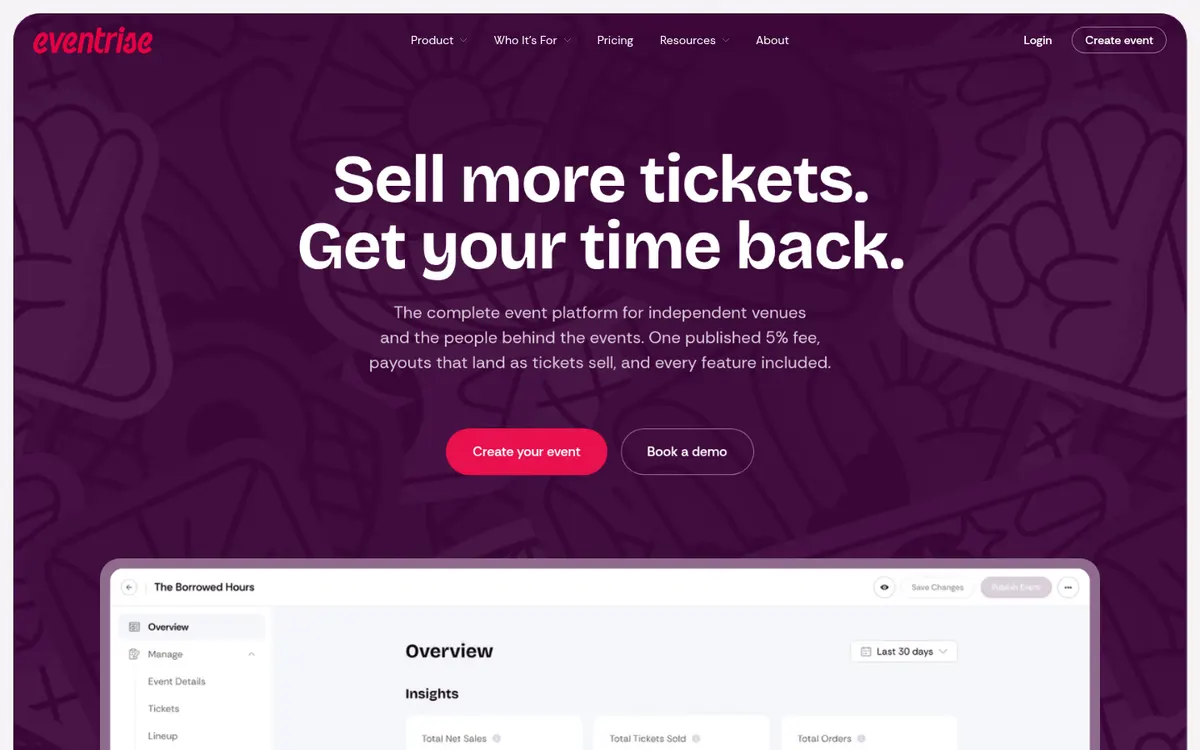
Best for independent venues that want one published fee, their own Stripe account and payouts that follow sales.
Eventrise sells itself on a single number: a 5% platform fee applied to the ticket price only. There is no subscription, no contract, no setup fee and no minimum, and free events run at zero cost with no cap on attendees. Money moves through the organizer's own Stripe account, so payouts settle as tickets sell rather than arriving weeks after the event closes. That combination suits independent venues that already sell direct and do not want a marketplace taking a slice of every order.
The feature set goes past basic checkout. Hosted event pages carry an embeddable checkout, seat maps handle reserved seating, and a box office layer adds finance and profit and loss reporting for venues running several shows. Door staff get mobile check-in with offline scanning, which matters in rooms with poor signal. An organizer facility fee is optional, and the API, webhooks, Zapier and MCP server are free, so ticketing data can flow into a CRM or accounting tool without an upgrade.
The honest catch is the bill at checkout. Fees are added on top by default, so the vendor's worked example puts a $100 ticket at about $108.45 for the attendee, though organizers can absorb the fees instead. Stripe processing is charged on top of the 5%, and reserved seating adds $1 per ticketed seat. You also need an organizer-owned Stripe account, which rules out anyone who wants the platform to hold funds.
It fits venues and promoters with their own audience and an existing Stripe setup. Free white-glove migration of events and attendee data lowers the switching cost.
You run your own audience, already use Stripe and want one flat percentage instead of a subscription.
You need the platform to bring buyers, or you would rather not hold your own payment processor account.
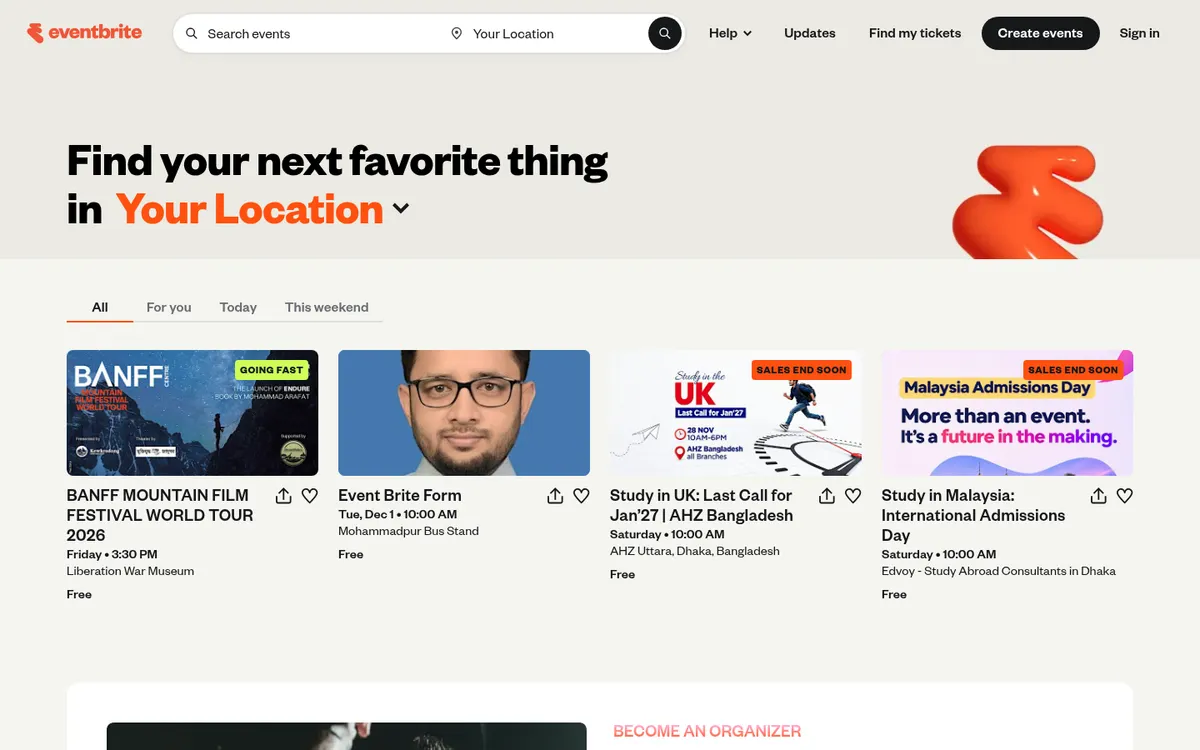
Best for public events that need built-in discovery, if you can absorb percentage plus per-ticket fees on every sale.
Eventbrite lists events in a global marketplace, and that exposure is the product. Events are listed in a marketplace that reaches roughly 180 countries, so a public event with no existing following has a chance of being found by people who are already browsing. Publishing is free and free events carry no platform fee, which makes it a low-risk place to test whether a night works. Paid tickets are where the cost appears. The pay-as-you-go rate is 3.7% plus $1.79 per paid ticket, plus card processing, so the fee has a percentage part and a flat part that both grow with volume. On a low-priced ticket the fixed dollar component is a large share of the price; on a high-priced ticket the percentage does more damage. An optional Pro tier adds tools on top for organizers running a heavy calendar. The organizer side covers the basics well: attendee management, a check-in app for the door, and Boost marketing tools that push your event into more feeds. What it does not do is give you a blank canvas. Checkout customization is more limited than white-label tools, so a venue with strict brand guidelines will feel the constraints. That is the trade. Eventbrite earns its fee when the marketplace is doing real work, sending you buyers you would not otherwise reach. When your audience already finds you directly, through a mailing list or a venue membership, the same fee erodes revenue you had already earned. Organizers in that position usually retain more on a flat-fee tool such as Eventrise or Ticket Tailor.
Your event is public, your following is thin and you want strangers to find the listing.
Your mailing list or membership already fills the room and you want to keep the percentage.
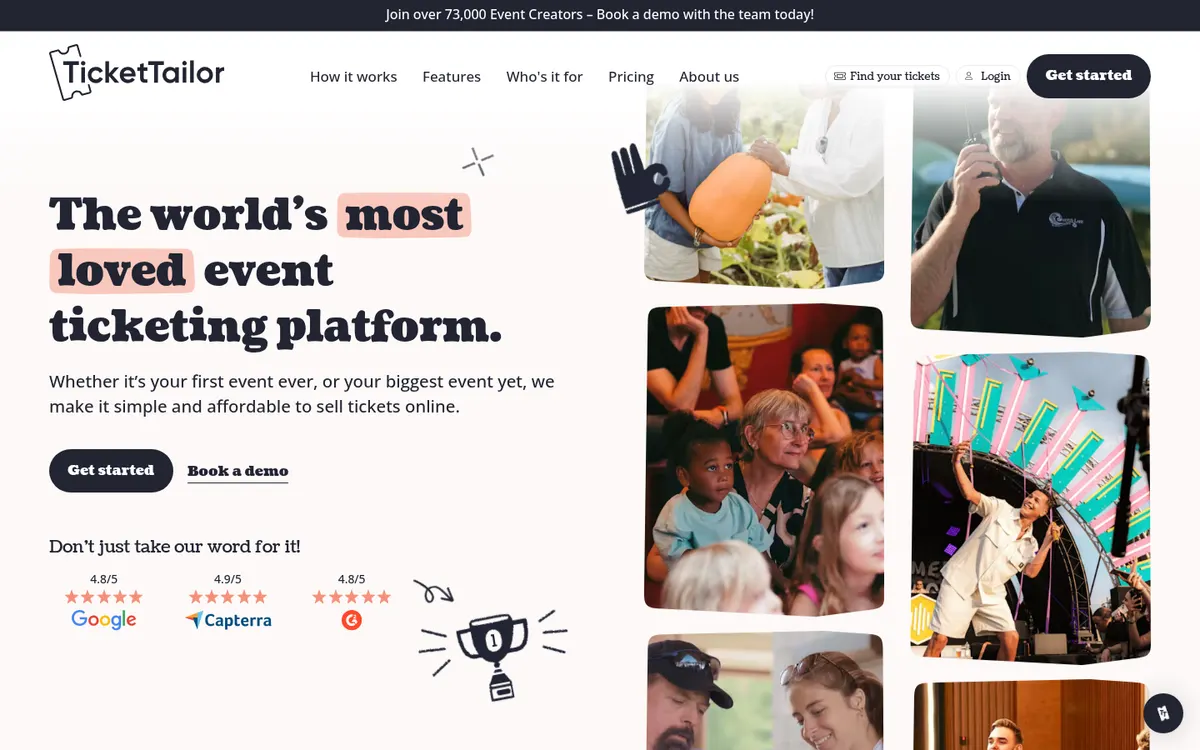
Best for organizers selling higher-priced tickets who want a flat per-ticket cost and no marketplace cut.
Ticket Tailor charges a flat fee per ticket rather than a percentage, which changes the arithmetic as prices climb. The published rate is GBP 0.60 per ticket, with prepaid credits from GBP 0.22 per ticket, and packages run from a free tier to monthly subscriptions. The first five ticket sales are free, which is enough to test a checkout end to end before committing. The model rewards organizers whose tickets cost real money. A GBP 0.60 charge is the same whatever the ticket price, while a percentage platform takes a bigger slice of higher-priced tickets. Organizers can also set their own booking fee and keep the markup, which lets you recover costs from buyers rather than absorbing them. On the free side, the platform supports up to 5,000 free tickets per year, so a venue running free entry nights or a community group with no budget can operate without a platform charge. Payment connections run through Stripe and PayPal, and the checkout can be embedded in your own site through widgets, so tickets are sold without sending buyers to a strange-looking page. The gaps are discovery and polish. There is no marketplace, so every ticket depends on your own marketing, and event branding takes configuration rather than appearing automatically. Support runs round the clock, and the company is a London-based certified B Corp, which matters to organizers who weigh environmental commitments. A Climate Impact Tracker reports event emissions. It suits budget-conscious organizers with rising ticket prices and an audience they already reach. It suits them less if they need a listing where strangers browse.
Your tickets cost real money and you want a fixed cost per sale rather than a percentage.
You need a marketplace to bring you buyers or want branding to work without setup.
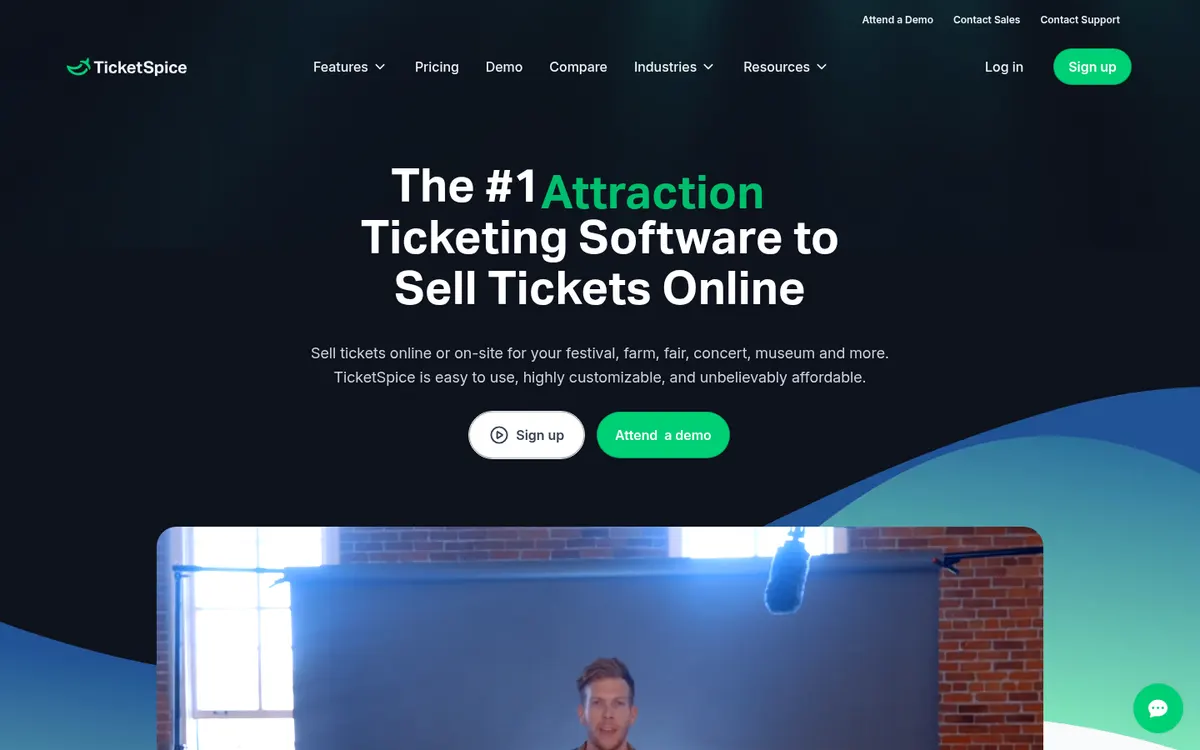
Best for events that want heavily branded pages and flat 99 cent tickets, with no monthly fee attached.
TicketSpice charges 99 cents per paid ticket on its Standard tier, with Premium and Pro tiers above it, and no monthly or setup fee. Refunds and comps are not charged, which matters at the door when a guest list changes at the last minute. Organizers keep 100% of their ticketing fees, so a booking fee you add is yours rather than shared with the platform.
The build quality is the reason to look. Pages are highly customizable, which suits events that treat the ticket page as part of the brand, and the platform supports timed entry slots and reserved seating without bolting on a second product. Text messaging reaches attendees with changes and reminders, and purchase protection is available as an option at checkout.
Scale is proven. The platform is used by high-attendance events such as the Albuquerque International Balloon Fiesta, which tells you the checkout holds under load. It is part of Sacramento-based Webconnex, so there is a larger software group behind the brand.
The trade-offs are straightforward. There is no free plan, so a free event still needs a paid arrangement, and support hours are US-focused, which is awkward for organizers elsewhere who need help at short notice. The flat fee is excellent value on expensive tickets and less compelling on cheap ones, where 99 cents can be a large share of the price. Lower-priced per-ticket options exist elsewhere on this list for events with low ticket prices.
Pick it when branded pages and a predictable per-ticket cost matter more than a free tier or a marketplace.
The ticket page is part of your brand and you want a flat cost that ignores ticket price.
You run free events, sell very cheap tickets or need support outside US hours.
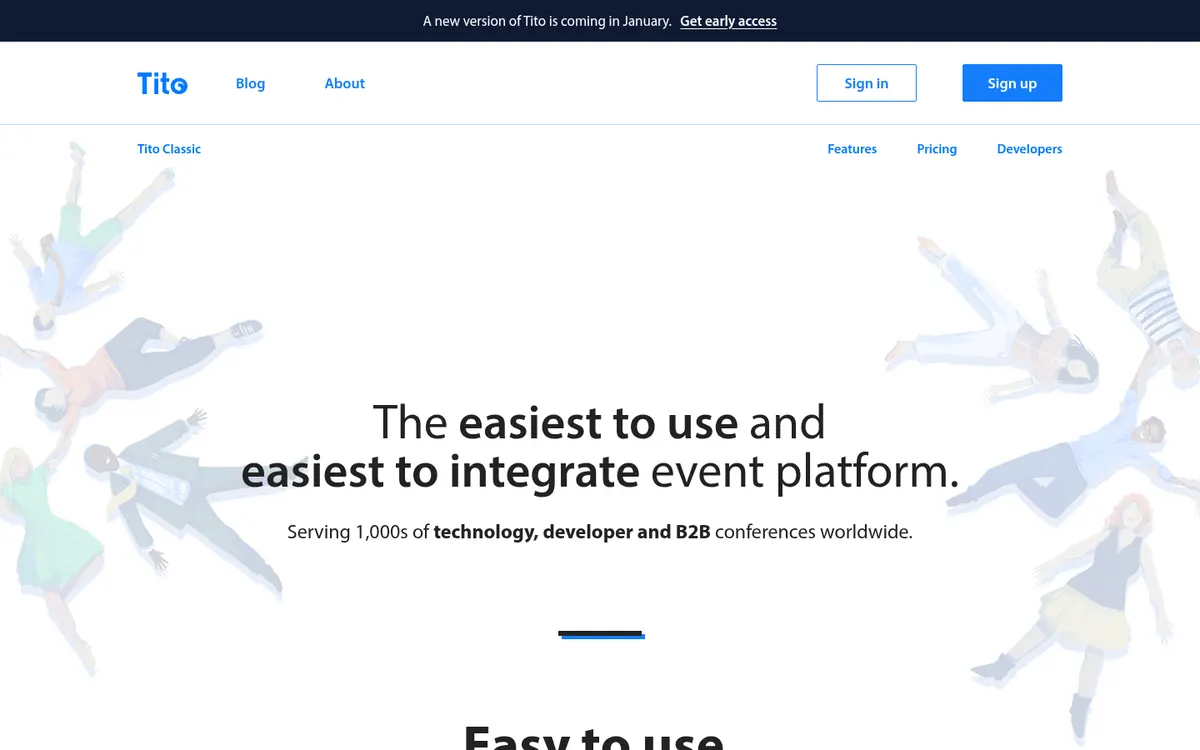
Best for community events and tech conferences that want a clean flow and a capped per-ticket fee.
Tito is a deliberately narrow tool: a hosted event page or an embeddable widget, discount codes, check-in and team accounts. The rate is 3% per ticket with no setup fee and no monthly subscription, and free events stay free. Non-profits and community organizers pay 2.5% instead of 3%, and the per-ticket fee is capped at 25 EUR, which stops the percentage running away on expensive tickets. That cap is the interesting part of the offer. On a high-priced conference ticket, a 3% rate would normally be painful; the ceiling turns it into a flat cost above a certain price. Combined with the absence of a subscription, the pricing is easy to model before an event goes on sale. The flow is clean and minimal, which is why it has held on with tech conferences and community groups since Team Tito started in Dublin in 2013. Team accounts let several staff work the same event without sharing a login, and check-in handles the door. There is very little else: no marketplace, minimal discovery, and fewer enterprise features than the conference app platforms that bundle agendas, networking and sponsor tools. It also keeps a deliberately narrow feature set, so you will not find a large body of built-in extras to lean on. The fit is a specific one. If you run a community event or a conference with a known audience and you want a tidy checkout with a capped fee, Tito does the job without a sales call. If you need the platform to bring attendees, or you need an app with agendas and networking, it is the wrong shape.
You run a community event or conference with a known audience and want a capped fee and a clean checkout.
You need marketplace reach or an attendee app with agendas and networking.
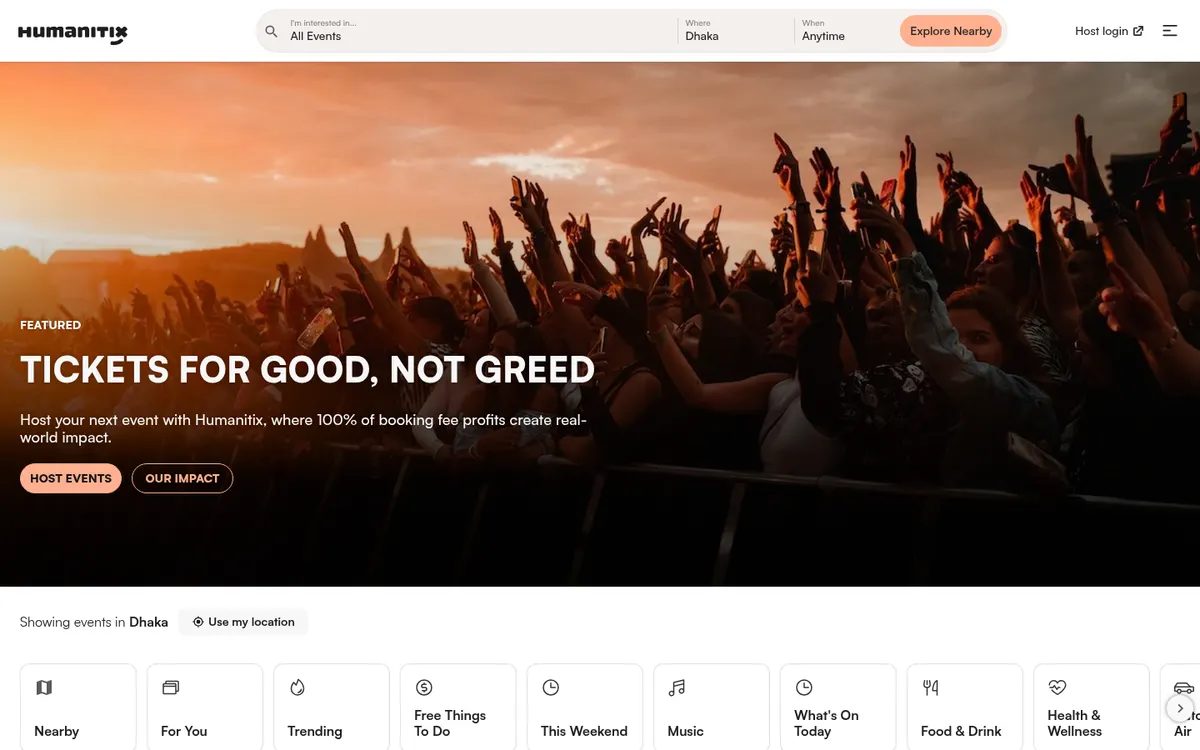
Best for fundraisers and social enterprises, since booking fee profit goes to charity rather than the vendor.
Humanitix routes booking fee profit to charity, which is the core of its appeal for impact-driven events. The platform charges 4% plus $0.99 per paid ticket, with custom pricing for large events, and free events run at no cost. The difference from other percentage platforms is where the money lands: the company reports more than $20M in fees converted to donations. The product underneath is more than a donation mechanism. Event pages are custom-branded, the interface is polished, and support is human rather than a knowledge base loop. Event management tools cover the practical work of running a calendar, and booking fees are handled so buyers can see what they are paying. It is an Australian-founded social enterprise, which suits fundraisers and impact-driven events. Basketball Queensland extended its partnership with the platform through 2028, an example of the long-run relationships the model attracts. For a fundraiser, the story is easy to tell donors, and the fee becomes part of the pitch rather than a cost to hide. The limits are size and reach. The marketplace is smaller than the large competitors, and the platform is newer in some regions, so organizers outside its strong markets should check local payment support before committing. At 4% plus $0.99, the fee is not the cheapest percentage rate on this list before you count the charitable angle, so a pure cost comparison will not favor it. Pick it when the mission is part of the event. Skip it when the lowest total fee is the only thing that matters.
Your event supports a cause and you want the platform fee to become part of the story.
You are buying purely on the lowest percentage and the charity angle does not move your buyers.
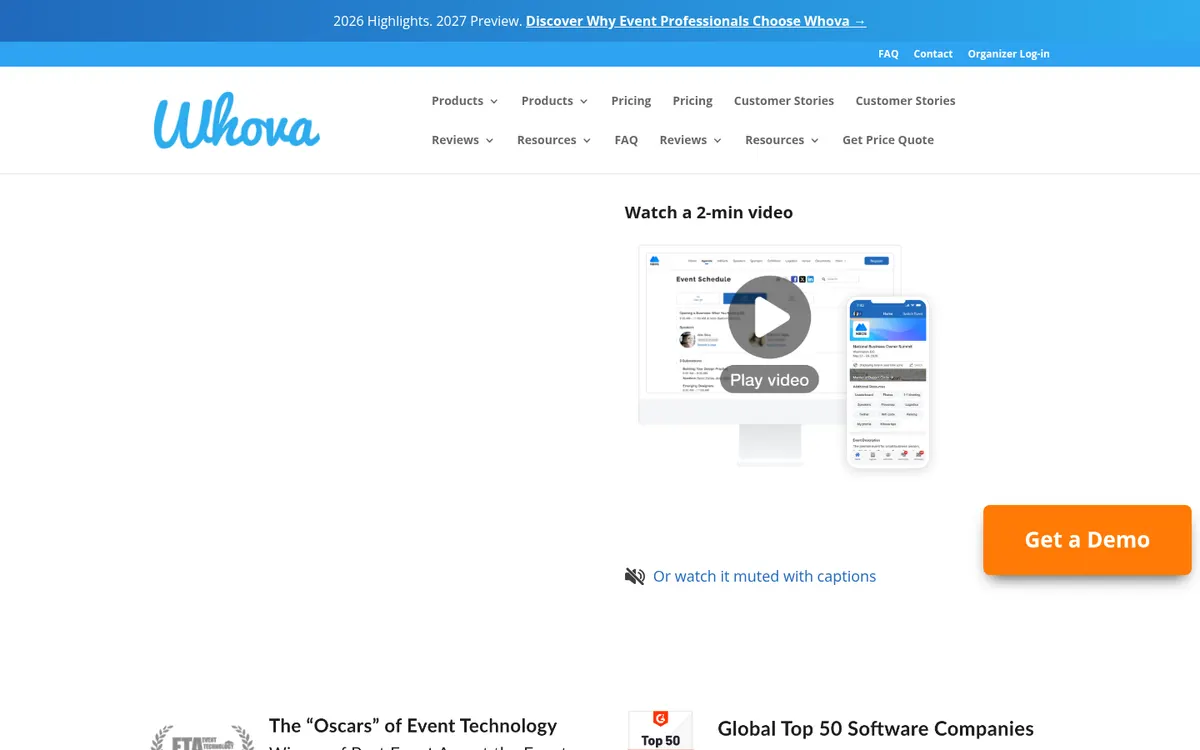
Best for conferences that need an attendee app with agendas and networking, not just a checkout page.
Whova is an event app with a registration and ticketing layer attached, which is the opposite shape to most tools here. The attendee side is the strength: a mobile app with agendas, networking tools, exhibitor engagement, surveys and polls, and support for in-person, virtual and hybrid formats. For a conference, that is the part attendees actually open on the day. Registration and ticketing sit in the same platform, alongside abstract and sponsor management, so a programme chair is not reconciling three systems. More than 30,000 events have run on the platform, which is a meaningful track record for an app that has to work under conference wifi. Pricing is the obstacle. There is no free tier and pricing is quoted, so you request a demo and get a quote per event, with custom event-based pricing starting around $1,000 per event. Pricing could not be checked on the vendor page for this update, so treat any figure as indicative and confirm it directly. For a small community meetup, that entry cost is hard to justify. For a multi-day conference with sponsors, abstracts and an exhibitor hall, the bundle can replace several separate subscriptions. The honest comparison is against assembling tools: a ticketing platform plus a separate conference app plus a spreadsheet for abstracts. Whova wins when the bundle removes real coordination work, and loses when you only needed a checkout page and a guest list. Pick it for conferences where the app is a core part of the attendee experience, not an afterthought.
You run a multi-day conference and the app, agenda and networking are part of what attendees paid for.
You only need a checkout page and a guest list for a single-room event.
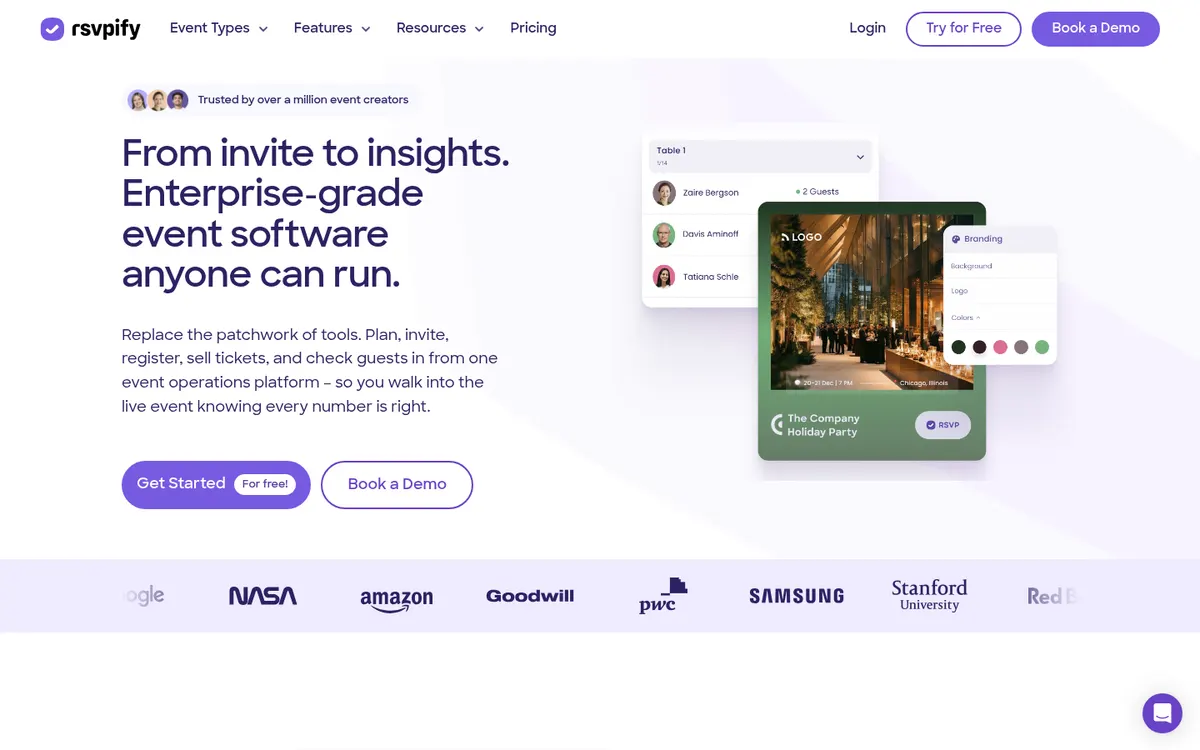
Best for branded invitations and RSVP workflows where ticketing is one part of a larger guest list.
RSVPify starts from invitations and guest lists rather than from a ticket checkout, which suits a particular kind of event: corporate functions, branded celebrations, galas and internal company events where the question is who is coming and what they need. Plans start at $39 per month on the Starter tier, with yearly billing showing a $24 per month equivalent, and a free plan exists. Paid plans can be tried free. What you get for the plan fee is deep customization: branded event sites, custom emails, RSVP forms and controls over how guests respond. Ticketing and payment collection sit inside that flow, as do check-in tools and seating plus guest list management, so one system covers the run-up and the door. An AI assistant and an MCP connector are included for teams wiring the platform into other tools. The catch is that the plan fee is not the whole cost. Per-ticket fees sit on top of the subscription, so a paid event pays twice: once for the software and once per sale. Some of the more advanced capability is gated to higher tiers, which means the entry price and the price you actually need can differ. The company is based in Chicago and is used by corporate and enterprise event teams, so corporate procurement is a familiar path. It fits teams that run a steady calendar of registration-led events and care about branding more than per-ticket economics. It fits badly when you are selling high volumes of low-priced tickets and counting every cent of fee.
Your event is invitation-led, branding matters and a monthly plan suits your calendar.
You sell high volumes of low-priced tickets and a subscription plus per-ticket fee doubles the cost.
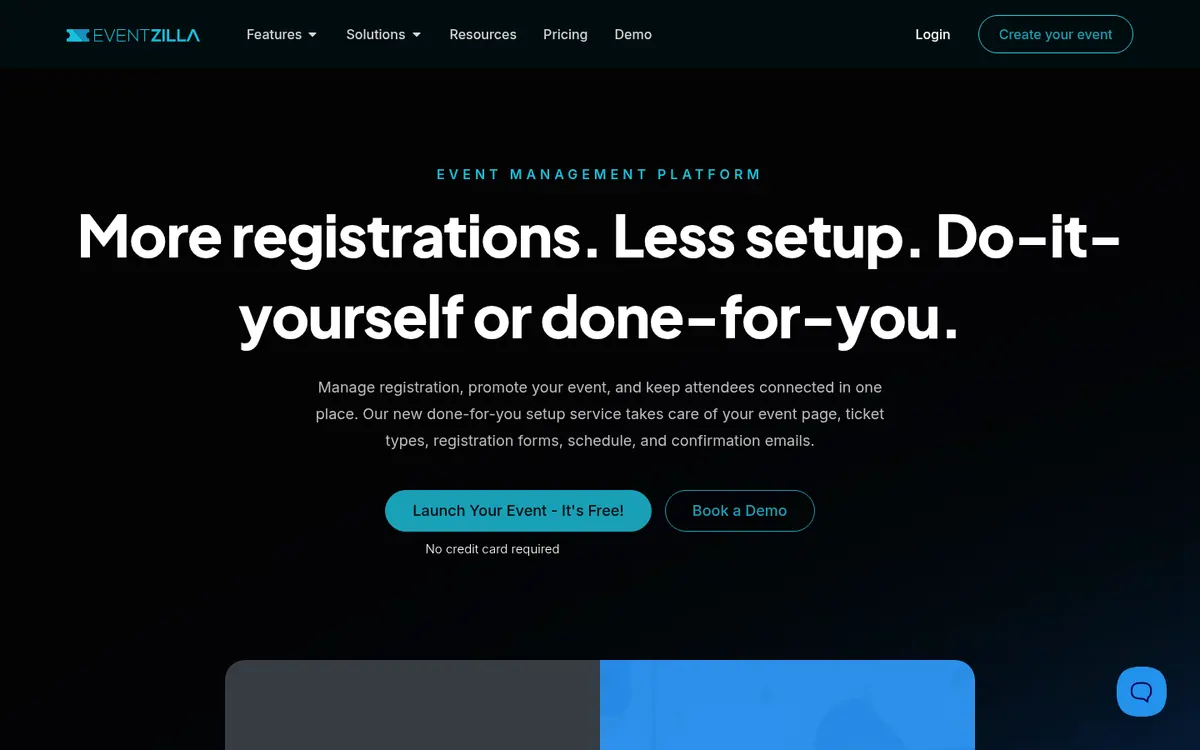
Best for small and mid-sized events that want quick self-serve setup and native webinar integrations.
Eventzilla bundles registration, scheduling, marketing and check-in for small and mid-sized events, and it has been doing so since 2009. The Basic tier is $1.50 per registration, with Pro and Plus adding percentage fees on top, and free events stay free. The company is based in Dublin, Ohio. Setup is self-serve and fast. Event hub pages, custom registration forms and scheduling are available without a sales call, which matters for a volunteer organizer building a page in the evening before a launch. Marketing automation handles reminders and follow-ups, speaker spotlights give a programme page some structure, and check-in covers the door when the day arrives. Hybrid events are where it earns a place. Zoom and GoToWebinar integrations mean a session can register people and hand them into a webinar without a second form or a manual export. For a small conference running a room and a stream, that saves real admin time. The trade-offs are size and depth. This is a smaller vendor with a lean team, so the roadmap moves slower than a venture-funded competitor's, and advanced marketing features are thinner than on a dedicated marketing platform. At $1.50 per registration on the Basic tier, a high-volume, low-price event will feel the flat fee, and the Pro and Plus tiers add percentage fees rather than removing them. It suits organizers who want a working event page, a form and a reminder email by Friday without a sales call. It suits less when the event is large enough that fee modelling, marketplace reach or a dedicated conference app start to drive the decision.
You want a registration page, a form and webinar links working tonight without a contract.
You need deep marketing automation or a large vendor roadmap behind the product.
A ticketing platform handles the money and the guest list between someone deciding to attend and someone scanning a code at the door. At minimum it publishes an event page, takes payment, issues a ticket with a unique code, and gives organizers a list of who is coming. Most platforms go further: seat maps, timed entry slots, discount codes, check-in apps, reporting, and a way to push attendee data into the other systems a business already runs. The category splits by who brings the audience. - Marketplace platforms, such as Eventbrite, list your event where buyers already browse, and charge for that exposure.
This comparison sits on the Events desk. Readers comparing neighbouring stacks often check our guides to demand forecasting software and ChatGPT alternatives next.
Ticketing platforms bill in four main ways, and the model matters more than the headline number once your ticket prices or sales volume change.
| Model | How it bills | Typical fit | Example from this list |
|---|---|---|---|
| Percentage plus processing | A share of each paid ticket, plus a flat per-ticket charge and card fees | Public events where the platform brings buyers | Eventbrite at 3.7% + $1.79 per paid ticket |
| Flat per-ticket | A fixed amount per paid ticket, whatever the price | Higher-priced tickets and organizers with their own audience | TicketSpice at $0.99 per paid ticket |
| Subscription | A monthly or annual plan, sometimes with per-ticket fees on top | Brands running a steady calendar of registration-led events | RSVPify from $39/month on the Starter tier |
| Custom quote | Priced per event after a demo or conversation | Conferences needing an app, agenda and networking | Whova, quoted per event |
Every price above was checked on the vendor's own pricing page on November 25, 2026. Where a vendor does not publish a figure we write "See website" instead of guessing. To compare annual and monthly billing quickly, try the free percentage calculator.
Comparing only the headline rate. A 5% platform fee can hide card processing on top, and a monthly plan can hide per-ticket fees. Add every line before you compare, including per-seat charges for reserved seating.
Choosing a marketplace you do not need. A percentage fee buys discovery, and discovery is worth little if your mailing list already sells the room out. Flat-fee tools usually retain more for organizers with their own audience.
Assuming free events stay free everywhere. Most platforms here do not charge for free events, but Whova has no free tier and RSVPify pairs a free plan with paid tiers. Check the rule before planning a free launch night.
Forgetting who holds the money. Eventrise requires an organizer-owned Stripe account and settles payouts as tickets sell. Confirm how any platform handles payouts, refunds and chargebacks before you rely on ticket revenue to cover event costs.
Buying an app you will not use. Whova's entry pricing starts around $1,000 per event, which is hard to justify for a single-room gathering. Match the tool to the event format, not to the longest feature list.
Use a marketplace when strangers need to find your event; use a white-label tool when your own audience already buys from you. Eventbrite lists events in a marketplace across roughly 180 countries, which is real value for a public night with no following. Eventrise and TicketSpice give you a branded page you drive traffic to, so the attendee relationship stays yours. The marketplace fee buys discovery, and it is worth paying only when discovery is actually happening.
Flat fees win as ticket prices rise; percentages win on cheap tickets. TicketSpice charges 99 cents per paid ticket and Ticket Tailor charges GBP 0.60, whatever the ticket costs. Eventbrite's 3.7% plus $1.79 combines a percentage with a flat per-ticket charge before card processing. Run your own average ticket price through both models before you decide.
Eventrise, Eventbrite, Ticket Tailor, Tito, Humanitix and Eventzilla all let free events run without a platform fee. Eventrise and Eventbrite put no cap on free attendees. Ticket Tailor covers up to 5,000 free tickets per year. Tito, Humanitix and Eventzilla also keep free events free. Whova has no free tier, and RSVPify offers a free plan alongside paid monthly tiers.
Whova is the fit when the app is central. It bundles a mobile app with agendas, attendee networking, exhibitor engagement, surveys and polls, plus registration, ticketing, abstract and sponsor management in one platform. Pricing is quoted per event and starts around $1,000 per event, so it targets conferences rather than small gatherings. If you only need a checkout and a guest list, a simpler platform costs far less.
When the platform sends you buyers you would not otherwise reach. Eventbrite's marketplace spans roughly 180 countries, and publishing plus free events cost nothing, so a public event with no following can be found. If your attendees come from a mailing list, a membership or a venue's regulars, you are paying a percentage for discovery that is not happening, and a flat-fee tool usually retains more revenue.
Eventrise publishes a free API, webhooks, Zapier and an MCP server, so ticketing data can move into a CRM or accounting system without an upgrade. RSVPify includes an AI assistant and an MCP connector. Eventzilla connects to Zoom and GoToWebinar for hybrid events, and Ticket Tailor offers website widgets and embedded checkout for your own site. Check whether the connector you need sits on a paid tier before you commit.
Browse every comparison on the Events desk, with the same rubric and dated prices.