Ranked #1
Sellbrite
Fast multichannel setup
See websiteFree to start, 14 day trial, paid tiers not shown
- Best for
- Small multichannel marketplace sellers
- Free plan
- Free to start
- Rubric
- 6.3 / 10
Seven Linnworks alternatives, ordered by the seller each one fits, with prices from vendor pages checked on November 25, 2026 and the limits the plan tables do not show.
 Prices checked November 25, 2026
Veeqo, Sellbrite and Zentail are the three Linnworks alternatives most small and mid-sized sellers should look at first, as of November 2026. Veeqo at $19 a month on the Inventory plan suits Amazon centered sellers who want cheap labels. Sellbrite, free to start with a 14 day trial, suits small multichannel sellers who need listings and stock in one place. Zentail at a $300 base suits catalog-heavy sellers who care about listing accuracy. Cin7, Brightpearl, Sellercloud and Rithum cover retail operations and enterprise programs.
Fast multichannel setup
See websiteFree to start, 14 day trial, paid tiers not shown

Cheap shipping labels
$19Inventory plan, per month, usage-based by order volume

Catalog accuracy tooling
$300Base, per month, usage-based, annual contract or month to month on Walmart self-serve
Disclosure for this page: All 7 tools here are unpaid editorial picks. The position of a paid listing can be part of what the vendor pays for. How we handle paid listings.
| Tool | Best for | Free plan | Actions | |||
|---|---|---|---|---|---|---|
| 1 | Sellbrite | Small multichannel marketplace sellers | See websiteFree to start, 14 day trial, paid tiers not shown | Yes | ||
| 2 | Veeqo | Amazon centred sellers on a budget | $19Inventory plan, per month, usage-based by order volume | Yes | ||
| 3 | Zentail | Listing and inventory automation | $300Base, per month, usage-based, annual contract or month to month on Walmart self-serve | No | ||
| 4 |  Cin7 | Retail, wholesale and light manufacturing | $349Standard, per month, 5 users, 6,000 orders per year | No | ||
| 5 |  Brightpearl | Omnichannel retail operations | See websitecustom quote | No | ||
| 6 |  Sellercloud | High volume sellers needing depth | $1,349Essentials, per month, annual subscription typical, unlimited users | No | ||
| 7 |  Rithum | Enterprise marketplace programmes | See websiteContract pricing negotiated through enterprise sales | No |
We built this list for sellers who have outgrown a spreadsheet but do not want a six month implementation. Every tool here does the same core job, connecting marketplaces to one inventory count, so the differences that decide a purchase are channel coverage, operations depth, pricing clarity, setup effort and how far the product scales before a seller outgrows it.
Those five criteria form the rubric. Channel breadth covers how many marketplaces and stores connect natively. Operations depth asks whether purchasing, warehouse processes and accounting live inside the product or beside it. Pricing clarity rewards published rates and penalizes quote only pages. Setup effort reflects whether a seller can be live in an afternoon or needs a paid project. Scale and support covers user limits, order ceilings and the vendor bench behind the software.
Prices and plan details come from vendor pricing pages checked on November 25, 2026, or from the sources named in each review where a page publishes no rate. We do not convert currencies and we do not estimate a quote. Where a plan note carries a limit, such as 5 users or 6,000 orders a year, we repeat it exactly as given.
When an entry is marked Featured, that placement is paid. We score a Featured tool against the same five criteria and list the same honest cons, and the label changes where it appears, not how it is assessed. The order of this list is editorial: it follows the buyer each entry describes, not a weighted total.
The full process, including how we handle corrections, is on the methodology page. Paid listings follow our advertising disclosure.
| Criterion | Weight | What we check |
|---|---|---|
| Channel breadth | 25% | How many marketplaces, storefronts and retailer networks connect natively, and how deep each connection goes. |
| Operations depth | 25% | Whether purchasing, warehouse work, wholesale pricing and accounting live inside the product or beside it. |
| Pricing clarity | 20% | Whether a buyer can model the cost before a sales call, and how clearly caps and usage bands are stated. |
| Setup effort | 15% | The time and outside help needed to get live, from an afternoon signup to a scheduled implementation project. |
| Scale and support | 15% | User limits, order ceilings, integration catalogue size and the vendor bench available once you are running. |

Free to start and quick to set up, Sellbrite covers listings, stock and labels for small sellers but stops short of warehouse work.
Sellbrite connects Amazon, eBay, Walmart, Etsy and Shopify to one catalog and one stock count. Every tier carries unlimited channels, SKUs and users, which removes the usual upgrade arithmetic when a seller adds a marketplace or hires a part time packer. Paid plans push inventory and price updates every 15 minutes, and discounted shipping labels are printed from the same screen as the order queue. Pricing runs on order volume rather than seats. The page shows a 14 day free trial and a free starting tier but no paid rates, so a budget conversation starts with a request rather than a number. The free tier syncs every two hours while paid tiers sync every 15 minutes. That gap matters on fast moving stock: two hours on a popular SKU can mean overselling and a marketplace defect. The platform stops well short of a warehouse system. There is no purchasing forecasting, no bin level picking and no production planning, so a seller who buys in containers and needs to know what to reorder keeps a spreadsheet or a second tool. Order ceilings mean a high volume seller can outgrow the plan they started on. It fits a small marketplace team that wants listings, stock counts and labels in one place without an onboarding project. Setup is usually an afternoon rather than a paid implementation, and the lack of channel, SKU and user caps keeps small teams from trading up too early. Owned by GoDaddy. Confirm current paid tiers on the vendor site, because the tier figures in circulation for 2026 were reported rather than published.
You sell on a handful of marketplaces and want listings, shared stock and discounted labels without a paid onboarding project.
You need purchasing forecasts, bin level warehouse work or a plan with published paid rates up front.
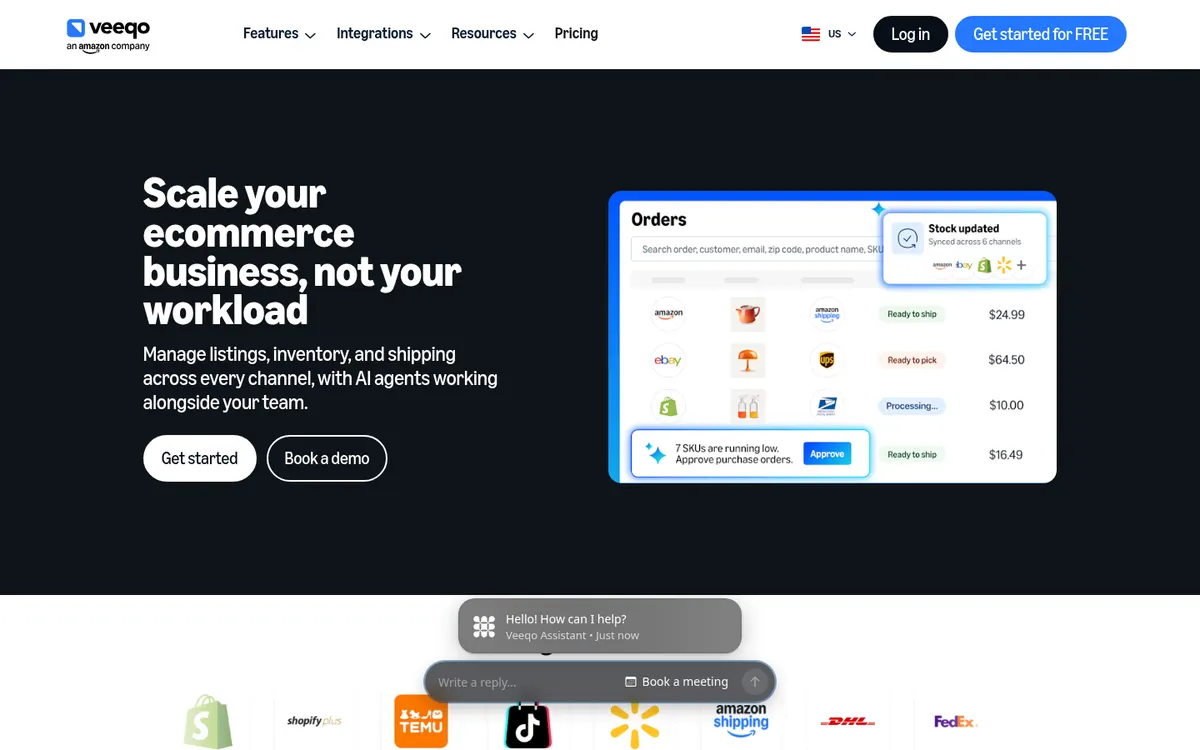
Cheap Amazon first shipping and inventory for budget sellers, with thinner support for the non-Amazon channels in the mix.
Veeqo began as a free shipping tool and still leads with labels. It generates shipping labels at discounted carrier rates, syncs inventory across connected channels and manages marketplace orders, with workflows shaped around Amazon selling. Reporting covers shipping spend and stock movement rather than deep financial analysis.
Amazon owns Veeqo, which explains both the carrier rates and the Amazon native feel. For a seller whose volume is mostly Amazon, merchant fulfilled or through FBA, the free shipping plan is a real entry point: labels and basic inventory at no cost, with paid tiers added for more. Label savings are the economic core of the offer, and they are the reason a small seller takes the call.
The paid entry is the Inventory plan at $19 per month, billed on usage by order volume, so the effective rate climbs as you grow. The product was originally free and has since added paid tiers, which means older write ups describe a model that no longer exists. Check the current plan table before building a cost model. Non-Amazon channels get a thinner experience than the Amazon side, and reporting plus automation depth trail the larger operations platforms.
It fits an Amazon centered seller on a budget who wants label savings to pay for the software and treats inventory sync as the bonus. It does not fit a seller who needs purchasing, warehouse bins or a full ledger. Nor does it fit a business where eBay, Walmart or a Shopify store carries most of the volume and Amazon is the side channel.
Amazon carries most of your volume and you want label savings to cover the software cost from the first month.
Your sales are spread evenly across marketplaces or you need purchasing, bins or a full accounting ledger.
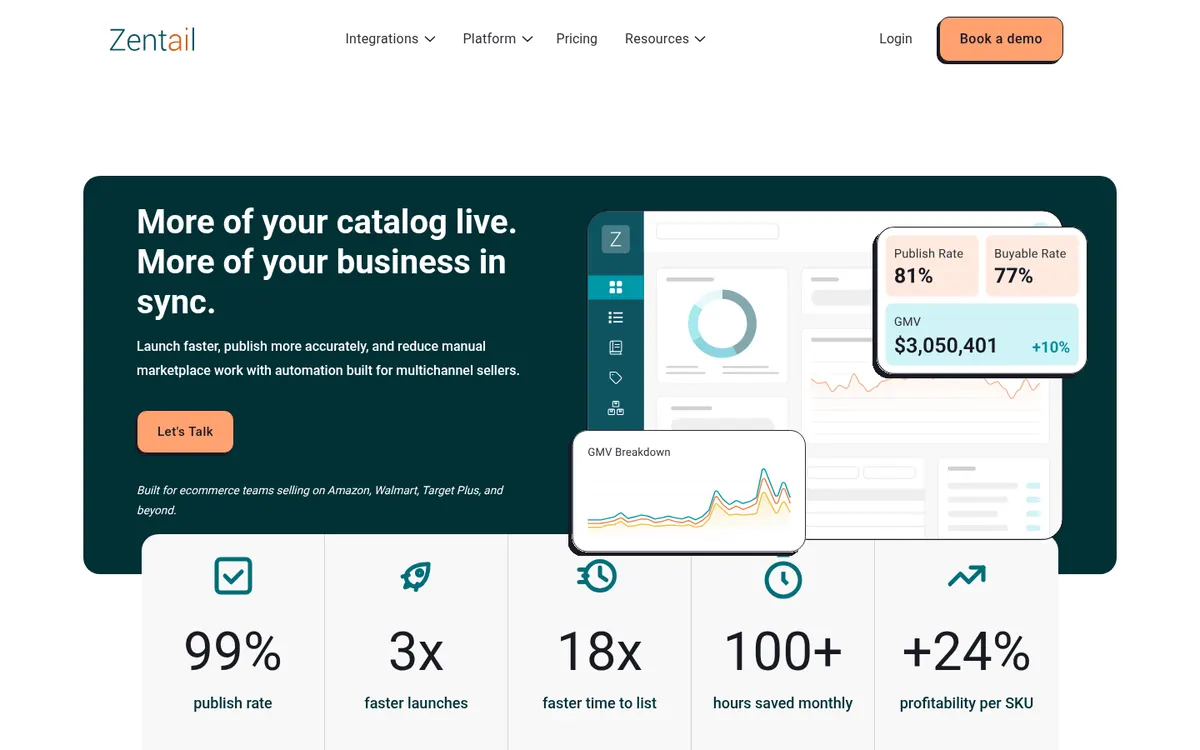
A focused listing and catalog accuracy tool for large SKU counts, with usage based pricing that is only partly published.
Zentail is the narrowest tool here by design. It publishes and manages listings across channels, syncs inventory and routes orders, and it spends its engineering effort on catalog accuracy: listing quality tooling flags missing attributes and catalog errors, then corrects them across a large SKU set.
That focus pays off for sellers with thousands of variations, where a missing size chart or a wrong category quietly kills conversion. Order routing automation sends each order down the right fulfillment path. Plans run from a Single Channel tier up to Enterprise, and the automation is aimed at accuracy rather than operational breadth.
Pricing is where the evaluation gets harder. The base plan is listed at $300 per month on a usage based model, sold on an annual contract, with a month to month path on Walmart self-serve. The $300 entry figure comes from third party comparisons rather than a public pricing sheet, a Pro tier is listed from $2,000, and no free plan or trial is stated, so a buyer starts with a demo and a quote.
There is no warehouse management and no deep fulfillment layer, and brand recognition is thinner than the larger operations suites, which matters if procurement wants references before signing. It fits a catalog-heavy seller whose real problem is listing quality and order routing rather than stock movement. It does not fit a seller who needs bins, purchasing forecasts or a full accounting ledger.
Your catalog runs to thousands of variations and bad listings, not stock movement, are what costs you sales.
You need a published pricing sheet, a free trial, or any warehouse and inventory depth beyond sync.
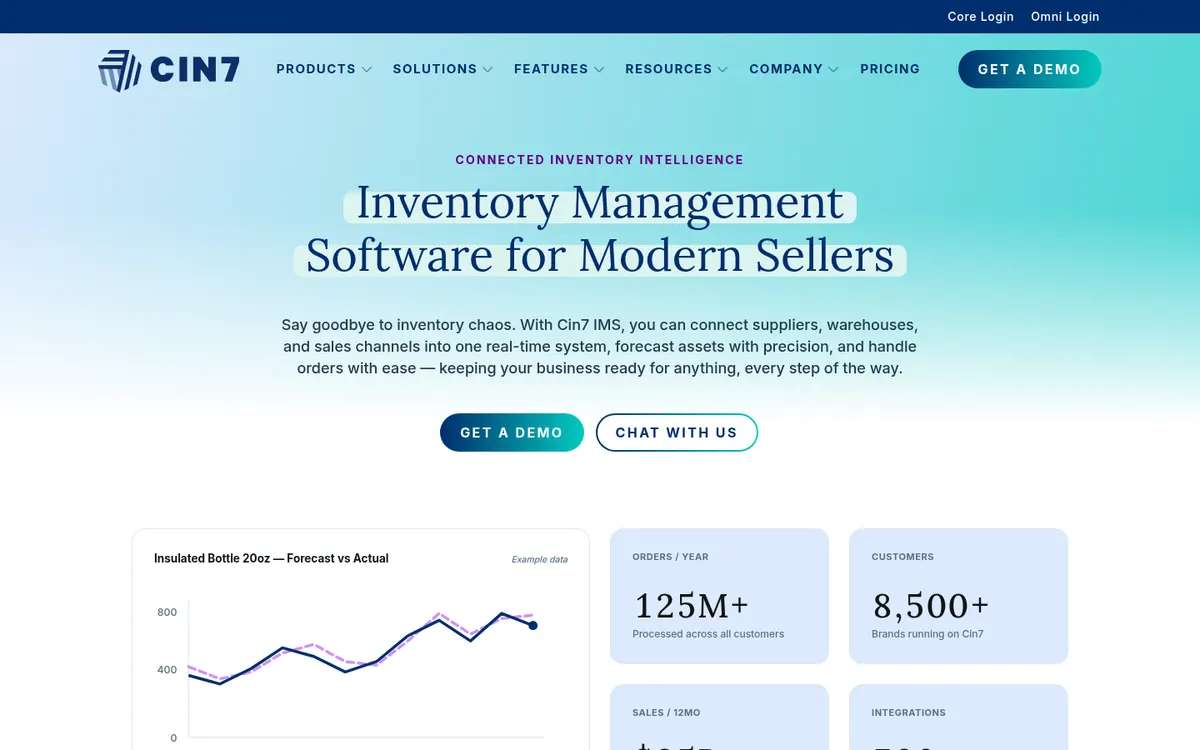
Inventory led software for brands selling wholesale and making light production runs, capped by a 6,000 order Standard plan.
Cin7 is inventory software first and a channel connector second. It tracks stock across stores and warehouses, handles wholesale and B2B ordering, supports light manufacturing and production, and connects ecommerce channels. Accounting integrations include Xero and QuickBooks, so the back office closes inside the same system family.
The Standard plan is published at $349 per month for 5 users and 6,000 orders per year, with a free trial. That order cap is the number to watch, because 6,000 orders a year works out to roughly 500 a month and a growing store crosses it quickly. Multi-location stock visibility is the reason most buyers accept the structure.
The top Omni tier is custom quoted, reintroducing a sales process, and the two tiers sit far apart in features, so an evaluation has to test both against your own purchasing and order flows. Channel breadth is narrower than the marketplace-first platforms: this is not the tool for a seller running a dozen storefronts and chasing listing accuracy.
Wholesale and manufacturing workflows need real configuration, and that work is what separates a live account from a demo. It fits a brand that sells wholesale, runs a small production step and needs one stock count across a warehouse and a shop. It does not fit a marketplace-only seller who mainly wants listings managed and orders routed.
You sell wholesale, assemble or produce some of what you sell, and need one stock count across locations.
You are a marketplace-only seller with high order volume and no wholesale or production workflow.
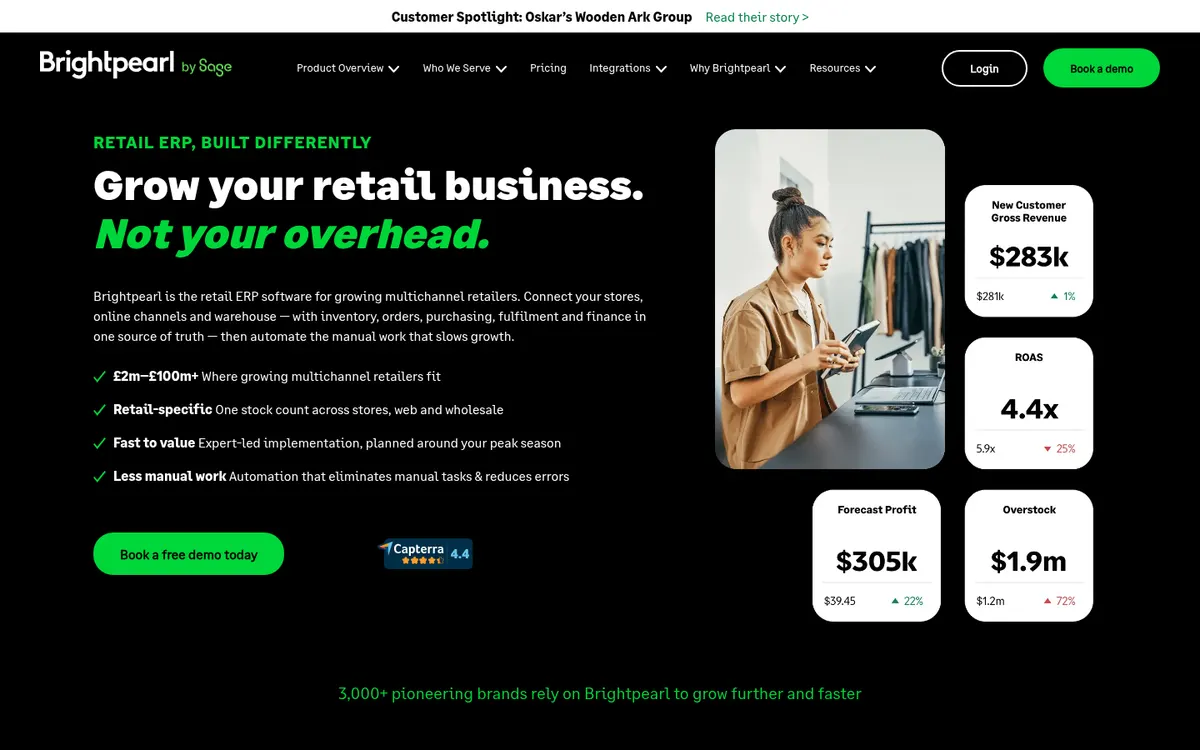
One system for inventory, orders, fulfillment and accounting, sold through a demo and quote, and built for omnichannel retail.
Brightpearl puts inventory, orders, warehousing, fulfillment and accounting in one system, which is a different promise from the sync tools here. Orders route by rule, stock moves through fulfillment workflows, and the built-in ledger means revenue, tax and margin do not depend on a separate connector holding the numbers together.
It handles online selling alongside stores, tills and wholesale, so a retailer with a shop, a website and a few trade accounts works from one order book. Reporting is aimed at retail operations rather than pure marketplace analytics, and the rule based automation is the feature buyers tend to test hardest in a demo.
Pricing is custom and delivered through a demo and quote, with no pricing sheet on the page, so any budget number is a conversation rather than a fact you can compare. Rollout is a project with a timeline rather than a signup. Part of Sage. That combination raises both the entry cost and the switching cost, and it means the evaluation has to include a services scope, not just a feature list.
It fits an omnichannel retailer, roughly a store plus a website plus wholesale accounts, where the ledger and the automation rules justify an implementation. It does not fit a marketplace-only seller, who would pay for warehousing and accounting features that stay idle, and it does not fit a business that needs to be live this week.
You run a shop, a website and wholesale accounts, and want inventory, fulfillment and the ledger in one place.
You sell only on marketplaces, need a self-serve start, or cannot commit to an implementation schedule.
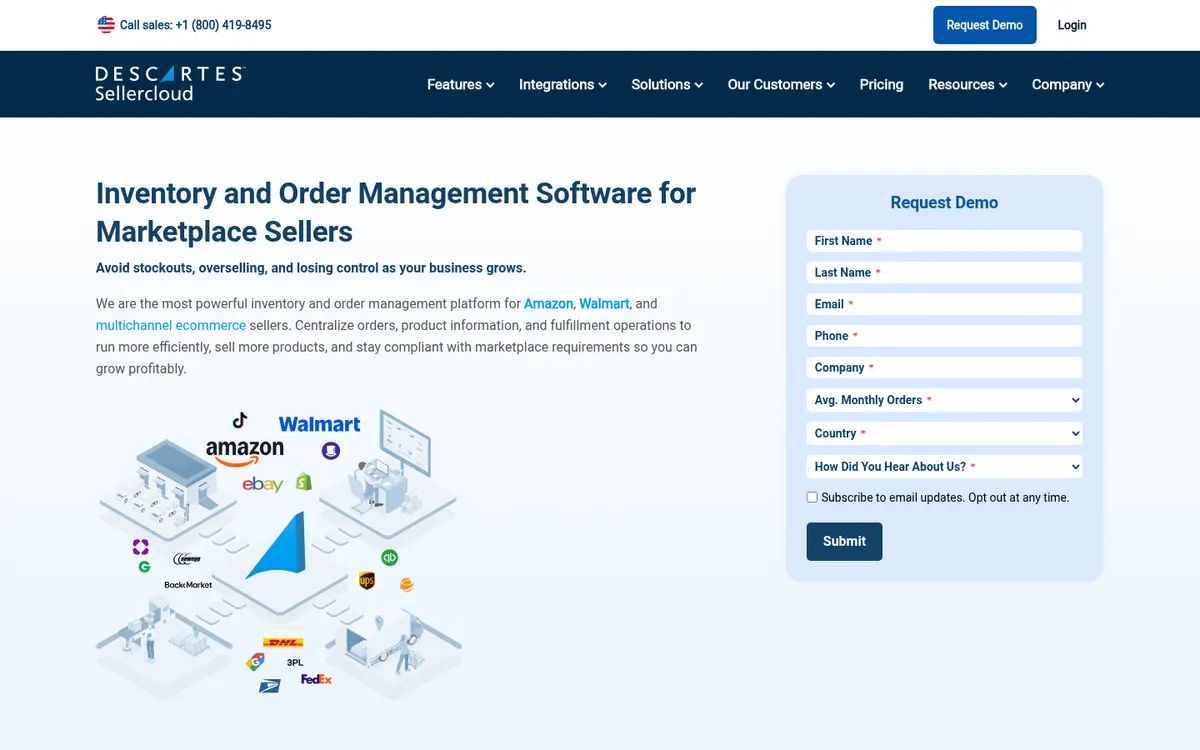
The deepest operations platform here, with warehouse, purchasing and more than 350 integrations, at the highest published entry price.
Sellercloud is the deepest operations platform in this comparison. Purchasing and procurement sit next to listings management, and warehouse work runs through Skustack: receiving, putaway, picking and barcode level cycle counting. Shipping connects to carrier accounts, and the integration catalogue runs past 350 marketplace, store, fulfillment and carrier connections.
Amazon support goes beyond listings, covering FBA, MCF and Vendor Central, which matters for a seller mixing fulfilled by Amazon inventory with its own warehouse stock and needing both in one view. Customisation is available for processes that do not fit the standard flows, and that flexibility is why larger teams end up here.
Pricing starts at $1,349 per month on Essentials, typically on an annual subscription with unlimited users, and Growth starts at $1,998. That is the highest reported entry price here, and the depth is the reason: a team needs configuration time or a consultant to get real value out of the setup, and a light touch deployment wastes the licence.
It fits an established seller or brand doing serious volume that needs purchasing, warehouse and marketplace management in one place with unlimited seats. It does not fit an early stage seller, and it does not fit a team that wants to be live next week without internal operations experience. Operates under Descartes.
You run an established operation with a real warehouse and need purchasing, picking and marketplace management in one system.
You are early stage, have no operations staff, or cannot absorb $1,349 a month plus setup time.
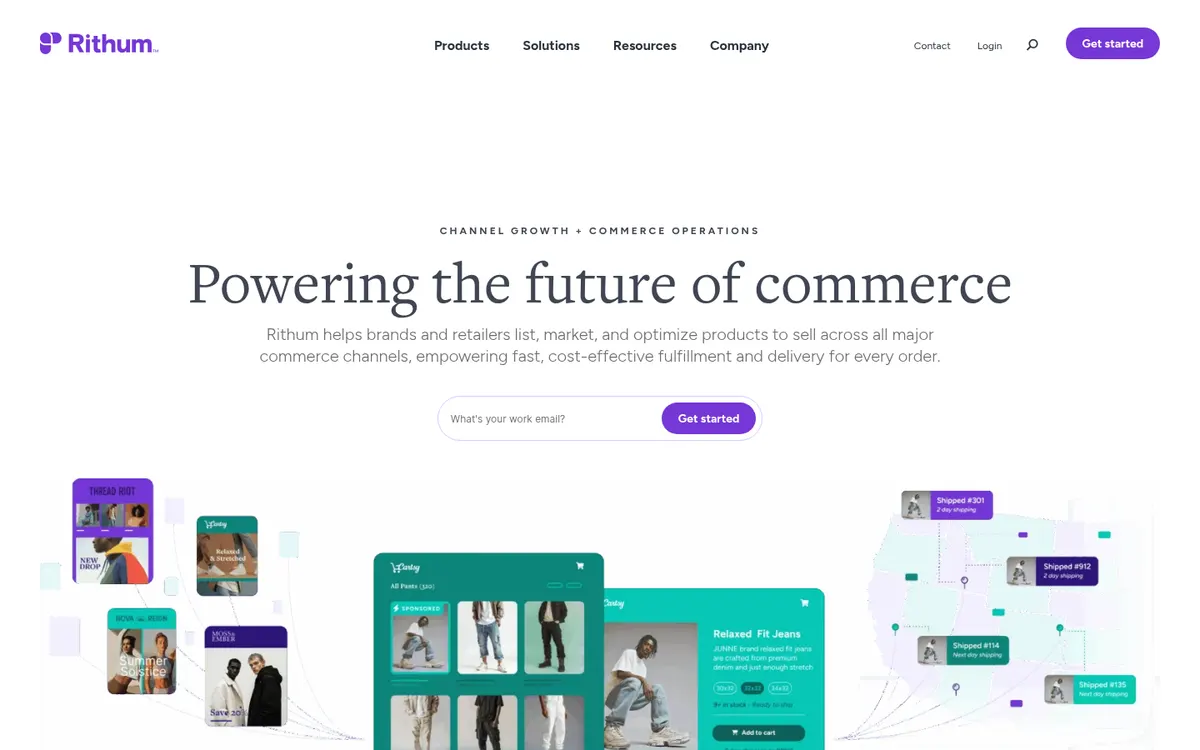
Enterprise marketplace management for very large channel portfolios, sold on contract with a managed services bench attached.
Rithum is the enterprise end of this list. It manages marketplaces across very large channel portfolios, runs product feeds at scale, and coordinates listings, inventory and pricing across retailer and brand network connections. Reporting is built for programs with hundreds of channels rather than dozens, and feed management at that volume is the core of the product. The product was rebranded from ChannelAdvisor and carries on the same marketplace management work under the new name, so the playbooks and the integration history came across with it. A managed services team is available alongside the software for programs that need someone to run the day to day, which is often the deciding factor for a lean brand team. Pricing is contract based through enterprise sales, with no published rate, and long sales cycles are part of the buying process. Program scale pricing exceeds what a mid market seller could justify, so this is not a tool to shortlist alongside a $19 a month plan. Budget approval usually arrives with procurement involved, not with a card. Warehouse operations get less attention than in Sellercloud or Brightpearl, so a business that needs bins, picking and cycle counts keeps a separate system. It fits a brand or retailer running a marketplace program across many channels and regions, with procurement that expects a contract and a services bench. It does not fit a mid market seller comparing published monthly rates.
You run a marketplace program across hundreds of channels and want software plus a services team behind it.
You are a mid market seller who needs a price this month or warehouse processes inside the same platform.
Multichannel operations software sits between the places you sell and the systems you run the business on. It holds one product catalog, pushes that catalog to Amazon, eBay, Walmart, Etsy, Shopify or a retailer portal, keeps stock counts in step across all of them, and pulls orders back into one queue for picking, packing and shipping.
If you are reading this because Linnworks is on your shortlist, you are looking at a crowded category. The tools fall into three rough groups, and the group matters more than the feature list:
The overlap is the confusing part. A sync tool will print shipping labels, and an operations platform will connect marketplaces, so both look like they do the whole job on a demo. The difference shows up in the second year, when order volume crosses a tier, a warehouse hire needs bins, or an accountant asks for a margin report the platform cannot produce.
What to check before shortlisting. The channel list, and whether the connections are native or through a partner. The order ceiling on each tier, because a cap of 6,000 orders a year is a growth limit, not a footnote. The sync interval, since a two hour window on fast stock is an overselling risk. Whether warehouse processes and accounting are inside the product or beside it. And the contract term, because a quote only platform can lock a small business into a schedule that a published price never would.
None of this requires a huge team. It requires knowing which of the three groups your business is actually in.
This comparison sits on the Software desk. Readers comparing neighbouring stacks often check our guides to demand forecasting software and glp 1 companies next.
Pricing in this category follows a handful of models, and the model tells you more about fit than the headline number does. Usage based plans look cheap on day one and climb with orders. Per plan prices with user and order caps look predictable until you cross a limit. Quote only models mean the figure depends on your bundle and your negotiating position.
Compare the Sellbrite page, which shows a 14 day free trial and a free starting tier but no paid rates, with Sellercloud, which lists $1,349 a month on Essentials and $1,998 on Growth. One asks you to enquire, the other lets you model. Neither approach is dishonest, but only one lets you build a budget before a sales call.
| Model | How it bills | Typical fit | Example from this list |
|---|---|---|---|
| Free to start, volume tiers | Order volume, paid rates on request | Small sellers testing channels | Sellbrite |
| Usage based monthly | Per order volume | Amazon centered sellers | Veeqo, $19 Inventory plan |
| Base plus usage | Monthly or annual contract | Listing automation | Zentail, $300 base |
| Per plan with caps | Monthly, user and order limits | Retail and wholesale | Cin7, $349 for 5 users and 6,000 orders a year |
| Custom quote | Annual contract after a demo | Omnichannel retail | Brightpearl |
| Tiered subscription | Monthly, annual typical, unlimited users | Established operations | Sellercloud, $1,349 Essentials |
| Enterprise contract | Negotiated | Large marketplace programs | Rithum |
Three costs sit outside the subscription. Implementation, which Brightpearl and Sellercloud both treat as a project. Contract term, since Zentail is sold on an annual contract and Sellercloud typically bills annually. And the cost of the gap, meaning the second tool you buy because the first has no warehouse layer or no ledger.
Ask for the order ceiling, the user limit and the sync interval in writing, then read that against the plan note. Those three numbers decide whether a cheap plan stays cheap in year two.
Every price above was checked on the vendor's own pricing page on November 25, 2026. Where a vendor does not publish a figure we write "See website" instead of guessing. To compare annual and monthly billing quickly, try the free percentage calculator.
Linnworks prices through a quote after a demo rather than a published pricing sheet, which is the same model Brightpearl and Rithum use here. That makes comparison harder, because seat counts, channel counts and order volumes are bundled differently for each buyer. Ask for the order ceiling, the channel limit and the contract term in writing before you compare that number to a published price such as Sellercloud's $1,349 a month.
Sellbrite is free to start and Veeqo keeps a free shipping plan, so those two are the cheapest entry points. Sellbrite adds a 14 day trial, and its free tier syncs every two hours against 15 minutes on paid plans, which limits it to slower moving stock. Veeqo's free tier covers shipping and basic inventory. Zentail, Cin7, Brightpearl, Sellercloud and Rithum have no free plan.
Sellercloud and Rithum. Sellercloud starts at $1,349 a month on Essentials with unlimited users and adds purchasing, Skustack warehouse processes and Amazon programs such as FBA, MCF and Vendor Central. Rithum handles very large channel portfolios and product feeds at scale, with contract pricing and a managed services team. Cin7 caps its Standard plan at 6,000 orders a year, so a high volume seller needs the custom quoted Omni tier or a different platform.
Pick operations software when the hard problem sits behind the listing: purchasing, bins, wholesale price lists, production steps or a ledger that has to reconcile. Brightpearl, Cin7 and Sellercloud cover those. Pick a sync tool when the hard problem is in front of the warehouse: listings, one stock count across channels and printed labels. Sellbrite, Veeqo and Zentail do that at a fraction of the cost and setup time.
No vendor publishes a fixed timeline, and anyone quoting one without seeing your data is guessing. The drivers are SKU count, channel count, whether you move order history and whether the new tool needs a warehouse setup. A listing and inventory tool can be live in an afternoon; a quote only operations platform with a ledger is a project with a schedule. Ask each vendor for a written cutover plan and a parallel run before you cancel.
Sellercloud includes warehouse management through Skustack, with receiving, putaway, picking and barcode level cycle counting, and Brightpearl includes warehousing and fulfillment workflows plus a built-in accounting ledger. Cin7 covers multi-location stock, light manufacturing and accounting integrations with Xero and QuickBooks, but not a native ledger. Sellbrite, Veeqo and Zentail are listing and inventory tools with no warehouse layer at all.
Browse every comparison on the Software desk, with the same rubric and dated prices.