Ranked #1

LEAFIO
SKU-store forecasting
See website
- Best for
- Retail chains needing SKU-store forecasts and automated replenishment across stores and DCs
- Free plan
- No (demo available)
- Rubric
- 7.3 / 10
Ten demand forecasting tools compared on forecast depth, ERP fit, pricing and rollout, with entry prices from $49 a month and quote-only enterprise suites.
 Prices checked November 25, 2026

Demand forecasting software predicts item-level demand and turns it into inventory decisions. In November 2026, LEAFIO is the pick for retail chains that need SKU-store forecasts and automated replenishment across stores and DCs, Netstock suits SMB distributors and manufacturers already running an ERP, and StockTrim fits growing SMBs that want published pricing and a short trial. The rest of this list covers mid-market statistical suites, programmable probabilistic forecasting and enterprise planning platforms, with the trade-offs spelled out.
SKU-store forecasting
See website

ERP connectors
From $900/month

Published entry pricing
From $49/month, billed annually
Disclosure for this page: All 10 tools here are unpaid editorial picks. The position of a paid listing can be part of what the vendor pays for. How we handle paid listings.
| Tool | Best for | Free plan | Actions | |||
|---|---|---|---|---|---|---|
| 1 | LEAFIO | Retail chains needing SKU-store forecasts and automated replenishment across stores and DCs | See website | No | ||
| 2 | Netstock | SMB distributors and manufacturers already using an ERP | From $900/month | No | ||
| 3 | StockTrim | Growing SMBs seeking affordable AI forecasting and order planning | From $49/month, billed annually | No | ||
| 4 |  EazyStock | Wholesale distributors wanting simple ERP-connected demand planning | See website | No | ||
| 5 | Lokad | Technical teams needing programmable probabilistic forecasting | See website | No | ||
| 6 |  Slimstock | Mid-to-large distributors needing deep statistical forecasting and scenarios | See website | No | ||
| 7 |  RELEX Solutions | Large retailers, wholesalers and manufacturers optimizing complex networks | See website | No | ||
| 8 |  ToolsGroup | Enterprise supply chain planning and S&OP | See website | No | ||
| 9 |  Anaplan | Enterprises connecting demand plans with finance and operations | See website | No | ||
| 10 |  John Galt Atlas Planning | Mid-market demand planning with collaborative S&OP | See website | No |
We scored each tool against the same five criteria: forecast depth, replenishment logic, ERP integration, pricing clarity and rollout effort. Weights reflect how much each factor changes the outcome for a typical buying team. Forecast and replenishment capability carry half the total, ERP fit carries a fifth, and price clarity and rollout effort split the rest. A tool that forecasts brilliantly but needs a long implementation program scores lower than one that fits a mid-market planning team. Prices come from vendor pricing pages and official FAQs, checked on 2026-11-25. Where a vendor publishes nothing, the listing says see website and we did not estimate a number. That is why several entries show no figure: EazyStock, Lokad, Slimstock, RELEX Solutions, ToolsGroup, Anaplan and John Galt Atlas Planning all sell through quotes, and we left them that way rather than guess. StockTrim's entry price and Netstock's $900 per month entry point come from published vendor material. LEAFIO's listing remains see website because no pricing page was available. An entry marked Featured is a paid placement. It is scored with the same rubric as every other tool and carries the same kind of honest cons. Placement affects where a listing appears, not its scores. The order is editorial. It reflects fit for the buyer each entry describes, weighed against the rest of the list, plus any disclosed Featured position. A distributor with one warehouse and a grocery chain with 400 stores should not read the same ranking the same way, which is why every entry has a pick line and a skip line. Where we could not verify a claim, we said so. Vendor statements about customer counts and country coverage are attributed to the vendor, not presented as our finding.
The full process, including how we handle corrections, is on the methodology page. Paid listings follow our advertising disclosure.
| Criterion | Weight | What we check |
|---|---|---|
| Forecast depth | 25% | How well the tool models seasonality, promotions, new products and intermittent demand, and whether it quantifies uncertainty. |
| Replenishment logic | 25% | Whether forecasts flow into safety stock, order quantities, minimum order quantities and multi-location replenishment without manual rework. |
| ERP integration | 20% | How the tool gets item, order and inventory data from your ERP, and how much field mapping that takes. |
| Pricing clarity | 15% | Whether a buyer can find a price, understand what it scales on and budget before a sales call. |
| Rollout effort | 15% | How much internal effort and outside services a mid-market or enterprise team needs to reach go live. |
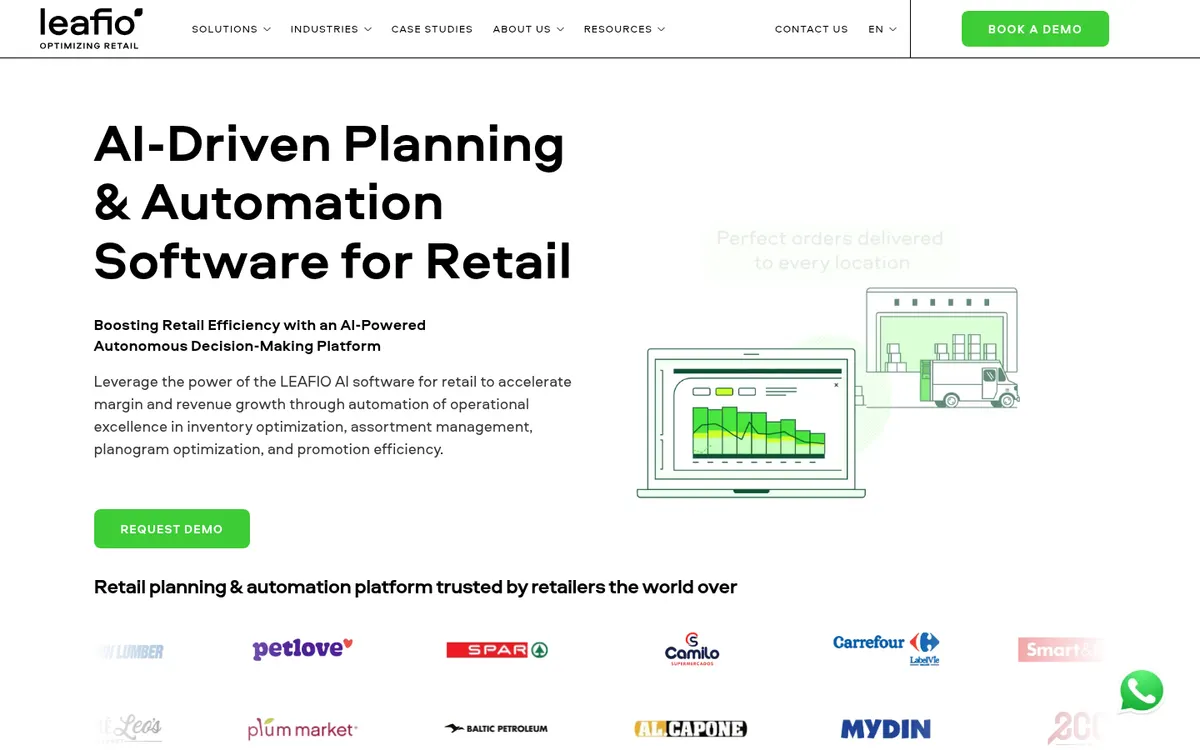
The strongest retail fit on this list, with SKU-store forecasts that feed automated replenishment, if you can accept quote-only pricing.
LEAFIO forecasts demand at the SKU-store level, which is the grain a retail chain actually replenishes at. The engine folds promotions, seasonality, holidays and local weather into the forecast, and it corrects sales history for stockouts so a product that was unavailable does not look like a product nobody wanted. From there, inventory planning spans stores, warehouses and distribution centers, and replenishment orders are generated automatically across the network.
That focus is why grocery, discount and pharmacy chains are the natural fit. Those formats carry thousands of SKUs across many stores, run frequent promotions and lose sales fast when a shelf goes empty. The vendor says it serves more than 250 retailers in over 45 countries and was founded in 2014, which is a track record you can test in reference calls.
The limits are equally clear. Pricing is quote only: no pricing page was available when we checked on November 25, 2026, so the listing stays at see website. Budget a sales cycle and a scoping call rather than a self-serve signup. There is no free plan and no trial, only a demo, so you cannot run a backtest on your own data without going through sales. The product is not aimed at small distributors, who rarely have the store-level complexity it is built for, and it is not built for apparel or fashion retail, where size curves and color way depth change the forecasting problem.
One commercial detail helps: the vendor says there are no per-seat fees, and Inventory Optimization can be bought alone or as part of LEAFIO AI Retail Platform. That matters if you want replenishment first and wider platform modules later. Ask for a pilot on one category and one region before committing to a chain wide rollout.
You run a grocery, discount or pharmacy chain and need forecasts at the SKU-store level feeding automated replenishment.
You need published pricing, a self-serve trial, or forecasting built for apparel and fashion.
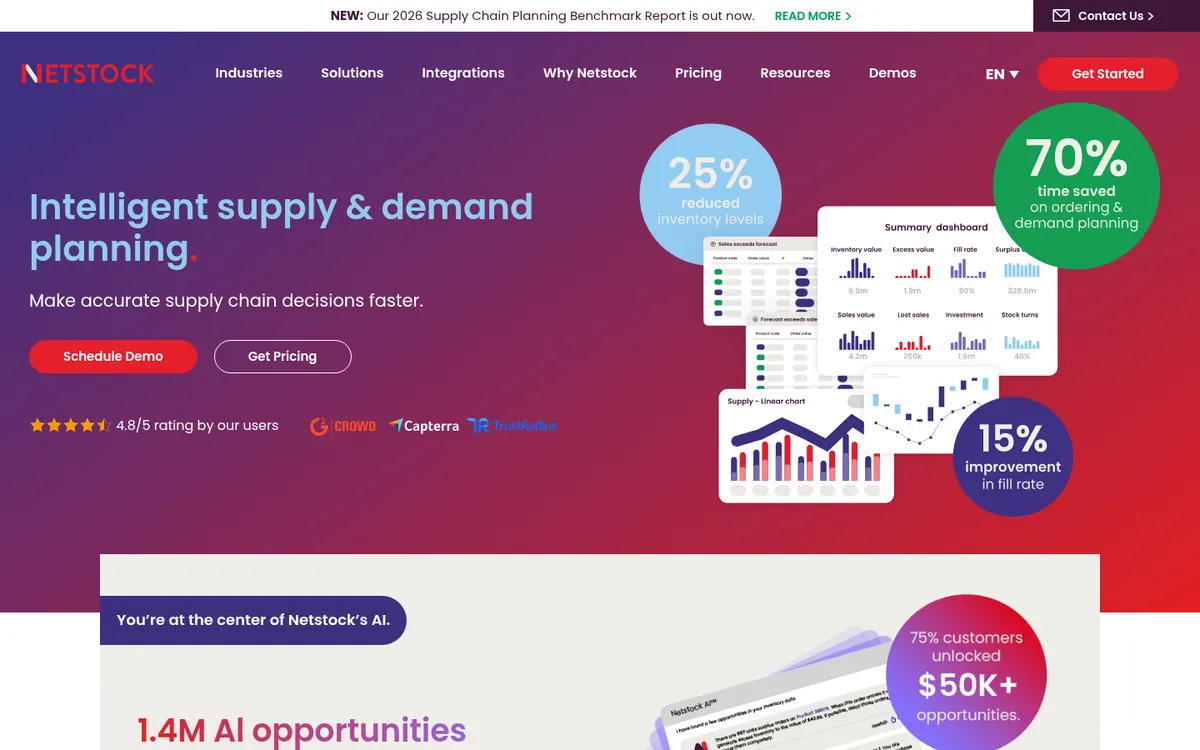
The best ERP-connected option for SMB distributors, with value-based pricing and safety stock tied to supplier performance.
Netstock is the practical choice for an SMB distributor or manufacturer that already runs an ERP and wants better forecasts on top of it. It ingests ERP data through native connectors to more than 60 systems, classifies products by value and velocity, and recalculates safety stock against both demand variability and supplier performance. Replenishment suggestions respect minimum order quantities, which is the detail that separates a usable tool from a report planners ignore. An AI predictive forecasting module is sold as an add-on. Pricing starts at $900 per month, per the vendor FAQ, with an annual commitment and a one-time activation fee. The bill scales with inventory value rather than seats or locations, so adding planners and warehouses does not add cost. For a distributor carrying a few million in stock, that structure is predictable; for a small one, it is a real annual commitment. Two operational notes. The dashboards on demand variability and supplier reliability are the fastest way to see whether the tool is earning its fee, because they show where the forecast is unstable and where suppliers run late. But some teams still adjust forecasts manually, and reporting customization is limited, so plan on spreadsheet exports if you need bespoke reports. There is no free plan and no trial, which raises the stakes on the sales process. Ask for a backtest on your own order history and a written implementation plan naming the ERP fields the connector will read. Confirm the activation fee and renewal terms in writing before signing, and check that the connector covers your item master, open purchase orders and on-hand balances, since those three feeds decide whether safety stock recalculates correctly.
You are an SMB distributor or manufacturer on an ERP and want safety stock and replenishment tuned to demand variability.
You need a free trial before committing, or you rely on heavily customized reports.
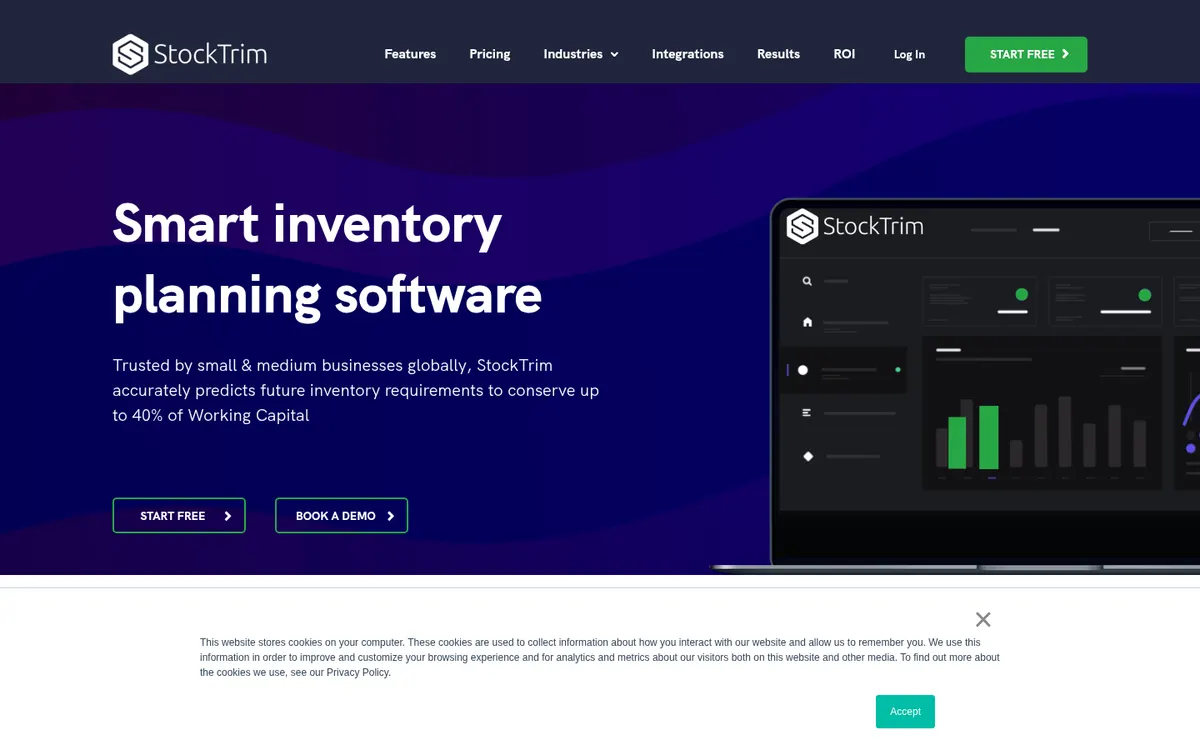
The easiest SMB entry point, with a published $49 starting price and AI forecasting, held back by thin enterprise depth.
StockTrim targets the smaller end of the market: growing SMBs that want AI forecasting and order planning without an implementation project. It forecasts demand, builds replenishment and order plans, handles new products that have no sales history, supports manufacturing planning and works across multiple locations. Tiered subscription plans are published, which is unusual in this category and makes it easier to budget. The entry point is $49 per month billed annually. The vendor page points to the website for the remaining tiers, so confirm what each tier includes before you commit. A 14-day free trial exists, which is short. Use it on a clean product set with at least a year of history rather than on your full catalog. The trade-offs are those of a lighter tool. Monthly cost climbs across tiers, and there is no published forecasting-accuracy figure, so you cannot compare the vendor's numbers with anyone else's. On complex networks with many warehouses, transfer logic and long lead times, it is thinner than enterprise platforms. For a wholesaler or ecommerce seller with a few thousand SKUs, a handful of locations and a planner who also does three other jobs, that trade is reasonable. You get forecasting and order planning in one place, priced like software rather than consulting. Run your own backtest during the trial, compare forecast error against your current reorder rule, and check how the tool handles a product launched last month. If the trial window feels tight, prepare your export before you start the clock.
You want AI forecasting and order planning at a published monthly price and can test it inside 14 days.
You run many warehouses with complex transfer logic or need published accuracy benchmarks.
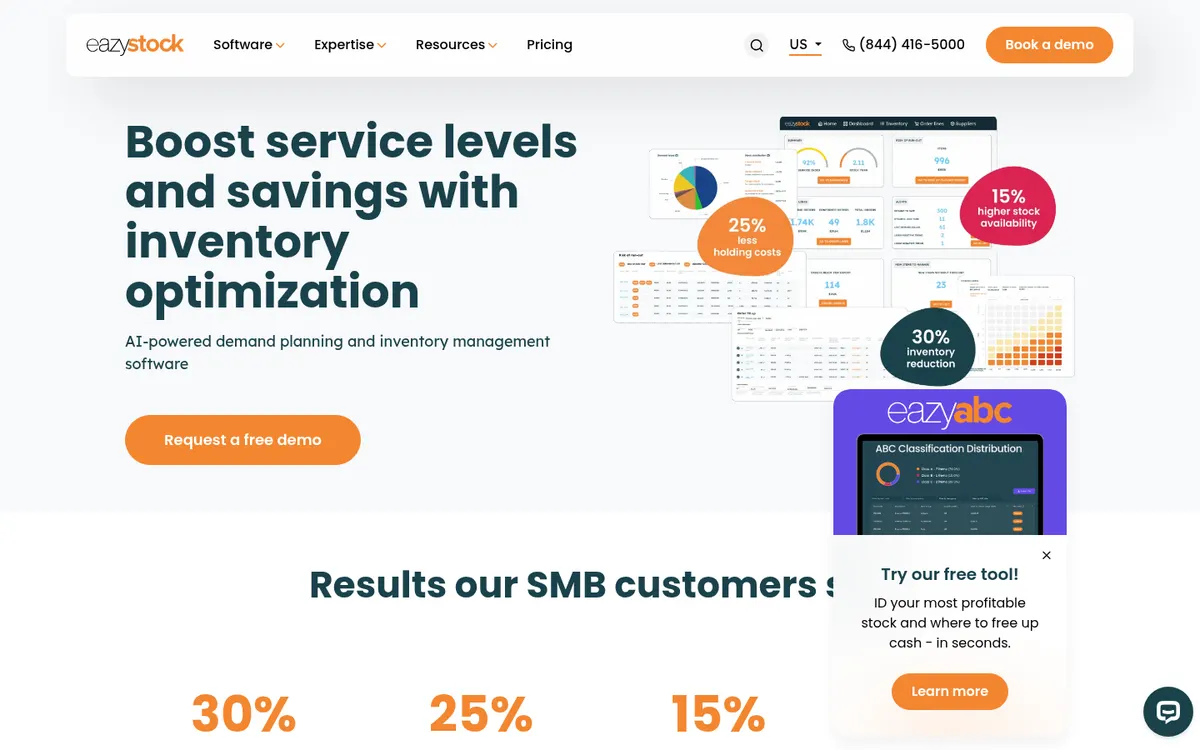
A dependable planning layer for wholesale distributors, let down by pricing you cannot see until you talk to sales.
EazyStock is a cloud subscription for wholesale distributors that want forecasting and purchase recommendations on top of an existing ERP without a long project. It connects to major ERPs, produces demand forecasts, and turns them into purchase and order recommendations. The interface is approachable for planners who are not statisticians, which is the point: most distributors do not have a dedicated forecasting team. The scope is deliberately narrow. You get demand forecasting, replenishment advice and ERP connectivity, not the wider supply chain suite around it. That suits a distributor who has decided to keep ERP transactions where they are and only wants the planning layer improved. Buyers who need a full supply chain suite will run into the edges quickly. Pricing is the gap. EazyStock does not publish pricing on its site, and no pricing page was available when we checked on November 25, 2026, so the listing remains see website. Ask explicitly what the subscription includes for onboarding and support, and get any quote in writing. There is no free plan and no trial. EazyStock is part of Syncron, which matters for buyers worried about a small vendor disappearing. In evaluation, ask for a backtest on your own item history, check that the ERP connector covers your item master and open purchase orders, and confirm how forecasts are adjusted when a buyer disagrees. The vendor's strength is that non-technical planners can run it, so test that with your actual team, not the vendor's demo data. A half day of one planner driving the tool tells you more than a full day of presentation.
You are a wholesale distributor who wants forecasting and purchase advice on top of an existing ERP, run by non-technical planners.
You need published pricing before a first call, or a full supply chain suite.
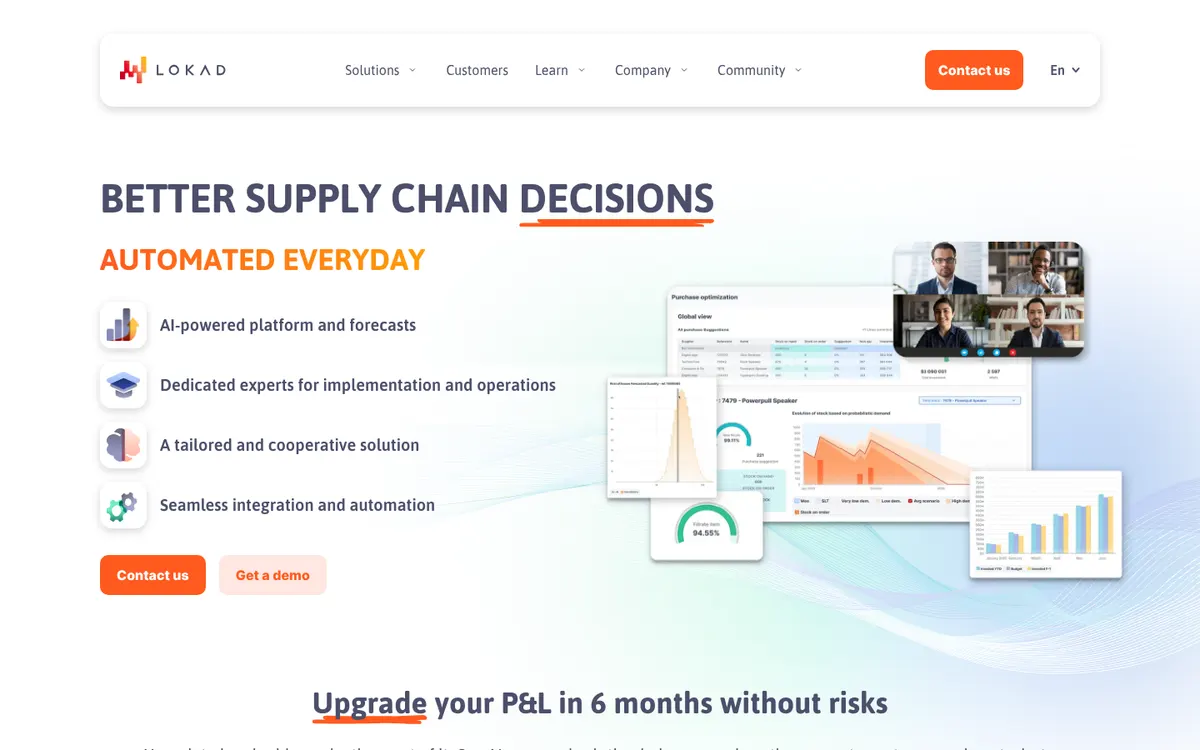
The most rigorous way to quantify forecast uncertainty, provided you have a technical owner who can program and maintain it.
Lokad sells probabilistic forecasting, which means it returns a probability distribution rather than one number. That sounds academic until you need it: a distribution lets you set a service level target and read off the inventory that target implies, instead of guessing at a safety stock multiplier. The platform is programmable, so a data science or analytics team can encode its own policies on top of the forecasts. Inventory optimization and pricing optimization sit alongside forecasting. This is not a tool you buy and hand to a buyer. It is built for quantitative users, and business-only planning teams often struggle with it, because the value comes from writing and maintaining logic rather than clicking through screens. Implementation needs technical ownership inside your company, plus access to order and inventory history in a clean form. Commercial terms are quote based. No pricing page was available when we checked on November 25, 2026, and there is no free plan or trial, so an evaluation means a scoping conversation about your data and your team's skills. Bring a named owner who can write the models and support them after go live; without that person the platform stalls. The payoff is real when you carry thousands of intermittent-demand SKUs, expensive stock and a service level commitment you can lose money on. In that setting, quantifying uncertainty is worth the technical cost. If your forecast meeting is a spreadsheet review with a planning team, this is more machinery than the problem needs, and a distributor tool will get you further for less effort. Ask how much of the modeling the vendor builds versus how much your team owns after go live.
You have a data science or analytics team that can own a programmable probabilistic model.
Your planners work in spreadsheets and no one on staff can maintain forecasting logic.
Deep statistical forecasting and scenario planning for mid-to-large distributors, priced and staffed like the project it is.
Slimstock, whose product is called Slim4, is a statistical forecasting and inventory planning suite for mid-to-large distributors. It carries deep statistical models, scenario planning, complex assortment handling and multi-warehouse planning, with ERP integrations the vendor has refined over a long European track record in distribution. The combination of scenario planning and assortment depth separates it from lighter SMB tools: you can test a range review or a supply disruption against the plan before it happens. Multi-warehouse planning matters for distributors that hold the same item in several locations and move stock between them. Slim4 handles that structure, and the ERP integrations are designed to work without heavy manual configuration, which shortens the data work that consumes most of an implementation. Demand and inventory planning sit in the same model, so a forecast change flows through to replenishment. Two limits. Pricing is quote based: no pricing page was available when we checked on November 25, 2026, and implementations are project based, so budget for services alongside the license. And the tool is heavier than SMB products in both cost and implementation effort. A wholesaler with a simple catalog and one warehouse would pay for statistical depth it never uses. The honest test is assortment complexity. If you run tens of thousands of SKUs, seasonal ranges, several warehouses and a planning team that argues about scenarios, Slimstock belongs on the shortlist. Ask for a reference in your sector, a backtest on your own history, and a fixed scope for phase one with named deliverables. Confirm license and services costs in writing before you sign, because neither is public.
You are a mid-to-large distributor with complex assortments across several warehouses and a planning team that runs scenarios.
You have a few thousand SKUs in one warehouse and need a price from a website.
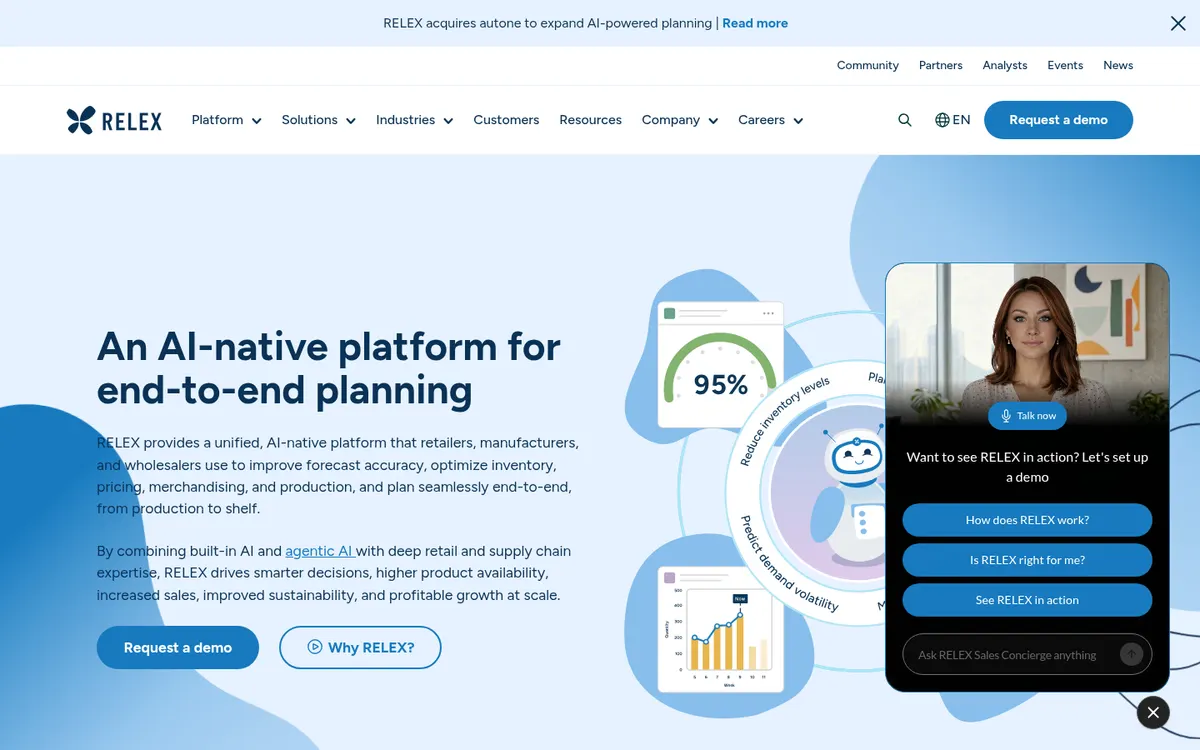
The strongest fit for large retail networks with fresh goods and promotions, and the heaviest program on this list.
RELEX Solutions is an enterprise planning platform for large retailers, wholesalers and manufacturers running complex networks. The product is AI-native: forecasting, promotion and seasonality modeling, fresh goods handling and network-wide inventory optimization are built on the same model, so a promotion forecast changes replenishment across stores and distribution centers rather than in one report. Multi-store and multi-DC optimization is the core use case. That breadth is aimed at organizations with the data and the planning headcount to use it. A grocery chain with fresh goods, daily deliveries and many stores is the archetype; so is a manufacturer distributing through several echelons. The retail chain references the vendor cites are the reason large buyers take the first meeting. The costs follow. There is no public pricing, and no pricing page was available when we checked on November 25, 2026, so the listing stays see website. Evaluation is sales led and implementations run as programs, with the timeline and services spend that word implies. For an enterprise, that is normal; for a mid-market distributor, it is disqualifying. Before shortlisting, be honest about your internal capacity. These projects need an owner on your side, clean item and location master data, and a planning team willing to change weekly routines. Ask what the first phase covers, what is deferred, and how the vendor measures forecast accuracy in production. No free plan or trial exists, so a phased program or a paid pilot is the only way to test fit on your own numbers, and you should insist on one before committing to a multi-year agreement.
You are a large retailer or wholesaler optimizing fresh goods, promotions and inventory across many stores and DCs.
You are mid-market, need public pricing or cannot staff an internal program owner.
Probabilistic planning and S&OP built for genuinely multi-echelon enterprises, and overkill for simple distributor reordering.
ToolsGroup is enterprise supply chain planning with a probabilistic forecasting heritage. It covers inventory optimization, S&OP, replenishment and multi-echelon planning, and it is built for complex manufacturing and distribution networks where a single forecast number is not enough to set service levels and buffer stock. Multi-echelon planning is the capability that matters most: it decides where in the network to hold inventory rather than treating every location as independent. The buyer is an enterprise with demanding planning requirements, often manufacturing with long lead times or distribution with several tiers of warehouses. For those organizations, S&OP collaboration and probabilistic inventory optimization in one suite reduce the number of handoffs between teams using different spreadsheets. The trade-offs are enterprise trade-offs. Pricing is quoted, and no pricing page was available when we checked on November 25, 2026, so expect a sales cycle and a scoping exercise before any number appears. Implementation is significant: data work, model configuration and process change across planning teams. There is no free plan or trial. For a straightforward distributor forecasting a simple catalog from one or two warehouses, this is overkill in both cost and complexity, and a tool like Netstock or EazyStock will deliver more value per dollar. The honest question is whether your network decisions are genuinely multi-echelon. If you hold stock in regional DCs and stores and argue about where to position it, ToolsGroup is in scope. If you only reorder into one warehouse, it is not. Ask for a backtest and a reference with a network shape close to yours.
Your inventory decisions are genuinely multi-echelon and you need probabilistic planning with S&OP in one suite.
You replenish into one or two warehouses and want forecasting live this quarter.
A connected planning platform that links demand to finance well, but you build the inventory depth yourself.
Anaplan is a connected planning platform, not a purpose-built demand forecasting tool, and buyers should start from that distinction. Demand plans sit in the same model as finance, workforce and supply plans, so a forecast change can be read against budget, headcount and margin in one place. The Hyperblock engine handles large multi-dimensional models, and scenario modeling is a genuine strength for what-if questions that cross functions.
The practical benefit is cross-functional. When sales, finance and operations argue about the number, a connected platform gives them one version with an audit trail. For a large enterprise that already runs financial planning on Anaplan, adding demand planning avoids a second vendor and a second data model, and a free trial is available according to the vendor.
The limits are inventory depth and cost. Anaplan is a platform you configure; forecasting methods, safety stock logic and replenishment rules have to be built on top. Teams expecting ready-made inventory optimization will find the work heavier than they assumed. Pricing is quote based: no pricing page was available when we checked on November 25, 2026, and enterprise licensing plus implementation partners add up quickly.
It fits enterprises whose main problem is connecting the demand plan to financial and operational plans across functions. It fits poorly as a replacement for a distributor's replenishment engine, where a focused tool will forecast and generate orders out of the box. If you shortlist it, scope the demand planning build precisely, name who owns the model after go live, and use the free trial on a real planning cycle rather than a demo dataset.
You need demand plans connected to finance and workforce plans in one enterprise model.
You want ready-made replenishment logic out of the box.
A sensible mid-market route to consensus forecasting and S&OP, with a smaller partner bench than the category leaders.
John Galt's Atlas Planning is demand planning software aimed at mid-market manufacturers and distributors, and its center of gravity is consensus. Statistical forecasting is there, but the product is organized around collaborative S&OP: planners, sales and operations work the same forecast, agree a number, and carry it into replenishment. That consensus workflow is the reason mid-market teams choose it over a statistical engine alone. The fit is an organization large enough to need a formal forecast review and small enough that an enterprise suite is unrealistic. Atlas Planning is more accessible than enterprise platforms in cost and implementation, with a scope a planning team can absorb without a multi-year program. Manufacturers with a sales-driven forecast and distributors whose demand plan sales reps influence are the natural buyers. The limits are market presence and transparency. Pricing is quote based, and no pricing page was available when we checked on November 25, 2026, so there is no way to budget from the website; you need a scoping call. The vendor's market presence is smaller than the largest names in the category. There is no free plan or trial. In evaluation, ask for a backtest on your own item history and a walkthrough of the consensus cycle with your actual participants, since that workflow is the selling point and the hardest thing to judge from a demo. Ask how the forecast flows into replenishment and what a typical implementation looks like for a company your size. Confirm license and services costs in writing, and check references in your sector.
You are a mid-market manufacturer or distributor that needs a consensus forecast and a formal S&OP cycle.
You need published pricing or a large partner ecosystem.
Demand forecasting software predicts how much of each item you will sell at each location in each period. Inventory and replenishment tools take that prediction and turn it into decisions: safety stock levels, order quantities, order timing and transfers between locations. Many products in this list do both, which is why the category boundary is blurry. The useful question is not what the label says but where the tool stops helping and your spreadsheet starts again.
The distinction matters most at the edges. A forecasting engine that produces a number but leaves buyers to work out order quantities has moved the problem, not solved it. A replenishment tool with a weak forecast will order the wrong quantity very efficiently. Look for a product where a forecast change visibly changes a purchase order without someone rekeying it.
Enterprise suites add a third layer: multi-echelon planning, S&OP workflows, promotion modeling and scenario testing across a network. That is where RELEX Solutions and ToolsGroup sit, and it is why their implementations are programs rather than signups.
When you evaluate, check these specific things:
If your demand is stable, your lead times are short and your SKU count is small, ERP reorder points may genuinely be enough. Software earns its fee when variability, promotions or network complexity make a static minimum wrong.
This comparison sits on the Software desk. Readers comparing neighbouring stacks often check our guides to ChatGPT alternatives and AI video ad creation software next.
Published subscription prices exist mostly at the SMB end. StockTrim lists $49 per month billed annually as its entry point, and Netstock's FAQ states $900 per month with an annual commitment and a one-time activation fee. Everything above that tier in this list is quoted, which means you cannot budget from a website and the first real number arrives after a scoping call. What a price scales on tells you more than the number itself. Netstock bills on inventory value rather than seats or locations, so adding planners is free and growing stock raises the bill. For quote-based suites, ask what the price scales on and whether implementation services are billed separately. LEAFIO notes no per-seat fees, which matters for chains with many buyers and planners.
| Model | How it bills | Typical fit | Example from this list |
|---|---|---|---|
| Published monthly subscription | Monthly fee billed annually, with published tiers | SMB and small planning teams | StockTrim, from $49 per month billed annually |
| Inventory-value subscription | Monthly fee scaled to inventory value, annual commitment, one-time activation | SMB and mid-market ERP users | Netstock, from $900 per month per the vendor FAQ |
| Value-based quote | Annual license quoted through sales | Distributors, manufacturers and technical teams | EazyStock, Lokad, Slimstock, John Galt Atlas Planning |
| Enterprise program | Quote plus implementation services | Large retail and manufacturing networks | RELEX Solutions, ToolsGroup, Anaplan |
| Demo or trial gate | No free plan; demo or short trial before any quote | Every tier | LEAFIO demo only, StockTrim 14-day trial, Anaplan free trial |
Every price above was checked on the vendor's own pricing page on November 25, 2026. Where a vendor does not publish a figure we write "See website" instead of guessing. To compare annual and monthly billing quickly, try the free percentage calculator.
Demand forecasting software predicts how much of each item you will sell in each period; inventory tools turn that prediction into order quantities, safety stock and replenishment timing. Many products do both, which is why the line is blurry. Forecast depth matters most when demand is seasonal, promoted or intermittent. Replenishment logic matters most when lead times, minimum order quantities and supplier reliability drive your stock position.
Entry subscriptions start at $49 a month billed annually for SMB tools such as StockTrim, and $900 a month for Netstock, per its FAQ. Mid-market and enterprise products are quoted. Netstock's FAQ lists an annual commitment and a one-time activation fee. Several vendors in this list publish no price at all. Budget implementation services separately.
Yes, if you pick a tool priced and scoped for your size. StockTrim publishes tiers from $49 a month with a 14-day trial, and EazyStock targets distributors with a simple ERP connection. Small teams get the most value when they have clean sales history and a manageable SKU count. Below that, ERP reorder points may be enough.
Run a backtest: hold back a recent period of sales history, forecast that period using only earlier data, then compare forecast error against your current method on the same items. Ask the vendor to run it on your data, not theirs. Weight the result by inventory value, because an error on a cheap fast mover matters less than the same error on an expensive slow one.
Implementation timelines vary by vendor tier. Netstock's 60-plus ERP connectors shorten the data work, while RELEX Solutions, ToolsGroup and Anaplan implementations are significant enterprise programs. Ask what phase one covers, what is deferred, and get the timeline in writing before signing.
ERP reorder points are enough when demand is stable, lead times are short and consistent, and you carry few SKUs. They break down with promotions, seasonality, new products, intermittent demand or long lead times, because a static minimum ignores variability. If you spend more than a few hours a week fixing stockouts and overstock by hand, dedicated forecasting usually pays for itself.
Browse every comparison on the Software desk, with the same rubric and dated prices.