Ranked #1

Smith.ai
AI plus live humans
See website
- Best for
- Property managers needing AI intake plus human escalation for sensitive calls
- Free plan
- No; free AI tier 25 calls per month
- Rubric
- 7.9 / 10
Nine services that answer tenant, leasing and emergency calls, compared on escalation design, billing model and whether they connect to AppFolio, Buildium or Yardi.
 Prices checked November 25, 2026

Smith.ai is the best fit for managers who want AI intake with live human escalation, AptaBook for landlords who want flat-rate AI handling of maintenance and showings, and PATLive for human-first after-hours coverage. The order below follows editorial fit for the buyer described in each entry, updated for November 2026. Each service publishes its rates on its own site or quotes them after a short call, so budget a scoping conversation before you compare. Prices were checked on 2026-11-25.
AI plus live humans
See website

Maintenance intake depth
See website

Warm bilingual humans
See website
Disclosure for this page: All 9 tools here are unpaid editorial picks. The position of a paid listing can be part of what the vendor pays for. How we handle paid listings.
| Tool | Best for | Free plan | Actions | |||
|---|---|---|---|---|---|---|
| 1 | Smith.ai | Property managers needing AI intake plus human escalation for sensitive calls | See website | No | ||
| 2 | AptaBook | Landlords and property managers needing AI for maintenance, emergencies, showings | See website | No | ||
| 3 | Ruby | Established firms wanting warm bilingual human reception for residents | See website | No | ||
| 4 |  PATLive | Human-first after-hours coverage with a trained person on every call | See website | No | ||
| 5 |  AnswerConnect | Mid-size property managers needing 24/7 live humans for leasing leads | See website | No | ||
| 6 |  Abby Connect | Small offices wanting human, AI, or hybrid answering on one plan | See website | No | ||
| 7 |  Nexa | Larger portfolios needing a virtual receptionist team with AI and CRM | See website | No | ||
| 8 |  MAP Communications | Large portfolios needing custom emergency protocols and per-property scripting | See website | No | ||
| 9 |  AnswerFirst | Low or variable volume property managers wanting pay-as-you-go live answering | See website | No |
We built this list for property managers who need calls answered, not for buyers comparing generic call centers. Each service was read against five criteria, and the scores in each review reflect those criteria only.
Property workflows and escalation design carry the most weight because they decide whether a service is useful or just a message pad. A vendor that logs a maintenance request with unit, issue, urgency and access fields, and that confirms an on-call staff member received an emergency, is doing something a generalist cannot. Integration depth covers AppFolio, Buildium and Yardi connections plus automation layers such as Zapier. Coverage hours look at whether nights, weekends and holidays are staffed without a surcharge. Pricing fit weighs the billing model against the call patterns property managers actually have, where a large share of calls are very short.
Prices, plans and trial terms come from vendor pricing pages checked on 2026-11-25. Where a page could not be read (an image, a rate-limited fetch, a quote form), the review says so and the price stays as See website rather than a guess. We do not estimate rates from third parties.
The order is editorial. It reflects how well each service fits the buyer described in its entry, plus any disclosed Featured position. A Featured listing is a paid placement and is scored with the same rubric as every other entry, cons included. Placement does not change a score.
Read the cons first. They are the fastest way to rule out a service that looks right on a feature list but does not fit your call volume or your on-call structure.
The full process, including how we handle corrections, is on the methodology page. Paid listings follow our advertising disclosure.
| Criterion | Weight | What we check |
|---|---|---|
| Property workflows | 25% | How well the service handles maintenance intake, leasing inquiries and resident calls as property work rather than generic messages. |
| Escalation design | 25% | Whether emergencies route to on-call staff under written rules and whether the service confirms a human received the alert. |
| Pricing fit | 20% | Whether the billing model matches the short, uneven, after-hours call patterns property managers actually produce. |
| Integration depth | 15% | Named AppFolio, Buildium or Yardi connections plus automation routes such as Zapier, Make or n8n for the data calls create. |
| Coverage hours | 15% | Staffed nights, weekends and holidays, and whether after-hours answering carries a surcharge. |
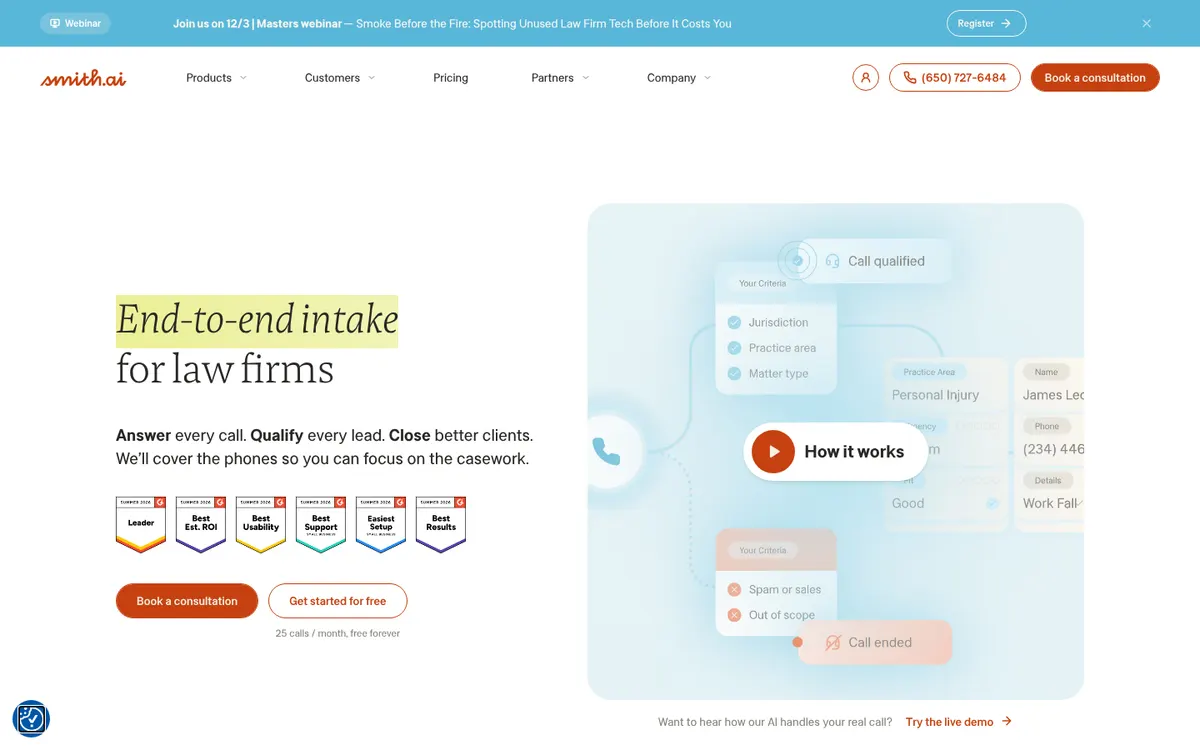
Best fit for managers who want AI to field routine tenant calls and humans to catch what the AI should not.
Smith.ai splits the work between an AI receptionist and live virtual receptionists, so routine tenant questions get answered without a person and sensitive calls can move to a human. The AI handles first contact: leasing questions, basic tenant queries and intake. When a call escalates, a North America-based receptionist takes over. Receptionists work all hours, and the service offers bilingual English and Spanish coverage, which matters in markets with large Spanish-speaking renter populations. For property work specifically, the built-in behaviors are short but practical: leasing lead capture, showing scheduling and tenant request intake. AppFolio, Buildium and Yardi integrations are named, and automation can run through Zapier, Make or n8n when a manager wants call data to trigger something else. That pairing of a named PMS integration with a general automation layer is the usual reason a mid-size manager shortlists Smith.ai at all. Pricing is the sticking point. Rates sit on the vendor site and the structure mixes AI and human billing. AI use has a free tier of 25 calls per month, and paid AI Pro tier pricing is on the vendor site. Human receptionist pricing was checked on 11 November 2026 and is quoted on the site. Paid plans carry a 30-day money-back guarantee rather than a conventional free plan. Calls bill per call, so a 40-second lockout question costs the same as a 6-minute maintenance report, and high volumes of very short calls get expensive fast. The honest limit is escalation. The AI is only as good as the rules that send a dispute or a burst pipe to a person, and those rules must reach on-call staff who actually pick up. Smith.ai fits property managers who want AI intake with a real human backstop and will pay per-call rates for it. It fits less well for shops whose calls are mostly very short and mostly routine.
You want AI to absorb routine tenant traffic and a human to take over disputes and emergencies.
Most of your calls are very short and routine, where per-call billing works against you.
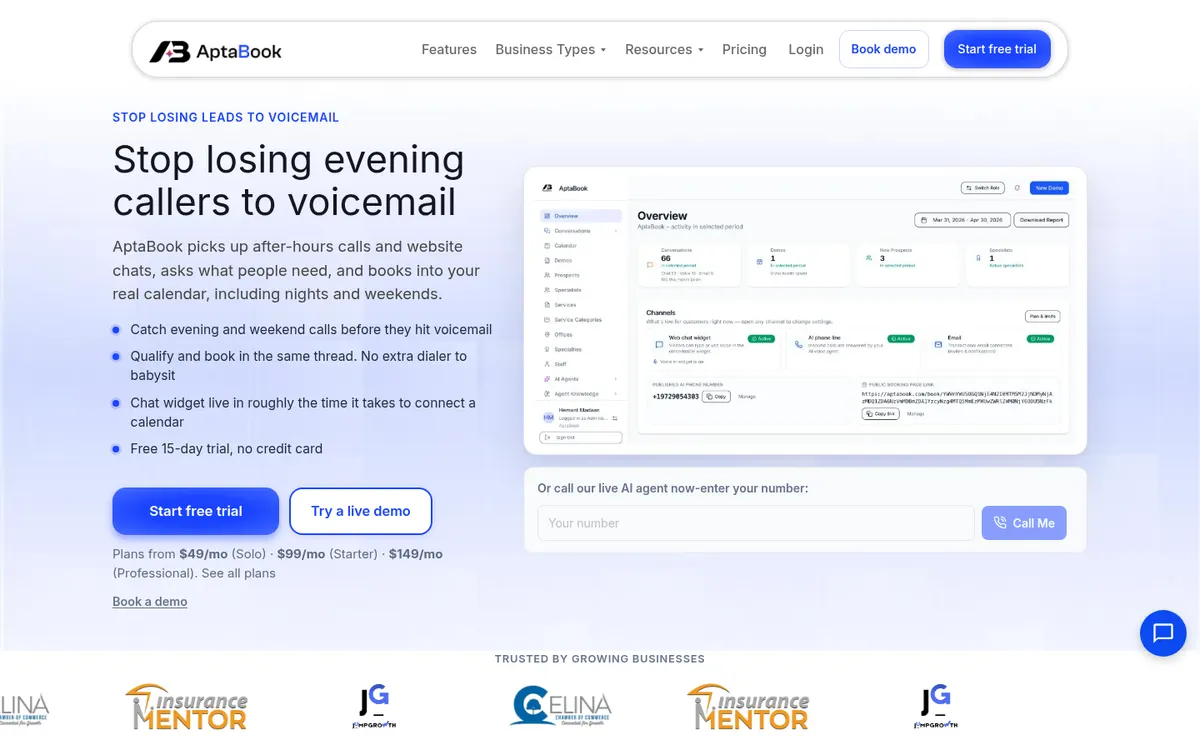
A flat-rate AI receptionist with unusually detailed maintenance intake, but no humans and no native PMS link.
AptaBook is an AI receptionist built for the calls landlords actually get. It answers across phone, website chat and email, and it logs maintenance requests with unit, issue, urgency and access fields rather than dropping a message in an inbox. Emergency detection covers leaks, flooding, no heat and lockouts, and routing follows the escalation rules the client sets. Two details separate it from generic AI answering. First, showing booking writes into Google Calendar or Outlook, so a leasing prospect can leave a call with a time on the books. Second, the service supports more than 20 languages across the US and Canada. Call summaries go out by email or Microsoft Teams, which suits operators who already live in Teams. The constraint is that there are no live human receptionists. Every call is handled by AI. That is fine for routine questions and structured intake, and it is why the plans stay flat and conversation-based with no overage fees. It is not fine for an upset tenant who needs to hear a person. Those calls route to on-call staff through your escalation rules, so the service's quality depends entirely on how well those rules are written and maintained. Setup also changes the phone number story. AptaBook does not port numbers; calls forward from the existing line into the service. Managers who built brand recognition around one number should plan that forwarding step. Nor is there a native AppFolio, Buildium or Yardi integration listed, so request data has to reach the PMS some other way, usually through exports or an automation tool. Pricing is on the vendor site. The 15-day trial requires no credit card, which is a low-risk way to test emergency routing with real calls. Pick AptaBook if you want low, flat AI costs and detailed maintenance intake. Skip it if your residents expect a human voice.
You want predictable AI pricing and structured maintenance intake without a human receptionist bill.
Residents or owners regularly need a person on the line during an emergency.
Warm, bilingual human answering around the clock, priced per minute and light on property-specific workflows.
Ruby is a generalist live answering service that happens to work well for resident calls. Receptionists answer 24/7 in the client's business name, take messages, book appointments and handle intake guided by custom FAQs. Spanish and bilingual call handling is included, and the receptionists are US-based. The strength is tone. A tenant calling about a parking spot or a rent question gets a warm, professional human voice at any hour, including nights, weekends and holidays. For an established firm whose reputation rests on how residents feel after a call, that matters more than a feature checklist, and it is hard to replicate with software. The weakness is depth. Ruby is not a property management specialist. It does not ship maintenance intake fields, emergency detection logic or PMS connections the way property-focused services do. The client supplies the property knowledge and designs the escalation path, so any emergency workflow is essentially a script your team writes and the receptionists follow. If that script is vague, the coverage is vague too. Cost is where the generalist model shows. Pricing is on the vendor site, and the entry plan bills per minute, steep compared with per-call or conversation-based models. Short, frequent tenant calls burn through minutes quickly. There is no free plan, and the guarantee details come from comparisons rather than a policy we could confirm on the site. Price data for Ruby dates to September and October 2026, and the live pricing page displayed rates as an image on 11 November 2026, so figures could not be confirmed from page text. Pick Ruby if warm bilingual human answering is the priority and call volume is moderate. Skip it if you need maintenance workflows, PMS integration or a low cost per routine call.
Resident experience and bilingual human answering matter more than per-call cost.
You need maintenance workflows and PMS integration built into the service.
A trained human on every call at any hour, with property scripts and no night surcharge, and no AI to cut costs.
PATLive has answered property management calls since 1990 and runs a human-first model with no AI option. Live agents in the US cover all hours, and the service does not add a night or holiday surcharge, which is unusual in an industry that often prices after-hours coverage at a premium.
Property-specific call flows are the core of the offer. Agents follow scripts for maintenance intake, qualify leasing inquiries, book showings and escalate emergencies to on-call staff. Because every call goes to a trained person, the awkward middle cases get handled without a transfer to voicemail: an angry tenant, a confused prospect, a contractor calling back about a work order. A cloud phone system is included on all plans, which can replace a separate provider for a small office.
The trade-off is cost control. There is no AI tier for routine calls, so every call is billed at live-agent minute rates. A portfolio with heavy after-hours lockout and noise complaints will pay human rates for calls an AI could have logged in seconds. Teams that want software to absorb volume and humans for the exceptions should look at a hybrid instead.
Pricing sits on the vendor site. Price data collected in September and October 2026 described per-minute and bundle structures, but on 11 November 2026 the pricing page returned FAQ text rather than rates, so figures were not confirmed. A 14-day trial runs on all plans, and that is the practical way to test whether the call flows match your scripts before you commit to a volume.
Escalation quality depends on the scripts you supply. PATLive will follow a documented emergency path, but it will not invent one for you, so write the per-property steps first. Pick PATLive if you want a trained human on every call and predictable all-hours coverage without a night premium. Skip it if routine volume is high enough that per-minute human billing would dominate the budget.
You want a trained human on every call and after-hours coverage without a surcharge.
Routine call volume is high and you want AI to absorb the cheap calls first.
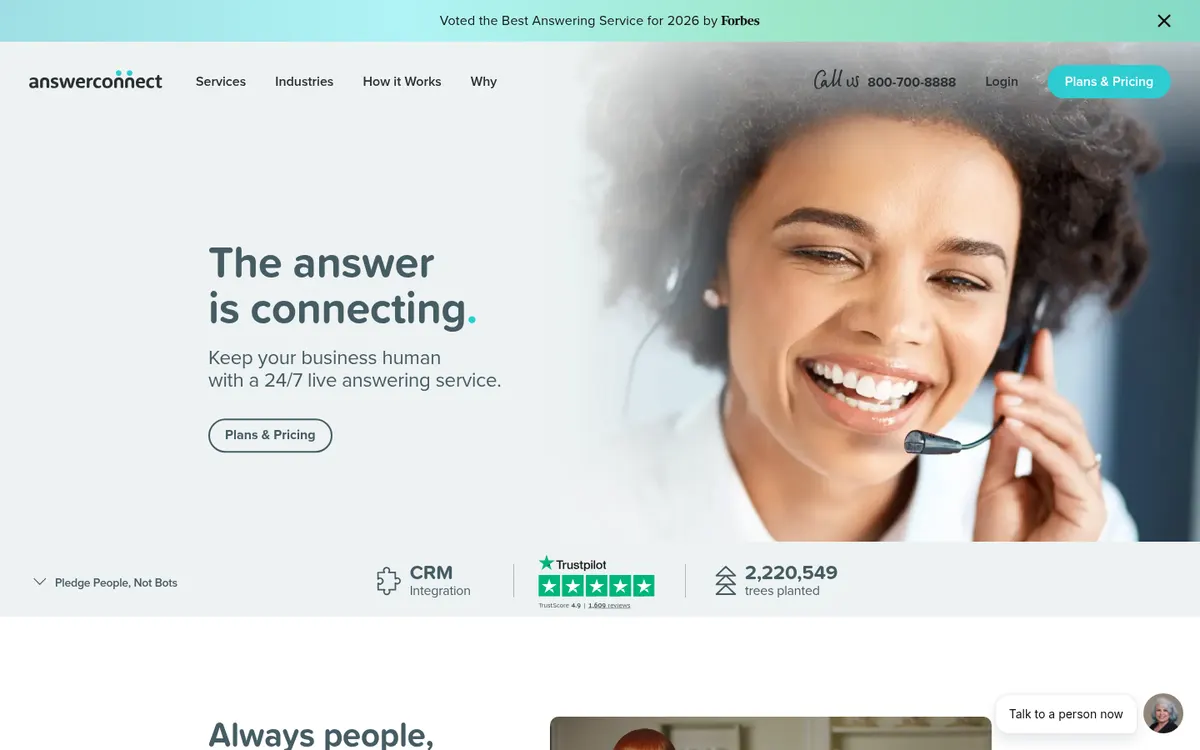
Human coverage tuned to leasing, with lead qualification and showings booked on the call, billed in full minutes.
AnswerConnect provides 24/7 live virtual reception with a leasing tilt. Receptionists answer in the client's business name, capture leasing leads, qualify prospects, book showings and take messages, using custom scripts and intake forms the client defines. The leasing workflow is the reason property managers shortlist it. A prospect who calls at 9 pm about a two-bedroom gets qualified against your criteria and booked into a showing slot rather than logged as a name and number for tomorrow. Scheduling runs on Setmore, and there are CRM and scheduling integrations for pushing lead data onward into whatever system the leasing team already uses. For tenant calls the picture is thinner. Maintenance intake exists through custom forms, but there is no native emergency detection engine, and the service is a generalist reception product rather than a property platform. Escalation is what your script says it is, so a property with complex emergency rules needs someone on staff who will write and maintain them. Billing has two irritations. Calls round up to the next full minute, so a short call costs more than the clock suggests, and some plans add a setup fee. There is no free trial; the vendor offers a demo. Price data dates to October 2026, and a direct page fetch was rate limited on 11 November 2026, so the pricing sheet could not be confirmed beyond what earlier checks recorded. Mid-size managers with steady leasing traffic and seasonal spikes get the most from it, because human coverage scales up without a hiring cycle. Pick AnswerConnect if leasing lead capture is the main job and your staff can write good qualification scripts. Skip it if you need per-second billing, deep maintenance automation or a trial before signing.
Leasing lead qualification and booked showings are the calls you most need answered.
You need per-second billing or a free trial before committing.
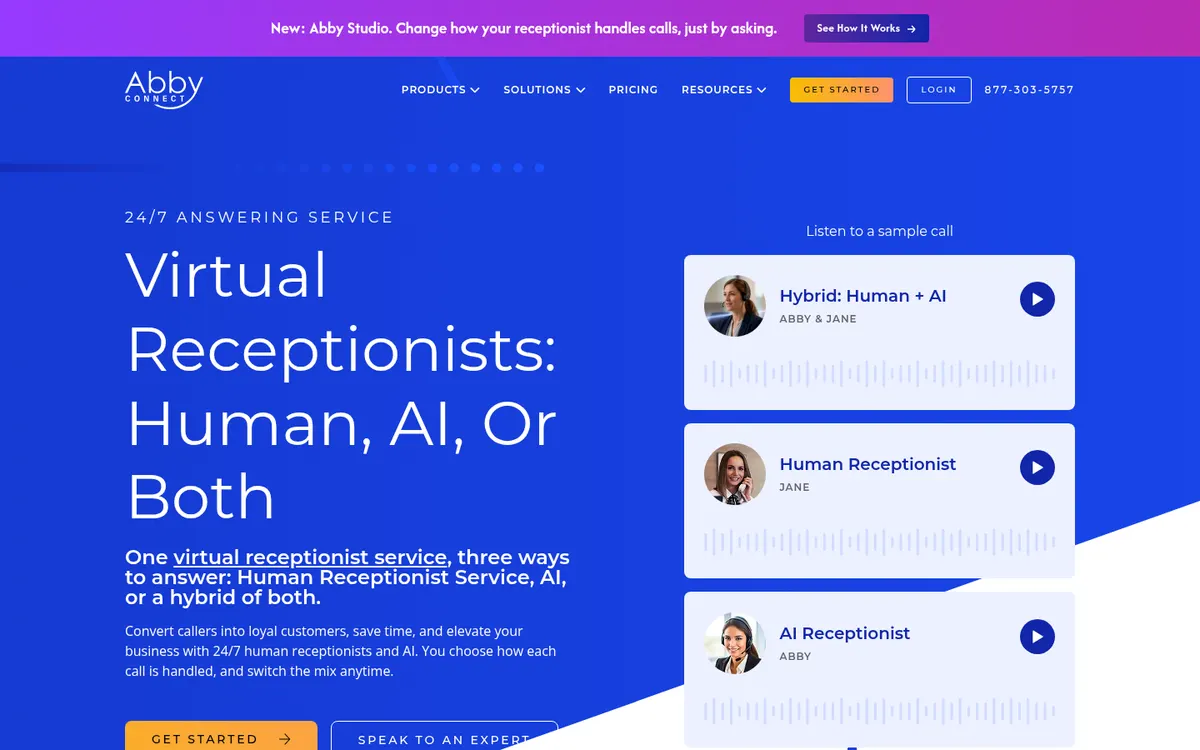
One plan that mixes human, AI or hybrid answering, with AI minutes counting at half the human rate.
Abby Connect is the flexible middle option: human receptionists, an AI receptionist or a hybrid of the two, all on the same plan structure. That matters for property managers who want AI to absorb routine calls now and keep a human path open for disputes without buying and managing a second service. The billing design is clever. AI minutes count as half an Abby Minute, so included minutes stretch roughly twice as far when the AI handles the call. Human receptionists handle message taking, intake, appointment scheduling and custom call instructions, and callers can be tracked through a portal and app. There is no setup fee, and every plan includes a trial, which lowers the cost of finding out whether the AI configuration suits your residents. The cost of human time is the honest downside. Effective human minute pricing is steep for high volume. A property with constant short calls about parking, pets and packages will find per-minute billing adds up quickly, and the AI discount only helps if the AI is configured well for those specific questions. Left at defaults, it will not be. Rates were confirmed on the vendor page on 11 November 2026. Listings can show slightly different rates from the vendor page, a small difference worth knowing when you compare quotes. There is no free plan, so the trial is the only way to test without paying. Abby Connect suits small and mid-size offices that want one vendor for both modes and will invest time in call handling instructions. It suits less well a large portfolio where per-minute human costs would swamp the AI savings. Pick it if flexibility across human and AI matters more than the lowest per-minute rate.
You want one vendor that can shift between AI and human answering as your call mix changes.
Your call volume is high enough that per-minute human billing would dominate the budget.
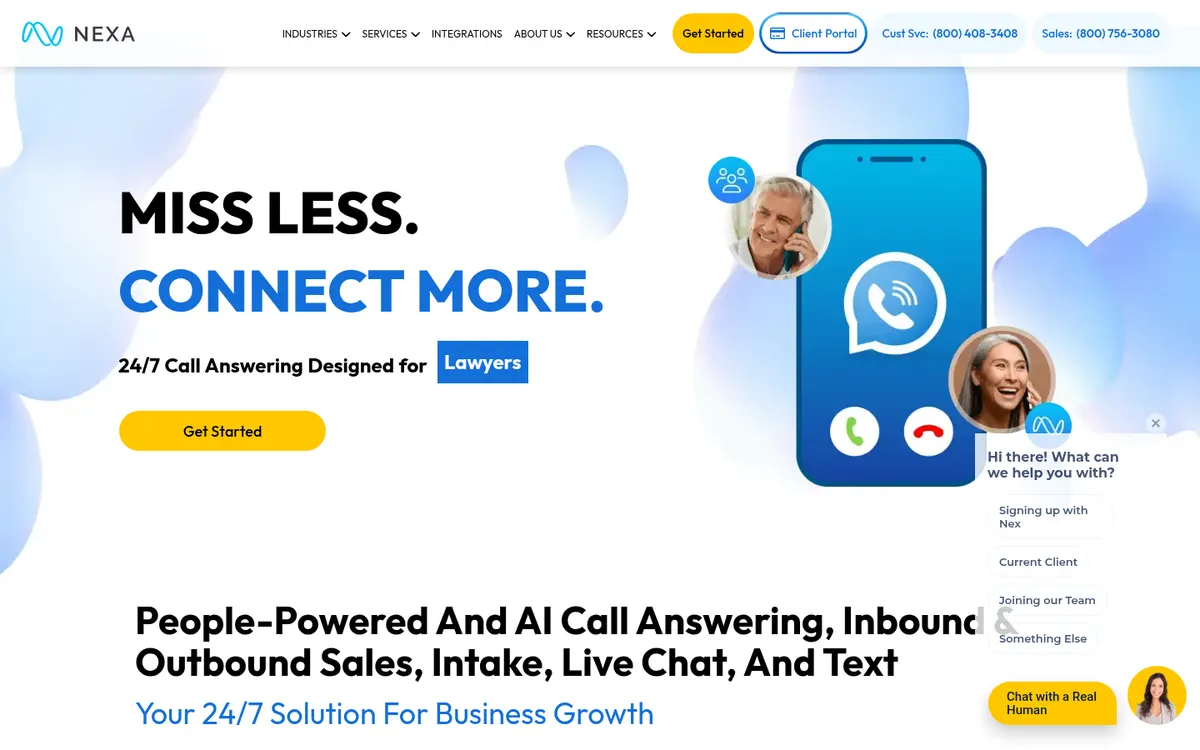
A multi-channel receptionist team with AI assistance, held back by quote-only pricing and a sales call before any number.
Nexa runs a Phoenix-based receptionist team and layers AI-assisted intake, lead qualification, scheduling, and chat and text support on top. Scripted tenant and leasing responses keep the human team consistent across shifts, and call transfers let a live agent hand a hot leasing lead straight to the property while the prospect is still interested. The multi-channel piece is the differentiator. Voice, chat and text all land in one service, which fits operators whose prospects start conversations on a website widget rather than a phone. CRM integration appears on the higher tier, so the cheaper plans are less useful for teams that want lead data flowing into their systems without manual re-entry. Pricing is the problem. Nexa does not publish rates. Plans are quoted by included minutes (100, 300 or 500) with setup and overage terms attached, and a sales conversation is required before any cost comparison. No published range matches the current plan lineup, so it should not be used for budgeting. A direct fetch was rate limited on 11 November 2026. That quote-only model suits larger portfolios with enough volume to negotiate, and it slows down small firms that just want a pricing sheet and a trial. Expect to describe call volume, escalation steps and integration needs before you see a number, and expect the number to change if the scope changes. Pick Nexa if you are large enough to negotiate and want voice, chat and text under one roof with AI assistance. Skip it if you need published pricing to shortlist quickly or you run a single property with modest volume.
You want voice, chat and text handled by one team and have the volume to negotiate a quote.
You need a published pricing sheet before you can shortlist.
The most property-specific human service here, with per-building emergency protocols and confirmed on-call handoffs.
MAP Communications is the most property-specific human service in this list. It has answered property calls for more than 30 years, runs US-based agents around the clock, and builds custom emergency protocols per property rather than per company.
That last point is the reason to consider it. A 400-unit portfolio spread across six buildings does not have one emergency procedure. MAP writes escalation steps for each property and confirms with on-call staff that a message was received, closing the loop that most answering services leave open. Maintenance intake, tenant calls and leasing inquiries are all part of the dedicated property management service, so agents are working from property context rather than a generic script.
The gap is automation. There is no AI option, so every routine call is a human minute, and no free trial is stated. For a portfolio where most calls are simple and repetitive, that is expensive insurance. For a portfolio where a missed burst pipe is a six-figure event, it can be the cheapest line item in the budget.
Price data collected in September and October 2026 covered bundle structures, but a direct page fetch was rate limited on 11 November 2026 and the figures could not be confirmed. Ask for the per-property scripting scope in writing before you compare quotes, because the quality of the emergency protocol is the actual product you are buying.
Pick MAP if emergency escalation matters more than per-call cost and you want per-building protocols with confirmed handoffs. Skip it if you need AI for routine volume or a free trial before committing.
A missed emergency is your biggest risk and you want documented per-building protocols.
Most calls are routine and you want AI or pay-as-you-go pricing to keep costs down.
Pay-as-you-go live answering with one-second billing and no after-hours surcharge, but rates sit behind a quote form.
AnswerFirst is built around pay-as-you-go live answering. There are no minute bundles, billing runs to the second and there is no after-hours surcharge. For a property manager whose call volume swings with lease turnover season, that structure is easier to budget than a bundle that expires before the busy month arrives.
Property management call handling covers maintenance requests, leasing inquiries and urgent tenant needs, answered 24/7 by live agents. Because billing is per second, a 25-second call about a gate code is not rounded up to a full minute, which matters when a portfolio generates a lot of very short calls. That single detail separates it from services that bill in whole-minute increments.
The catch is transparency. The complete pricing sheet sits behind a quote form, and the per-minute rate varies with usage, so two managers with different volumes see different effective prices. A 30-day risk-free trial is advertised, but there is no free plan. Price data came from September and October 2026 sources and the vendor real estate page, and a direct fetch was rate limited on 11 November 2026, so figures were not confirmed on the day.
There is also no AI tier, which means every short routine call costs money at human rates. That is still cheaper than a bundled plan you do not fully use, but it is not cheaper than an AI receptionist logging the same call. Low-volume owners and managers with seasonal peaks get the most from the model.
Pick AnswerFirst if your volume is low, seasonal or unpredictable and you want to pay only for what you use. Skip it if you want published rates up front, a free plan, or AI handling routine tenant questions.
Your call volume is seasonal or unpredictable and you want to pay only for the seconds you use.
You need a published pricing sheet or AI to handle routine tenant questions.
A property management answering service answers the calls that would otherwise hit voicemail, a leasing office after close, or an on-call manager's cell at 2 am. The category covers three delivery models, and the model you choose shapes cost far more than any feature list.
Live human reception: a trained agent answers in your business name, follows a script, takes a message or transfers the call. Firms hire this when residents expect a person and when tone carries the brand.
AI reception: software answers, asks structured questions, books a showing and writes a summary. It costs less per contact and never sleeps, but it cannot comfort an upset tenant.
Hybrid: AI takes first contact and hands exceptions to a human under escalation rules.
What the calls actually contain:
The property-specific part is the intake structure and the escalation path, not the answering. Any receptionist can take a message. A service built for rentals captures the unit number, the urgency and whether the tenant will be home, then reaches a specific on-call person and confirms they got it. That is the difference between a message pad and a system of record.
Integration matters for the same reason. If a maintenance request has to be retyped into AppFolio, Buildium or Yardi, the answering service added a step instead of removing one. Named PMS integrations and automation routes such as Zapier, Make or n8n decide whether a call becomes a work order or an email someone reads on Monday.
Expect to choose by call mix, not by brand. High volumes of short routine calls reward AI or pay-as-you-go billing. Low volumes of high-stakes emergency calls reward a human service with written per-property protocols and confirmed handoffs.
This comparison sits on the Software desk. Readers comparing neighbouring stacks often check our guides to demand forecasting software and glp 1 companies next.
Property management answering services bill in five ways, and the model usually matters more than the headline rate. Match the model to your call lengths before you compare vendors, because the cheapest published rate can be the most expensive one for your call mix.
| Model | How it bills | Typical fit | Example from this list |
|---|---|---|---|
| Per minute | Live-agent minutes at a plan rate, sometimes rounded up | Steady volume with predictable call lengths | AnswerConnect rounds each call up to the next full minute |
| Per call | Each answered call billed the same regardless of length | Teams taking many short, routine calls | Smith.ai charges short and long calls equally |
| Conversation based | Flat plan by number of conversations, no overage | AI-first shops wanting predictable cost | AptaBook sells flat conversation plans with no overage fees |
| Hybrid AI and human | AI minutes count at a discount against human minutes | Offices wanting both on one plan | Abby Connect counts AI minutes as half an Abby Minute |
| Pay as you go | One-second billing with no minimum usage | Low or seasonal volume | AnswerFirst bills by the second with no minimum |
| Quote only | Rate built after a scoping call | Larger portfolios with custom protocols | Nexa quotes by included minutes after a sales call |
Every price above was checked on the vendor's own pricing page on November 25, 2026. Where a vendor does not publish a figure we write "See website" instead of guessing. To compare annual and monthly billing quickly, try the free percentage calculator.
Count two weeks of calls. Log volume, time of day, call length and call type before you look at any vendor. The mix, especially the share of calls under one minute, decides which billing models are even viable for you.
Sort calls into AI-safe and human-only. Routine questions about rent, parking and amenities can go to software. Disputes, injuries, floods and anything emotional need a person. This split tells you whether you need a hybrid, a human service or pure AI.
Write the escalation path first. Document which emergencies page which person, in what order, and how receipt is confirmed. Then ask each vendor how they follow it. Services that confirm on-call receipt, such as MAP Communications, are worth the premium for high-stakes properties.
Check the PMS connection. Confirm whether AppFolio, Buildium or Yardi is named natively, or whether data arrives by email and gets retyped. Smith.ai names all three. AptaBook names none, so plan the workaround before signing.
Match the billing model to your call lengths. Per-call, per-minute, conversation-based and per-second plans reward different volumes. Model one month of your real call log against two or three candidates rather than comparing headline rates.
Run the trial on real calls. Use actual tenants and prospects, including nights and weekends. Check summaries, escalation timing and how the service sounds to a frustrated resident before you commit to a term.
Most services in this list price on their own website, and the budget depends on the billing model. Smith.ai has a free AI tier of 25 calls per month and a paid AI Pro tier with pricing on the vendor site. Abby Connect lists its plan rates on its vendor page. Ruby's entry plan bills per minute. Model your own call log before comparing quotes.
Per-minute billing rewards long calls and punishes short ones, because a 40-second question still consumes a minute or rounds up to one. Per-call billing does the reverse: a six-minute maintenance report costs the same as a 30-second gate code question. Count how many of your calls run under a minute, then pick the model that charges less for that majority.
Write the path before you shop. For each property, list the emergencies that qualify (leaks, flooding, no heat, lockouts), the order of on-call contacts, the response window and how receipt is confirmed. MAP Communications builds protocols per property and confirms on-call receipt. AptaBook and Smith.ai route by the rules you set, so vague rules produce vague outcomes.
Smith.ai is the clearest in this list, naming all three plus automation through Zapier, Make or n8n. Others work around the gap: PATLive lists calendar, CRM and property software integrations, AnswerConnect and Nexa offer CRM integration, and AptaBook lists no native AppFolio, Buildium or Yardi connection. Always confirm the specific integration in writing before signing.
AI handles routine questions about rent, parking, pets, amenities, availability and showing requests, and it logs structured maintenance intake with unit, issue, urgency and access fields. Bring in a human for disputes, injury or safety reports, emotional callers, legal threats and anything that needs judgment. Set escalation rules so those calls leave the AI queue quickly.
Use a real trial with real callers. Route live after-hours calls through the service, then review summaries, escalation timing and how the agent or AI handled a frustrated resident. PATLive, AptaBook, Abby Connect and AnswerFirst offer trials or risk-free windows. Where there is no trial, such as MAP Communications and AnswerConnect, ask for a demo and a written escalation walkthrough instead.
Browse every comparison on the Software desk, with the same rubric and dated prices.