Ranked #1

Archer IRM
Broad enterprise coverage
See websiteQuote-based, no public list price
- Best for
- Large regulated enterprises with complex risk programs
- Free plan
- No
- Rubric
- 6.7 / 10
Nine risk platforms compared on coverage, configurability, time to value, price transparency and integrations, with the honest limits of each one spelled out for buyers.
 Prices checked November 25, 2026

Archer IRM is the pick for large regulated enterprises running a formal risk program, MetricStream for global banks that want predictive analytics across many entities, and LogicGate Risk Cloud for mid-market teams that need configurable workflows without a long IT project. Those three cover the two ends of the market and the middle. Prices were checked on November 25, 2026, and none of the nine publishes a list price, so plan for a quote-based sales process with every vendor on this page.
Broad enterprise coverage
See websiteQuote-based, no public list price

Predictive risk scoring
See websiteQuote-based, no public list price

No-code workflow builder
See websiteQuote-based, no public tiers
Disclosure for this page: All 9 tools here are unpaid editorial picks. The position of a paid listing can be part of what the vendor pays for. How we handle paid listings.
| Tool | Best for | Free plan | Actions | |||
|---|---|---|---|---|---|---|
| 1 | Archer IRM | Large regulated enterprises with complex risk programs | See websiteQuote-based, no public list price | No | ||
| 2 | MetricStream | Global banks and heavily regulated industries | See websiteQuote-based, no public list price | No | ||
| 3 | LogicGate Risk Cloud | Teams wanting configurable GRC without heavy IT involvement | See websiteQuote-based, no public tiers | No | ||
| 4 | ServiceNow IRM | Companies already running the ServiceNow platform | See websiteCustom quote, varies by modules and users | No | ||
| 5 |  NAVEX One | Ethics, compliance and policy programs | See websiteQuote-based, enterprise sales process | No | ||
| 6 |  Riskonnect | Integrated enterprise risk and business resilience | See websiteQuote-based, no public list price | No | ||
| 7 |  Vanta | Startups automating SOC 2 and ISO 27001 | See websiteQuote-based, buyer-reported entry near $10,000 per year for a small team | No | ||
| 8 | Drata | Engineering-led teams automating compliance | See websiteFoundation, Advanced and Enterprise tiers, no public price | No | ||
| 9 |  LogicManager | Mid-size companies formalizing their first risk program | See websiteQuote-based, mid-market positioning | No |
We scored nine products against five criteria that decide whether a risk tool survives its second year. Risk coverage (28 percent) asks how much of the program the product actually runs: operational risk, IT risk, audit, continuity, third-party risk and regulatory mapping. Configurable workflows (18 percent) covers how much a business user can change without a developer. Time to value (20 percent) weighs implementation length and whether a team goes live in weeks or needs a partner for months. Price transparency (14 percent) rewards published tiers and penalizes quote-only sales processes. Reporting and integrations (20 percent) covers connectors, dashboards and whether the reporting layer holds up for a board pack. Every price and plan detail on this page was read from vendor pricing pages on November 25, 2026. Where a vendor publishes no price, we say so and describe the plan structure instead of inventing a number. We did not convert currencies and we did not estimate contract values. There is no Featured entry in this edition. When a vendor holds the Featured position it pays for that placement, and it is still scored against the same five criteria as everyone else, cons included. The order of the list is editorial. It reflects how well each product fits the buyer described in its entry, not a weighted total of the scores, and a lower entry can be the better buy for a specific team.
The full process, including how we handle corrections, is on the methodology page. Paid listings follow our advertising disclosure.
| Criterion | Weight | What we check |
|---|---|---|
| Risk coverage | 28% | How much of the program the product actually runs, from operational and IT risk to audit, continuity, third-party risk and regulatory mapping. |
| Configurable workflows | 18% | How much a business user can change in fields, forms, stages and approvals without a developer. |
| Time to value | 20% | How long a team waits between signing and running a working process, including implementation and partner dependence. |
| Price transparency | 14% | Whether tiers, boundaries and entry costs are visible before a sales call, or hidden behind a custom quote. |
| Reporting and integrations | 20% | Connector breadth, dashboard quality and whether the reporting layer holds up for a board pack or an ad-hoc question. |
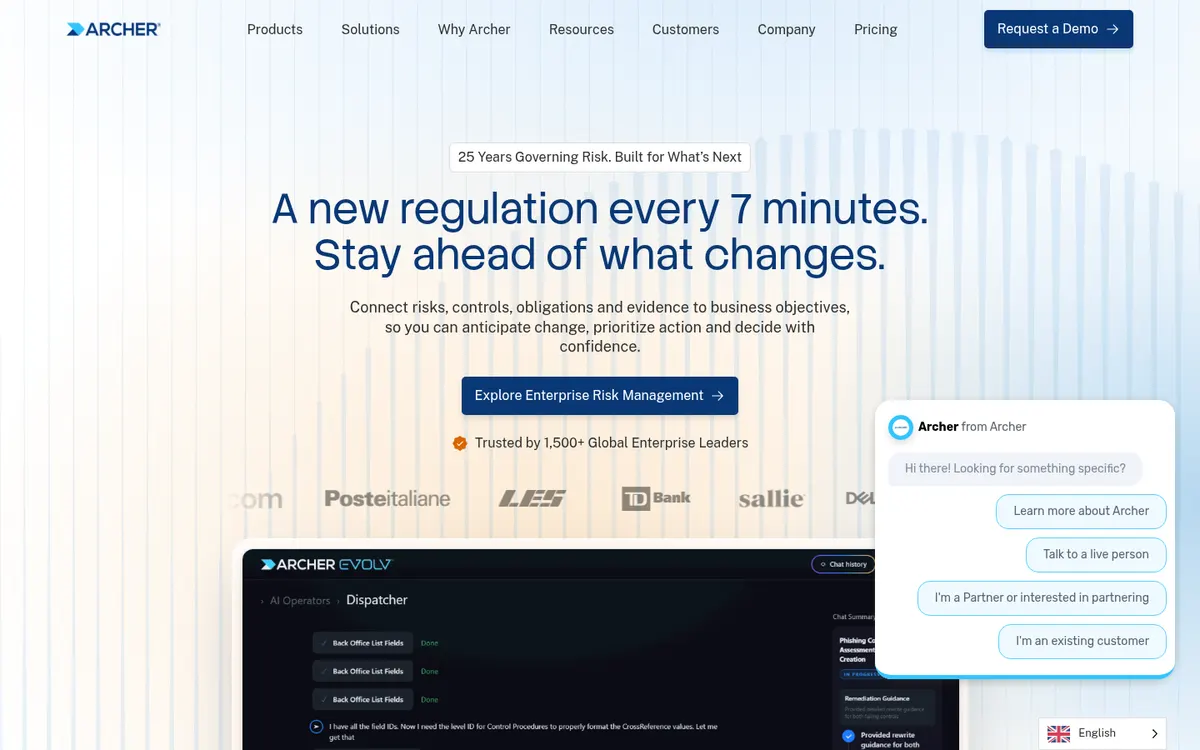
The broadest enterprise risk suite here, and the hardest to buy: quote-only sales, long builds and specialist staff required.
Archer IRM is the widest risk suite in this list. Operational risk, IT risk, compliance, internal audit, business continuity and third-party risk all live in one product, which means a large risk function can run one register, one control library and one reporting layer instead of stitching four tools together. The product is the former RSA Archer Suite, and that lineage shows in the depth of its control structure and the number of prebuilt objects a team can adopt rather than design. Deployment is the reason many regulated buyers shortlist it. Archer runs in the cloud or on-premise, and on-premise still matters where risk data cannot leave a controlled environment. The trade is effort. Implementations are long, they usually need specialist staff or a partner, and the configuration surface is large enough that a small team will only ever use a fraction of it. Pricing is quote-only, with no public list price, and the sales process is aimed at enterprises. Pricing is quote-only, with no public list price, so budget for the subscription, the implementation and the ongoing administrator as three separate lines rather than one number. Pick it if you already run a formal risk program with dedicated owners and need audit, continuity and regulatory work in one system. Skip it if you are buying your first risk tool, have nobody to administer it, or need a price on a page before anyone will meet you.
Your risk program already has owners, a control library and a board reporting cycle that needs one system.
You have no administrator to run it or you need a visible starting price before shortlisting.
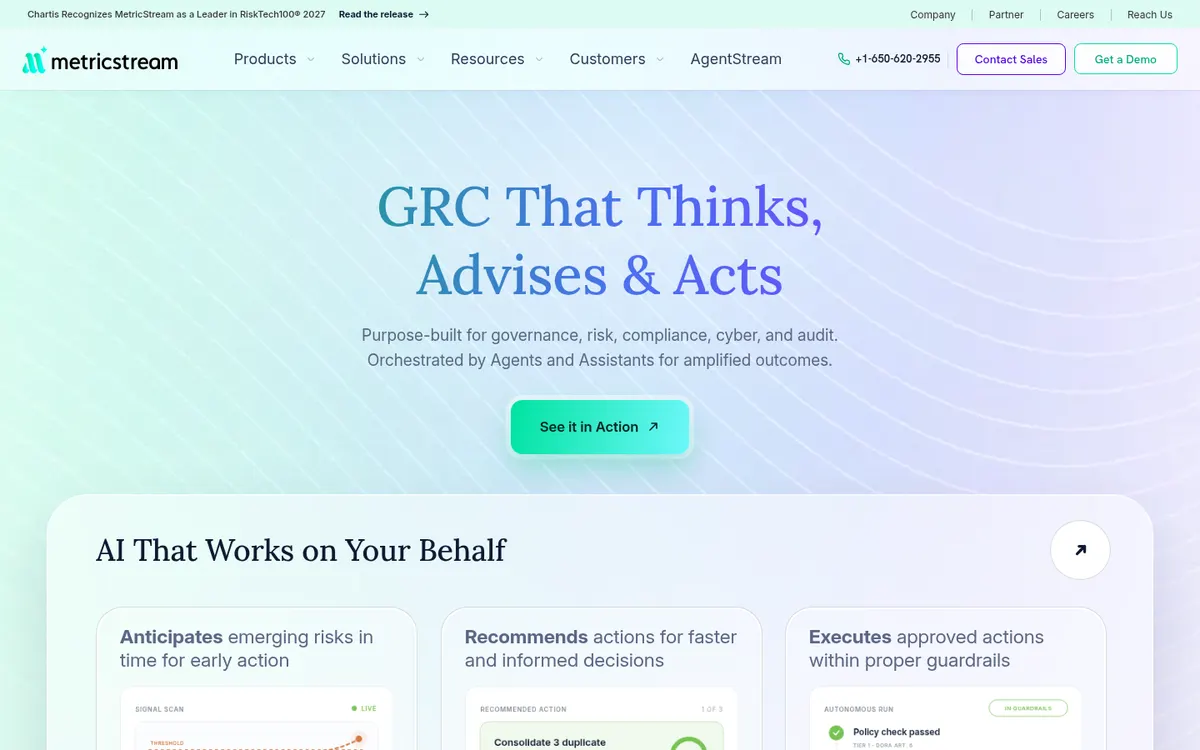
Analytics-heavy enterprise platform built for global banks, with the cost and customization load that scale implies.
MetricStream targets the very largest risk programs and competes with Archer on coverage while leaning harder on analytics. AI-driven risk analytics and predictive risk scoring are built into the platform rather than bolted on, so a risk team can rank exposures and watch trends instead of only recording assessments after the fact. Enterprise-wide risk registers and regulatory mapping across jurisdictions are the objects a large bank or insurer will spend most of its working time inside. The federated data model is the feature that separates it in multi-entity groups. Business units and countries can keep their own structures while group risk sees one picture, which is exactly the problem that breaks spreadsheets and lightweight tools at scale. Depth in banking, energy and healthcare reflects that design, and it is why the product turns up where a regulator expects consistent reporting across many legal entities. The cost and effort are real. It is among the most expensive options in this category, customization usually needs specialist IT or consultants, and ad-hoc reporting is a recurring complaint from buyers who want a quick answer outside the standard dashboards. Expect a long sales cycle on top of a long implementation. Test reporting workflows during evaluation if board-level dashboards matter, and bring a data owner who can commit real time to the model. Pick it for a global, regulated program with a dedicated team and a multi-year horizon. Skip it if you need a working register this quarter.
You run a multi-entity regulated program that needs predictive analytics and cross-jurisdiction regulatory mapping.
Your reporting needs are simple or you cannot fund consultants alongside the subscription.
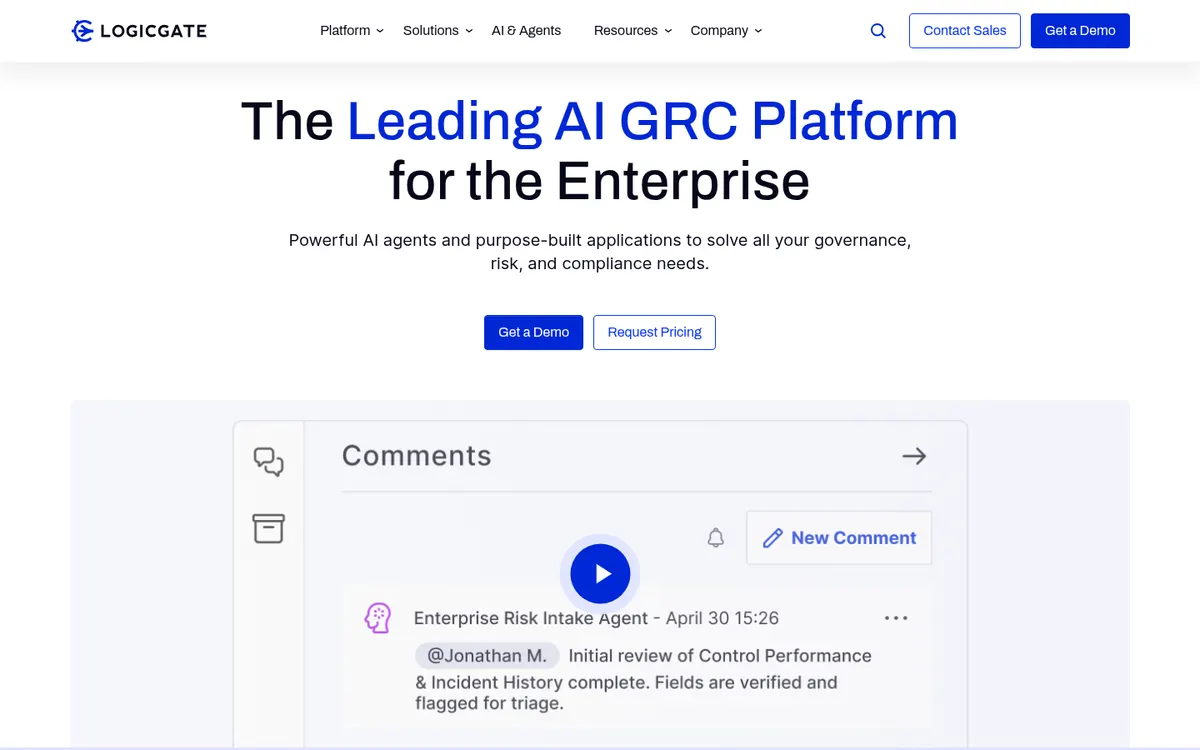
The configurable middle ground: business users build risk and vendor workflows without waiting on IT or a services contract.
LogicGate Risk Cloud sits in the configurable middle of the GRC market. A no-code application and workflow builder lets a compliance or risk lead create fields, forms, stages and approvals without a developer, so the tool bends to the process the business already runs instead of forcing a rebuild around vendor defaults. That sounds like a small thing until you have waited six weeks for a field change. Out of the box it covers risk assessments, compliance tracking, incident management and third-party risk, with configurable reports on top. Because the same platform handles vendor reviews, incidents and control testing, mid-market teams can consolidate two or three spreadsheets and a shared inbox into one place. Time to value is shorter than the enterprise suites in this list, which is the main reason buyers choose it over Archer or MetricStream. There is no published pricing and no self-serve tier, so a sales conversation is unavoidable. Standalone reporting is also limited when you want custom analysis outside the built-in report builder, which means heavy data work still ends up in a spreadsheet or a BI tool. It is a common pick for a team formalizing risk management for the first time, especially one with a compliance owner but no IT project budget. Pick it if business users need to own configuration. Skip it if you need deep quantitative modeling or a published starting price.
A compliance or risk lead should own configuration and you want live workflows in weeks rather than quarters.
You need quantitative risk modeling or you will not start without a public price.
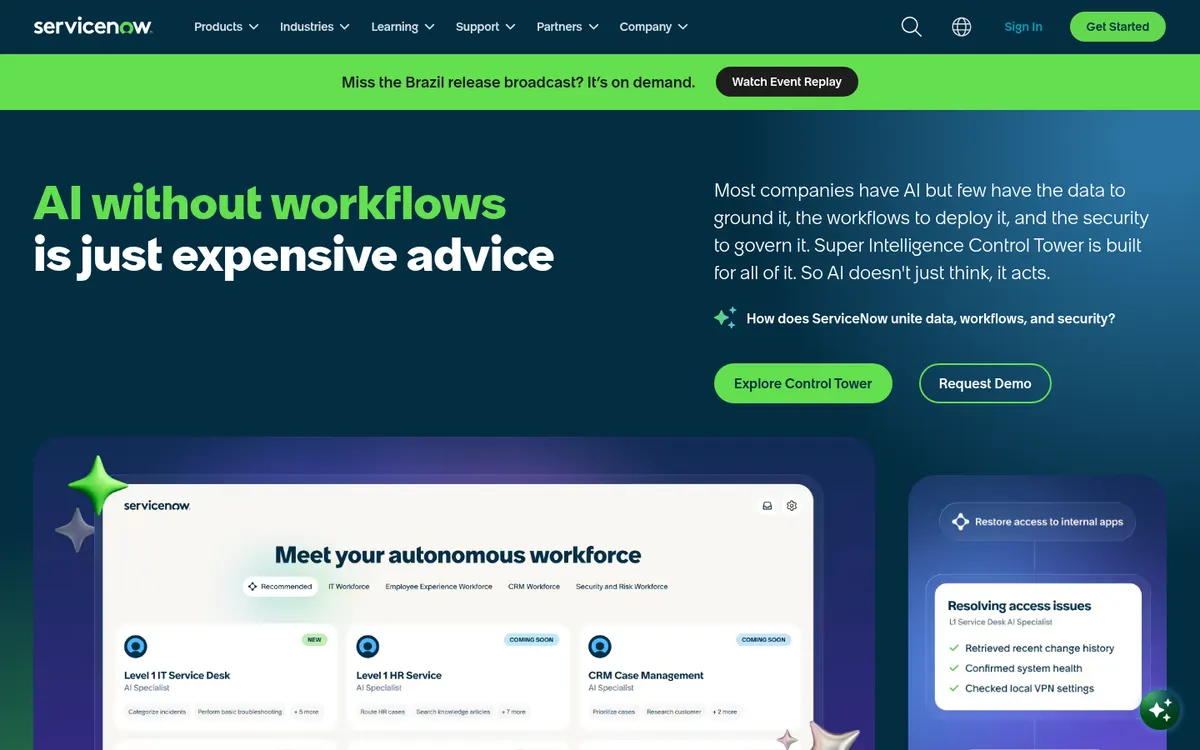
Excellent inside a ServiceNow estate and hard to justify outside one, with custom quotes that scale by module and user.
ServiceNow IRM answers a narrow question well: should risk management live on the platform the rest of the company already runs? Its integrated risk workflows, IT risk management and digital operational resilience capabilities reuse the same data, approvals and reporting that IT, security and operations teams already work in, and the large integration catalog absorbs connector work that would otherwise be a project in itself. That native fit is the product's whole case. Shared data means an issue found in security, or an outage recorded in operations, can feed a risk register without a nightly export, and it avoids duplicate ownership between teams that already argue about who owns which control. IT risk and operational resilience are the strongest areas. Broader enterprise risk work is possible but less differentiated against the specialist suites above. Pricing is a custom quote that varies by modules and users. Because it sits on top of an existing platform contract, the honest comparison is the incremental module cost plus the internal effort to configure it, not a standalone price against Archer or MetricStream. Pick it if ServiceNow is already the system of record for IT or operations and you want risk data in the same place. Skip it if it is not. Standing up the platform purely to get risk management is an expensive route to a register.
ServiceNow already runs your IT and operations workflows and risk should share the same data model.
You would be buying the platform only to get risk management.
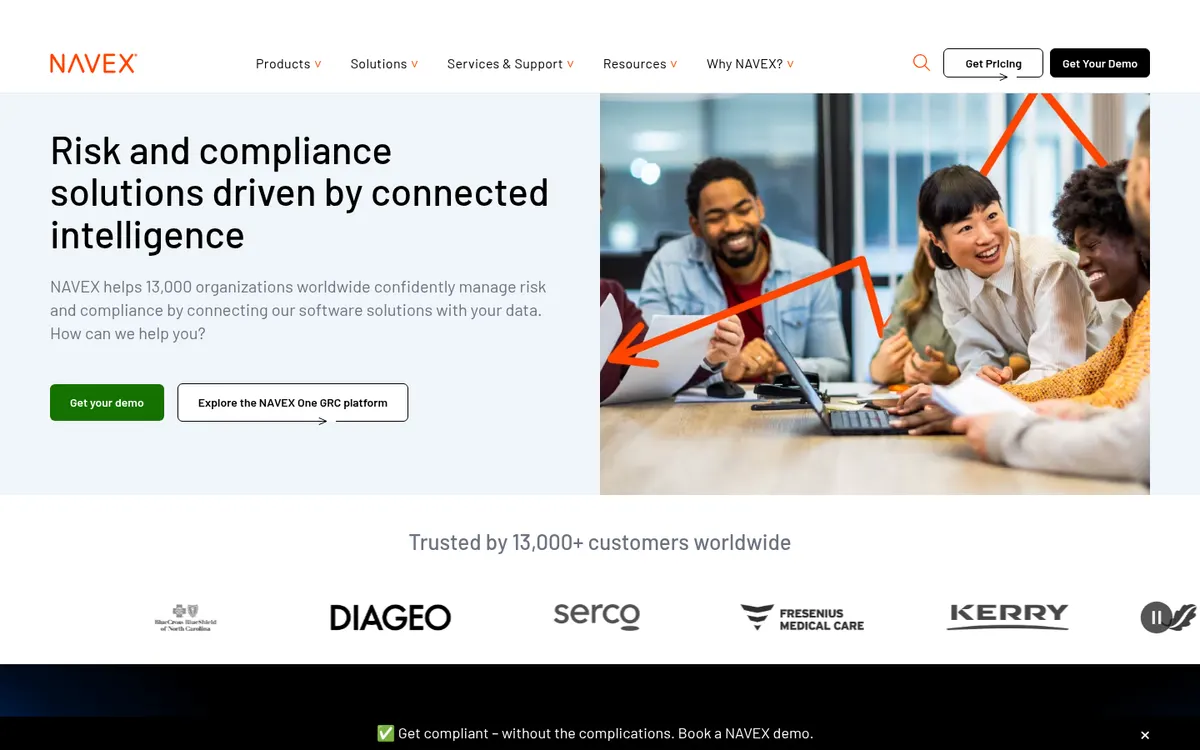
Ethics and compliance first, risk second: strong hotline and policy tools, thinner quantitative risk modeling than the suites above.
NAVEX One comes from ethics and compliance rather than from enterprise risk, and that heritage is the product. Whistleblower and ethics hotline reporting, case management, policy management and compliance training are the core, and they are mature. For a compliance officer that means familiar workflows and a suite that already holds the documents, attestations and case history a board committee asks about at every meeting. Risk management is one module in that wider suite, sitting alongside third-party risk and regulatory compliance tracking. It supports risk management as one module alongside third-party risk and regulatory compliance tracking, which fits a program anchored in policy and conduct. It does not attempt the quantitative risk modeling or deep IT risk structure that Archer and MetricStream build their products around. Pricing is quote-based through an enterprise sales process, with no public tiers. Budget for the compliance core plus the modules you add, and expect the commercial conversation to be framed around the whole suite rather than risk alone, which makes a like-for-like comparison with a pure risk platform harder than it first appears. Pick it if your board's priority is ethics, policy and conduct and risk is a supporting workstream. Skip it if risk analytics is the reason for the purchase.
Ethics, policy and training sit at the center of your program and you want risk evidence in the same suite.
Quantitative risk modeling or board-level risk analytics is the main requirement.
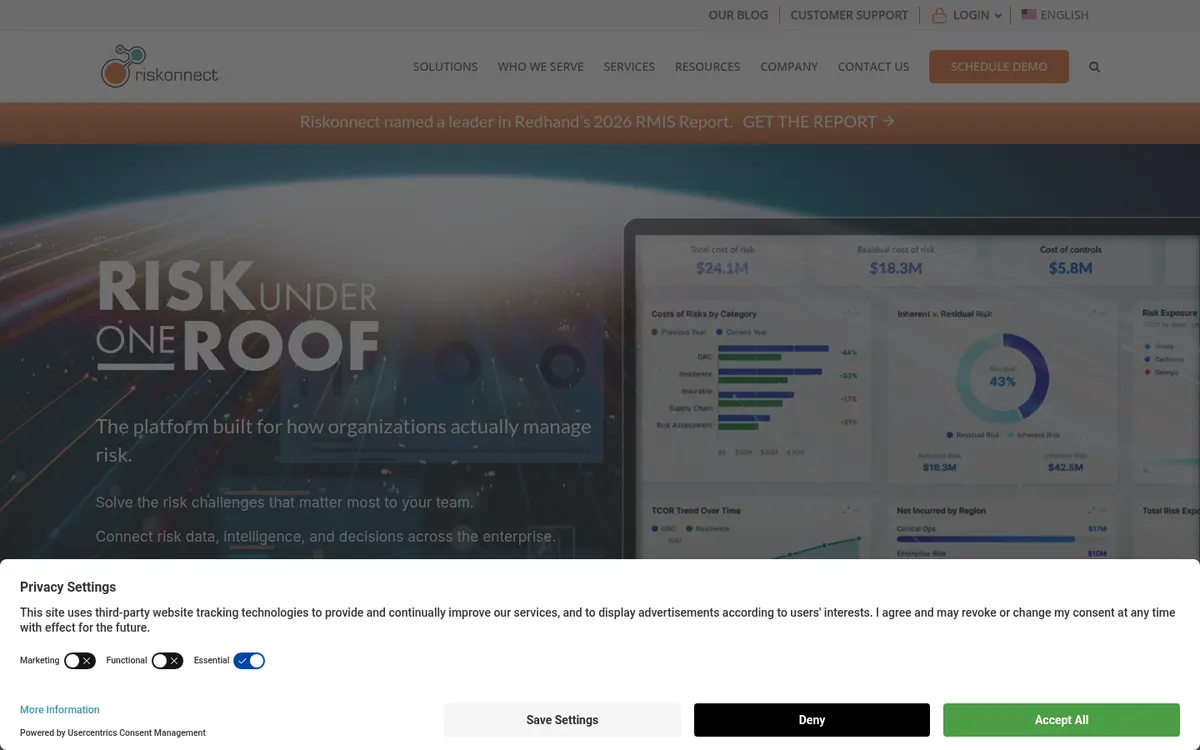
Best where claims, incidents and continuity overlap, and a tier below Archer and MetricStream in market presence.
Riskonnect connects things that usually live apart: enterprise risk management, business continuity planning, claims administration and third-party risk. For an operationally complex firm, that overlap is the point. An incident can become a claim, feed a continuity lesson and update a risk rating without three teams reconciling three systems at quarter end, and the audit trail stays in one place. Configuration is possible without a heavy development team, which keeps total cost of ownership below the largest suites while still supporting real structure: shared data across risk, claims and resilience, plus the workflow discipline a board expects. It fits insurance-adjacent and operationally complex firms where claims, incidents and resilience planning are handled by people who already talk to each other weekly. Pricing is quote-based with no public list price. Market presence sits a tier below Archer and MetricStream, which is not a quality judgment but a practical one: fewer public references means more reference calls you have to arrange yourself, and sales conversations that can be more flexible on terms because the vendor is competing harder for the shortlist slot. Pick it if your risk, claims and continuity work overlap and reconciling them costs more than the software. Skip it if you need the deepest regulatory mapping for a global bank, or a published price before you will take a call.
Claims, incidents and continuity planning overlap in your business and reconciliation across tools is the real cost.
You need global-bank regulatory depth or a published entry price.
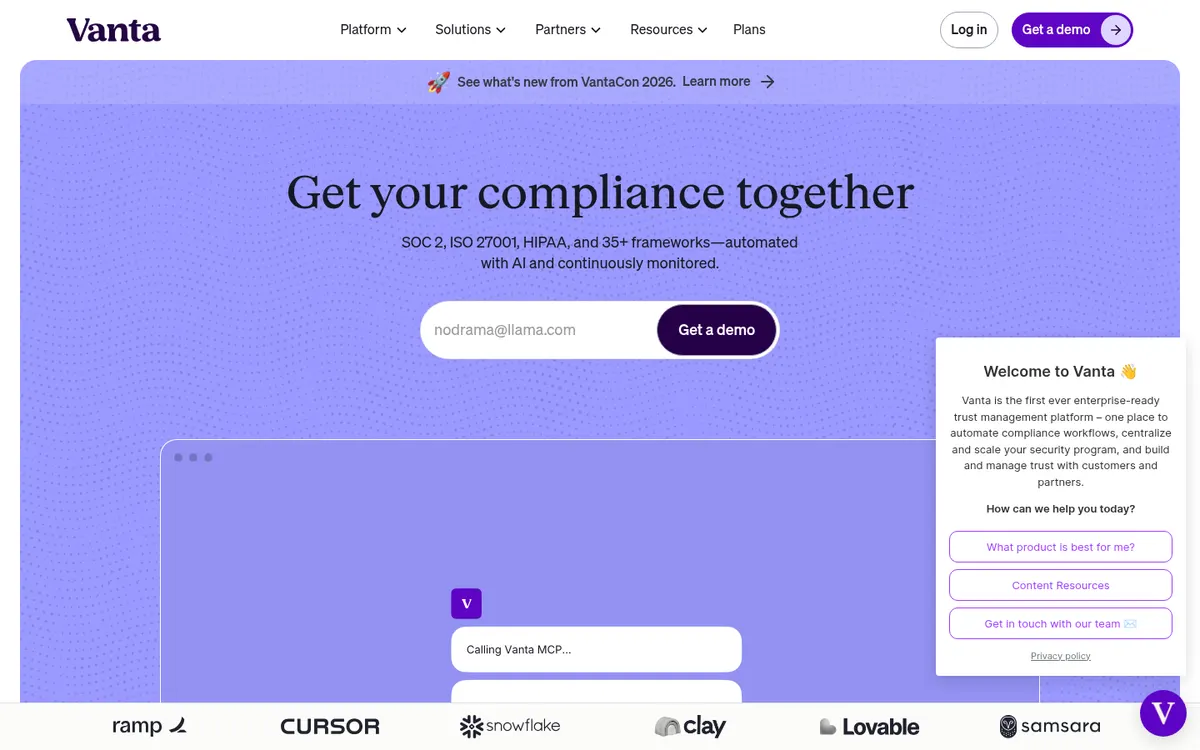
The fastest route to a first SOC 2 report, if you accept quote-based pricing and reported renewal jumps.
Vanta is compliance automation, and it is very good at the first job most startups need: reaching a SOC 2 report without a consultant rebuilding everything from scratch. Automated evidence collection and continuous control monitoring keep tests running between audits, while auditor coordination workflows and an auditor marketplace shorten the path from readiness to a signed report. Framework coverage includes SOC 2, ISO 27001 and HIPAA, backed by a large integration library that pulls evidence from cloud and identity providers. The Trust Center page publishes your security posture to prospects, which shortens enterprise security reviews more reliably than most features on this list, and it is often the reason a sales team stops complaining about the compliance budget. Pricing is quote-based. Pricing is quote-based and rises with frameworks and headcount. Ask for renewal terms in writing while you still have leverage at signing, and confirm which frameworks the quoted tier actually includes. The limit is scope. This is a compliance automation product, not an enterprise risk suite. It will not run an enterprise risk register or quantitative risk program. Pick it to get certified fast. Skip it if risk management, not audit evidence, is the problem you are solving.
A SOC 2 or ISO 27001 report is the next milestone and you want the shortest path with the largest auditor network.
You need enterprise risk management or you cannot get a renewal cap in the contract.
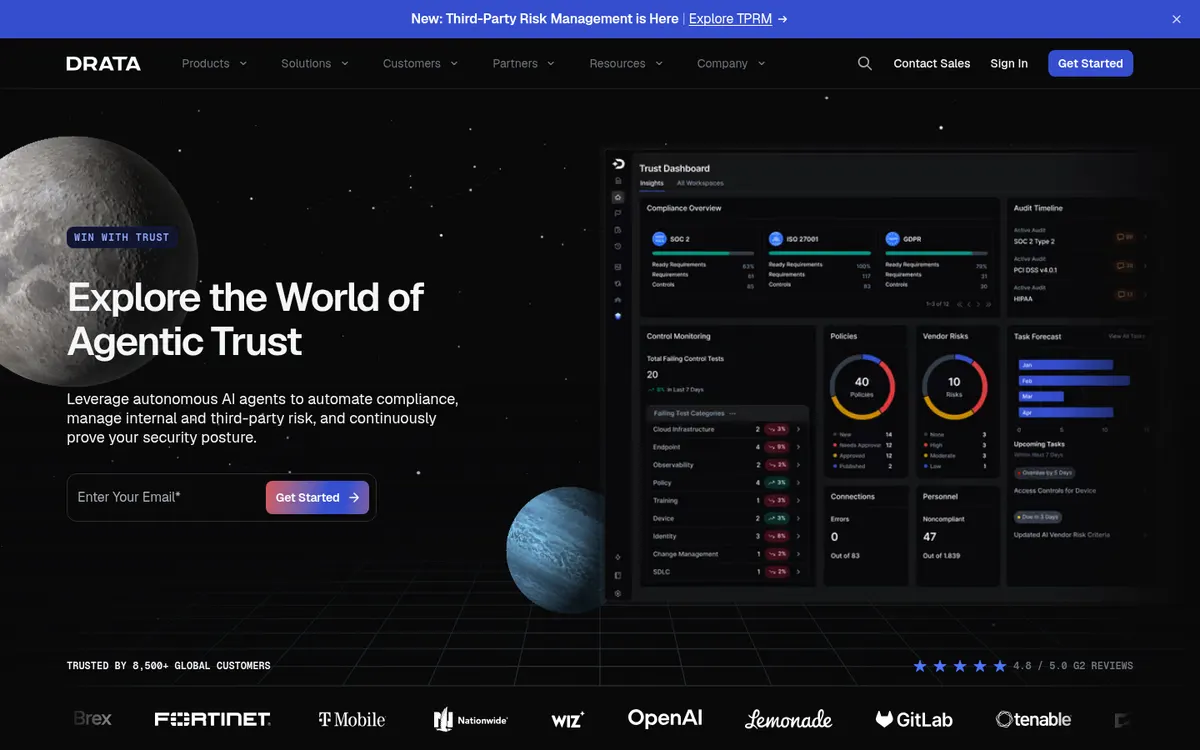
Engineering-led compliance automation with unlimited users and strong value at comparable scope but not a risk suite.
Drata is built for engineering teams that would rather wire compliance into pipelines than manage it in a spreadsheet. Automated evidence collection runs against CI/CD and cloud infrastructure integrations, and the Drata Agent checks endpoint posture, so controls are tested continuously rather than assembled in the week before an audit. For a DevOps-heavy team, that difference decides whether the tool gets used. Unlimited users on every tier is the commercial detail that changes comparisons: no per-seat math, so security, engineering and finance can all have access without a procurement argument. Multi-framework support lets one control set serve SOC 2, ISO 27001 and other frameworks, and AI risk classification was added in late 2025. The Foundation, Advanced and Enterprise tiers are listed with features but no prices. Ask the vendor for a quote for your scope. Ask for the pricing sheet and confirm which frameworks and entity structures are included at each tier, because that is where two quotes for the same product name diverge most. Like Vanta, this is not a full enterprise risk management suite. It is not built for board-level risk reporting across many business units or quantitative modeling. Pick it if DevOps owns compliance and you want unlimited users at comparable scope. Skip it if you need a formal ERM program.
Engineers own compliance and unlimited seats across a multi-framework program matter more than a formal risk register.
You need enterprise risk reporting across business units or scenario modeling.
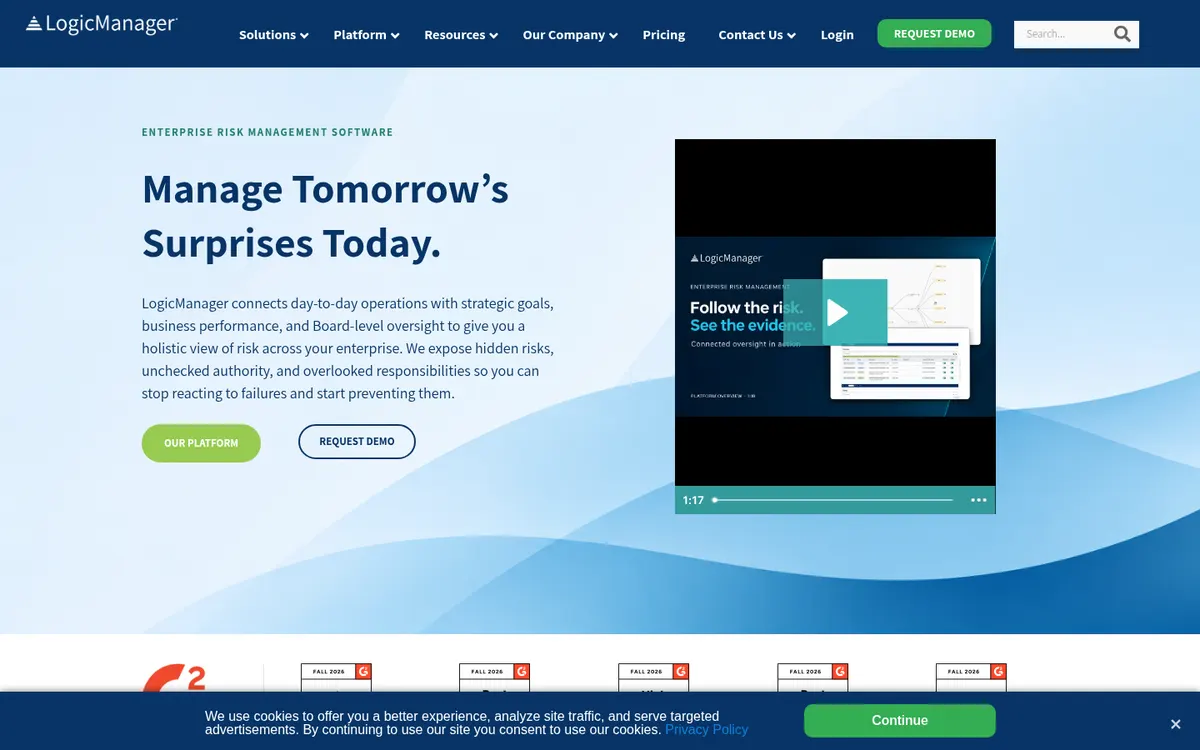
A sensible first risk program for mid-size firms moving off spreadsheets, with advisory help and thinner modeling underneath.
LogicManager is aimed at the teams that most often get stuck: mid-size organizations moving a risk program off spreadsheets for the first time. Structured risk assessments, control libraries, incident tracking and risk reporting give a new risk function the pieces it needs to show auditors and the board that a program exists, has owners and is actually running quarter to quarter.
The differentiator is support. Advisory services help first-time risk teams design the program rather than just configure software, and spreadsheet migration support means last year's register does not have to be rebuilt by hand. For an organization of roughly 200 to 2,000 people, that combination is often more useful than another module nobody has time to implement.
Pricing is quote-based with a mid-market position, which usually means smaller contracts than Archer or MetricStream but still a sales process rather than a checkout page. The trade is depth: quantitative modeling is thinner than the enterprise suites, and the integration catalog is narrower, so heavier data work will still involve exports and a BI tool.
Pick it if you need a working, defensible risk program this year and want help building it. Skip it if you are a global bank with complex modeling needs, or if you already have a mature risk function that needs granular configuration rather than guidance.
You are building a first risk program for a company of a few hundred to a couple of thousand people.
You need advanced quantitative modeling or broad prebuilt integrations.
Risk management software is the system of record for how a company identifies, rates, owns and reports risk. Instead of one spreadsheet per department, it holds a single register with consistent scales, assigns an owner to every risk, links controls and evidence to each entry, and produces the reporting a board or auditor asks for. The category spans a wide range, from a configurable register for a mid-size company to a suite that runs operational risk, IT risk, audit and continuity for a global bank. Enterprise platforms in this list cover several risk types at once. The common ones are operational risk (process failures, people, systems), IT and cyber risk, third-party and vendor risk, compliance and regulatory mapping, internal audit management and business continuity planning. Riskonnect adds claims administration. The point of buying one platform rather than four tools is that a single issue can update a risk rating, a control test and a board dashboard without anyone reconciling exports at month end. There are two families of product here, and buyers confuse them constantly. - GRC platforms (Archer IRM, MetricStream, LogicGate, ServiceNow IRM, Riskonnect, LogicManager, NAVEX One) hold risk registers, controls, assessments, incidents and audit work.
This comparison sits on the Software desk. Readers comparing neighbouring stacks often check our guides to demand forecasting software and glp 1 companies next.
Every vendor here quotes per deal, so the first budgeting task is to accept that a list price does not exist. Enterprise platforms are quoted by scope, which means two companies can pay very different amounts for the same product name. Compliance automation tools are also quoted by scope. The table below maps the models in this list.
| Model | How it bills | Typical fit | Example from this list |
|---|---|---|---|
| Enterprise platform quote | Quote-based, no public list price | Large regulated programs with dedicated staff | Archer IRM, MetricStream |
| Platform add-on quote | Custom quote scaling with modules and users | Companies already on the underlying platform | ServiceNow IRM |
| Configurable or enterprise quote | Quote-based, no public tiers | Mid-market teams or integrated risk programs | LogicGate Risk Cloud, Riskonnect |
| Compliance automation subscription | Annual, quote-based, by frameworks and headcount | Startups and engineering teams | Vanta, Drata |
| Guidance-included subscription | Quote-based with advisory services | First-time risk functions | LogicManager |
Every price above was checked on the vendor's own pricing page on November 25, 2026. Where a vendor does not publish a figure we write "See website" instead of guessing. To compare annual and monthly billing quickly, try the free percentage calculator.
It centralizes the work of finding, rating, tracking and reporting risk so a company can show auditors and the board that risks have owners and controls. Enterprise platforms in this list cover operational risk, IT risk, compliance, internal audit, business continuity and third-party risk, with regulatory mapping on top. Lighter tools cover a subset, usually assessments, controls, incidents and vendor reviews.
Because the price depends on scope sold in the deal: modules, entities, users, frameworks and services. Every vendor on this page is quote-based as of November 25, 2026. That is not automatically bad, but it means you must ask for the pricing sheet, the plan boundaries and the renewal triggers, then compare total first-year cost including services.
Ask what the output is. If the goal is a SOC 2 or ISO 27001 report and passed security reviews, compliance automation such as Vanta or Drata is faster and often more cost-effective. If the goal is a risk register, control testing across business units, third-party risk and board reporting, you need a GRC platform. Plenty of companies end up buying both.
No, not at enterprise scale. Vanta and Drata automate evidence collection, control monitoring and audit coordination. They do not provide multi-entity risk registers or the audit and continuity modules that enterprise suites such as Archer IRM offer. Treat them as a complement, not a substitute.
Compliance automation tools are typically faster to deploy because integrations do the setup. Configurable mid-market platforms take longer and include process design. Enterprise suites have long implementations, often with partner involvement, because the data model and controls are built from scratch.
Budget three lines: subscription, services and internal owner time. Enterprise contracts are quote-based; ask each vendor for a quote. ServiceNow IRM pricing is a custom quote that varies by modules and users. Add implementation services, then a permanent administrator, then ask for renewal caps in writing. Compare three-year cost, not year one.
Browse every comparison on the Software desk, with the same rubric and dated prices.