Ranked #1
NAVEX
Benchmark dataset
See website
- Best for
- Large enterprises wanting whistleblowing inside a full GRC suite
- Free plan
- No
- Rubric
- 8.2 / 10
Eight whistleblowing platforms ranked for November 2026, from enterprise GRC suites that bundle ethics intake to free reporting channels for small nonprofits.
 Prices checked November 25, 2026
NAVEX is the pick for large enterprises that want whistleblowing inside a full GRC suite. Whispli suits mid-size companies that want a modern, trusted speak-up channel, and SpeakUp fits European and multinational firms that need EU directive depth. Pricing for all three sits behind a sales conversation, and the vendor site is the place to start as of November 25, 2026. Below, eight tools are ordered by editorial fit for the buyer each one describes, not by a weighted total.
Benchmark dataset
See website
Two-way anonymity
See website

EU directive depth
See website
Disclosure for this page: All 8 tools here are unpaid editorial picks. The position of a paid listing can be part of what the vendor pays for. How we handle paid listings.
| Tool | Best for | Free plan | Actions | |||
|---|---|---|---|---|---|---|
| 1 | NAVEX | Large enterprises wanting whistleblowing inside a full GRC suite | See website | No | ||
| 2 | Whispli | Mid-size companies wanting a modern, trusted speak-up channel | See website | No | ||
| 3 | SpeakUp | European and multinational firms needing EU directive depth | See website | No | ||
| 4 | Vault Platform | Enterprises focused on misconduct resolution and workplace culture | See website | No | ||
| 5 |  Case IQ | Teams needing hotline intake plus serious incident case management | See website | No | ||
| 6 |  #NotMe | Small organizations and nonprofits needing a fast, low-cost channel | See website | Yes | ||
| 7 |  Elker | Mid-size organizations wanting compliance without GRC suite complexity | See website | No | ||
| 8 |  Whistleblowing Solutions | EU companies, especially in southern Europe, needing directive-focused reporting | See website | No |
Every tool here was scored on the same five criteria: reporting intake, case depth, reporter trust, compliance fit and value clarity. Weights are published in the rubric so you can re-run the math with your own priorities, and each score is a judgment about how the product serves the buyer described in that entry, not a general grade. Pricing came from vendor pricing pages checked on November 25, 2026. Where a page returned nothing usable, the entry says pricing is on the vendor site rather than carrying a number we could not verify. That is why none of the eight entries shows a confirmed starting price. #NotMe's free tier is the exception, and we flag that it was carried over from earlier notes rather than re-confirmed on the day. Feature and strength claims come from vendor material and public product descriptions. We did not run a hands-on trial of every tool, so treat the reviews as a buying map: what each product is built to do, where its edges are, and which buyer it fits. The order of the list is editorial. Each position reflects fit for the buyer that entry describes, plus any Featured placement. A Featured label marks a paid placement; that entry is scored with the same rubric and gets the same honest cons as everyone else. Placement does not move a score. Two things we deliberately did not do: invent a price where none was published, and call a focused intake tool a compliance suite. Small distinctions like that decide whether a rollout works.
The full process, including how we handle corrections, is on the methodology page. Paid listings follow our advertising disclosure.
| Criterion | Weight | What we check |
|---|---|---|
| Reporting intake | 25% | How many channels a reporter can use, how anonymous filing works, and how much configuration the intake forms allow. |
| Case depth | 25% | Whether a report becomes a managed investigation with tasks, evidence, deadlines and a documented outcome. |
| Reporter trust | 20% | Two-way follow-up, tracking for reporters, and the features that make an employee believe speaking up is safe. |
| Compliance fit | 20% | Coverage of EU member state requirements, languages, retention and the reporting a regulator or board will ask for. |
| Value clarity | 10% | How easy it is to understand what you pay, how the product scales in price, and whether cost matches scope. |
Best for large enterprises that want ethics intake, investigations, policy and training governed in one place.
NAVEX places whistleblowing inside a broader governance, risk and compliance platform. A report that arrives through a configured intake channel moves straight into case and investigation workflows, and the same environment holds policy management and compliance training. For a company already running those modules, adding ethics intake is an extension of an existing vendor relationship rather than a new procurement cycle, which is the main reason large groups consolidate here.
Benchmark reporting is the piece focused rivals find hard to match. NAVEX draws on aggregated report volumes from more than 13,000 customers, so a compliance team can compare its case mix and reporting rate against a large pool instead of guessing whether a quiet quarter means a healthy culture or a channel nobody trusts. Intake channels and routing are configurable, which matters when a group wants one global entry point with local handlers behind it.
The trade-off is scope. Enterprise pricing and implementation complexity arrive with the platform, and a 200-person company that only needs an anonymous inbox ends up paying for risk and training tooling it may never switch on. For EU-focused smaller businesses, the company offers WhistleB as a narrower route into compliant reporting, though that is still a sales-led purchase.
Pricing is on the vendor site. No pricing page was captured during our check on November 25, 2026, so treat any budget number as a sales conversation rather than a published rate. Ask about implementation timelines, how the ethics module is priced against the wider suite, and how benchmark data is licensed and refreshed before you sign.
You are a large enterprise that wants ethics reporting governed next to policy, training and risk.
You are a small team that needs an anonymous inbox this month, not a multi-module rollout.
Best for mid-size companies that want a speak-up channel reporters trust enough to keep using.
Whispli builds the product around the reporter rather than the investigator. An employee files a report anonymously, then stays in the conversation through secure two-way messaging, answering follow-up questions without confirming who they are. That one design choice changes how investigations run: instead of a dead-end tip that arrives with no detail, the case team can ask for dates, documents or witnesses and get answers back inside the same thread.
Intake covers web, phone and mobile, so a shift worker without a company laptop has the same route in as someone at head office. Case triage and investigator workflow sit behind the intake, so a report can be assigned, worked and closed with a record of what happened. The trust features are aimed at the reason most channels fail, which is employees believing nothing will come of a report.
The limit is scope. Whispli is an intake and case tool, not a compliance suite. Organizations that also need policy management, training records or risk registers have to pair it with other software, and there is no benchmark product bundled in. Buyers comparing it with NAVEX should be clear that they are buying depth in the reporter experience rather than breadth across compliance.
Pricing is on the vendor site. Our check on November 25, 2026 returned no usable page text, so the starting price stays unconfirmed and a quote is the only route to a number. Ask how pricing scales with headcount, whether phone intake is included or metered, and how long reporter threads are retained and who inside the company can read them.
The reporter experience is the part of your channel that keeps failing.
You need one vendor to cover policy, training and risk as well as intake.
Best for European and multinational employers that need multilingual intake tuned to member state rules.
SpeakUp, sold under the People Intouch name, has been in European compliance reporting since 2004, and that history shows in how the product handles language and local rules. Intake is available in dozens of languages, which is the practical requirement when a directive rollout covers ten countries and each workforce reports in its own tongue. Case handling is tuned to EU legal requirements rather than retrofitted from a US hotline model, and multi-country rollouts are the design center rather than an afterthought.
The product covers anonymous employee reporting, configurable intake forms and routing, plus reporting and analytics on case volumes. For a multinational running one policy across several member states, that combination means a single program with local handlers behind it instead of a patchwork of country tools managed by different departments.
Two things hold it back. Recognition outside Europe is limited, so a company with large US or Asia operations may find fewer local references and less coverage of non-EU regimes. The interface also feels dated in parts, which matters more than it used to, because reporters now compare an internal channel against consumer apps and judge it in seconds.
Pricing is on the vendor site. No page text was available to verify a starting price during our November 25, 2026 check, so budget planning starts with a quote. Ask how pricing changes as you add languages and countries, what implementation support is included for a multi-country launch, and whether analytics exports feed the HR and board reporting you already run.
Your reporting channel has to work in ten languages across EU member states.
Most of your workforce sits outside Europe and needs non-EU regime coverage.
Best for enterprises that treat misconduct as a culture problem running from first report to resolution.
Vault Platform frames whistleblowing as misconduct resolution rather than a compliance checkbox. A concern is recorded through the web app or the reporter-facing mobile app, then carried through investigation steps to a documented resolution. The case record and audit trail are the point: the product is built so an organization can show what it did after a report landed, not just that it received one. Coverage leans toward workplace misconduct, including harassment cases, which are the categories that most often go wrong when a hotline tool with no investigation layer is expected to cope. Program reporting on speak-up activity sits on top, so a People or Ethics team can see volumes, categories and outcomes across the business without rebuilding the numbers in a spreadsheet. The fit is large enterprises with a real investigations function. Premium positioning and custom-only pricing mean there is no self-serve path and no published rate, and mid-market buyers often find the commercial model out of reach. The vendor is also newer than the established rivals on this list, so a shorter track record is part of the evaluation, particularly if procurement asks for long-run references in your sector. Pricing is on the vendor site. No page was captured during our November 25, 2026 check, so no rate could be verified. Ask for a scoped quote covering seats, case volume and the mobile app, and ask how the audit trail exports if a regulator or an employment tribunal requests the file.
You have an investigations team and need the resolution trail, not just the inbox.
You need a published price and a self-serve start this quarter.
Best for teams needing a 24/7 multilingual hotline plus real case management across mixed incident types.
Case IQ approaches whistleblowing from the case side. A hotline with 24/7 multilingual support feeds reports in, and web, email and form intake sit alongside it, but the weight of the product is on what happens next: investigation workflow, task assignment and analytics on incident trends. Teams that already run HR, fraud and ethics cases in one place recognize the shape of it quickly.
That breadth is the appeal. A compliance officer handling a harassment complaint, a procurement fraud allegation and a safety concern in the same week does not want three systems, and Case IQ keeps them under one case management model with configurable forms and routing rules. Trend reporting across categories is where the value compounds, because patterns are hard to see when each case type sits in its own tool.
The trade-off is specialization. Whistleblowing is one workload among several, so a buyer who wants a channel built entirely around anonymous reporter dialogue and EU directive language will find less depth there than in a focused vendor. Pricing is quote-based only, which also means a scoping call before you learn anything about cost.
Pricing is on the vendor site. The page was empty during our November 25, 2026 check, so the starting price remains unverified. Ask how the hotline is charged, whether it is bundled or metered by report, which languages are covered at which tier, and how rising intake volume affects the annual contract at renewal.
Your ethics team handles many case types and wants one workflow for all of them.
Whistleblowing is your only workload and you want a channel built around reporters.
Best for small organizations and nonprofits that need an anonymous channel working this week at no cost.
#NotMe is the low-barrier entry point on this list. Reports come in anonymously through the web and mobile apps, reporters can track what happens to a submission, and basic case handling lets a small team work through what arrives. Setup is simple enough that an organization without a compliance department can stand up a channel quickly rather than waiting on an IT project.
That is the honest use case. A nonprofit, a school, a 60-person company or a sports club that has to offer a reporting route can start on the free tier, then decide whether it needs more. The mobile apps matter for workforces that are not desk-based, and reporter tracking is a real trust feature rather than a checkbox on a comparison sheet.
The ceiling arrives fast. Investigation workflow and analytics are lighter than in the paid platforms here, so a case that needs structured evidence handling, task assignment across departments or trend reporting will feel constrained. The vendor is also smaller than the enterprise players, which means less compliance depth, fewer integration options and a shorter track record to examine. For organizations with a legal obligation and auditors watching, that gap is the whole decision.
Pricing is on the vendor site. Our November 25, 2026 check returned no page text, so the free tier is carried over from earlier notes rather than confirmed today. Verify what the free tier includes, what paid tiers add, and where data is hosted before you rely on it for reporting that a regulator may inspect.
You need a working anonymous channel now and have little or no budget.
You face a legal reporting duty, audits, or complex multi-department cases.
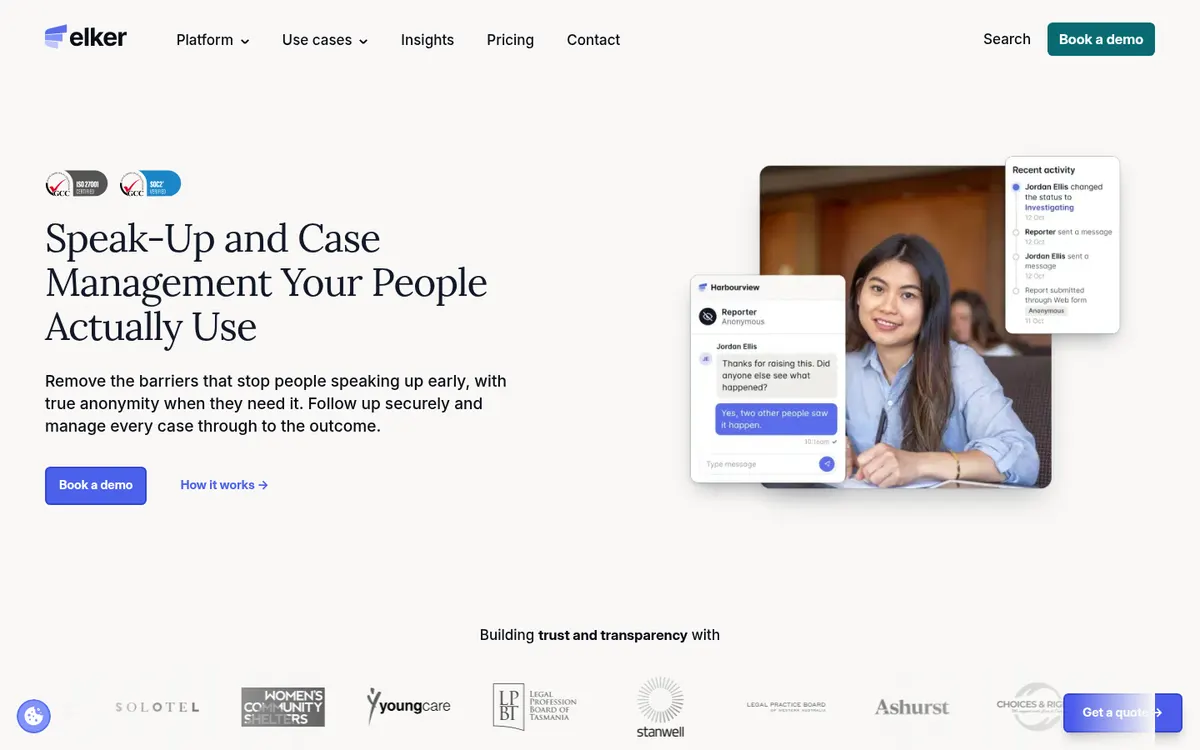
Best for mid-size organizations that want reporting, routing and analytics without a full GRC rollout.
Elker keeps the scope narrow on purpose: a secure reporting channel, automated routing of reports to the right handlers, compliance workflows and analytics dashboards, without the policy and risk modules that make a GRC suite heavy. For a mid-size organization that has to run a channel and show it works, that is often exactly the right amount of product. The operational details are the interesting part. Routing rules send a report to the correct handler automatically, which removes the manual triage step where small teams usually drop the ball. Dashboards give a compliance lead something to show a board or works council, and integrations with Microsoft 365 and Okta mean rollout rides on identity and productivity tools the company already runs instead of a separate login nobody remembers. The constraints are the mirror image. Elker is a smaller vendor with limited market presence, so fewer peers can vouch for it and procurement due diligence takes longer. Benchmark data and advanced analytics are thinner than on the large platforms, which matters if you want to compare your reporting rate against an industry pool rather than just track your own trend. Pricing is on the vendor site. No page content was captured to confirm a rate during our November 25, 2026 check, so the number has to come from a quote. The vendor offers tiers scaled to organization size, so ask which tier a company of your headcount lands in and what changes at the next one up.
You want focused reporting and routing that plugs into the tools you already run.
You need benchmark comparisons or a vendor with a long enterprise reference list.
Best for EU companies, especially in southern Europe, that want directive-ready intake and routing.
Whistleblowing Solutions is built around the EU directive rather than adapted to it. Intake is compliant with the directive's requirements, reports route automatically to the right handler, multi-language support covers cross-border workforces, and reporters can hold a real-time chat with the person handling their case. Case workflow and analytics sit underneath, so the channel is not a mailbox that fills up.
The geography explains the design. The vendor is rooted in Italy and strongest in southern Europe, where local language support and familiarity with national transposition rules carry real weight. A company rolling out in Italy, Spain or Portugal will find the fit more natural than a US-built hotline product trying to cover member state variation from a distance.
The limit is reach. This is a smaller vendor with a limited global footprint, so a multinational needing consistent coverage across the Americas and Asia will likely need a second tool or a different primary platform. Analytics are adequate rather than deep, and there is no benchmark dataset to compare your reporting rate against an external pool.
Pricing is on the vendor site. The page was empty during our November 25, 2026 check, so no starting price could be verified and a quote is the only path. Ask how the real-time chat is logged and retained, which languages are covered by support staff rather than machine translation, and what happens to case data if you later move platforms.
Your rollout is concentrated in the EU and local language handling matters.
You need one platform covering the Americas and Asia at the same depth.
Whistleblowing software gives employees a route to report misconduct, and gives the organization a way to receive, route, investigate and document what comes in. The channel is only half of it; the case record is the other half. A report that arrives and then disappears is worse than no channel at all, because it teaches the workforce that speaking up is pointless.
Case types are broader than the name suggests. Typical intake covers:
The tool does not decide whether a concern is valid. It captures the report, acknowledges it, and moves it to a handler with a deadline attached, so the organization can show what was done and when.
Anonymity is where product design differs most. Basic tools accept an anonymous report and stop there. Better ones give the reporter a private code or login so they can return, read a reply and answer follow-up questions without ever naming themselves. Two-way follow-up is what turns a vague tip into an investigation with evidence behind it, and it is the single feature most often missing when a program stalls.
Legal obligation drives most purchases. In the EU, the 2019 whistleblowing directive has been transposed into national law, and which employers must run internal channels, and at what size threshold, varies by member state, so check your own jurisdiction rather than assuming. In the US, listed companies have long been expected to run complaint procedures and anonymous channels, and sector rules add more on top. Smaller organizations often buy voluntarily to protect culture and cut legal risk.
Two product shapes dominate. A focused tool does intake and case work well and connects to other systems. A GRC platform bundles reporting with policy management, training and risk registers, which suits enterprises that want one vendor and one audit trail. The focused tool deploys faster; the suite reduces the number of vendors a compliance team has to police.
Rollout questions matter as much as features. Decide who administers the channel (Legal, HR, Compliance or a shared triage group), whether reports can be filed in every language your workforce speaks, and how case data flows into HR systems, ticketing tools and document stores.
This comparison sits on the Software desk. Readers comparing neighbouring stacks often check our guides to demand forecasting software and glp 1 companies next.
Almost nothing in this category has a published price. Of the eight tools here, none showed a starting price we could confirm on November 25, 2026, and #NotMe is the only one with a free tier. That is not an accident of the market. Whistleblowing contracts are priced on headcount, number of countries, languages, case volume, hotline minutes and add-on modules, so vendors scope the account before they quote. The practical result is that budget comparison happens after three or four sales calls, not before. Expect questions about employee count, the jurisdictions you operate in, whether you need telephony intake staffed by live agents, and whether the buyer wants a standalone channel or a suite.
| Model | How it bills | Typical fit | Example from this list |
|---|---|---|---|
| Enterprise platform quote | Quote-based, scoped to the modules you buy | Large enterprises consolidating compliance | NAVEX |
| Speak-up subscription | Quote-based, priced through a sales conversation | Mid-size companies running one global channel | Whispli |
| Regional compliance subscription | Quote-based, priced through a sales conversation | European and multinational employers | SpeakUp |
| Case management quote | Scoped quote, with pricing on the vendor site | Teams handling mixed incident types | Case IQ, Vault Platform |
| Free tier | No cost to start, with any paid options listed on the vendor site | Small organizations and nonprofits | #NotMe |
Every price above was checked on the vendor's own pricing page on November 25, 2026. Where a vendor does not publish a figure we write "See website" instead of guessing. To compare annual and monthly billing quickly, try the free percentage calculator.
It captures reports of misconduct, routes them to the right handler, and tracks the investigation to a documented outcome. Typical cases include fraud, harassment and discrimination, safety and environmental breaches, conflicts of interest, theft and retaliation. The tool does not judge whether a concern is valid; it makes sure the report is acknowledged, assigned and worked within a deadline, with a record you can show an auditor.
It depends on jurisdiction and headcount. In the EU, the 2019 whistleblowing directive was transposed into national law, and the employee threshold for mandatory internal channels varies by member state, so check your own country rules rather than assuming a single European number. In the US, listed companies have long been expected to run complaint procedures. Sector regulation adds further duties. Many smaller organizations run a channel voluntarily.
The reporter files without giving a name and receives a private code or login. They return to that thread to read replies and answer investigator questions, still unnamed. Investigators see the messages, not the identity. Tools such as Whispli and Whistleblowing Solutions build much of the product around this, because a tip that cannot be questioned usually produces a case that cannot be proven.
A GRC platform puts reporting next to policy management, training and risk registers, so one vendor and one audit trail cover more of the compliance program. That suits large enterprises. A focused tool does intake and case work with more depth on the reporter experience and deploys faster. The trade-off is integration work: you will connect the focused tool to whatever handles policy and training.
Show visible outcomes. Report back on themes and fixes without naming anyone, keep anonymity genuinely untraceable, reply to anonymous threads quickly, and make sure the channel is not run by the same manager people are complaining about. Training managers to point to it helps. Trust is built from the first three cases being handled well, not from a launch email.
Track reports per 1,000 employees, intake channel mix, time to acknowledge, time to close, substantiation rate, case category mix and repeat reporters. Compare trends quarter to quarter rather than chasing an industry average. Administration usually sits with Legal, Compliance or a dedicated Ethics office, with HR handling employment cases; whoever owns it needs protected time to work the queue, not just a license.
Browse every comparison on the Software desk, with the same rubric and dated prices.