Ranked #1

Anaplan
Connected cross-functional models
See website
- Best for
- Enterprise connected planning across demand, finance and supply
- Free plan
- No
- Rubric
- 7.3 / 10
Nine demand planning platforms ranked by forecasting depth, implementation weight and fit, from enterprise connected planning suites to cloud tools a small distributor can run in weeks.
 Prices checked November 25, 2026

Anaplan, o9 Solutions and Kinaxis lead this list as of November 2026, each for a different buyer. Anaplan suits large consumer goods and retail teams that need demand tied to finance and supply in one model. o9 Solutions fits global networks where forecast accuracy is a board metric and machine learning forecasting matters. Kinaxis wins when the plan must recalculate instantly across demand, supply and inventory. The other six entries cover mid-market manufacturers, distributors and small teams that need forecasting without an enterprise program.
Connected cross-functional models
See website

ML forecasting engine
See website
In-memory replanning
See website
Disclosure for this page: All 9 tools here are unpaid editorial picks. The position of a paid listing can be part of what the vendor pays for. How we handle paid listings.
| Tool | Best for | Free plan | Actions | |||
|---|---|---|---|---|---|---|
| 1 | Anaplan | Enterprise connected planning across demand, finance and supply | See website | No | ||
| 2 | o9 Solutions | AI-driven integrated business planning for global networks | See website | No | ||
| 3 | Kinaxis | Concurrent supply chain planning with instant recalculation | See website | No | ||
| 4 |  Blue Yonder | Large-scale demand and supply planning plus execution | See website | No | ||
| 5 |  John Galt | Mid-market demand and inventory planning without enterprise overhead | See website | No | ||
| 6 |  ToolsGroup | Probabilistic forecasting for long-tail and intermittent demand | See website | No | ||
| 7 |  Logility | Demand and supply planning for manufacturers | See website | No | ||
| 8 |  Netstock | Inventory-focused demand planning for small and mid-size businesses | See website | No | ||
| 9 |  EazyStock | Cloud demand planning for distributors and wholesalers | See website | No |
We scored nine demand planning tools against five criteria, then ordered the list by fit for the buyer each entry describes. Price data was checked on 2026-11-25 by reading each vendor's own pricing page. Where a page could not be fetched or returned no usable text, we say so in the review and do not publish a number. Every vendor here shows price on request, so no figure in this list is inferred or converted from another currency.
Forecasting depth carries the most weight at 30 percent, because forecast quality is the product. Planning breadth follows at 25 percent for whether demand connects to inventory, supply and S&OP. Implementation fit and integration reach take 20 and 15 percent, since a model nobody can deploy or feed is worthless. Usability and value closes at 10 percent.
This edition carries no Featured placement. When a vendor does appear as Featured, that position is paid, and the tool is scored with the same five criteria and carries the same kind of cons as every other entry. Placement does not change a score.
We did not test the software hands-on for this edition. Scores come from documented capability, published scope, stated implementation approach and the pricing information each vendor makes available. Ranges in the reviews come from the vendors' own material. Your SKU count, ERP and data quality will move the outcome more than any score here, so use the list to build a shortlist of two or three and run them against your own history.
The full process, including how we handle corrections, is on the methodology page. Paid listings follow our advertising disclosure.
| Criterion | Weight | What we check |
|---|---|---|
| Forecasting depth | 30% | How well the tool models statistical, machine learning, intermittent and promotional demand. |
| Planning breadth | 25% | Whether demand connects to inventory, supply, S&OP and financial planning in one place. |
| Implementation fit | 20% | Time, services and internal skill needed before the tool produces a plan you trust. |
| Integration reach | 15% | Connectors and data preparation demands for pulling ERP, order and item master data. |
| Usability and value | 10% | Interface clarity, learning curve and how much capability you get for the spend. |
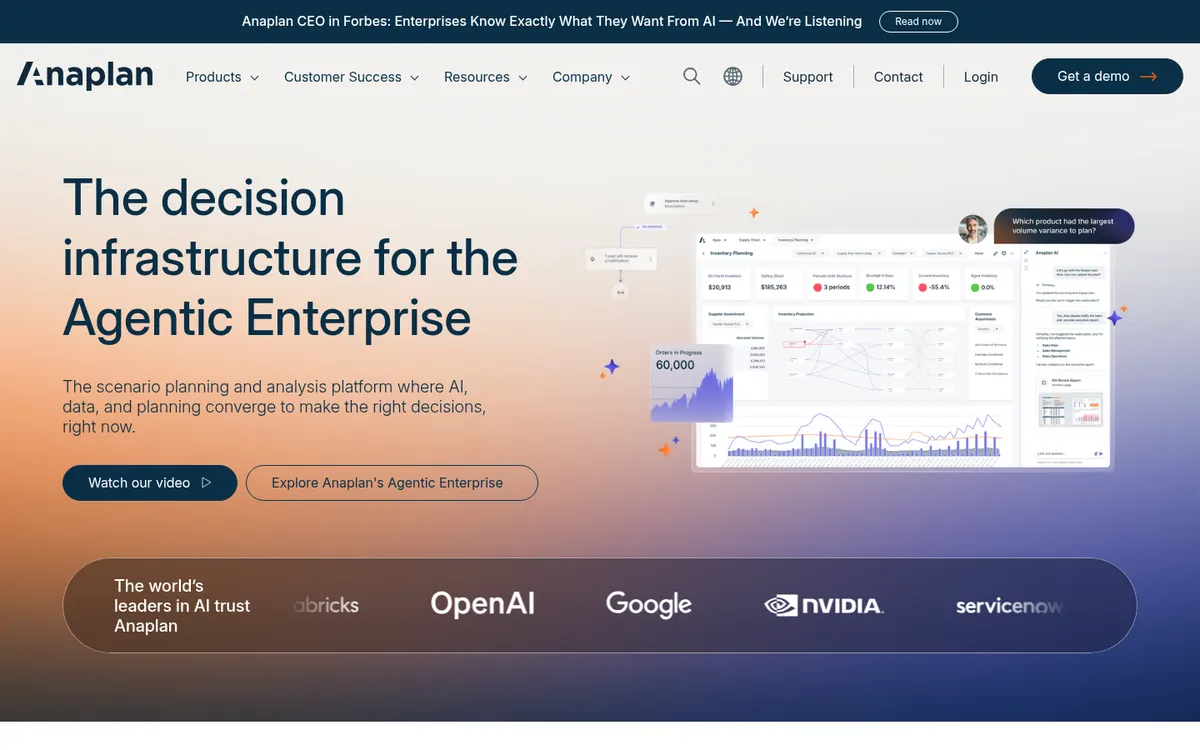
The strongest choice when demand planning must sit in the same model as finance and supply, and you can staff it.
Anaplan is a connected planning platform, not a forecasting module bolted onto an ERP. Demand, finance and supply models sit on one data model, so a change in the demand plan flows into revenue, capacity and budget views. Real-time what-if scenario modeling lets planners test a promotion, a lost account or a supplier failure without rebuilding the model, and the app marketplace supplies prebuilt planning models for common industry patterns. Collaborative multi-user planning and forecast-to-budget linkage are the reasons finance teams stay in the same tool as supply. The strengths are structural. Few planning tools tie demand to finance and supply this tightly, and large planning teams get scenario modeling built for long review cycles. The cost is commitment. Enterprise-level licensing, an implementation typically measured in months, and a need for trained model builders or consulting partners all point to an organization that already has a planning function with a budget line. Where it strains is skills. Anaplan expects a model builder who understands dimensional planning, and most deployments lean on a partner for the first build. Teams that want a forecasting tool an inventory manager can run alone should look further down this list. Pricing is on the vendor site and was not confirmable on the check date, so treat any figure you hear as quote-based. Anaplan is listed here for large consumer goods and retail organizations with dedicated planning staff. A mid-size company with a small planning team will pay for capability it cannot staff. Compare license plus partner days against a fixed-scope mid-market deployment before you commit.
Demand planning must report into finance and supply from the same model and you have model builders on staff.
Your planning team is two people and you need a forecast running this quarter.

The deepest forecasting engine on this list, built for global networks where one demand shift has to be traced across tiers.
o9 Solutions is an integrated business planning platform built around a forecasting engine that mixes statistical models with machine learning. It incorporates external demand signals, then models the supply network as a graph rather than a set of disconnected tables. That matters when a node three tiers away changes. Promotion and seasonality handling, multi-tier distribution planning and forecast accuracy analysis all sit in the same model, alongside supply, inventory and commercial planning. The forecasting depth and graph modeling are the reasons very large global enterprises pick it. Fewer tools handle a network where a single demand shift has to be traced through contract manufacturers, distribution centers and commercial commitments. Accuracy work also has a home: scenario and forecast accuracy analysis means the model gets reviewed rather than rebuilt. The trade-offs are cycle time and cost. Deals typically involve a multi-month evaluation and implementation with services support, and the platform is generally too heavy for a company under roughly $100M in revenue. Small teams also underestimate the internal analyst time needed to keep external signals and hierarchy mappings current after go-live. Pricing is on the vendor site and we could not confirm a figure on the check date. Budget for services as well as license, because the value depends on how well the network model is built. o9 is the pick for a complex global network where forecast accuracy is a board-level metric. If your planning meeting covers one warehouse and forty SKUs, the program overhead will outweigh the forecast gains.
You run a multi-tier global network and forecast accuracy is reported to the board.
A multi-month evaluation and services engagement would outlast your budget cycle.
Built for speed: the concurrent in-memory engine replans demand, supply and inventory the moment an assumption changes.
Kinaxis is built around one idea: replanning should not wait. Its in-memory planning engine recalculates the concurrent plan across demand, supply and inventory the moment an assumption changes, so a planner sees the impact of a demand spike or a late shipment without waiting overnight. Scenario comparison sits on top of that, and disruption and demand spike analysis is a working part of the flow rather than a report you build yourself.
The speed shows in the industries that buy it: electronics, automotive and pharmaceutical supply chains, where component shortages and demand swings arrive together. Scenario comparison is the feature teams cite when they explain why sequential planning in spreadsheets stopped working, and instant demand, supply and inventory impact views are what make a weekly planning meeting practical.
The limits are operational. Pricing and licensing are complex and not published, the learning curve is steep for a small team, and the implementation plus training budget needs to be taken seriously before signature. Companies that plan monthly and rarely re-forecast pay for latency reduction they will not use. Customization requests also tend to pull in the vendor's services team.
Kinaxis is sold mainly as an annual subscription scoped to planning coverage. Pricing is on the vendor site and could not be verified on the check date, so plan on a scoped quote. It fits manufacturers and brand owners with volatile supply and a planning team that meets more than once a week.
Supply breaks often and your team needs to see the impact across the whole plan before the meeting ends.
You replan once a month and cannot fund a serious training program.
A suite that spans forecasting through warehouse and transport execution, best value for large retailers and grocery chains.
Blue Yonder covers planning and execution in one suite. Demand forecasting and promotion forecasting feed fulfillment planning, and the same vendor sells warehouse management and transportation management, which is why retailers with a large store and grocery footprint end up there. Fresh-food replenishment is a specific strength: short shelf life forces forecast, order and delivery decisions into the same cycle. Machine learning demand models sit underneath the forecasting layer. The advantage is consolidation. One vendor across planning and execution removes a class of integration projects and gives a single number for demand, and the retail and grocery coverage is mature; the platform was formerly known as JDA. Machine learning demand models handle promotional lift and new item introduction better than spreadsheet methods, and promotion forecasting is a first-class module rather than an add-on. The disadvantage is weight. Implementation is a heavy enterprise exercise, integration with legacy ERPs takes effort, and the breadth of the suite is wasted if you only need demand forecasting. Suite breadth may be unnecessary for demand-only needs, and you will still pay for the platform you bought. Expect a multi-quarter change program with training and process redesign attached. Pricing is not published; no official pricing page text was captured on the check date. Blue Yonder fits retailers and distributors that want one vendor across planning and execution and have budget for a full-scale transformation. If forecasting is your only gap, a narrower tool will land sooner.
You want one vendor from forecast through warehouse and transport, and you can fund a multi-quarter program.
Demand forecasting is the only gap and your ERP integration capacity is thin.
The mid-market option: demand, inventory and S&OP in one platform, live in weeks rather than quarters.
John Galt sells the Atlas Planning Platform to mid-size manufacturers and distributors, and the pitch is scope without enterprise overhead. Statistical forecasting, inventory optimization and S&OP workflows are in the same product, along with demand planning for multi-plant operations and distribution center planning. Many customers arrive from spreadsheets and go live in weeks rather than quarters.
The fit is the point. A company with a few plants or distribution centers and a lean planning team gets forecasting, inventory targets and an S&OP cadence without hiring a model-building group. Deployments are faster than enterprise suites, the vendor stays close to customers during rollout, and demand, inventory and S&OP land in one place instead of three spreadsheets and an email thread. Distribution center planning covers the replenishment questions that usually trigger the purchase.
The limits are scale. Highly complex global networks with multi-tier constraints will outgrow it, the partner ecosystem is smaller than larger vendors, and it is not a replacement for a top-tier enterprise platform. If your planning problem is a global supply network with dozens of nodes and shared capacity, look at o9 Solutions or Kinaxis instead.
Pricing is on the vendor site and could not be confirmed on the check date, so ask for a written quote rather than an estimate. Ask specifically for a fixed-scope implementation quote. The value case rests on weeks to go live, so make the vendor commit to a timeline alongside the license.
You run a few plants or DCs and want forecasting, inventory targets and S&OP live in weeks.
Your network spans dozens of nodes with shared multi-tier constraints.
The specialist for long-tail and intermittent demand, where averages mislead and a forecast range changes the order.
ToolsGroup forecasts a probability distribution rather than a single number, and that is the whole argument for it. The SO99+ platform models intermittent and lumpy demand explicitly, so a slow-moving part with two orders a quarter gets a forecast range instead of a misleading average. Inventory optimization, service level and stock trade-off analysis, long-tail SKU planning and aftermarket parts forecasting sit around that engine.
That approach pays off in distribution and aftermarket parts, where a large share of SKUs sell rarely and a normal distribution misleads the buyer. Service level targets become something you set per segment rather than one company-wide number, and the inventory optimization layer translates the forecast into order quantities you can act on. Long-tail SKU planning is the reason buyers shortlist it in the first place.
Two things slow projects down. The technical positioning is hard for non-specialists, so expect to explain probabilistic forecasting internally before anyone trusts the numbers, and the engine needs clean, granular historical data. Messy item masters and inconsistent demand history add data preparation work before go-live, which is often the largest line in the project.
Pricing is on the vendor site; page text was empty at the check on 2026-11-25, so no figure could be verified. ToolsGroup fits distributors and aftermarket parts businesses carrying thousands of slow movers. It is a poor match for a company whose real problem is a handful of high-volume SKUs, where a simpler forecast does the job.
Thousands of slow movers dominate your inventory and service level targets differ by segment.
Your item master is messy and nobody owns demand data cleanup.
A manufacturer's planning platform with real S&OP depth, dated interfaces and an ERP tie to Aptean.
Logility is a long-standing demand and supply planning vendor for manufacturers, now owned by Aptean. Demand forecasting, inventory optimization, supply planning and S&OP processes sit on one platform, with manufacturing vertical templates for process and discrete producers and ERP integration through Aptean. The template approach means fewer blank-canvas configuration decisions during implementation, which shortens the scoping conversation.
Manufacturers that prioritize planning depth over interface design are the core fit. Integrated demand, supply and S&OP on one platform means the monthly cycle runs in one tool, and the deeper ERP ties since joining Aptean reduce the integration work that used to sit with the customer. Planners who came up on classic supply chain tools will find the model familiar, and inventory optimization output feeds the supply plan directly.
The trade-offs are visible. The sales process is consultative and enterprise-oriented, so expect a scoped evaluation rather than a quick trial; the interface feels dated in places compared with newer cloud tools; and implementation requires a services engagement you should price separately from the license. A distributor with simple replenishment needs will find the whole thing heavier than necessary.
Pricing is on the vendor site and no page content was available to check on 2026-11-25, so no figure is quoted here. Logility fits process and discrete manufacturers that run a formal S&OP cycle and want demand, supply and inventory in one model. Ask whether Aptean ERP integration shortens your specific build.
You run a formal S&OP cycle in manufacturing and planning depth beats interface polish.
You need a modern interface and a self-service rollout without a services engagement.
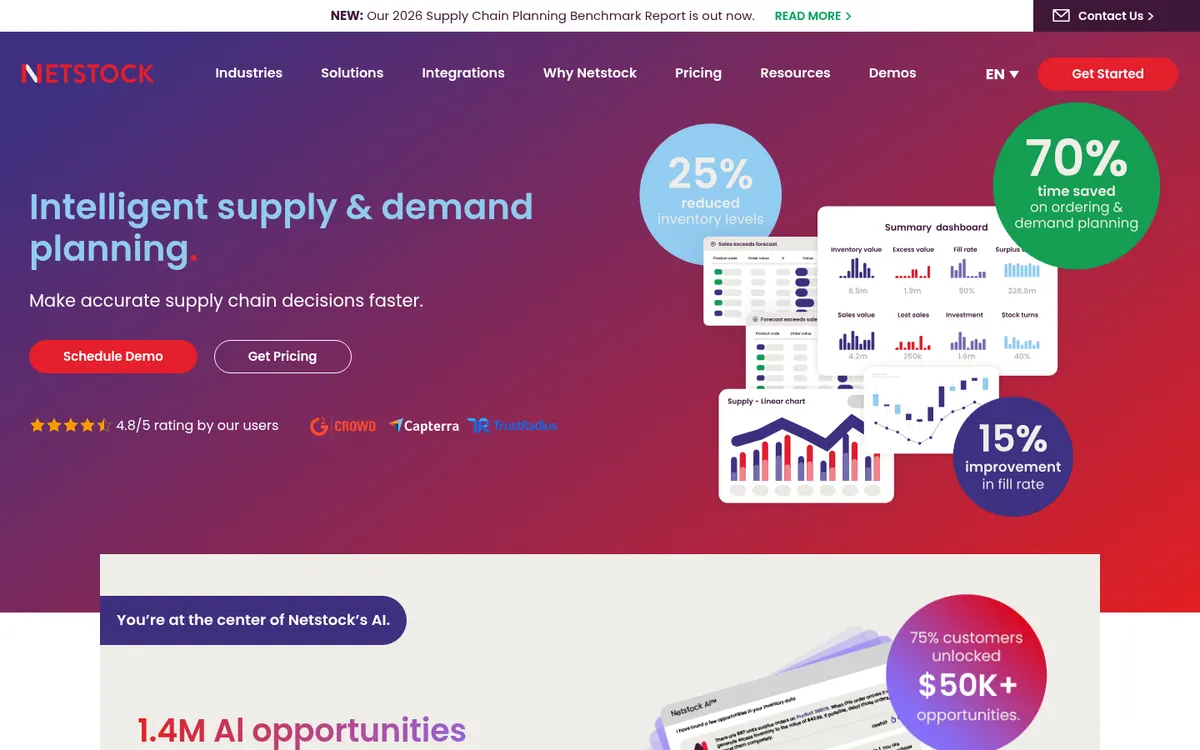
Fast, ERP-connected inventory and demand planning for distributors that still run replenishment from spreadsheets.
Netstock aims at distributors and manufacturers that still plan inventory in spreadsheets, roughly $5M to $250M in revenue. ERP connectors pull order and item history, SKUs are classified by demand pattern, and exception-based alerts and dashboards point a small team at the items that need a decision today. Inventory planning and demand forecasting share the same data, and cloud deployment typically runs in weeks.
The design assumption is few planners, many SKUs. Exception alerts are the feature that earns its keep, because a three-person team cannot review thousands of items one at a time, and connecting to a common ERP is a configured task rather than a development project. Classifying SKUs by demand pattern also stops fast movers and dead stock from being planned the same way, which is the usual failure mode of a spreadsheet.
Scope is the honest limit. Multi-echelon network optimization is shallow compared with enterprise suites, the product is inventory and demand planning rather than full S&OP, and it is not a complete supply chain suite. If you need multi-plant capacity planning or financial S&OP, budget for a platform further up this list.
Pricing is on the vendor site and the fetch failed on the check date, so no figure is confirmed here. Netstock fits a distributor with a lean planning team and a common ERP. Compare it against EazyStock, which targets the same buyer with a cloud-native distributor product, and run both on your own item history.
A small team plans thousands of SKUs in spreadsheets and needs exceptions surfaced daily.
You need multi-plant capacity planning or financial S&OP in the same tool.
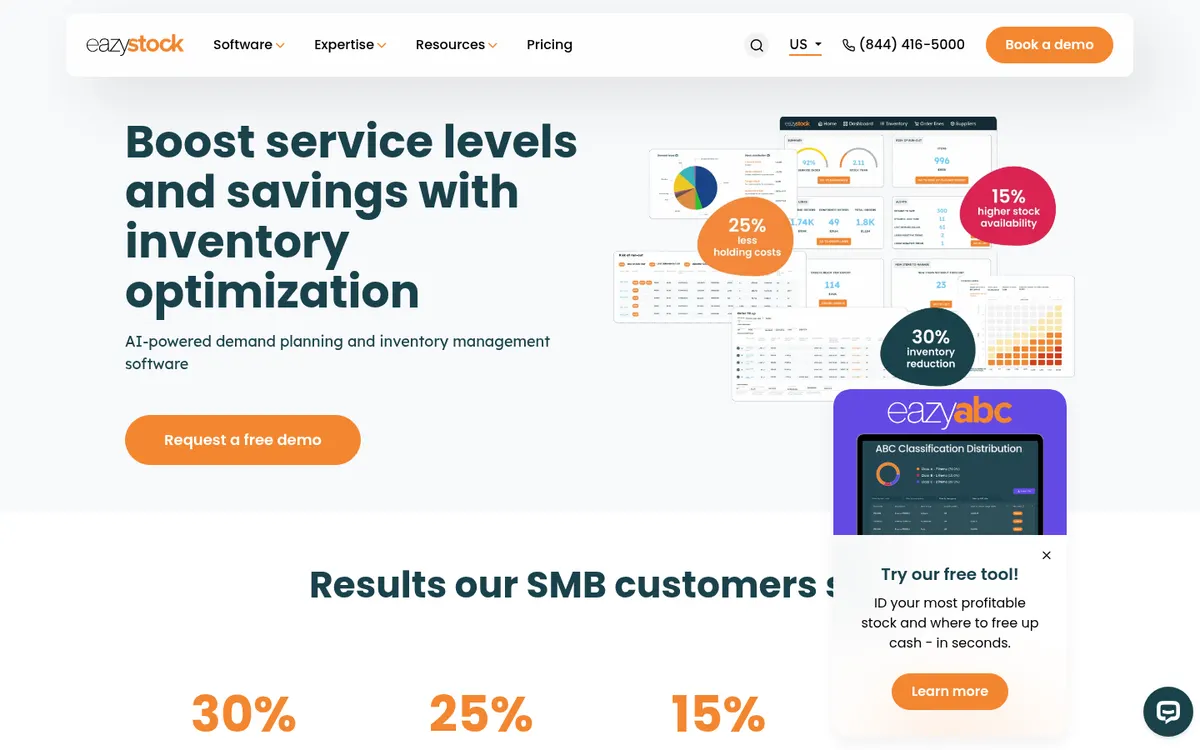
A clean cloud tool for distributor forecasting and purchasing, strongest when a buyer actually uses the forecast.
EazyStock is a cloud-native demand forecasting and inventory optimization product sold to distributors and wholesalers. Forecasting, inventory optimization and purchasing workflows sit in one package, with standard ERP integrations for distributor ERPs and an interface that does not need a week of training. A combined forecasting and replenishment package is available. The value case is time to competence. A clean, modern interface means buyers and purchasers use the forecast instead of exporting it, and the ERP integrations cover the systems distributors actually run. For the included feature set the price tends to compare well, which is why a demo alongside Netstock is a common comparison for the same buyer. Purchasing workflows close the loop between the forecast and the purchase order. The constraints come from size. EazyStock is a smaller vendor with a narrower partner network, advanced customization is limited, and the reference base is smaller than larger competitors. Companies with unusual planning requirements, multi-echelon networks or heavy customization needs will hit the edges of the product and end up running a parallel spreadsheet, which defeats the purchase. Pricing is on the vendor site and the pricing page text was missing at the check on 2026-11-25, so no number is quoted. EazyStock fits a wholesaler or distributor that wants forecasting and purchasing in one cloud tool and does not need custom logic. Run both EazyStock and Netstock against your own SKU data before deciding, and ask how each handles your slowest movers.
You want forecasting and purchasing in one cloud tool your buyers will actually open.
You need custom planning logic or multi-echelon network optimization.
Demand planning software turns history, open orders and market signals into a forecast, then converts that forecast into inventory, purchasing and supply decisions. The forecast is the visible output, but the real product is the decision layer on top: how much to buy, where to hold it, and which items need a human to look at them this week. An ERP usually stores the transactions; a demand planning tool decides what the transactions should be.
Most tools in this category share a common core:
The differences show up in three places. The first is forecast method: some tools produce a single number, while ToolsGroup produces a distribution, which changes how you plan slow movers. The second is breadth: Anaplan and o9 Solutions push demand into finance and supply, while Netstock and EazyStock stop at inventory and purchasing. The third is deployment weight: John Galt and Netstock talk in weeks, while Blue Yonder and Kinaxis talk in months.
You likely need this software when SKU count outruns the planning team, when forecast error is visible in stockouts and excess at the same time, or when the monthly S&OP meeting argues about numbers nobody trusts. A distributor with 4,000 items and two planners is the classic case. A single-product manufacturer with stable demand and one plant usually is not: a good spreadsheet and a reorder point will do the same job for less money and less disruption.
This comparison sits on the Software desk. Readers comparing neighbouring stacks often check our guides to demand forecasting software and glp 1 companies next.
None of the nine vendors here publishes a list price. Every entry shows price on request, so any budget figure you build has to come from a scoped quote, not from a comparison chart. That is a category norm rather than an accident: the cost depends on planner seats, SKU volume, number of locations and how many ERP connectors you need, and vendors price those inputs rather than a product.
The commercial models still differ enough to plan around. Enterprise platforms are scoped after a discovery process and priced as a platform license with services on top. Mid-market tools quote a subscription and often bundle the implementation into a fixed scope. Smaller cloud tools quote per company or per module with a short setup. Every vendor in this list shows no free plan and no free trial, so the evaluation has to run through a demo and a scoped quote rather than self-service signup.
| Model | How it bills | Typical fit | Example from this list |
|---|---|---|---|
| Enterprise platform license | Quoted after scoping, not published | Large organizations with dedicated planning staff | Anaplan |
| Annual subscription scoped to planning coverage | Billed yearly, sized by planning scope | Complex global supply networks | Kinaxis |
| Platform plus services engagement | Quoted with implementation services support | Global enterprises expecting a multi-month evaluation | o9 Solutions |
| Suite license across planning and execution | Quoted, no official price published | Retailers and distributors buying planning plus execution | Blue Yonder |
| Mid-market platform subscription | Quoted, deployment measured in weeks | Manufacturers and distributors with lean teams | John Galt |
| Cloud subscription with ERP connectors | Quoted, go-live measured in weeks | Small and mid-size distributors | Netstock, EazyStock |
Two budgeting rules apply across the board. Price services separately from license, because implementation, data cleanup and training are where overruns happen. And ask for the quote at your real SKU and location count, since a pilot quote at a tenth of your volume tells you nothing about year two.
Every price above was checked on the vendor's own pricing page on November 25, 2026. Where a vendor does not publish a figure we write "See website" instead of guessing. To compare annual and monthly billing quickly, try the free percentage calculator.
Count your SKUs, locations and planners. Write the three numbers down before any demo. Every vendor will price and scope against them, and a tool that fits 4,000 items at two sites may be wrong at 40,000 across eight.
Name the decision the forecast will change. Be specific: which purchase orders, which stock transfers, which production slots. If the answer is vague, the project will stall after go-live, because nobody can point to a decision that improved.
Set a data readiness bar. Check whether item masters, lead times and two years of demand history are usable. ToolsGroup needs clean granular history, and Netstock and EazyStock depend on a working ERP feed.
Choose a tier before you shortlist. Enterprise if you need demand tied to finance and supply, mid-market if you need forecasting plus S&OP in weeks, small cloud if the problem is inventory and purchasing. Mixing tiers wastes everyone's time.
Ask for a fixed-scope implementation quote with dates. Separate license, services and internal time, and get the go-live assumption in writing. Compare total first-year cost, not subscription cost.
Test the top two on your own history. Ask each vendor to forecast a sample of your SKUs, including slow movers, and compare accuracy against what you do today before you sign anything.
Buying forecast depth you cannot staff. Anaplan and o9 Solutions reward trained model builders and punish teams without them. Match the platform to the skills you have or will actually hire, not to the demo.
Skipping data cleanup. Item masters, lead times and duplicate SKUs cause more failed go-lives than forecast math. ToolsGroup and most other tools need granular history, so budget cleanup weeks before kickoff, not after.
Treating the demo as the deployment. A polished scenario with clean sample data says nothing about your ERP integration. Blue Yonder and Kinaxis implementations take serious effort, so ask what the first 90 days look like.
Comparing license price only. Services, internal analyst time and training usually exceed the subscription in year one. Ask every vendor for a full first-year figure including implementation and data work.
Buying a suite for a single problem. If forecasting is the only gap, a broad platform like Blue Yonder adds modules and process change you did not ask for. Narrow tools go live sooner and cost less to run.
It produces a forecast from history, orders and market signals, then turns that forecast into decisions about inventory, purchasing and supply. Most tools add hierarchies, exception alerts, accuracy measurement and a link into S&OP or financial plans. The forecast is the input; the repeatable decision is the output you are buying.
Netstock and EazyStock are the two built for that buyer, both aimed at distributors with lean planning teams and common ERPs. Netstock reports go-live in weeks and targets roughly $5M to $250M in revenue. EazyStock pairs forecasting with purchasing workflows. Both cover inventory and demand, not full S&OP, so plan upmarket if you need capacity planning.
Anaplan, o9 Solutions, Kinaxis and Blue Yonder carry the enterprise load, each for a different problem. Anaplan connects demand to finance and supply in one model of record. o9 Solutions is built around machine learning forecasting and graph based network modeling. Kinaxis wins on instant concurrent replanning, and Blue Yonder wins when you want planning plus warehouse and transport execution from one vendor.
The vendors here do not publish prices, so no figure can be quoted reliably. What differs is the structure: small cloud tools are quoted on a limited scope with a short setup, mid-market platforms quote a subscription plus a scoped implementation, and enterprise platforms are quoted after a discovery process with services on top. Ask for first-year total cost, not subscription cost.
The split is tiers, not vendors. Small cloud tools such as Netstock and EazyStock talk in weeks. Mid-market platforms like John Galt also go live in weeks for a few plants or distribution centers. Enterprise deployments at Anaplan, o9 Solutions and Blue Yonder are usually measured in months, and o9 deals typically include a multi-month evaluation before implementation even starts.
No. All nine show no free plan and no free trial as of November 2026, and every one lists price on request. Evaluation therefore runs through a guided demo, a scoped quote and often a paid pilot. Plan for a structured selection process rather than self-service signup, and ask each vendor what a paid pilot would cover.
Browse every comparison on the Software desk, with the same rubric and dated prices.