Ranked #1
Optro
Shared control library
See website
- Best for
- Large public companies with dedicated internal audit and SOX teams
- Free plan
- No
- Rubric
- 7.7 / 10
Eight audit management platforms compared on audit depth, GRC breadth, evidence automation and pricing, with prices checked in November 2026 for teams buying now.
 Prices checked November 25, 2026

Optro is the best audit management software for large public companies running SOX programs with a dedicated internal audit team, Diligent One suits audit teams that report into boards, and LogicGate fits risk teams that want configurable no-code workflows. That is the short answer as of November 2026, after comparing eight platforms on audit depth, GRC breadth, evidence automation, reporting and price clarity. Each entry below states who it fits, what it does well, where it falls short, and how its pricing is sold. Prices were checked on 2026-11-25.
Shared control library
See website
Board reporting layer
See website

No-code workflow builder
See website
Disclosure for this page: All 8 tools here are unpaid editorial picks. The position of a paid listing can be part of what the vendor pays for. How we handle paid listings.
| Tool | Best for | Free plan | Actions | |||
|---|---|---|---|---|---|---|
| 1 | Optro | Large public companies with dedicated internal audit and SOX teams | See website | No | ||
| 2 | Diligent One | Audit teams reporting into boards and executive committees | See website | No | ||
| 3 | LogicGate | Risk teams building configurable, no-code GRC workflows | See website | No | ||
| 4 |  MetricStream | Global enterprises running complex multi-domain GRC programs | See website | No | ||
| 5 |  Workiva | Audit tied directly to financial and regulatory reporting | See website | No | ||
| 6 | Resolver | Teams whose audit priorities follow incidents and investigations | See website | No | ||
| 7 |  Hyperproof | Teams needing continuous compliance evidence across frameworks | See website | No | ||
| 8 |  Vanta | Technology startups automating security compliance and audits | See websitecustom quote | No |
This list ranks on fit for the buyer named in each entry, not on a single aggregate number. We scored eight platforms against five criteria that decide most audit software purchases, and we weighed evidence we could check rather than claims on a features page. Audit depth carried the most weight at 30 percent: does the tool handle planning, testing, workpapers and issue tracking as first-class objects, or bolt audit onto something else? GRC breadth followed at 22 percent, because many buyers need risk, third-party and compliance work in the same place. Evidence automation took 20 percent, covering connectors, control reuse and AI-assisted testing. Board reporting took 15 percent. Price clarity took 13 percent, and it is the criterion where every vendor lost points: none of the eight publish a figure at all, and Vanta lists tier names but quotes only through a demo. Prices and plan details come from vendor pricing pages checked on 2026-11-25. Where a page carried no figures, we say so in the entry instead of estimating. We did not use reseller quotes, analyst estimates or third-party numbers, and we did not convert currencies.
The full process, including how we handle corrections, is on the methodology page. Paid listings follow our advertising disclosure.
| Criterion | Weight | What we check |
|---|---|---|
| Audit depth | 30% | How completely the product handles planning, testing, workpapers and issue tracking as native objects. |
| GRC breadth | 22% | Whether risk, third-party, compliance and resilience work live in the same platform as audit. |
| Evidence automation | 20% | Connectors, control reuse and AI-assisted testing that cut manual evidence gathering. |
| Board reporting | 15% | How well audit output turns into committee and director-level reporting. |
| Price clarity | 13% | Whether a buyer can learn the cost without running a full sales cycle. |
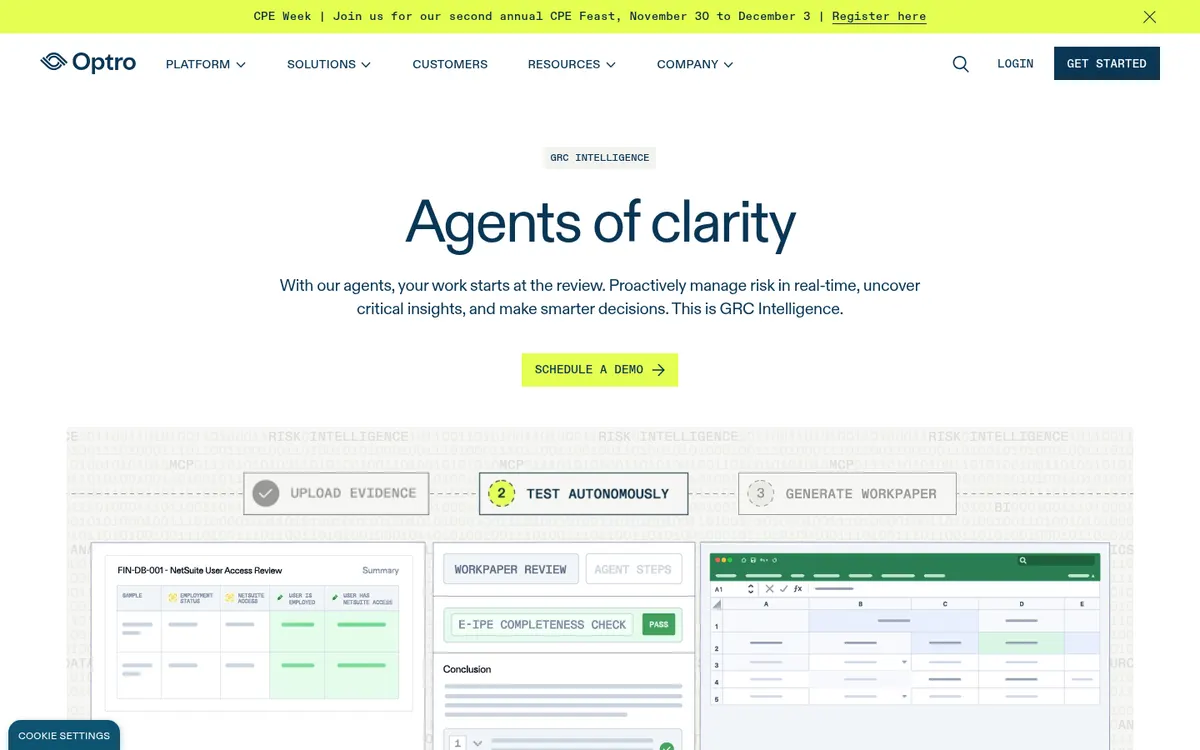
The strongest audit-native fit for large public companies running SOX, with a control library shared across audit, risk and infosec.
Optro is audit management software built for large public companies that run a dedicated internal audit function and a SOX program. Controls live in a shared library that audit, risk, infosec and IT compliance teams draw from, so a control tested for SOX can be reused for SOC 2 or ISO 27001 work rather than rebuilt in a second tool. The platform was renamed Optro in March 2026, having previously traded as AuditBoard, a change announced at an IIA event and framed around agentic AI in GRC. The company and product set stayed the same, so buyers working from an older AuditBoard shortlist are looking at the same platform.
Core modules cover internal audit planning, testing and issue tracking, enterprise risk management, and audit committee reporting with dashboards. Framework support extends to SOC 2 and ISO 27001 alongside SOX, and integrations connect to common business systems. The AI agents are positioned around continuous risk identification rather than one-off document review, which matches the direction the rename signaled.
The honest limits are cost and scope. Pricing is positioned for large audit functions, and no pricing page could be fetched when we checked, so nothing about cost could be confirmed. Wide platform scope also means careful rollout planning. A lean team that switches on every module at once ends up with processes nobody owns and a control library that drifts away from how the business actually works.
Pricing sits on the vendor site and is discussed with sales; there is no free plan and no trial. That makes a scoped demo and a defined pilot the practical evaluation route. Optro fits organizations where internal audit is a standing function with SOX obligations and enough headcount to maintain a shared control library. A five-person audit team with one framework should start narrower.
You run a SOX program with a dedicated internal audit team and want one control library across audit, risk and infosec.
You have a small audit team with a single framework and no appetite for a broad platform rollout.
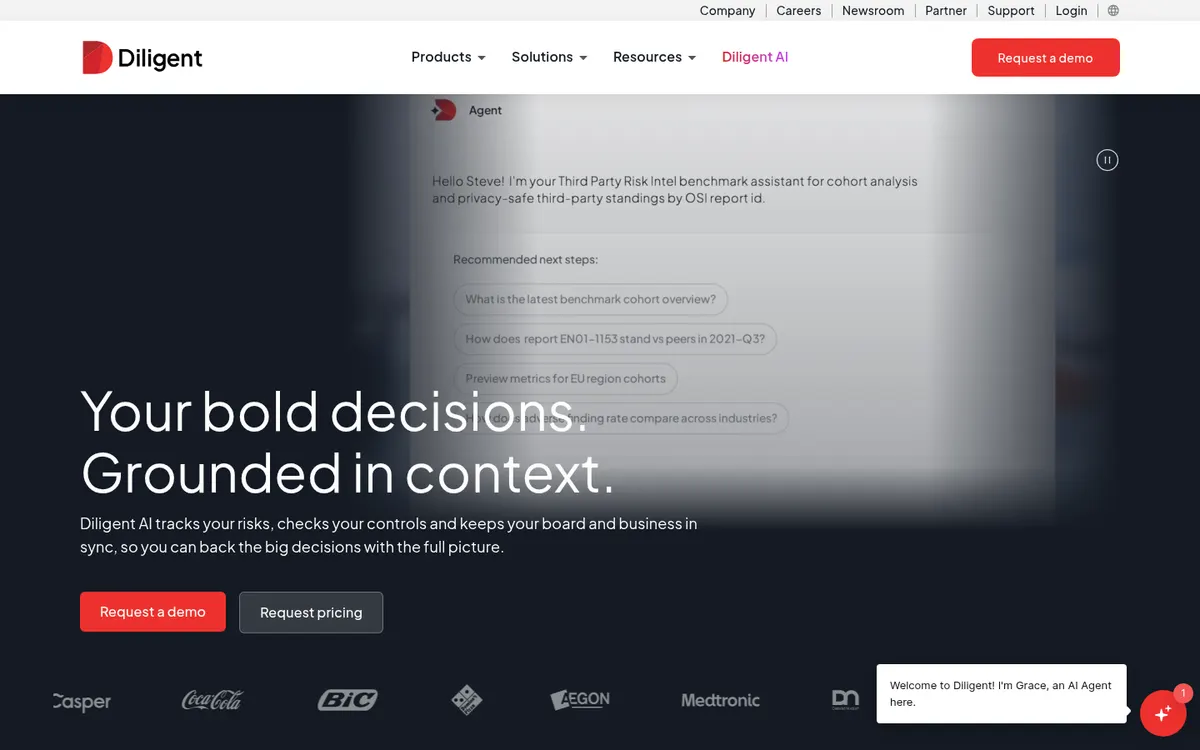
Best when audit findings must reach the board, though smaller audit teams will pay for modules they never open.
Diligent One is the entry to shortlist when internal audit reports into a board or an executive committee and findings have to arrive in a format directors already read. Audit management, findings escalation and committee reporting sit in the same platform as risk registers, policy and compliance management, ESG disclosure tracking and third-party risk, so a finding raised during an engagement can be followed through to the board pack without a second system.
The board and committee reporting views are the differentiator, and they rest on a long governance and board portal heritage. Third-party risk onboarding and ongoing monitoring come from 3rdRisk's AI-native tooling, including AI-assisted vendor due diligence, which matters when audit scope reaches into supplier exposure. Governance dashboards keep directors on a standing view instead of a quarterly scramble for numbers.
The trade-off is scope and cost. This is an enterprise platform, and a smaller audit team may only ever use a small share of the modules it is licensed for, which is a hard cost to defend at budget time. Pricing is on the vendor site and handled through sales; no figure could be confirmed when we checked, and there is no free plan or trial.
Evaluate Diligent One if audit is one of several voices feeding board reporting and you want them in one place. If you need deep audit lifecycle tooling and nothing else, the wider platform is more than the job requires. Ask for a demo built around your committee reporting cycle rather than a full platform tour, and confirm exactly which modules a quote includes before you compare it with anything else.
Audit findings have to reach a board or executive committee and you want risk, compliance and ESG reported the same way.
Audit is your only need and you do not want to pay for governance modules you will not run.
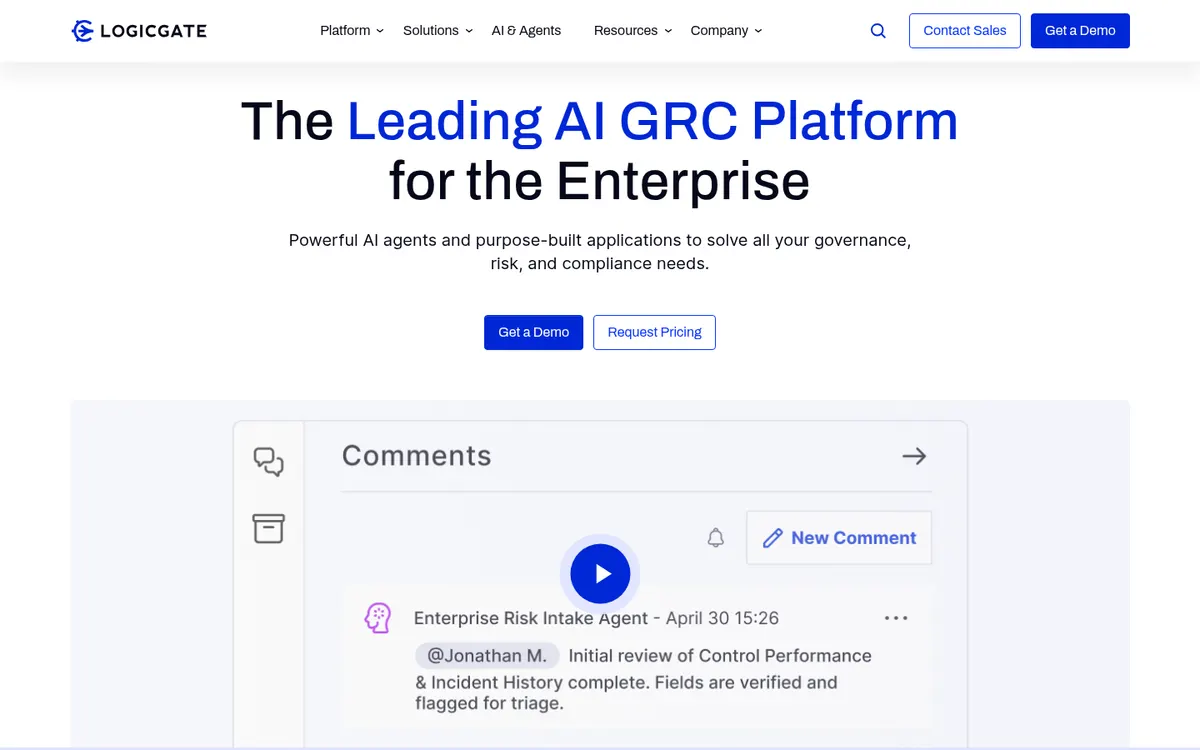
A configurable GRC platform that lets risk teams build their own audit workflows, provided someone governs the building.
LogicGate, sold as Risk Cloud, is the pick when your risk or audit team wants to change its own workflows without filing an engineering ticket. It is a no-code app builder for GRC processes: audit programs and engagement workflows, third-party risk management, cyber risk quantification and scoring, policy lifecycle management and configurable dashboards are assembled from the same building blocks, so a process that does not match a vendor template can be reshaped to fit. The AI features target the tedious part of the work. AI agents handle evidence testing and report drafting, and autofill populates forms and assessments, which reduces the manual review that consumes audit capacity. LogicGate includes a third-party risk management application, which is useful if supplier exposure is a large share of your audit plan and you want the same platform to cover it. The caveat is governance. High configurability means process sprawl is a real risk: three teams build three versions of one assessment and nobody can compare results across a portfolio. Someone has to own app design standards and naming conventions. Budget for that role, not just the license. Pricing is enterprise level and quoted through sales, with no figures available to confirm and no free plan or trial. LogicGate fits an organization with a GRC owner who likes building things and a risk profile broad enough to justify the configuration effort. A pure internal audit team running fixed SOX cycles will get less from it than a risk function that keeps inventing new assessments and needs them live in weeks rather than quarters.
You have someone who will own GRC configuration and processes that keep changing.
You want fixed, vendor-defined audit workflows and no in-house build work.
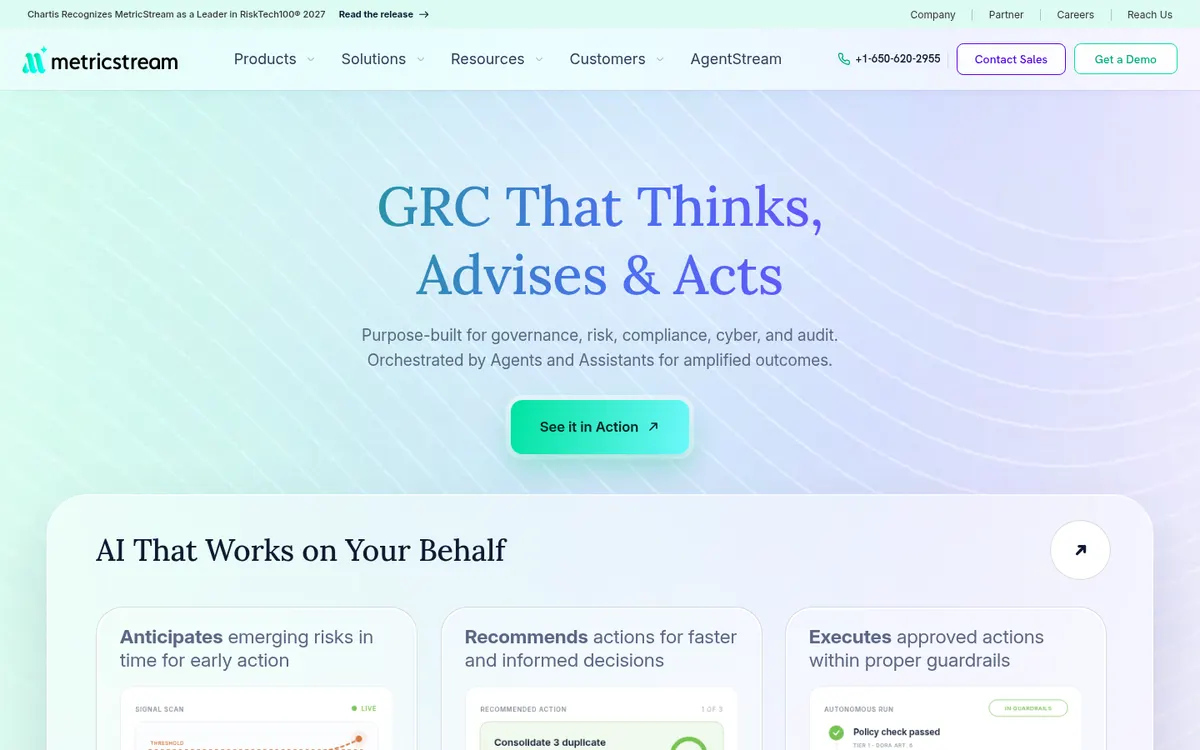
The broadest GRC coverage here, suited to global regulated enterprises that can absorb a heavy implementation.
MetricStream is the entry for global enterprises running multi-domain GRC, where internal audit is one program among many that share risk data. The platform covers internal audit management, enterprise and operational risk, regulatory compliance, cyber GRC and IT risk, third-party and supply chain risk, and business resilience and continuity planning, with low-code and no-code configuration across the modules and AI agents layered on top. Industry-specific product editions for banking, insurance, healthcare and energy let a regulated firm start closer to its own vocabulary instead of configuring a generic model from scratch. The platform suits global enterprises running multi-domain GRC, and its breadth is the main reason to consider it if you plan to consolidate several tools into one contract and one reporting line. The cost of that breadth is implementation. This is heavy work with significant spend attached, and it is more capability than a mid-market organization typically needs. Pricing is on the vendor site and quoted through sales; no figure could be confirmed when we checked, and there is no free plan or trial. Expect the services side of the contract to matter as much as the license, and scope it separately so you can see what you are paying for. MetricStream fits a large regulated enterprise with a multi-year consolidation plan and staff to run it. If audit is a standalone need inside a 200-person company, a narrower tool will deliver value faster and cost far less to stand up. Ask which modules are live in reference accounts of your size before committing to the full suite.
You are consolidating several GRC tools across regions and regulated business lines.
You are mid-market and need audit live inside a quarter.
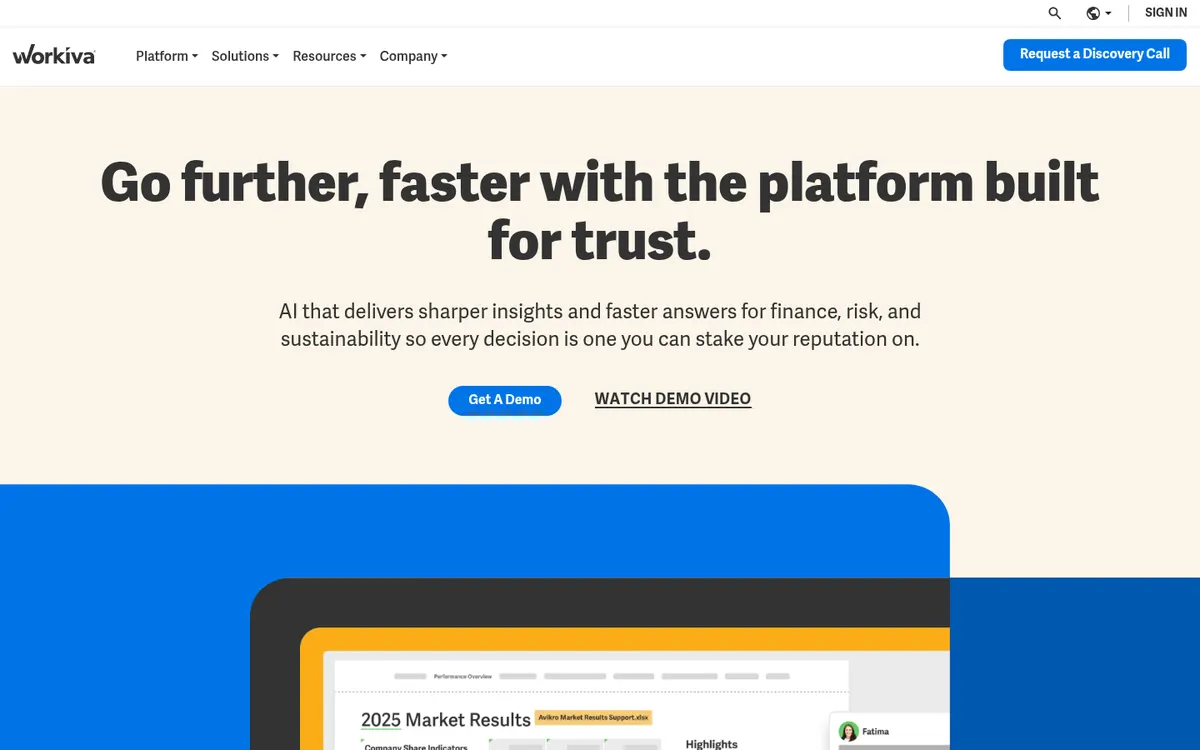
Unbeatable when audit evidence must tie to filed numbers, but audit planning and workpapers run shallower than audit-native tools.
Workiva is the pick when audit work feeds directly into financial or regulatory reporting. Its connected data model links controls, evidence and the financial figures those controls support, so SOX testing, SEC filing preparation, ESG reporting and XBRL tagging all draw on one set of records. Audit evidence stays tied to reported numbers rather than living in a separate workpaper system that someone rekeys every quarter.
That connection is the real product. Collaboration and review workflows carry audit trails, and integrations with ERP and finance systems keep the underlying data current. The vendor's customer base includes a large share of the Fortune 500, which reflects how many large public companies need reporting and controls work in the same place. For an audit committee, the appeal is one version of a number that both the controller and the auditor can point at.
The limits are about depth. Workiva is reporting-first, and its audit planning and workpaper depth trails audit-native platforms. If your team runs a complex risk-based audit plan with resource scheduling and engagement-level workflow, you will feel the difference quickly. Pricing is on the vendor site and quoted through sales; no figure could be confirmed when we checked, and there is no free plan or trial.
Choose Workiva when the audit team's output has to reconcile with what the company files, and when the people doing that reconciliation sit in finance as much as in audit. Choose an audit-native platform when the audit program itself, not the report it supports, is the center of gravity for the team you are equipping.
Audit evidence has to tie back to the numbers in your filings and reports.
Your audit team needs deep planning, workpapers and engagement workflow.
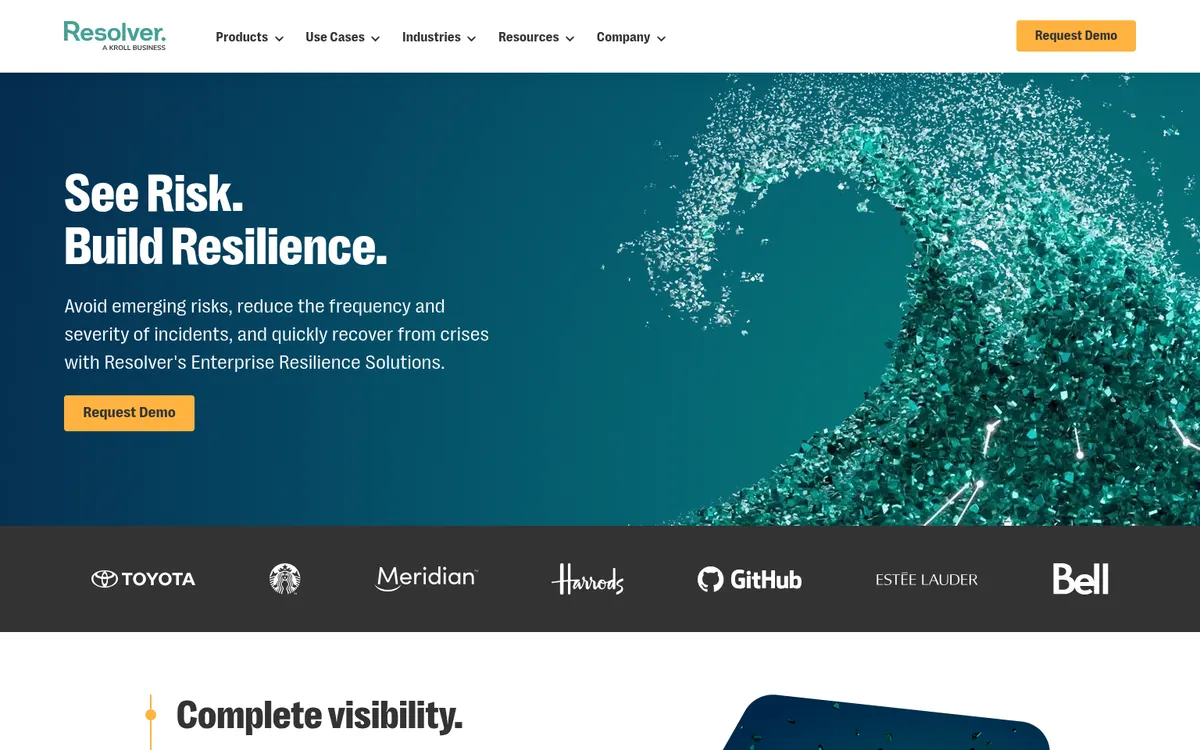
A strong incident and investigation platform that feeds audit scoping, with an audit module less proven than its risk tools.
Resolver is the pick when audit priorities follow incidents and investigations rather than a fixed calendar. It handles incident management and case workflows, investigations case management, risk assessment and registers, and internal audit planning and issue tracking, with operational risk data feeding into audit scoping. A cluster of incidents in one business unit changes the next audit plan rather than waiting for an annual refresh.
Automated end-to-end risk and audit workflows keep cases moving, and reporting and analytics are built for risk committees. The platform also covers corporate security and resilience use cases, which is why incident data and audit work sit side by side instead of in two systems with a manual bridge. Resolver operates as a Kroll company, and that shapes its risk intelligence positioning and the resources it can bring to a conversation about threat exposure.
Two things to weigh. The brand is less prominent than the largest enterprise GRC suites, which matters if procurement wants a familiar name on the contract. And the audit module is less well known than the risk and incident tools, so ask for references in an audit-led deployment rather than a security operations one. Pricing is on the vendor site and quoted through sales; no figure could be confirmed when we checked, and there is no free plan or trial.
Resolver fits organizations where incidents, investigations and audit are managed by overlapping teams that already share data informally. If audit runs on a clean annual plan with no incident feed and no case backlog, the incident depth is paid for and never used, and a narrower audit tool will serve you better.
Incidents and investigations already drive what your audit team looks at next.
Audit runs a clean annual plan with no incident or case data feeding it.
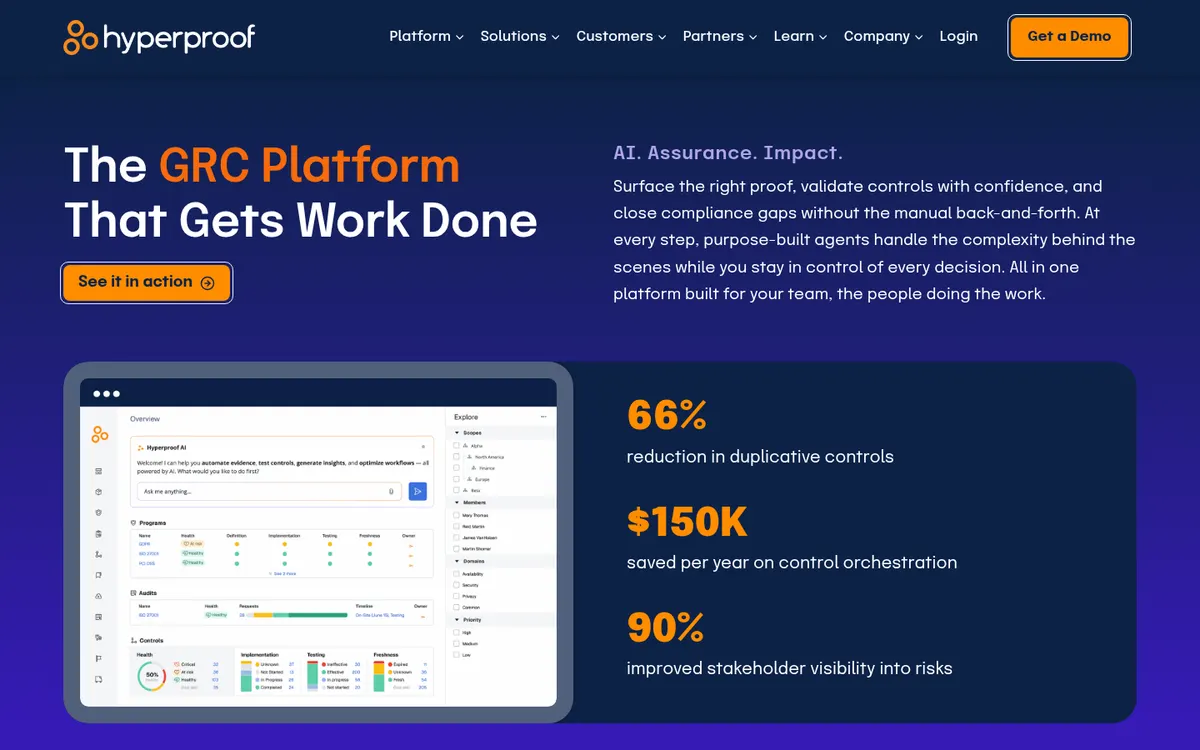
The best evidence automation in this list for multi-framework compliance, with internal audit depth as the trade-off.
Hyperproof is the pick when a small team has to keep evidence current across several frameworks at once. Automated evidence collection runs through cloud integrations the vendor calls Hypersyncs, with more than 110 available, and framework mapping covers SOC 2, ISO 27001 and HIPAA. One control set maps to multiple frameworks, so a test performed once can support several obligations instead of being repeated for each one. Continuous monitoring and alerts give real-time visibility into compliance status rather than a quarterly snapshot, and dashboards show posture across frameworks in one view. A risk register and vendor risk tracking are included, and auditor collaboration and evidence sharing are built in, which removes the shared drive scramble that eats the week before an audit starts. The limit is scope. Hyperproof is built around compliance evidence, not the full internal audit lifecycle, and internal audit planning is shallower than in audit-native tools. A team that needs full internal audit lifecycle management will find the product is built around compliance evidence instead. Pricing is on the vendor site; the page we fetched is a product overview with no figures, and there is no free plan or trial. Hyperproof fits technology and finance companies juggling SOC 2, ISO 27001 and HIPAA with a compliance lead rather than an audit department. It fits badly if internal audit is the buyer and engagement management is the requirement, because the workflow you need simply is not the workflow the product was built around. Test it against your busiest control first.
You maintain evidence for SOC 2, ISO 27001 and HIPAA with a small compliance team.
Internal audit planning and workpapers are the core requirement.
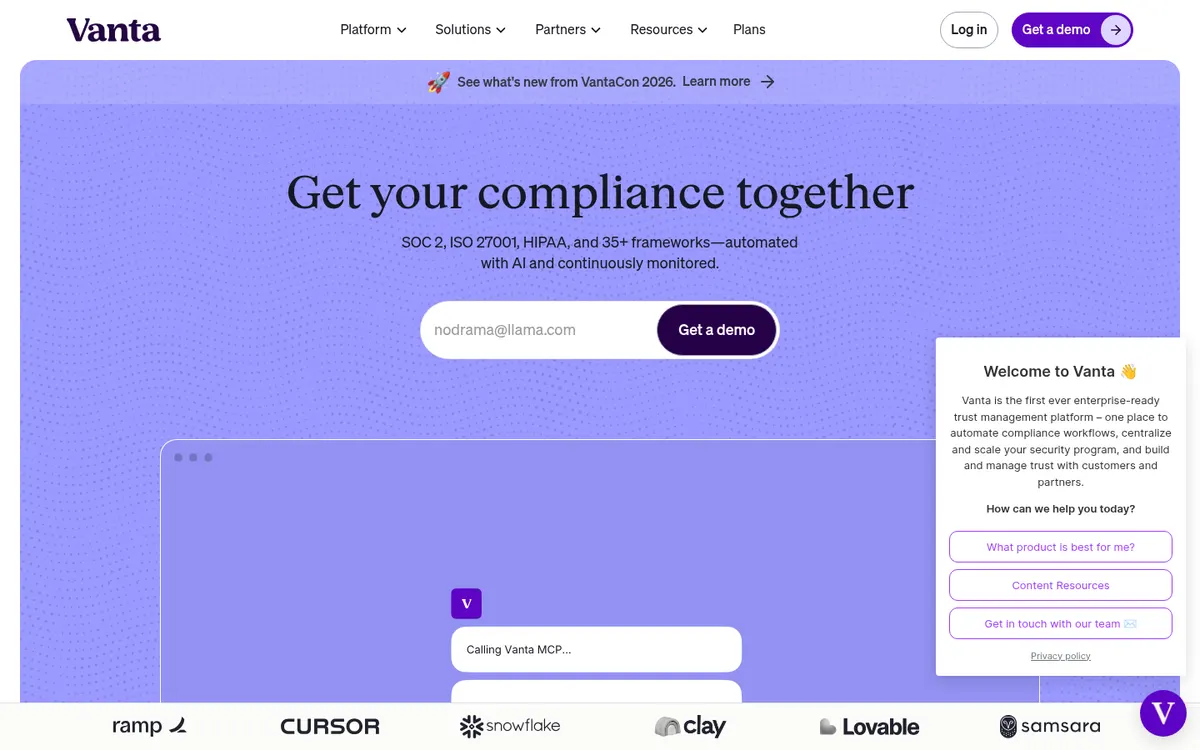
The fastest route to SOC 2 or ISO 27001 for a startup, and the wrong tool for an internal audit function.
Vanta is the pick for technology startups whose main audit obligation is passing a security certification. Continuous security monitoring and automated evidence collection cover SOC 2 and ISO 27001 readiness workflows, auditor collaboration and report delivery are built in, and vendor and third-party security reviews sit alongside. Policy templates, employee security training, risk assessments and remediation tracking fill in the controls a first-time certification needs. The value is speed. The vendor compresses SOC 2 and ISO 27001 timelines substantially, and automation runs from evidence gathering through ongoing monitoring rather than stopping at the report. Adoption among startups and SaaS businesses is strong, which is a point in its favor for a first certification. The limit is scope, and it is a real one. Vanta targets security compliance, not internal audit, and it is not built for full audit lifecycle management. Its scope is security compliance rather than internal audit, so it is not a replacement for full audit lifecycle management. Pricing is on the vendor site: the page lists Essentials to Enterprise tiers but offers only personalized pricing through a demo, so the arrangement is a custom quote. No free plan, no trial. Buy Vanta when the question is whether you can pass SOC 2 quickly and keep evidence fresh year round. Look elsewhere when the question is how your audit function plans, executes and reports a year of engagements across a complex business, because that job needs a different class of product entirely.
You are a startup that needs SOC 2 or ISO 27001 quickly and wants evidence collection automated.
You need internal audit planning, workpapers or a findings workflow.
Audit management software runs the audit lifecycle in one place: the risk-based plan, the engagements, the workpapers and evidence, the findings, the remediation follow-up and the reporting that goes to an audit committee. The point is continuity. A finding raised in March is still attached to its owner, its evidence and its due date in September, and the committee pack gets assembled from those records rather than from a spreadsheet someone rebuilt from memory.
Typical capabilities fall into a few groups:
Two things separate products in this category. The first is whether audit is the center of the product or a module inside a larger GRC suite. The second is how evidence gets in: manual upload, connector-based collection, or AI-assisted testing. Those choices decide how much of the year your team spends gathering material rather than analyzing it, and they are where demos look most alike and behave most differently.
It is not the same as compliance automation. Compliance tools exist to prove a certification such as SOC 2 or ISO 27001 and to keep evidence fresh; audit tools exist to run a repeatable program across many engagements. Some vendors cover both, and that overlap is exactly where buyers get confused about what they are purchasing.
Buyers should also check framework coverage against real obligations. A company with SOX obligations needs control-linked workpapers and testing tied to financial reporting. A SaaS company preparing for its first SOC 2 needs automated evidence and an auditor portal far more than a multi-year audit plan.
This comparison sits on the Software desk. Readers comparing neighbouring stacks often check our guides to demand forecasting software and glp 1 companies next.
None of the eight vendors here publishes a price on the vendor site, and Vanta names tiers (Essentials to Enterprise) but offers only a personalized quote through a demo. Budgeting therefore starts with a scoping call, not a calculator. Ask each vendor what the quote covers: modules, named users, frameworks and implementation work. A company buying audit only and a company buying audit, risk, third-party and ESG can have similar headcount and very different contracts. Ask how implementation services are scoped and priced, and treat them as a separate budget line.
| Model | How it bills | Typical fit | Example from this list |
|---|---|---|---|
| Not published | Pricing is on the vendor site | Large internal audit and GRC functions | Optro, MetricStream |
| Not published | Pricing is on the vendor site | Audit teams reporting to boards | Diligent One |
| Not published | Pricing is on the vendor site | Risk teams with no-code requirements | LogicGate |
| Not published | Pricing is on the vendor site | Audit tied to financial reporting | Workiva |
| Custom quote | Essentials to Enterprise tiers, personalized quote only | Security certification programs | Vanta |
Every price above was checked on the vendor's own pricing page on November 25, 2026. Where a vendor does not publish a figure we write "See website" instead of guessing. To compare annual and monthly billing quickly, try the free percentage calculator.
Name the audit obligation first. SOX program, annual internal audit plan, first SOC 2, or incident follow-up? That single answer removes half this list. Optro and Workiva suit SOX, Hyperproof and Vanta suit certification, Resolver suits incident-led work.
List every framework you must evidence. Write down what auditors and regulators will ask for over the next 18 months. Two or more frameworks points toward Hyperproof, Optro or MetricStream; a single security certification points toward Vanta.
Decide who configures the tool. If nobody on staff wants to build, favor vendor-defined workflows. If a GRC owner exists and processes keep changing, LogicGate's no-code builder earns its place, but only with design standards written down first.
Trace where the output ends up. Audit committee pack, board portal, or an actual filing? Diligent One and Workiva are built for that last mile. If findings die in a spreadsheet today, test that exact gap in the demo.
Ask for a written module and user scope. No vendor here publishes a price. Ask each one for a quote that names modules, named users, frameworks and implementation services, or the numbers you receive will not be comparable.
Run a pilot on one real engagement. Give two finalists the same audit, the same evidence and the same reporting deadline. Watch how long each takes to produce a committee-ready output, and clarify who does the setup work.
It usually covers four things: a risk-based audit plan, engagement workpapers and testing, issue and remediation tracking, and reporting for management and audit committees. Most products add a reusable control library and some form of evidence collection. Optro, Diligent One, MetricStream and Resolver all cover internal audit, while Hyperproof and Vanta concentrate on evidence automation and framework mapping instead.
AuditBoard became Optro in March 2026. The rename was announced at an IIA event and framed around a push toward agentic AI in GRC. The company and the product set stayed the same, so the audit, risk and SOX capabilities did not change with the name. Buyers working from an older shortlist are evaluating the same platform under a new label.
Audit management software centers on engagements: planning, testing, workpapers and findings. A full GRC platform adds risk registers, policy management, third-party risk, regulatory compliance and often ESG reporting in one system. Diligent One and MetricStream sit at the GRC end, covering broad governance domains, while Workiva and Hyperproof stay narrower. The practical question is whether audit is the main job or one input into board reporting.
Compliance automation is usually the better first buy. If the main obligation is passing SOC 2 or ISO 27001, Vanta and Hyperproof automate evidence collection and auditor collaboration, which is the work that consumes a small team. A full audit platform such as Optro or MetricStream is built for a standing internal audit function and will be far more than a startup needs.
Several can, and the mechanism differs. Hyperproof maps one control set across SOC 2, ISO 27001 and HIPAA and pulls evidence through more than 110 connectors. Optro keeps a shared control library spanning SOX, SOC 2 and ISO 27001 and also serves risk and infosec teams. LogicGate and MetricStream offer no-code or low-code configuration for teams that want to build their own workflows.
Optro and Workiva are the clearest SOX fits, with control-linked workpapers and evidence tied to reported figures. Diligent One and MetricStream cover internal audit within broader GRC suites. Hyperproof and Vanta focus on security certifications such as SOC 2 and ISO 27001 rather than internal audit, so they are not aimed at a SOX program.
Browse every comparison on the Software desk, with the same rubric and dated prices.