Ranked #1

BlackLine
Full lifecycle suite
See websiteQuote only, volume-based Data Plans with unlimited users, no figure published
- Best for
- Large groups needing a dedicated intercompany lifecycle suite
- Free plan
- No
- Rubric
- 6.8 / 10
Eight intercompany accounting tools ranked by buyer fit, from full lifecycle suites to close overlays, with prices and plans checked on 2026-11-26.
 Prices checked November 25, 2026

In November 2026, the best accounting software for intercompany transactions depends on whether you need a dedicated engine or a layer on top of an ERP. BlackLine suits large groups that want the full create, balance, net and settle lifecycle in one suite. Trintech fits enterprises that need trade and non-trade flows with a strong audit trail. Sage Intacct is the mid-market pick when the ledger and consolidation should live in one system, at a published £1,200 per month.
Full lifecycle suite
See websiteQuote only, volume-based Data Plans with unlimited users, no figure published

Fast close overlay
See websitecustom quote

Trade and non-trade
See websiteQuote only, no pricing page with figures
Disclosure for this page: All 8 tools here are unpaid editorial picks. The position of a paid listing can be part of what the vendor pays for. How we handle paid listings.
| Tool | Best for | Free plan | Actions | |||
|---|---|---|---|---|---|---|
| 1 | BlackLine | Large groups needing a dedicated intercompany lifecycle suite | See websiteQuote only, volume-based Data Plans with unlimited users, no figure published | No | ||
| 2 | FloQast | Close management with intercompany reconciliation tasks | See websitecustom quote | No | ||
| 3 | Trintech | End-to-end intercompany lifecycle automation | See websiteQuote only, no pricing page with figures | No | ||
| 4 |  Sage Intacct | Mid-market groups wanting ledger plus consolidation | £1,200Sage Intacct, per month, excluding 20 percent VAT, tailored pricing available | No | ||
| 5 | Oracle NetSuite | Groups already running NetSuite that need intercompany | See websiteQuote only, intercompany requires the OneWorld add-on | No | ||
| 6 | Workday | Large global groups already using Workday | See websiteQuote only, licensed on total worker count | No | ||
| 7 | Tipalti | Cross-entity accounts payable and global payouts | $99Accounts Payable, per month, unlimited users, Mass Payments from $249 per month | No | ||
| 8 |  HighRadius | Enterprise record-to-report and close automation | See websiteOutcome-based model, no subscription or implementation fee until go-live, then a gain-share percentage | No |
Every tool here was scored against the same five criteria, and the scores sit under each entry so you can reweight them for your own situation. Intercompany depth carries 30 percent because it is the reason you are shopping: does the product match balances, net them, settle them and eliminate them, or does it only track tasks? ERP fit carries 20 percent, since an overlay that fights your ledger costs more than it saves. Pricing clarity (15 percent) rewards vendors that publish a number. Time to live (15 percent) reflects published implementation windows. Scale fit (20 percent) asks whether the product fits a group of your size in both directions: not too small to cope, not so large that you fund modules nobody opens. Prices, free plan status and trial availability come from vendor pricing pages checked on 2026-11-26. Where a vendor publishes nothing, the entry says so and the value is recorded as unverified rather than estimated. The order is editorial. Each entry is placed for the buyer described in its best-for line. Any Featured position is a paid placement, disclosed and scored on this same rubric with the same honest cons. This list carries no Featured placement.
The full process, including how we handle corrections, is on the methodology page. Paid listings follow our advertising disclosure.
| Criterion | Weight | What we check |
|---|---|---|
| Intercompany depth | 30% | Does the product record, match, net, settle and eliminate balances, or only track tasks? |
| ERP fit | 20% | How well it works with the ledgers and ERP instances a group already runs. |
| Pricing clarity | 15% | Whether a buyer can see a real number, a plan structure or only a quote form. |
| Time to live | 15% | Published implementation windows from signature to first close. |
| Scale fit | 20% | Whether the product fits a group of your size without funding capability you never use. |
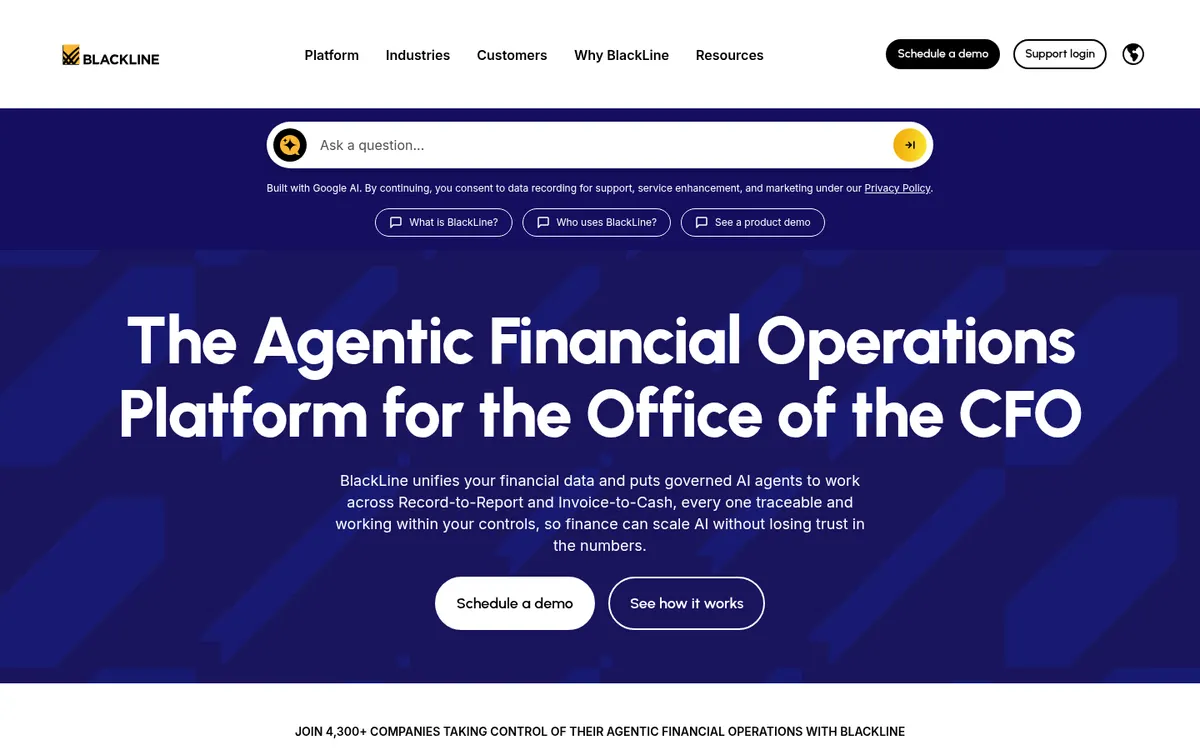
A full intercompany lifecycle suite, but the quote-only price and five-month build suit large groups only.
BlackLine covers the full intercompany lifecycle in one suite, and it is priced for the groups that need that completeness. The suite splits into three stages: Create for recording cross-entity transactions, Balance and Resolve for matching and clearing differences, and Net and Settle for netting and settlement. Currency conversion, multi-entity clearing, and connectors for SAP S/4HANA, Microsoft Dynamics 365, Acumatica and Workday all sit inside that flow. BlackLine also supports several ERP instances at once, which matters after an acquisition spree. Verity AI agents match, reconcile and eliminate balances continuously rather than only at period end. Pricing is quote only. BlackLine sells volume-based Data Plans with unlimited users and publishes no figure, so the first number you see comes from a sales conversation. The vendor retired its Modern Accounting Playbook bundle in 2026 and now sells the unified Studio360 platform instead, which changes the scope of a typical contract. Plan a long runway. Implementation commonly takes around 4.5 to 5 months, and the learning curve is steep enough that you want a dedicated in-house administrator rather than a part-time one. Cost and complexity are aimed squarely at large enterprises. A smaller group running one ERP will pay for capability it never uses, and the unlimited-user model does not help if your team is small.
You consolidate many entities across more than one ERP and want matching, netting and settlement in a single system.
You run one ERP, a small entity count, or need a fixed price before the business case goes to the board.
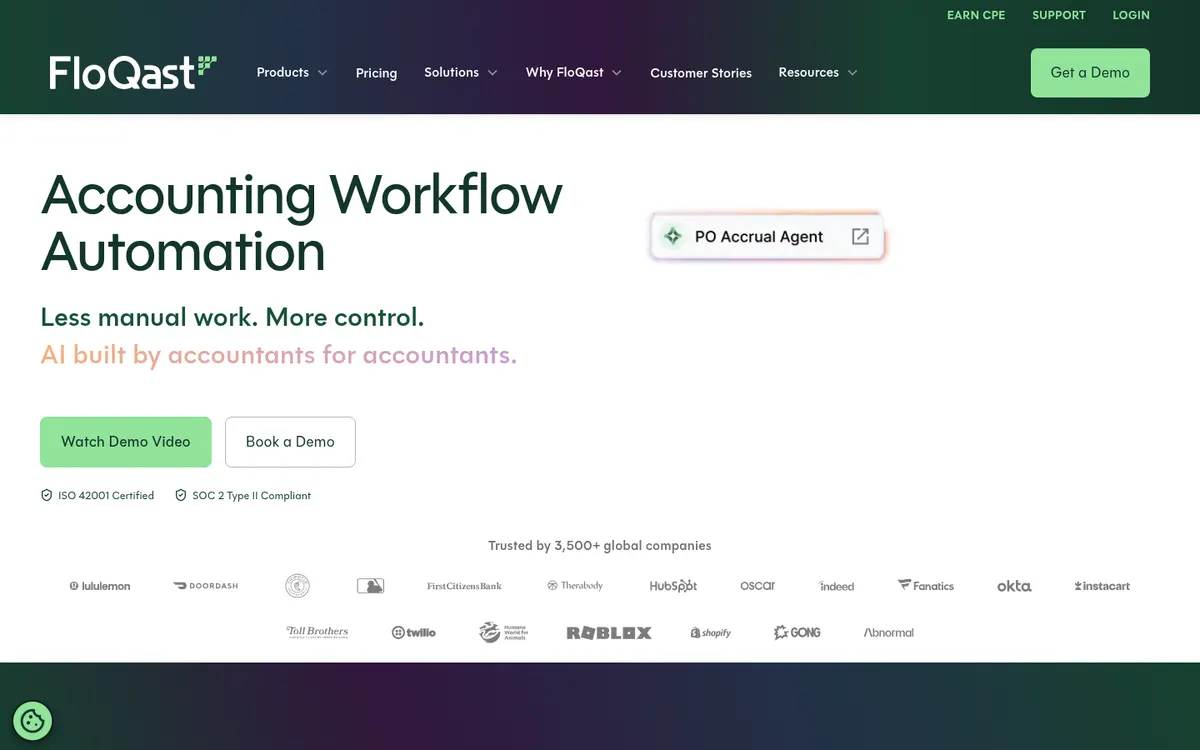
A fast close-management overlay that tracks intercompany reconciliation tasks but stops short of netting, settlement and eliminations.
FloQast is a close-management tool first and an intercompany tool second, and that ordering matters when you buy. The close checklist tracks intercompany reconciliation tasks, close AI agents handle repetitive reconciliations, and AI matching extends to three-way matching. Journal entries post automatically, and the whole thing sits on top of NetSuite, SAP, Workday, Sage Intacct or Xero without replacing any of them. The pricing model does not charge per user, which keeps a large accounting team from inflating the bill. What it will not do is net, settle or eliminate. A September 2026 check found no dedicated intercompany product page behind the claim, which tells you how the vendor positions the capability: a task inside the close, not a module of its own. Small groups with a handful of cross charges can live with that. Groups with many entities and monthly mutual balances cannot. Pricing is a custom quote, with no dollar figure published on the pricing page. Implementation is quick by category standards, typically 2 to 3 months, and because FloQast layers onto an existing ERP you avoid a ledger migration entirely. Treat it as a way to automate the close you already run, not as a way to fix an intercompany process that has no matching or settlement controls.
You already own a capable ERP and want intercompany reconciliation tasks folded into a faster, better controlled close.
You need to net mutual balances, settle between entities or eliminate balances at consolidation.
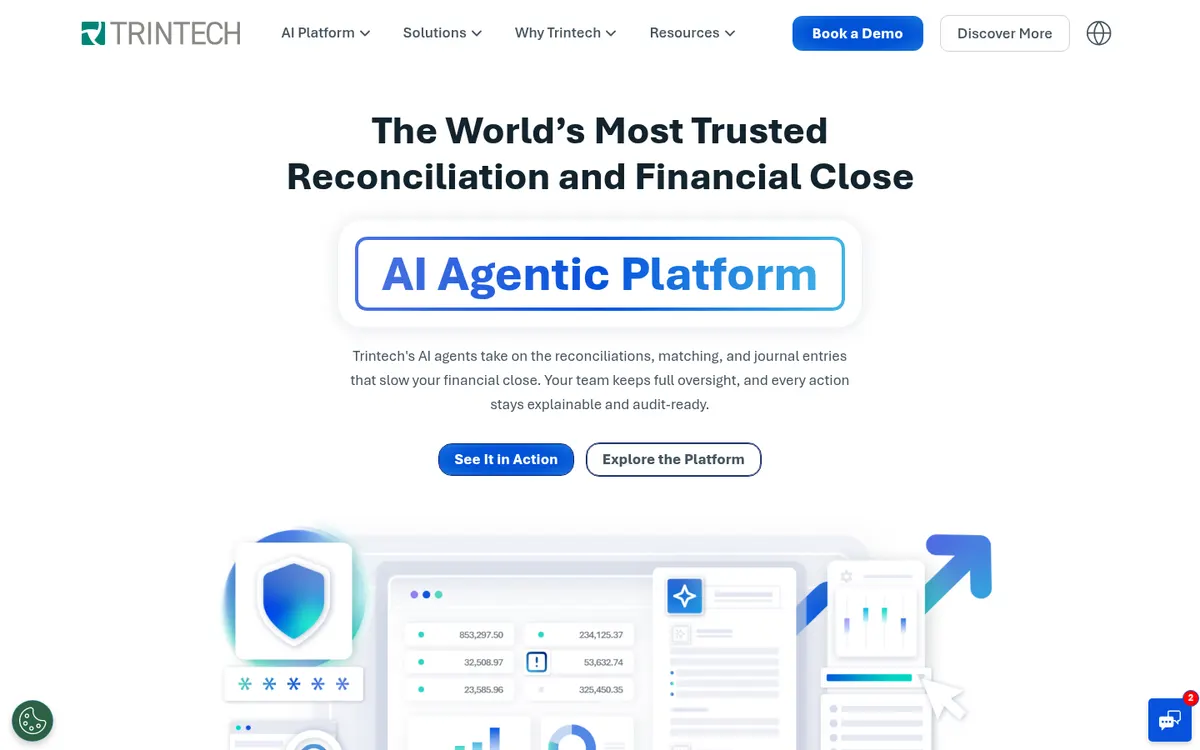
Cadency covers trade and non-trade intercompany from recording to elimination, with partner-led builds running 4 to 9 months.
Trintech's Cadency Intercompany is a genuine end-to-end product. Real-time transaction matching, reconciliation, settlement and consolidation across entities sit in one place, with automated allocations and settlements, standardized agreement and invoice templates, tax rule handling for trade transactions, and a centralized audit trail. It handles both trade and non-trade flows, which is the split that trips up groups running a shared service center alongside a treasury function. Compliance is the selling point. Controls and the audit trail are a core strength, and the lifecycle runs from recording through to elimination rather than stopping at reconciliation and handing the rest back to a spreadsheet. Two things to weigh before you sign. Pricing is quote only, with no pricing page carrying figures, so budget work starts with a sales call. Implementations are partner-led and usually run 4 to 9 months. The product split matters more than buyers expect. Cadency serves enterprise buyers while Adra targets the mid-market, and the two sit on separate foundations rather than being tiers of one system. Pick the wrong one at the start and you face a migration later rather than an upgrade. Mid-market groups should look hard at Adra before assuming Cadency is the only door in.
You run a complex enterprise group with trade and non-trade flows and compliance evidence is as important as speed.
You are mid-market and impatient: the build window is long and the two-product split punishes a rushed choice.
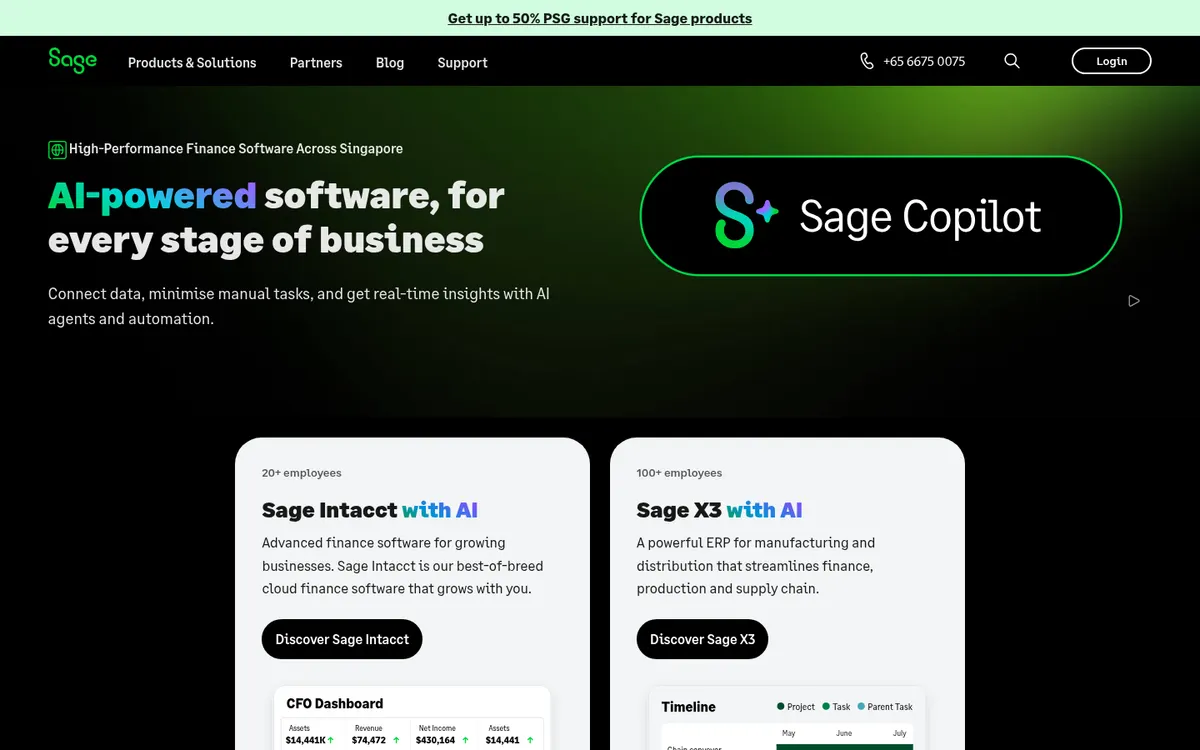
A mid-market option with a published price, pairing a real ledger with consolidation sold as a separate module.
Sage Intacct is the rare entry here that publishes a number: £1,200 per month for the base subscription in the UK, excluding 20 percent VAT, with tailored pricing available above that. The base subscription includes 3 full users and a 10-pack of employee users as standard, which suits a small finance team running a multi-entity ledger. On the intercompany side you get self-balancing inter-entity transactions, centralized due-to and due-from setup, auto-eliminations with audit-ready entries, and consolidation of hundreds of entities. Automatic cumulative translation adjustments run on live OANDA rates. The ledger and the consolidation live in one system, so you are not reconciling a consolidation tool back to the source every month. The catch is packaging. Multi-entity consolidation is a separate paid module rather than core functionality, so the £1,200 headline is not the whole bill. US buyers see no starting figure at all and go through a 30-minute scoping call, with a written quote in 24 to 48 hours. Implementation typically runs 3 to 6 months at roughly 1 to 1.75 times the annual subscription, a ratio worth putting in the business case before you compare it to a dedicated suite. For a mid-market group that wants ledger plus consolidation without an enterprise contract, it is a straightforward path on this list.
You are a mid-market group that wants the ledger and the consolidation in one system and a published starting price.
You already own a ledger you like, or if you need netting and settlement rather than consolidation alone.
Intercompany is native and complete, but only through the OneWorld add-on and per-subsidiary fees that stack quickly.
Oracle NetSuite handles intercompany inside the ERP record rather than in an overlay, which is a strong argument for it. OneWorld manages subsidiaries, currencies and tax jurisdictions, and the Intercompany Framework generates cross charges between them. Matched payable and receivable pairs, intercompany netting to settle mutual balances, and automatic eliminations through elimination subsidiaries are all available, though eliminations require the Automated Intercompany Management module. The commercial shape is where it gets expensive. Intercompany only comes with the OneWorld add-on, per-subsidiary fees stack up for multi-entity groups, and service tiers cap users, storage and transaction lines, which forces upgrades as you grow into them. Oracle publishes no price list, so nothing here can be budgeted from a web page. Contracts are annual and sold through Oracle or partners. Pricing is quote only, so ask Oracle or a partner for a written quote. For a group already running NetSuite, adding OneWorld avoids integrating a separate intercompany suite. For a group choosing a ledger from scratch, intercompany capability rarely justifies NetSuite on its own.
NetSuite is already your ledger and adding OneWorld beats integrating a separate intercompany suite.
You are buying a first ledger for a small group, or if per-subsidiary pricing would punish your entity count.
One data model and multi-book reporting for Workday shops, licensed on total workers rather than the finance team using it.
Workday is a multi-book, multi-GAAP cloud ERP built on one data model, and intercompany work benefits from that more than the feature list suggests. General ledger, consolidation, close, procure-to-pay and revenue all read from the same records, so parallel UK GAAP and IFRS reporting comes out of one ledger rather than a reconciliation exercise. Consolidation and Elimination sit in the higher Workday GO package, so the cheaper tier will not carry a complex group. Sana AI agents handle anomaly detection and audit support. Licensing is the deciding factor. Workday is priced on total worker count rather than finance users, which means a large company pays for intercompany features scaled to headcount, not to the small finance team that touches the ledger. No price list is published. Adaptive Planning, Prism Analytics and Extend are priced as overlays, often plus 15 to 35 percent. Third-party context, not Workday figures, puts Financial Management near $50 to $200 per worker per year, with mid-market subscriptions commonly $150,000 to $350,000 annually, and large-enterprise implementations commonly $50,000 to $500,000-plus. That math works for a global group already standardized on Workday, where one data model removes real reconciliation work. It works poorly for a group shopping for intercompany alone. If you are not already a Workday shop, the honest comparison is a dedicated suite layered onto the ERP you own.
You are a large global group already on Workday and want intercompany handled inside the same data model as everything else.
Your headcount dwarfs your finance team, or if you are shopping for intercompany tooling rather than a new ERP.
Excellent cross-entity payables at a published $99 per month, with no netting or elimination engine behind it.
Tipalti solves a narrower problem than the rest of this list, and it solves it well. Accounts Payable starts at $99 per month with unlimited users, Mass Payments starts at $249 per month, and multi-entity pricing scales on the number of legal entities rather than headcount. Bi-directional ERP sync covers NetSuite, Sage Intacct, SAP and Microsoft Dynamics, with auto invoice capture, GL coding, 2-way and 3-way purchase order matching, and automated reconciliation back to the ERP. Global payouts reach more than 200 countries with tax compliance, and a self-service supplier portal keeps payees out of your inbox. What is missing is the accounting side of intercompany. There is no netting or elimination engine, so mutual balances between entities still need a dedicated tool or a spreadsheet. Procurement, Expenses and Treasury are sold as extra modules, transaction and foreign exchange fees are unpublished, and there is no free tier and no trial. Budget from the platform fee plus an unknown variable rate. The fit is a group with several legal entities paying suppliers and contractors across borders, where the pain is payables execution and reconciliation rather than consolidation. If your month-end problem is intercompany profit elimination, this is the wrong product. If it is several entities each running its own payment run, it is a fast and cheap fix at a published price.
Several legal entities each run supplier payments across borders and you want one payables platform with a published entry price.
Your intercompany problem is netting, settlement or elimination, or if you need every fee visible up front.
Reconciliation, netting and eliminations in one platform, with outcome-based fees that defer cost until go-live.
HighRadius sells intercompany as one part of a record-to-report platform, and the breadth shows. Intercompany Reconciliation matches AR and AP across entities, dispute workflows handle differences, Automated Net and Settlement covers multi-currency netting, and Intercompany Eliminations deals with investments, equity and balances. Pre-built connectors cover SAP, Oracle, NetSuite, Microsoft Dynamics 365 and Workday, so much of the integration work is done before you start. Consolidation and reporting sit in the same platform.
The commercial model is unusual. HighRadius uses an outcome-based structure with no subscription or implementation fee until go-live, then a gain-share percentage. That removes the usual upfront risk and defers the cost conversation, but it also means your bill scales with the benefit the vendor claims to deliver, and those claims need scrutiny in the contract. The vendor claims auto-match rates above 90 percent, a close that is 30 percent faster and 99 percent reconciliation accuracy.
No price, tier or range is published, and enterprise-only pricing runs above market average once the gain-share is running. For a single-entity business or a low-volume group this is overkill by a wide margin. For a large group with high transaction counts and an appetite for a shared-risk contract, having reconciliation, netting and eliminations in one platform is worth a serious look.
You are an enterprise with high intercompany volumes and want a shared-risk contract that starts charging only at go-live.
You run a small entity count, want a predictable subscription, or need published pricing before the first call.
Intercompany accounting software records, matches, nets, settles and eliminates transactions between legal entities that share one parent. In a group with several subsidiaries, one entity sells to another, lends to another and charges shared costs to another. Each of those moves creates a payable in one ledger and a receivable in another, possibly in different currencies and different ERPs, and every pair has to agree before the group can consolidate.
A dedicated tool does four jobs in sequence. It captures or generates the cross-entity transaction at the source, with templates and tax rules for trade flows. It matches the payable against the receivable, continuously or at period end, and routes differences into a dispute workflow. It nets mutual balances so the group settles one residual amount rather than dozens of gross payments. It eliminates the balances and any unrealized profit so the consolidated statements show nothing left over.
ERP-native setups do the same work inside the ledger, which keeps the audit trail clean but ties you to that vendor's module pricing. Overlays and close-management tools cover part of the chain, usually matching and task tracking, and leave netting and eliminations to someone else.
This comparison sits on the Finance desk. Readers comparing neighbouring stacks often check our guides to accounting software for electrical contractors and AI tools for sales prospecting next.
Enterprise finance software is often quoted, not listed, and intercompany pricing is commonly quoted. The reason is volume: a price that fits a small group is wrong for a very large one. Vendors price on entity count, transaction volume, worker headcount or a gain-share formula, and none of those fits on a web page as a single number. Several pricing models appear on this list. Volume or entity-based subscriptions scale with how much flows through the system. Headcount licensing bills on total workers. Module add-ons publish a base price and charge extra for the consolidation or intercompany capability you actually came for. Outcome-based contracts defer fees until go-live and then take a share of the gain.
| Model | How it bills | Typical fit | Example from this list |
|---|---|---|---|
| Volume or entity subscription | Annual subscription priced on transactions or legal entities, unlimited users | Groups with high cross-entity volume | BlackLine Data Plans, no published figure |
| Close overlay | Custom quote, not per user | Teams that already own a capable ERP | FloQast, custom quote |
| ERP plus module | Monthly base subscription plus paid add-ons | Mid-market multi-entity groups | Sage Intacct, £1,200 per month excluding 20 percent VAT |
| ERP add-on | OneWorld plus per-subsidiary fees | NetSuite shops | Oracle NetSuite, quote only |
| Headcount licensing | Priced on total worker count | Large global groups | Workday, quote only |
| Published platform fee | Monthly platform fee plus transaction and FX fees | Cross-entity payables and payouts | Tipalti, $99 per month AP, Mass Payments from $249 per month |
| Outcome based | No fee until go-live, then a gain-share percentage | Enterprises with high transaction volume | HighRadius, no published price |
Every price above was checked on the vendor's own pricing page on November 25, 2026. Where a vendor does not publish a figure we write "See website" instead of guessing. To compare annual and monthly billing quickly, try the free percentage calculator.
It records, matches, nets, settles and eliminates transactions between legal entities under one parent. Every cross-entity sale, loan or cost allocation creates a payable in one ledger and a receivable in another, and the software makes those pairs agree before consolidation. Dedicated suites handle the whole chain. Close-management and payables tools cover only matching or payment.
BlackLine, Trintech Cadency, NetSuite (with Automated Intercompany Management), HighRadius and Workday in the higher GO package all automate eliminations. Sage Intacct does too, but through a paid consolidation module rather than the base subscription. FloQast and Tipalti do not eliminate balances at all, so neither can be your only purchase for that job.
Because the price depends on volume, entity count or headcount, and vendors prefer to shape the deal around your numbers. BlackLine sells volume-based Data Plans with unlimited users and publishes no figure. NetSuite, Workday, Trintech and HighRadius also publish nothing. Only Sage Intacct at £1,200 per month and Tipalti at $99 per month give a starting number here.
Stay ERP-native if the ledger already consolidates well and you want intercompany inside the audit trail, as with NetSuite OneWorld or Sage Intacct. Choose a dedicated suite if you run several ERPs, need netting and settlement, or want continuous matching rather than period-end work. ERP-native ties you to one vendor's module pricing. A suite ties you to an integration project.
No. FloQast tracks intercompany reconciliation tasks inside the close but stops short of netting, settlement and eliminations. Tipalti handles cross-entity payables and global payouts well but has no netting or elimination engine. Both work as layers beside a suite. Neither replaces one when mutual balances must be cleared and eliminated at consolidation.
Published windows range from 2 to 3 months for FloQast to 4 to 9 months for Trintech, with BlackLine commonly around 4.5 to 5 months and Sage Intacct at 3 to 6 months. On cost, Sage Intacct implementations typically run 1 to 1.75 times the annual subscription. Quote-only vendors rarely publish a ratio, so ask directly.
Browse every comparison on the Finance desk, with the same rubric and dated prices.