Ranked #1

IBM Envizi
Finance-grade audit trails
See websitePriced by data volume, quote-based
- Best for
- Large multinationals needing auditable ESG data across many sites
- Free plan
- No
- Rubric
- 8.0 / 10
Eight platforms ranked for audit-grade carbon accounting, Scope 3 supplier data and disclosure reporting, with quote-based pricing, free trials and implementation reality noted for each.
 Prices checked November 25, 2026

IBM Envizi, Persefoni and Watershed top our November 2026 list of the best sustainability management software, and each fits a different buyer. Envizi suits large multinationals that need auditable ESG data across many sites. Persefoni suits companies with audit-grade carbon accounting and disclosure obligations. Watershed suits enterprises that want measurement, reporting and carbon action in one platform. All eight tools price by quote, so budget talks start with scoping calls rather than a public pricing sheet.
Finance-grade audit trails
See websitePriced by data volume, quote-based

Financed emissions depth
See websitePro and Advanced tiers, quote-based

Measurement to action
See websiteQuote-based pricing
Disclosure for this page: All 8 tools here are unpaid editorial picks. The position of a paid listing can be part of what the vendor pays for. How we handle paid listings.
| Tool | Best for | Free plan | Actions | |||
|---|---|---|---|---|---|---|
| 1 | IBM Envizi | Large multinationals needing auditable ESG data across many sites | See websitePriced by data volume, quote-based | No | ||
| 2 | Persefoni | Companies needing audit-grade carbon accounting and disclosure | See websitePro and Advanced tiers, quote-based | Yes | ||
| 3 | Watershed | Enterprises running end-to-end climate measurement, reporting and action | See websiteQuote-based pricing | No | ||
| 4 |  Sweep | Value-chain and supplier data management for disclosure | See websiteQuote-based pricing | Yes | ||
| 5 | Greenly | Mid-market teams completing a first credible carbon footprint | See websiteQuote-based pricing | Yes | ||
| 6 |  Normative | Teams wanting traceable science-based emissions data plus an advisor | See websiteQuote-based pricing | Yes | ||
| 7 |  Plan A | European firms prioritizing decarbonization planning from day one | See websiteQuote-based pricing | Yes | ||
| 8 |  Workiva | CFOs and controllers embedding ESG reporting in finance workflows | See websiteQuote-based pricing | No |
Eight tools made this list after we compared them on five weighted criteria: carbon accounting depth at 30 percent, disclosure coverage at 25 percent, data traceability at 20 percent, pricing clarity at 15 percent, and fit and support at 10 percent. The weights follow what goes wrong in practice. A tool that cannot evidence a Scope 3 number becomes a liability at assurance time, and a tool nobody can price becomes a procurement problem before anyone sees a dashboard. Pricing information was checked on 2026-11-26. Every entry is listed as quote-based or See website, and we say so rather than guessing a number. No currency conversion appears anywhere in this list. Every entry, including any Featured position, is scored with the same rubric. A Featured listing is a paid placement and is labeled as Featured; it does not skip the criteria above, and it carries the same kind of honest cons as everything else. The order reflects fit for the buyer each entry describes, not a weighted total, so a tool scoring lower overall can sit above one that scores higher when it serves its stated buyer better. Read the pick and skip lines together with the review. They carry more of the decision than the scores do, especially when every vendor on the page refuses to publish a price.
The full process, including how we handle corrections, is on the methodology page. Paid listings follow our advertising disclosure.
| Criterion | Weight | What we check |
|---|---|---|
| Carbon depth | 30% | How far the calculation engine reaches on Scope 1, 2 and 3, emission factors and defensible numbers. |
| Disclosure coverage | 25% | Breadth of framework support, from CSRD and TCFD to GRI, CDP, ISSB, PCAF and XBRL tagging. |
| Data traceability | 20% | Whether a reported figure can be followed from source data through calculation to the published disclosure. |
| Pricing clarity | 15% | How much a buyer learns about cost and commitment before a sales call, including trials and free tiers. |
| Fit and support | 10% | How well the product, regional coverage and service model match the size and maturity of its stated buyer. |
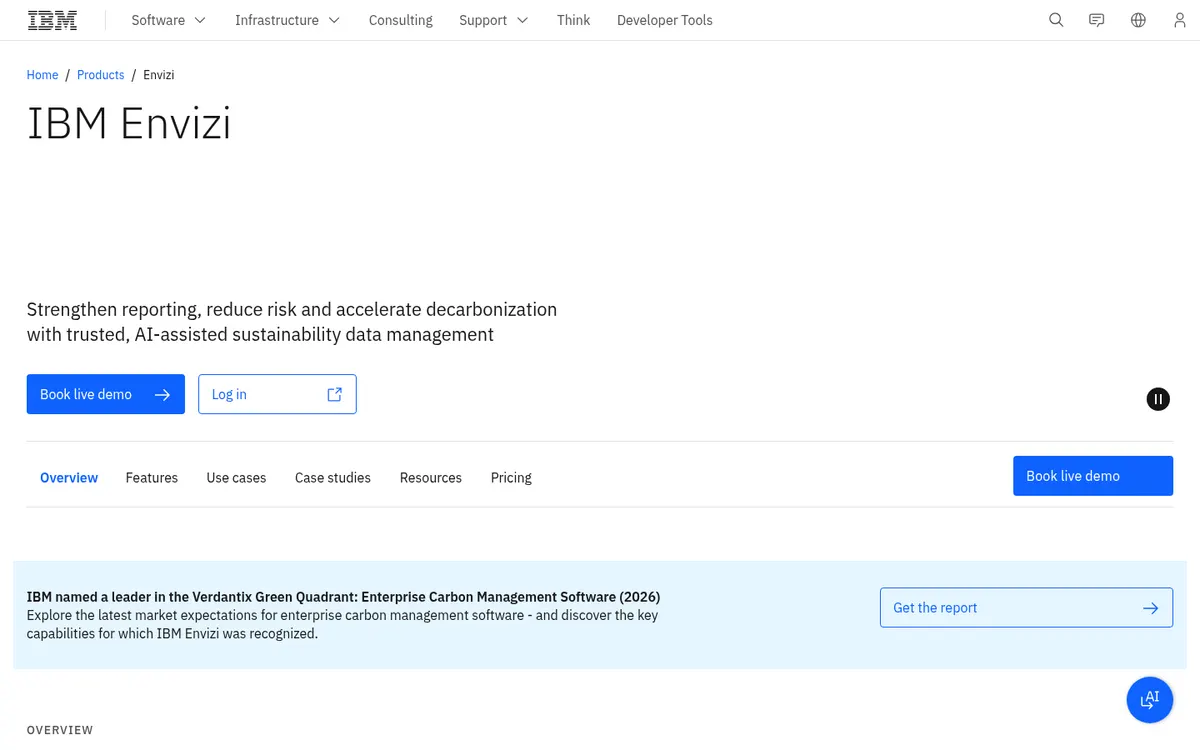
The heaviest data governance option here, built for multinationals that must defend every emissions number to an auditor.
Envizi is the data governance layer of this list. It computes Scope 1, 2 and 3 emissions through a GHG Protocol calculation engine, then reports against major ESG frameworks. Data arrives from ERP systems, IoT meters, utility feeds and supplier portals, and every figure carries finance-grade validation and audit trails. Organizational roll-ups mirror your corporate structure, so a site level number rolls into a region and then into group totals without a spreadsheet rebuild. AI forecasting supports decarbonization planning once the baseline is in place. Pricing runs on data volume, not seats, and the vendor does not publish a number. Buyers go through scoping calls, pricing calculators and implementation partners before they see a contract. There is no free plan and no trial, so a small team cannot test the product without entering a sales process first. That structure fits a multinational with a sustainability office and an internal audit function. It frustrates a small team that wants a first footprint quickly. The trade-off is weight. Envizi is heavy and costly for small teams, and the integration with the wider IBM stack is a real plus only if you already run it. If your obligation is one entity with a modest supplier list, look at Persefoni Pro or Greenly first, then revisit Envizi when site count, meter count and audit pressure grow.
You run many sites and need auditable emissions data that survives an assurance review.
You are a small team that needs a first footprint without a scoping call.
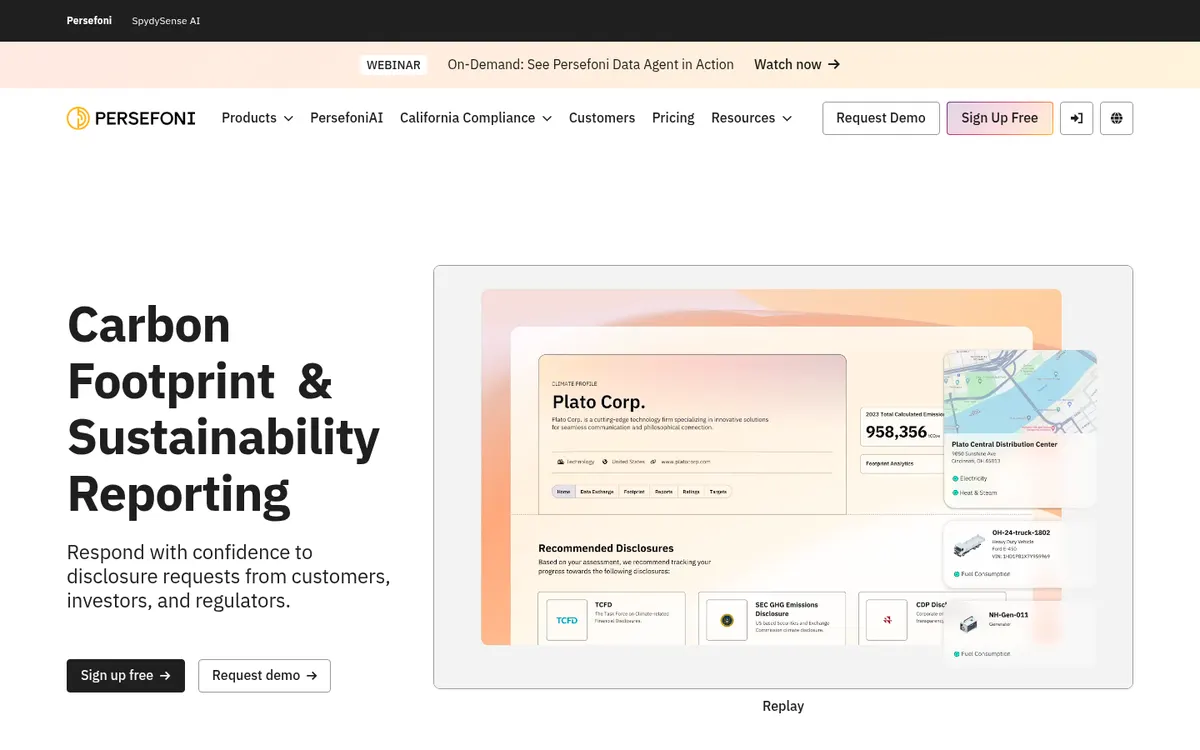
Audit-grade carbon accounting with AI assistants on every plan, sold by quote to companies with real disclosure duties.
Persefoni treats carbon like a ledger. Scope 1, 2 and 3 footprints are built from consumption datasets, with anomaly detection watching for odd entries, and natural language mapping assigns emission factors without hand coding every row. PersefoniAI Copilot is a chat interface, and the PersefoniAI assistants ship on every plan rather than as a paid add-on. Supplier engagement tools push requests out into the value chain. The platform maps to CSRD, TCFD, PCAF and SASB, and carbon transactions are handled with the rigor you would expect from financial accounting. Two tiers exist, Pro and Advanced, both quote-based. Net-zero modeling sits on the Advanced tier. Financed emissions support is aimed at financial institutions working under PCAF, a niche that general ESG suites tend to handle badly, and Pro reaches somewhat down-market for a company with a real deadline but a smaller footprint. The limits are structural rather than technical. There is no public price beyond the free trial, and the product is built for organizations with serious disclosure obligations. A small company that needs a defensible first footprint will find Greenly or Plan A easier to buy and faster to stand up. A bank, insurer or listed manufacturer producing an assured CSRD report is the natural buyer here.
You face CSRD, TCFD or PCAF disclosure and need assured carbon numbers you can defend.
You need a cheap first footprint and no external assurance deadline.
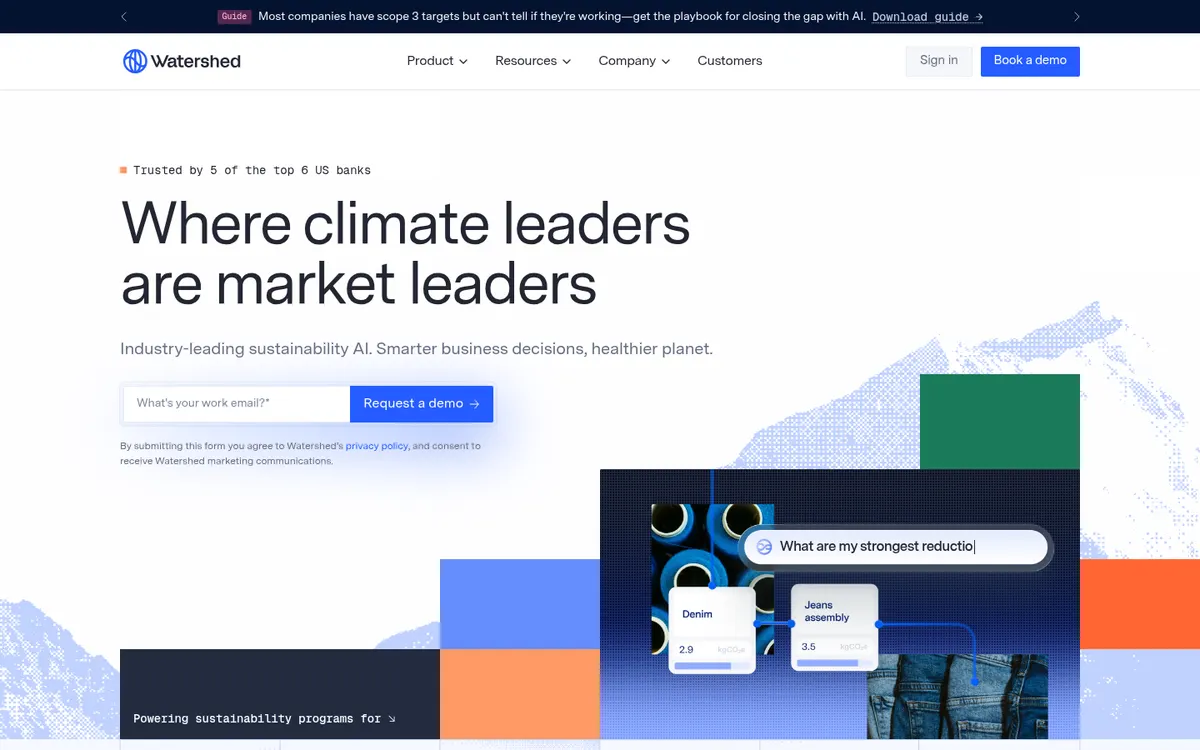
One platform for measuring, reporting and funding reductions, sold through a sales-led enterprise process with no free tier.
Watershed spans the full arc. You measure emissions across all scopes, draft ESG reports from the same data, and then spend against reductions through a marketplace of vetted carbon removal projects. AI agents clean, format and analyze datasets, but calculations stay transparent and a human reviews the output before it reaches a disclosure. In-house science and policy staff support board-ready reporting. The vendor says its platform covers 4.1 gigatons of emissions under management. There is no free tier and no public price list. Every deal runs through a sales-led enterprise process with quote-based pricing. That model suits a large enterprise that wants a single vendor for measurement, reporting and action, rather than stitching a carbon tool to a reporting tool and a procurement marketplace. The catch is the entry point. A mid-market team with one reporting entity and no removal budget pays for capability it may not use for a long time. During scoping, ask which AI agents are live today, which sit on the roadmap, and how much of the marketplace spend is genuinely optional. Buyers who mainly need audited carbon numbers at lower cost should price Persefoni before signing.
You want one vendor covering carbon measurement, ESG reporting and reduction spending.
You only need audited carbon accounting and cannot fund removal projects.
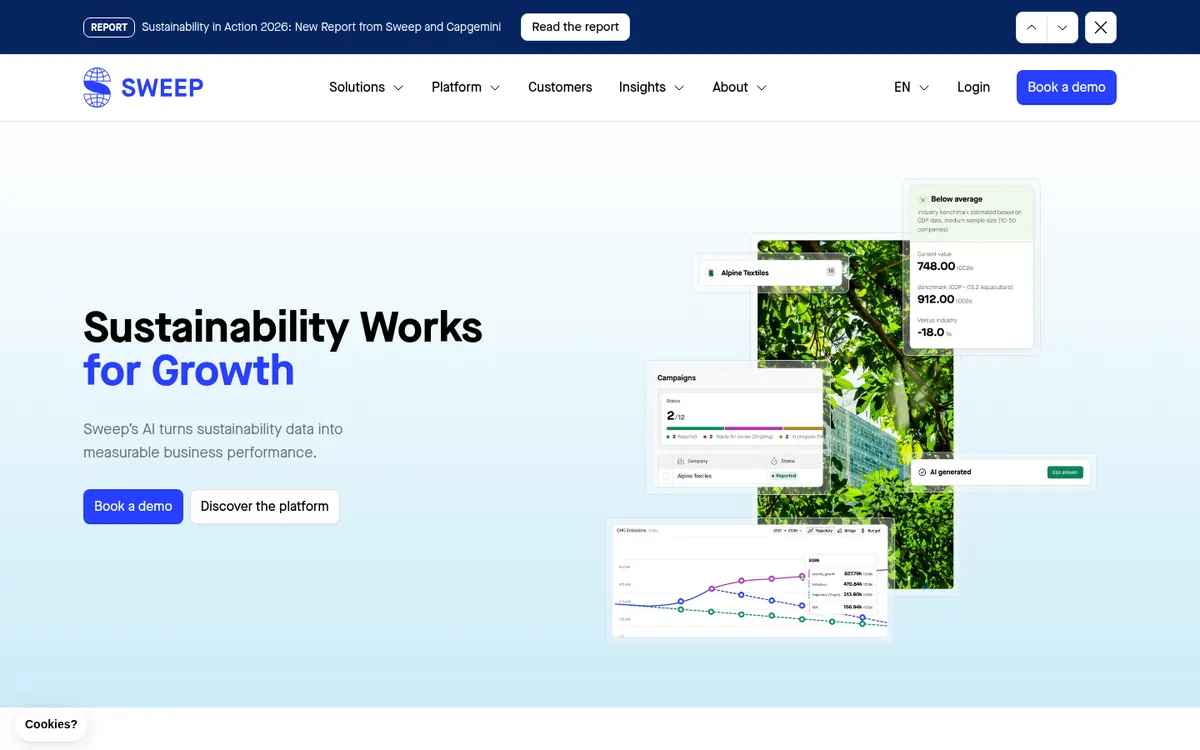
A value-chain data hub with a genuinely useful free sandbox, best for teams whose Scope 3 problem is supplier evidence.
Sweep is built around the value chain. Sustainability data from your own sites and from suppliers lands in one place, and disclosures are produced from that single source with an audit trail behind them. Sweepy, the AI assistant, maps purchase data to emission factors. The platform supports plain-language disclosure drafting and dashboard building. Framework coverage runs across CSRD, ISSB, GRI, CDP, SASB, TCFD and the GHG Protocol. A free sandbox trial covers Scope 1 and 2 reporting, which is unusual at this end of the market and lets a team test the workflow before a contract exists. Implementation typically runs through consultancy partners such as Capgemini, KPMG and ERM. Pricing is quote-based and not published, so the sandbox is the practical way to start. Sweep is headquartered in France, so US buyers should confirm regional support hours and partner coverage before committing. Mid-market and enterprise teams with a heavy supplier list get the most from it. A single entity with a short supplier roster will find more value in a lighter tool. The B Corp certification matters to buyers who screen vendors on it, and it is one of several entries here that hold it.
Supplier data collection is your bottleneck and you want to test before you buy.
You operate only in the US and need proven local partner coverage.
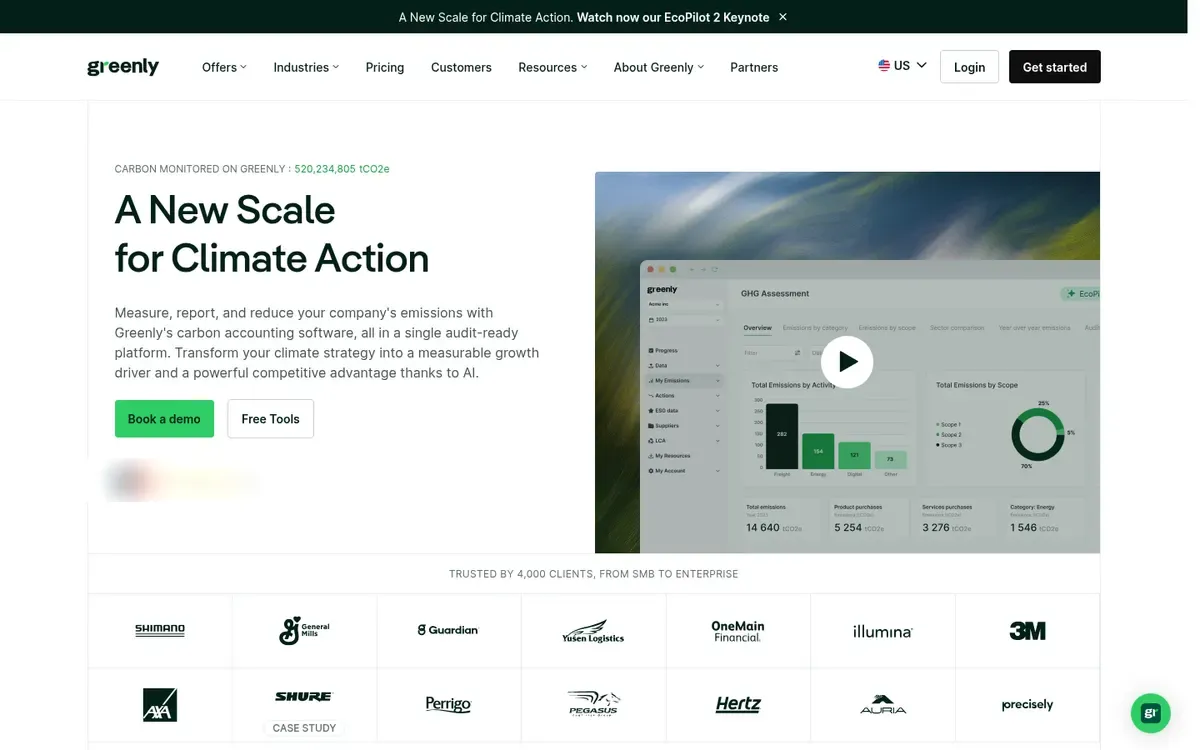
The fastest route to a credible first carbon footprint for mid-market teams, with less depth at group consolidation.
Greenly aims at the first credible footprint rather than the deepest enterprise build. Carbon accounting, environmental footprint measurement, reporting and reduction sit in one product, with product lifecycle assessment and environmental product declarations available for companies that sell physical goods. EcoPilot is the vendor's AI assistant. Compliance support covers SBTi, CSRD, CDP, B Corp and ISO 14067, and the output is designed to be audit-ready. Pricing is quote-based with a free trial, which makes the buying conversation shorter than with the enterprise-only vendors here. Greenly is B Corp certified and positioned for SMBs and mid-market teams that want a first footprint quickly. Two caveats matter. The homepage defaults to French, though an English version exists, and complex multi-entity groups will eventually outgrow the structure. Greenly and Normative are also combining into a larger climate software group, so ask how the two roadmaps merge and which product line your account will sit on before signing anything long. Lighter enterprise features mean fewer controls for internal audit, so pair it with a finance-owned reporting tool if your disclosure will be assured.
You need a defensible first footprint this quarter without an enterprise sales cycle.
You are consolidating several legal entities with group-level assurance.
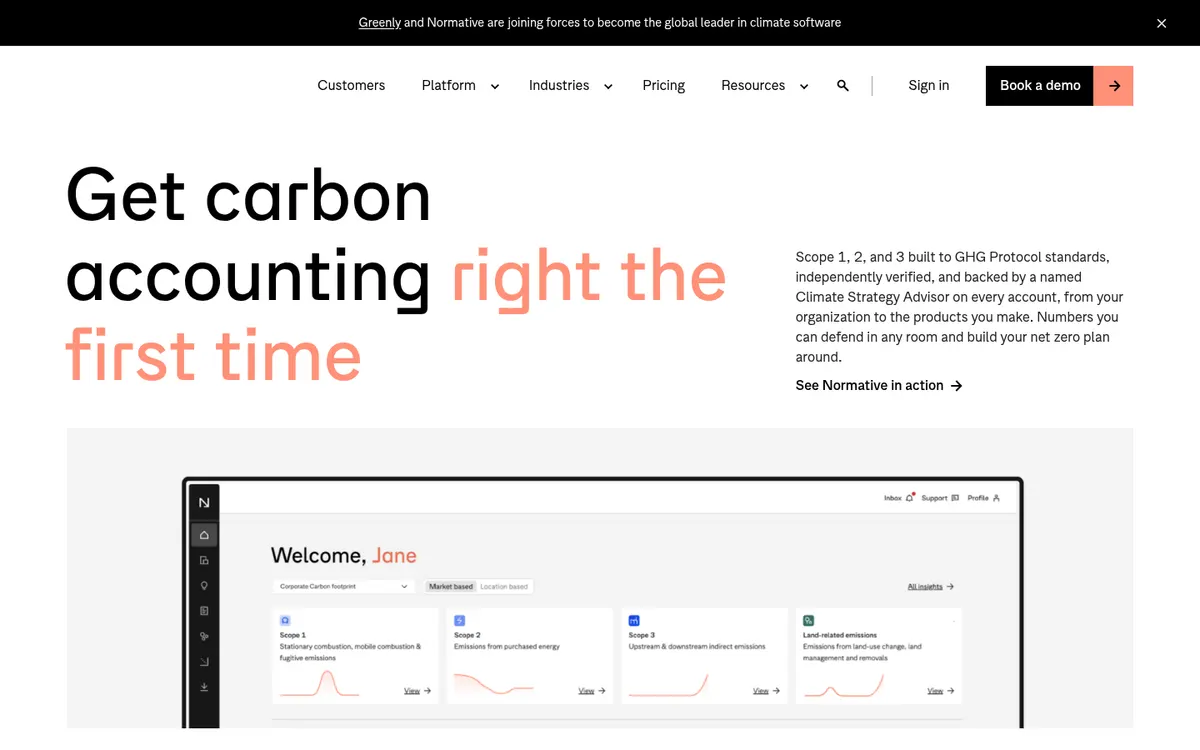
Traceable calculations backed by 349,000 verified emission factors, plus a named climate advisor on every account.
Normative's pitch is traceability. Calculations run on 349,000 verified emission factors, and every figure can be followed from source data through to the reported output, with the calculation engine independently verified. Scope 1, 2 and 3 are covered, the engine aligns with the GHG Protocol, and updates track CSRD and CDP standards. AI handles data ingestion and categorization, and the Carbon Network supplies verified supplier data so Scope 3 does not rest entirely on estimates.
The differentiator is the service model. Every account includes a named Climate Strategy Advisor certified under the GHG Protocol rather than a shared helpdesk queue. For a sustainability lead who is the only person in the role, that is worth more than another dashboard, and it shortens the path from raw data to a defensible number.
Pricing is quote-based and not published, and the product is positioned at enterprises, so expect a scoping process. Normative is joining forces with Greenly, which raises fair questions: which platform survives, how the emission factor library is maintained through the merger, and whether account teams stay in place. Teams below enterprise scale should price Greenly first and compare support before committing.
Traceability to source data matters more to you than a self-serve start.
You need published pricing or a fast low-touch rollout.
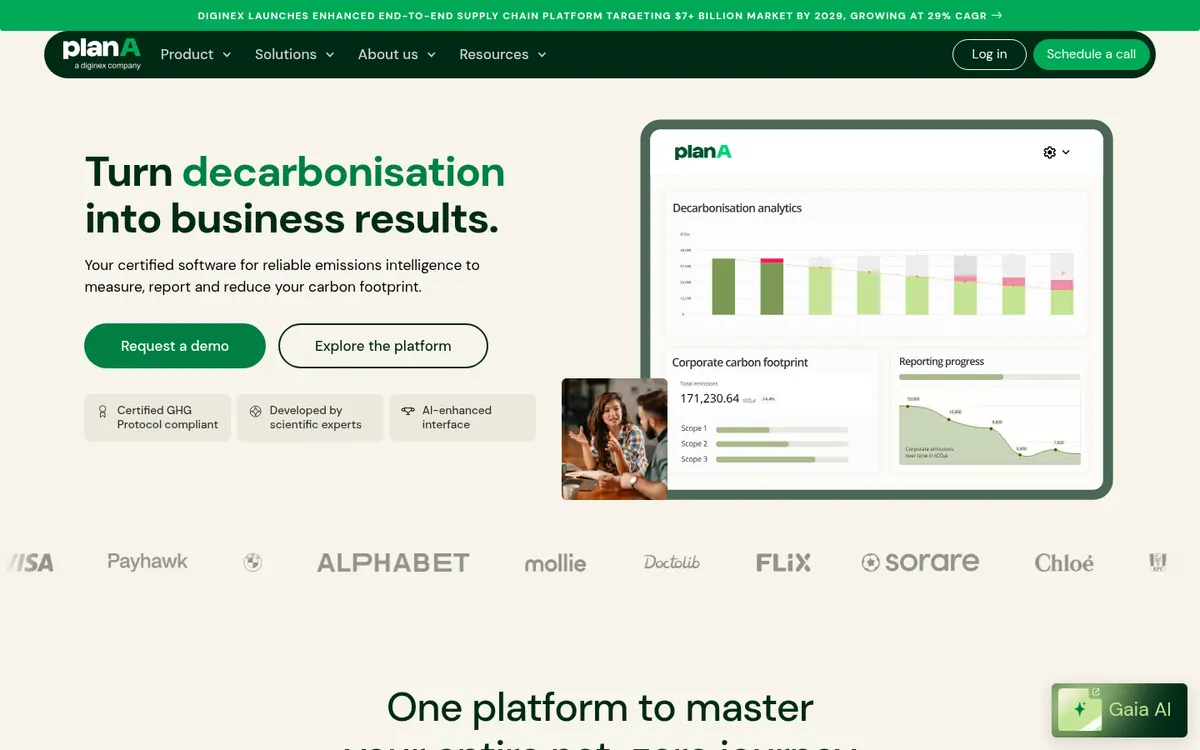
Reduction planning first, with in-house science and a bundled advisor, best suited to European firms with a CSRD deadline.
Plan A leads with reduction planning rather than reporting volume. Carbon footprint measurement, reporting and reduction sit together, and the calculation methods come from in-house scientists. One-click corporate carbon footprint reports cover a first reporting cycle, and AI-enhanced workflows speed up the data work behind them. The engine is certified GHG Protocol compliant, output aligns to CSRD for European companies, and personalized services carry a team from baseline through to a net-zero strategy. That service layer is effectively part of the product. A team without a sustainability hire gets a baseline, a target and a plan, not just a login. Pricing is quote-based and not published, and a free trial is available so the workflow can be tested first. Plan A is B Corp certified. Two risks to weigh. Plan A is based in Berlin, so US support coverage needs confirming with references in your region. It also signed a definitive agreement in early 2026 to be acquired by Diginex, which may change the roadmap. Ask what is contractually committed before you sign. European firms with a CSRD deadline get the most from it.
You want a baseline plus a reduction plan and will use the bundled advisory service.
You operate mainly in the US or need roadmap stability before signing.
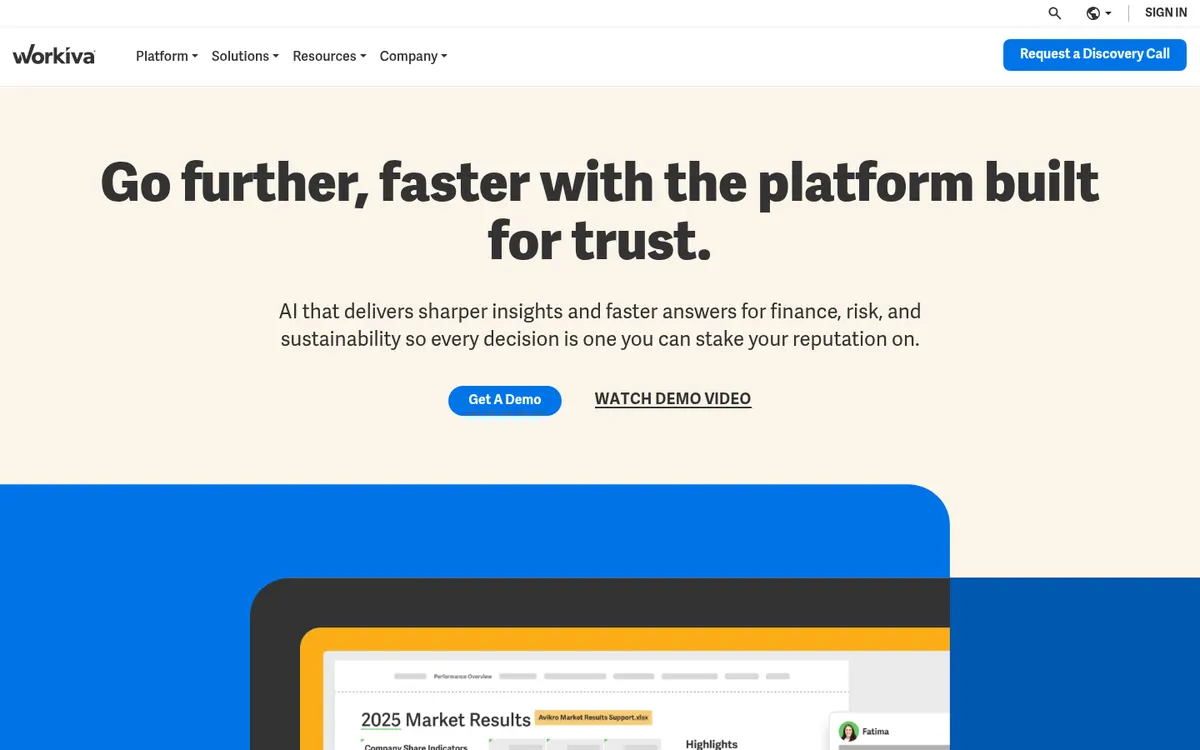
A reporting and controls platform that does sustainability, the right fit when the CFO owns the disclosure.
Workiva is a reporting platform that does sustainability, not a carbon tool that added reporting. Carbon accounting and sustainability program management sit alongside framework mapping, double materiality assessment and designed reporting, all running on the same controlled system used for financial filings. Data collection is automated, AI accelerates drafting, and XBRL tagging produces machine-readable disclosure. Audit-ready controls come from the finance side, which is precisely the point.
The vendor says more than 6,700 companies use the platform. It supports standalone sustainability reports or a single integrated report across global sustainability frameworks, so a controller can keep one controlled environment instead of reconciling a carbon tool against a filing tool at year end. Pricing is quote-based, with no free plan and no trial.
Buy it if your CFO or controller owns the disclosure and wants one system for financial and sustainability reporting. Do not buy it as a pure carbon accounting tool. Teams that mainly need Scope 3 supplier data and emission factor depth will get more from Envizi, Normative or Persefoni, and may still end up using Workiva for the filing itself.
The finance team owns ESG reporting and wants it inside the filing workflow.
Your main job is Scope 3 carbon accounting rather than disclosure production.
Sustainability management software collects energy, fuel, spend and supplier data, converts that activity into greenhouse gas numbers, and produces disclosures you can defend. It replaces the workbook most companies start with: meter readings, utility invoices and spend files, held together by a consultant and one person who knows which tab is right.
The category covers three overlapping jobs.
Most tools here do all three at different depths. IBM Envizi and Persefoni lead on calculation rigor and audit trails. Workiva leads on the reporting and controls side because it already runs financial filings. Greenly and Plan A lead on time to a first footprint.
Buyers should also be clear on scopes. Scope 1 covers fuel you burn, Scope 2 covers purchased electricity and heat, and Scope 3 covers everything in the value chain, from purchased goods and business travel to the use of sold products. Scope 3 is usually the largest share and the hardest to evidence, which is why supplier data appears in almost every vendor's feature list.
Software does not remove the need for judgment. It makes the judgment traceable.
This comparison sits on the Sustainability desk. Readers comparing neighbouring stacks often check our guides to carbon accounting software and AI tools for sales prospecting next.
Every tool on this list is quote-based. None publishes a number, and no price could be confirmed from a public pricing sheet when we checked on 2026-11-26. The practical difference is what each quote is anchored to, and that changes how your budget behaves as the program grows. IBM Envizi sizes cost by data volume rather than seats, so the number moves when you add sites, meters or supplier records. Persefoni sells Pro and Advanced tiers. Watershed, Sweep, Greenly, Normative, Plan A and Workiva use quote-based pricing.
| Model | How it bills | Typical fit | Example from this list |
|---|---|---|---|
| Quote by data volume | Quoted contract sized by the data you ingest | Multinationals with many sites and meters | IBM Envizi |
| Quote by product tier | Quoted contract on a Pro or Advanced tier | Companies with disclosure duties | Persefoni |
| Quote by platform scope | Quoted contract covering measurement, reporting and action | Enterprises consolidating tools | Watershed |
| Quote with a free sandbox | Free Scope 1 and 2 sandbox first, then a quote | Teams that want to test first | Sweep |
| Quote with a free trial | Free trial, then a quoted contract | First footprints and enterprise evaluations | Greenly, Normative, Plan A |
| Quote inside a finance platform | Quoted contract for reporting, controls and XBRL tagging | CFO and controller led reporting | Workiva |
Every price above was checked on the vendor's own pricing page on November 25, 2026. Where a vendor does not publish a figure we write "See website" instead of guessing. To compare annual and monthly billing quickly, try the free percentage calculator.
Name your obligation first. Write down whether you face CSRD, CDP, a customer request or an internal target. That single line eliminates half this list and tells you whether you are buying a reporting platform or a carbon engine.
Check Scope 3 before the demo. Ask each vendor how supplier data arrives, how emission factors are assigned, and what evidence sits behind the number. Scope 3 is usually the largest share and the weakest part of any implementation story.
Use the trial or sandbox if one exists. Sweep's free sandbox covers Scope 1 and 2 reporting, and Persefoni, Greenly, Normative and Plan A offer free trials. Load three months of your own data, not theirs, and see what breaks.
Ask who configures the emission factors. Several vendors deliver through consultancy partners. Get the name, the hours and the cost in writing, because implementation is where quiet budget overruns live.
Confirm regional support. Sweep and Plan A are European vendors, and Normative and Greenly are merging. Ask for support hours in your time zone and references in your market before you sign.
Compare quotes on the same scope. Line up entity count, site count, supplier count and frameworks before you read a single number, otherwise the cheaper quote is simply the smaller scope.
It collects energy, fuel, spend and supplier data, converts that activity into greenhouse gas emissions, and produces disclosures you can defend to an auditor or regulator. The stronger tools add target modeling, supplier engagement and framework mapping. Treat the calculation engine and the audit trail as the core purchase, because reporting templates are the easy part to add later.
Every tool on this list quotes privately, so there is no published number as of November 2026. IBM Envizi sizes cost by data volume, which means the invoice grows with sites and meters rather than seats. Budget separately for implementation, since several vendors deliver through consultancy partners. Ask for written scope that names the consultant, the emission factor library and the frameworks included.
Scope 1 covers fuel you burn directly, such as gas boilers and fleet vehicles. Scope 2 covers purchased electricity, heat and cooling. Scope 3 covers everything else in the value chain: purchased goods, transport, travel, waste and the use of sold products. Scope 3 is usually the largest share and the hardest to evidence, which is why supplier tools appear in almost every platform.
Move when a second person needs to touch the numbers, when an auditor asks how a figure was calculated, or when supplier data arrives in formats nobody can reconcile. A single site with a simple footprint can survive a year on a careful workbook. Multi-entity groups, CSRD filers and anyone facing assurance should be on a platform.
No. It replaces the spreadsheet and the manual trail, and it makes a consultant's work checkable. Several vendors here sell implementation through partners, and Normative and Plan A bundle advisory into the account. The realistic split is that software holds the calculation and the evidence, while an advisor shapes targets, materiality and the narrative your board signs.
Start with your obligation and your entity count. A single entity chasing a customer-driven footprint gets faster value from Greenly or Plan A than from a platform built for group consolidation. Multi-entity groups with assurance needs want the audit trails in IBM Envizi, Persefoni or Normative. Workiva fits when the CFO owns the report and wants one system for both filings.
Browse every comparison on the Sustainability desk, with the same rubric and dated prices.